Mount Hood

Ryan Kelly hosts virtual comedy show

Student Activities Board holds online comedy show starring TikTok comedian Ryan Kelly

Sydney Carpenter | News Editor

On Jan. 2, the Student Activity Board announced on Instagram that their first major event for the term would be comedian Ryan Kelly ⏤ known online as Youth Pastor Ryan ⏤ who will perform in a virtual stand-up comedy event featuring interesting life experiences.

Despite his namesake and going to a Christian school for 18 years, Kelly is not actually a youth pastor. In his Twitch trailer, Kelly explains he looks like what people would imagine a youth pastor might look like.

In St. Louis, Illinois, he began doing comedy as an improviser. According to ryankellycomedy.com, he had received training from iO Theater ⏤ formerly known as The ImprovOlympic ⏤ The Second City, The Groundlings Theatre and School and Upright Citizens Brigade Theatre. In college, he was interested in new life experiences and began performing stand-up comedy. According to neon-entertainment.com, he often draws inspiration for his comedy routines through experiences including: surviving a plane crash, being tackled inside the National Security Agency and negotiating deals while being mugged.

“I needed something,” said Kelly when asked why he does comedy. “I needed something to give purpose and joy.”

 His favorite part of comedy is when the whole room laughs. 

“Because laughter is a very binding thing,” explained Kelly. “(I try to) make the bigger guys laugh because when you do that it shows a diffusal and makes people feel like they are safe.”

Kelly explains that this comedic approach brings shyer people out of their comfort zone in a natural way.

“Once everyone’s at peace then being able to hit jokes where people feel comfortable and they all laugh is a beautiful moment. Having a full crowd laugh together, they’ve all become friends and they don’t even know it,” explained Kelly.

To view the virtual comedy show taking place on Jan. 13 at 6 p.m., go to Engage and click the Zoom link located in the event’s advertisement. To learn more about Ryan Kelly, view him on Twitch @youthpastorryan where he posts gameplays, TikTok @youthpastorryan or on YouTube @Youth Pastor Ryan.

Contact the author at scarpenter18@mail.wou.edu

COVID-19 vaccines arrive in Oregon

Oregon enters Phase 1A of vaccine delivery initiative

Sydney Carpenter | News Editor

In late December, select Oregon residents received doses of the Pfizer and Moderna COVID-19 vaccines.

To deliver the vaccine to all Oregonians, the state has implemented a three-phase rollout plan. On Jan. 5, Oregon began Phase 1A of its vaccination schedule. In Phase 1A, the Oregon Health Association lists in its plan: hospital workers and first responders, elderly and those involved in their care, prison doctors, clinics serving high-risk groups, visiting nurses/home health care providers, other health care providers and funeral home workers to be vaccinated first. 

Over 51,000 Oregonians have received the first dose of the Coronavirus vaccine since the beginning of 2021, whereas only nine people have completed the two doses required for full vaccination according to covidvaccine.oregon.gov. Currently, the CDC reports Oregon has delivered over 117,000 doses of Pfizer vaccine and over 121,000 doses of the Moderna vaccine.

Currently Pfizer and Moderna are known to have three major differences, including age restrictions, temperature storage requirements and length of time between each dose. In comparison to Pfizer, the Moderna vaccine can be kept at -4 °F, whereas Pfizer’s must be kept at  -94 °F. Additionally, a person must be at least 18 years old or older to receive the Moderna vaccine and the two doses must be administered 28 days apart in comparison to Pfizer’s 21-day separation, which has an age restriction of 16 years.

On Dec. 22, West Valley Hospital in Dallas received its first shipment of Moderna vaccine according to a press release by Salem Health. 

“For decades, West Valley Hospital has been providing a wide range of quality care to residents of Polk County,” said West Valley Hospital Chief administrative officer and licensed registered nurse Brandon Schmidgall in the press release. “Today we begin offering a new and historic service — the COVID-19 vaccine — first to our health care heroes, but eventually to our small-town community.”

As of Jan. 5, Polk County has vaccinated 1% of an estimated 82,000 residents according to the OHA. Local clinics like Western’s Student Health and Counseling Center have not received COVID vaccines yet; although, on Dec. 22, Oregon added educators to the list. 

 “Teachers have recently been added to Phase 1A and who that all includes will need to be more clearly defined by OHA,” said Polk County Public Health Administrator Jacqui Umstead. “We will work with Western Oregon University, and other local educational institutions to ensure that both staff and students have access to the vaccine, when it is their turn.” 

Contact the author at scarpenter18@mail.wou.edu

Cuts to Western’s departments and programs

President Fuller’s Article 15 Task Force proposes draft of program curtail and Non-Tenure Track reductions

Sydney Carpenter | News Editor

Beginning in 2011, the administration office began seeing lower enrollment rates at Western, resulting in financial challenges in the years following.

In spring 2020, COVID-19 accounted for 70% of the university’s 25% drop in enrollment. This resulted in the university asking the deans to propose two budgets to reduce salaries by 10% and 17% in June. In addition, all Cabinet members were asked to review budgets for FY21 and develop 10% and 17% cuts, based on salary. 

When the task force began reviewing program curtailments, an extensive list of qualitative and quantitative factors were taken into account. 

Additionally, the task force also utilized feedback from original reports from the deans, the recommendations from Western Oregon University’s Federation of Teachers, the recommendations from the Faculty Senate Executive Committee, PowerPoint for panel discussion, feedback from three faculty panel discussions, the report from the faculty Sustainability Task Force and Article 15 of the Collective Bargaining Agreement outlining faculty contracts and rights.

In totality, the task force has proposed the elimination of five majors, two programs, seven minors, one program freeze and one history concentration removal. For non-tenure track faculty, 15 departments have received deductions in full-time equivalents.

All of us are frustrated and shocked, and more importantly we are not okay with it,” said senior earth science major Nicole Niskanen. “Granted, the times we are in are very challenging and it is understood that the university is not exclusive with the sacrifices it is making, because many other schools are in the same position.”

Niskanen explained that a lot of the cuts are impacting first-generation college students that are interested in pursuing degrees in science, technology, engineering and math.

“Western Oregon University is an affordable option for many first-generation college students, along with that, the campus prides itself on diversity and equality,” said Niskanen. “The Earth Science program at Western has a significant number of women and other individuals from diverse backgrounds and populations enrolled in the program including students with disabilities.”

According to Niskanen, eliminating the program strips away the opportunities for some of those underrepresented first-generation college students and deprives those who cannot afford to attend expensive STEM-focused universities.

Under the current program cuts, students will be permitted to complete their major and professors will still teach until students learning in their areas complete their major or minor; the effects of program cuts will impact all incoming students starting in 2021.

“I am writing on behalf of all of the Earth Science students who have completed the program, who are currently trying to finish the program, and those who will complete the program; we don’t want to see any of our professors leave because they have done so much for us by dedicating their time to support us and by selflessly helping prepare each student for whatever career path they take. We want to fight for the program and fight for our educators,” said Niskanen.

Currently, faculty are working to try and save these programs. To advocate for programs or faculty jobs, students can go to the ASWOU site within Engage. From there, students can fill out the Student Concern Report.

UPDATE (DEC. 15TH, 2020 @ 6:52PM)

Western has announced its final program curtailment enacted by Article 15, as well as non-tenure track layoffs outside of Article 15.

Under the article, the university is permitted to make reductions in cases of demonstrable financial need, discipline curtailment or retrenchment. As of now, Western is claiming financial strain due to COVID-19 and long-term decline in enrollment as the cause of enacting Article 15.

Since fall of 2011, Western’s enrollment has decreased over 25% from 6,217 to 4,552 in fall of 2020, as reported in the Article 15 Task Force’s finalized plans. Currently, under the Article 15 program curtailment plans, 14 full time positions will be lost, and a total of 10 majors and minors will be eliminated along with two masters programs. Outside of Article 15, a total of 16 full-time non-tenure tracks are being laid off.

“Quite frankly, our options for achieving a balanced budget are limited,” said President Rex Fuller in a letter to the campus community. “Given that more than 85% of our expenses are salary and benefits. With limited options for tuition increases, declining enrollment, and likely cuts to state funding, we must act decisively to align our budget with our fiscal reality.”

As of now, the impact of the program cuts will not impact students who are currently majoring or minoring in the program. In the letter, Fuller noted how important it is for students impacted by the program cuts to finish their degrees. According to the campus-wide letter, program curtailment will only impact incoming students starting in the 2021 to 2022 school year. Tenure-track and non-tenured positions will not be cut until deans and division heads submit final layoff decisions. The decisions are expected to be an ongoing discussion through the month of January.

Some members of Western’s faculty union — the WOU Federation of Teachers — are asking for program curtailment to be delayed until the new university president comes into office.

“We know that WOU is in some financial difficulties,” said WOUFT Communications Director Scott Beaver. “We just don’t want to rush, do long term solutions without due diligence.”

In an effort to advocate for faculty and departments WOUFT included some alternatives to department layoffs in the finalized plan, including moving Western out of Division II sports, looking for efficiencies in non-instructional office budget cuts and personnel assignments, reduce the number of campus sponsored events and used additional money from the fund balance.

In the final plan, all layoff notices must be given to designated faculty no later than the end of January. Affected tenure-track faculty will receive a one-year layoff notice before their positions end, at the latest by the end of January 2022.

The union at this time remains hopeful that there are departments that can be saved before layoff notices are issued. Beaver said the union is still fighting. 

Contact the author at scarpenter18@mail.wou.edu

Approved IFC fee application makes historic changes for student run committees

ASWOU and WOU administration debate over IFC fee application leads to new Oregon Legislation proposals 

Sydney Carpenter | News Editor

The Associated Students of Western Oregon University and Western administration have concluded their debate over fee application for winter term. 

As a result of the actions of administration, ASWOU is working with Oregon legislators to improve the current Oregon statue that is supposed to protect and guarantee student autonomy over incidental fees.

“Much of the problem is that the law as written now provides the opportunity for an institution to ‘pocket veto’ the student fee through inaction and enough delays,” said Oregon Student Association Executive Director Andrew Rogers in an article written by Oregon Public Broadcasting. 

During the discussions fee revision, ASWOU President NJ Johnson reports delayed action and staling of IFC processes by President Rex Fuller.

“We had sent the fee request on Nov. 25,” said Johnson, “ We needed … for him to respond to the fee request by Dec. 9.”

At the time President Fuller was sent the request, he had no authority to approve the fee in its entirety. However, in an emergency Board of Trustees meeting held on Dec. 8, the committee gave Fuller temporary permission to approve the IFC fee. According to President Johnson, President Fuller was asked to approve the fee by 1 p.m. on Dec. 9, and reports receiving a response around 12:34 p.m that day. Instead of approving the fee Fuller questioned aspects of the proposal.

“He had two weeks to ask questions,” said Johnson, “All of the questions asked were just meant to stall our process so that a potential HECC appeal would have been nullified. We’d be in a position where we have to accept the university’s offer for another stimulus. A stimulus that wouldn’t be able to sufficiently fund the programs that we needed to.”

At that time, ASWOU was in the process of filing a second appeal to the Higher Education Coordinating Commission to have a third party evaluate the administration’s rejection of the IFC fee. 

The first appeal was written in September after the IFC was denied consultation with the Board of Trustees to discuss formatting their fee so that it reflected a campus attending classes 95% online. The appeal was ultimately withdrawn by ASWOU after Fuller stated that the IFC would receive a negotiated million dollar deal on the condition they withdraw their appeal to HECC. ASWOU filed their second appeal later that afternoon on Dec. 9, after their discussion with Fuller.

Following the HECC appeal, Johnson received an email from Fuller saying he would charge the IFC fee.

“For the IFC it seemed that we appealed and there was an attempt to stall us, but we didn’t let it stall us,”  said junior communications major and IFC chair Makana Waikiki. “The president then realized that we were very serious and prepared to move along with the HECC appeal.”

Waikiki explained that it appeared the administration didn’t want ASWOU to make the HECC appeal, so they agreed to charging the IFC fee. Never in Western’s IFC history has a fee established for the year been changed in the middle of that fiscal year. Although a monumental moment for student autonomy, Johnson expressed how disappointed he was that the fee was only accepted after legal action was taken.

“It’s a disappointment that so much effort and time has to go into retaining our rights as students,” said Johnson.

For the upcoming term, regardless of modality and amount of credits being taken, all students will see an flat rate IFC fee of $150 on their bill in comparison to their previous two tier fee system approved back in Apr. 2020. This fee charged students over $200 depending on course load.

In a press release issued on Dec. 16, ASWOU calls for students to participate in the new legislative process taking place within Oregon law. To be involved in the statewide student effort to pass legislation which regulates student fees, contact Oregon Student Association at andrew@orstudents.org to learn how to advocate for student voices.

Contact the author at scarpenter18@mail.wou.edu

Polk County Warming Centers celebrates its third season of service

Warming centers continue to provide temporary sleeping accommodations to Polk County’s homeless population

Sydney Carpenter | News Editor

During the winter months, Oregon temperatures can drop below freezing at night, leaving those without a place to call home exposed to the elements. Starting in 2017, a group of pastors around Polk County identified the growing need for temporary housing within the area.

“A few pastors and I were having a meal at Rock-N-Rogers when a young gentleman walked in   needing a place to stay,” said Pastor Matt Smucker of Praise Assembly Church and co-founder of the Polk County Warming Centers. “We, through the course of the day, realized we don’t have any shelter options in Polk County.”

Determined to help a community in need, Smucker explained that he and Monmouth Christan Church Pastor Sean Bitzer reached out to the Director of the Family and Community Outreach Program, Brent DeMoe, and began drafting a grant proposal to fund the Warming Center in Polk County. According to Smucker, their initial ask was $12,000, but they were pleasantly surprised when they received $25,000.

 “It really allowed us to do so much more that first year,” explained Smucker. “We were able to get a trailer, to get all of the equipment, mattresses and even to start paying our overnight hosts a stipend to oversee the program that night.”

Under their current model, the Warming Center rotates through seven churches in the communities of Dallas and the IndyMo area — each location on call for a two-week period — rather than having a designated facility. According to their website, this was done to avoid overburdening any singular faith community or resource partner. 

The Warming Center season runs from Nov. 1 through March 31, and is active on nights when the temperature is forecast to drop below freezing, housing a maximum of 25 people. This year, Smucker says that they are trying to open up more on nights that are above freezing when weather conditions are particularly wet or stormy. The center welcomes singles, couples, families and people with animals.

“We want to have as low a barrier as possible,” said Smucker. “We want to make sure that everyone is able to be safe and warm on nights that get below freezing, because death from exposure is a real threat.”

According to Smucker, a resident of Polk County passed away from hypothermia on the streets in Independence about four years ago.

To abide by COVID-19 regulations, the Warming Center now takes people’s temperature before admitting them into the church. According to Smucker, the Warming Center has been able to partner with some hotels in Polk County to temporarily house and quarantine anyone running a fever of 100.4 °F, in accordance with the guidelines from the Center for Disease Control and Prevention. Additionally, for community members permitted into the church, all beds are placed 10 feet apart to ensure maximal social distancing.

“We need to still address this emergency need even though we are still dealing with COVID,” said Smucker. “We are trying to put in the best practices of keeping people safe with masks, distancing, cleaning procedures and things like that.”

Smucker says he firmly believes that the Warming Center is an essential service for the community that needs to keep running, but safely. Despite current circumstances, the Warming Center has continued to receive volunteers and could always use more.

“I found out about the Warming Center through Polk County Service Integration,” said new volunteer Ramon Martinez. “I just think that this is an important initiative that’s being done. We’re not in the big city, but the reality is that there are some folks in our community that do need a place to stay.”

Martinez explained that the Warming Center is not only a place to stay, but also a place that helps people get on their feet. The center acts as a resource to help an individual get access to information that improves their overall quality of life. Depending on volunteers, guests also are served snacks and hot meals.

To learn whether the Warming Center is open, check their website www.polkwarming.weebly.com, or their Instagram page @polkwarming. If someone needs transportation to their sites or wants to donate items, call 503-949-4987 to speak with Annie. Currently, they need granola bars, packaged nuts, menstrual care items, Christmas gifts, wool socks and hats, gloves, hand warmers, medicated chapstick, bath and hand towels, disposable drink and plateware, soda, peanut butter and jelly and anything water resistant. 

For volunteer opportunities, contact them via Facebook or Instagram @polkwarming. 

Contact the author at scarpenter18@mail.wou.edu

ASWOU makes a million dollar deal with WOU administration

Administration denies ASWOU the ability to collect IFC fees, instead offering a one million dollar stimulus

Sydney Carpenter | News Editor

Across Oregon, many universities are converting a majority of in-person classes to online due to COVID-19, Western is one of them. On Aug. 18, a group designated as the “reopening committee” voted in favor of Western holding 95% of its classes online. 

Based on the Tuition & Fees for the 2020 to 2021 academic year, student governed fees — such as Incidental Fees — could not be applied on the fall bill. At the time of approval, fee application was dependent on course delivery. If a student does not attend an in-person class on campus, then the fee would not be applied to their bill.

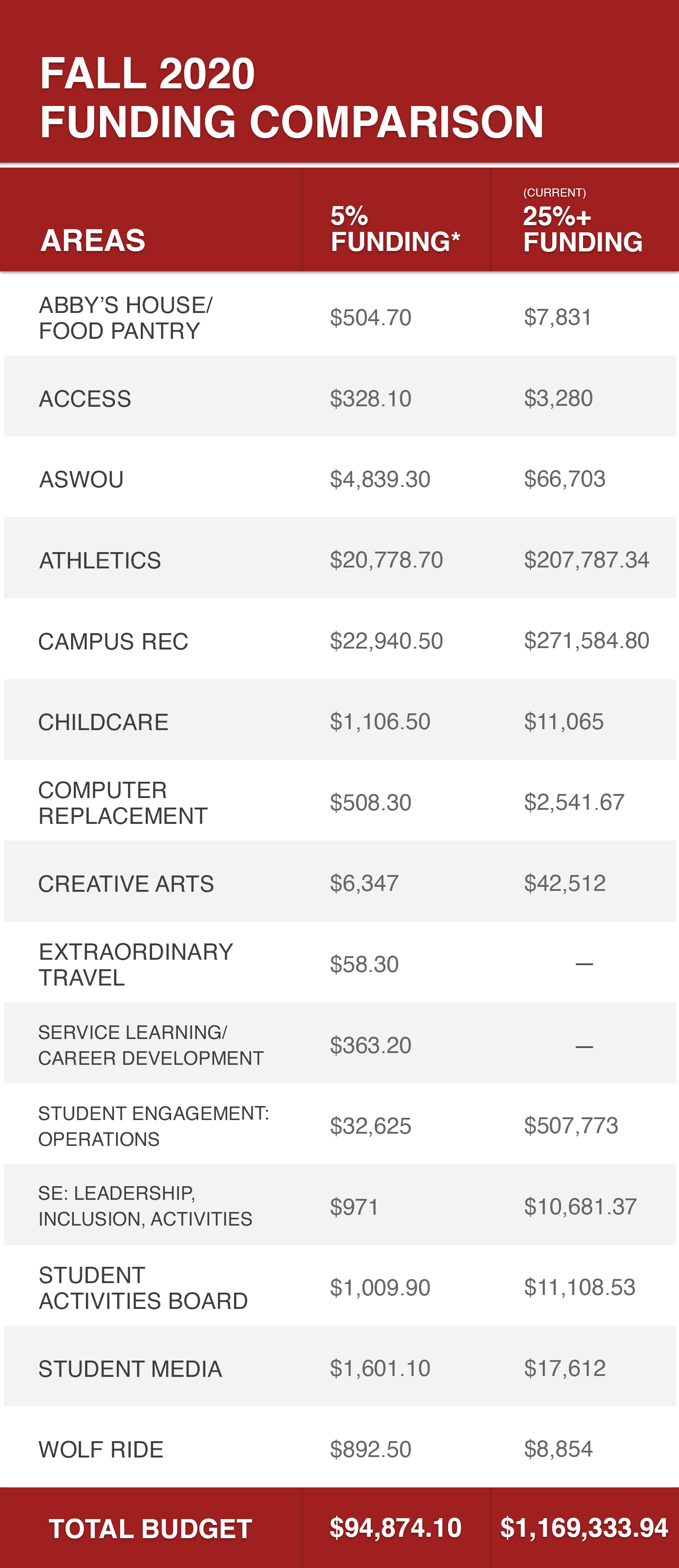
As a result of the online conversion, the Incidental Fee Committee estimated collecting only 5% of their anticipated 1.9 million dollar budget for fall term.

“I was on the committee … designed to reopen campus in a safe way, but I was the only student on that committee,” said senior public policy and administration major and ASWOU President N.J Johnson, “When we were putting together the email announcement…about classes being online I had expressed my concerns.” 

Johnson stated that the email indicated online students wouldn’t be paying a fee. He went on, saying he voiced to the reopening committee that the IFC was not consulted. Johnson said he was outvoted by other members of the reopening committee, resulting in no online students being charged incidental fees.

In the days following the email announcement, the IFC Steering Committee — a group tasked with reviewing and changing IFC bylaws — met on Aug. 31 to take action in response to the reopening committee’s decisions.

“We made two amendments to the bylaws,” said junior communications major and IFC member Makana Waikiki. “One of them was to allow a Special Committee to meet and it also specified who would be a part of the committee.” 

Waikiki voices how the committee felt it important to have more than one student in a room making decisions.

The second amendment gave the IFC control over defining what a fee paying student is. It is considered by the committee to be a historic change.

“We haven’t had the power to define a fee-paying student (until) recently,” said junior philosophy and English double major and IFC Member Nick Denning, “which is absolutely integral in us charging online students.”

After the bylaws were passed by the Steering Committee, the newly formed Special Committee sent out a petition to the student body, asking if they wanted to have a fee applied on the fall bill to fund the 15 programs covered by the IFC. On Sept. 2 the Special Committee convened to discuss applying applying a flat rate fee of $250. During the meeting Denning revealed the petition sent out by the Special Committee received over 300 signatures. Currently Western has 4,164 students registered for classes. 

On the same day of the Special Committee’s first meeting, Johnson reported he was contacted by President  Rex Fuller.

During their discussion , Fuller offered a one million dollar stimulus from the $53 per credit online tech fee approved back in April. According to the Business office the online tech fee is not new. In April when the Board of Trustees were finalizing billing, they took the difference of online tuition  — $228  —  and Oregon residency tuition  — originally $176 before the 4.55% increase in April — increased it by $1 and made it a separate fee for bill transparency.  According to Fuller, the $53 was originally intended for Western’s new Learning Management System called Canvas. However due to COVID-19, Western  entered a contract with Canvas that is funded by the CARES act until the end of 2020.

“Due to the unique situation of Fall 2020 being almost 95% online, I offered to ASWOU a $1M allocation of online course fee revenue to ease the revenue shortfall,” Fuller explained.

After talking with Fuller, Johnson said that he told the Special Committee about the million dollar deal immediately. However, the minutes from the Special Committee’s first gathering discussed applying a temporary flat rate fee of $250, and did not mention the conversation between President Fuller and ASWOU President Johnson. 

Although they were offered a million dollars, Johnson explained the fee application was still requested.

“We had two reasons we wanted to apply a fee,” said Johnson, “The first reason is to have a recognized student government.” 

The second reason Johnson cited for fee application was precedence.

“It’s about having your decision … through (the) proper process as stated in the IFC bylaws. We thought it was important … that those decisions were recognized.” he stated.

On Sept. 23, ASWOU posted a press release claiming the Board of Trustees were asked to meet in September to review the fee being discussed by the Special Committee. However, the Board affirmed they wouldn’t meet till Nov. 18.

“Chair Komp and President Fuller said it wasn’t advisable at the time. Because we have the million dollars from the tech fee that would buy us enough time to solve this problem collaboratively,” recalled Johnson.

In order to work with the Board of Trustees, ASWOU lowered the original $250 fee to $50 because the million dollar offer funded more than 51% of the IFC’s budget. Even so, ASWOU still wanted to establish precedence and the student body government as a legitimate power on campus.

Johnson went on to say that the Board of Trustees still did not want to meet, citing that they felt it would be better to apply a fee in the winter and spring. 

After being denied consultation, on Sept. 14 ASWOU submitted an appeal to the Higher Education Coordinating Commission, requesting a third party to evaluate the administrative rejection process of ASWOU’s request to collect incidental fees. 

Negotiations regarding the million-dollar agreement spanned two days following the Sept. 14 HECC appeal.

On Sept. 16, ASWOU and WOU admin reached an agreement; the three terms of the agreement were not released to the IFC funded area heads until Sept. 17. In the joint email sent by Fuller and Johnson, the three conditions of the agreement were as follows.

First, the University will assess fall term fees based on the course modality of classes offered. For remote/online classes, a technology fee will be assessed while the incidental fee will be assessed on all face-to-face courses. 

Second, the university will provide one million dollars from the tech fee and the remaining funds will be drawn from student reserves. 

Third, ASWOU would drop its appeal to HECC.

ASWOU complied to secure the million-dollar stimulus for the IFC funded areas. After the deal, the IFC received 61% of their projected funds. 

Currently, all areas are being funded 25% or more and the IFC does not intend to apply fees this fall. 

Johnson says that the full IFC will be meeting to discuss what took place this the fall in preparation for winter and spring term. More information will be released when there are developments in the story.

UPDATE (OCT. 28TH, 2020 @ 2:09PM)

For fall term, students did not see an Incidental fee on their billing statements. As a result, IFC was not able to fund the areas it covers until ASWOU President N.J Johnson and Western’s President Rex Fuller made a million dollar deal giving the IFC 52% of their previously anticipated $1.9 million budget. However, the deal was made with the intent to fund the IFC for fall term.

“The online course fee is not designed, as a general proposition, to supplement incidental fees,” said Fuller. “Due to the unique situation of fall 2020 being almost 95% online, I offered to ASWOU a $1M allocation of online course fee revenue to ease the revenue shortfall to support student services funded by incidental fees.”

The IFC met on Oct. 22 to discuss plans going forward. The committee decided to make decisions only for winter term due to the money being unknown so far in the future, feeling it was better to take it term by term, and being able to effectively allocate funds to what best serves students. Currently, all seven IFC area heads are being asked to be prepared to present a 50% budget proposal at their next meeting on Oct. 29.

For the budget proposal, areas are being asked to base 50% funding off of last year’s allocation. In addition to running cost estimation, each department is being asked to present a brief presentation on where the money is going and what has been prioritized in their budgets. The IFC did not give the areas restrictions on what the budget can or can’t be used for.

At this time, President Johnson and President Fuller are revisiting the definition of a fee-paying student — a power the IFC implemented to their amendments in September, but not fully recognized by the Board of Trustees at the time.

All decisions regarding budget proposals and definition of a fee-paying student must be finalized before the first subcommittee meeting for the Board of Trustees, which meets around Nov. 11.

The story will be updated as more information is released.

Contact the author at scarpenter18@mail.wou.edu

Services provided by Valsetz plan to switch online

Valsetz accommodates students opting to stay on campus over the Thanksgiving holiday 

Sydney Carpenter | News Editor

During the holidays, most Western students return home to see family and friends. Under current circumstances with the two-week statewide freeze, many students have chosen to reside on campus through the entirety of Thanksgiving break. In a survey sent out by University Housing as of Sept. 13, nearly 25% of the 536 respondents stated they were staying on campus.

During Thanksgiving break, services like Campus Dining will be closed to allow student and staff workers time to enjoy the holiday festivities. However, like years prior to 2020, Campus Dining Services offered provisionals to those students on campus.

“What we end up doing is we ask students to put in an order,” said Albert Worotikan, Director of Campus Dining. “We can provide them with food (breakfast, lunch and dinner) that will stay (good) for three to four days like milk, sandwiches or frozen pizzas that they can order in advance and pick up before we close on Wednesday at 2 o’clock.”

After Thanksgiving break, Worotikan reported that Valsetz plans to convert its services to entirely online orders for the rest of fall term.

“Because some of the students who are coming back might be traveling around, we want to make sure we don’t spread the virus,” said Worotikan. “We will be adding an additional two weeks because we want to ensure the safety of students and staff.”

During that time, students will not be permitted to sit in the dining halls and are expected to continue wearing their masks and remaining six feet apart.

If students who are staying on campus still haven’t submitted their order for the four-day break, Worotikan said that while the deadline has passed, students can email him at worotikana@mail.wou.edu and ask for an extension. Worotikan explained that he too has children and understands that in times like these, extensions are important and students need understanding and support.

Contact the author at scarpenter18@mail.wou.edu

Western student petitions to change University Housing Guest Policy

Students rally behind petition advocating for a change in resident hall guest visitation policies

Sydney Carpenter | News Editor

On campus, University Housing has adapted to the ongoing challenges presented by COVID-19 by reducing housing capacity, reducing double rooms to singulars, ensuring masks are worn, prohibiting off-campus guests and students from visiting other students if they do not live in the same building.

In response to the current visitation policies, junior English education major Maya Schlosser-Hall created a petition advocating for a change.

“I created the petition because my partner also lives on campus, but in a different building,” said Schlosser-Hall. “The intention of the rule is clear; housing wants to protect their students from possible exposure. I have nothing but respect for housing staff and all the hard work they do. However, I do believe there are other ways of supporting students.”

After creating the petition, Schlosser-Hall received 193 responses. From there, Schlosser-Hall organized a meeting with Tina Fuchs — Dean of Students, Director, University Housing — and Shelly Clark — Associate Director, Residential Education. 


“I was expecting to not be taken seriously,” said Schlosser-Hall. “I started the meeting knowing Kate Brown had submitted a two-week freeze over Oregon due to spikes of COVID-19.”

Much to Schlosser-Hall’s surprise, she reported that both Fuchs and Clark were encouraging and adamant in hearing what she had to say.

According to Schlosser-Hall, University Housing is listening to their residents; discussions regarding the policy had already been in process prior to the petition. Additionally, guest policies will be reflected upon prior to every term, and both Fuchs and Clark are taking the petition into deep consideration.

“One of the solutions (given to me by another student) is to think of guests as a resource for other students on campus. Instead of fully opening guest policies, this suggestion asks students to document one or two people they deem necessary for their mental, physical and academic wellbeing,” explained Schlosser-Hall.

Contact the author at scarpenter18@mail.wou.edu

The IFC decides winter term fee and department area funding

The IFC has completed 85% of their fee establishment process, but are still in debate with WOU Administration and Board of Trustees Chair

Sydney Carpenter | News Editor

In the third open hearing on Nov. 25, the Incidental Fee Committee evaluated all student feedback they received on fee proposals and department area funding. From their survey sent out to students, it was revealed that 192 students participated in the questionnaire.

Based on their feedback, the IFC ultimately determined all funded areas would receive their full asking amount. However, Interim Executive Director of Intercollegiate Athletics Randi Lydum asked for a budget reduction of approximately $100,000 due to some sports opting out of traveling.

Of the two fees proposed, 62% of the respondents voted on the lesser fee of $150. Unanimously, the IFC agreed to the $150 fee proposal and approval of all area funding proposals. With total operating costs of around $920,000, the IFC is pulling around $270,000 out of reserves.

While the IFC has completed most of its legislative process, they are still being opposed by WOU Administration and Board of Trustees chair Betty Komp. In an emergency IFC meeting held on Nov. 23, IFC members discussed the areas of disagreement between the IFC and the Board of Trustees with President Rex Fuller. 

In the meeting, Fuller voiced he does not agree with changing the current fee structure that was approved by the board in April. Fuller went on to say that he couldn’t fully say whether he would be in support of the IFC’s request of an emergency meeting with the Board of Trustees because he had seen no formal proposal from the IFC.

“I would need to see more of the argument for resolution or the recommendation you are proposing,” said Fuller. “I have not seen a clear definitive argument that you want the board to consider. What I’ve seen are ideas.”

Although Fuller says he is unwilling to have the IFC change their fee midyear, many IFC members explained that their attempts to meet with the Board of Trustees during the summer were denied, believing the discussion would be better at a later date. According to IFC Vice Chair Nick Denning, when ASWOU President NJ Johnson and President Fuller were discussing the million dollar deal, Fuller said the IFC would be given time to discuss fee applications in the winter..

“In an email that you (President Fuller) sent to NJ regarding what your plans were for winter term,” said Denning, “we (The IFC) agreed we would take your million dollars on the condition that you would plan to organize 2020-2021 IFC at the earliest possible date in order to advance incidental fee for winter and spring term of 2021. This work will form the basis joint presentation to the board of trustees at the Nov. 18 meeting.”

At this time, due to the unwillingness of the Board of Trustees to initiate an emergency meeting — granted by the bylaws — and President Fuller’s plans to withdraw funding for winter if the IFC continues its process, the IFC will continue to look into writing an appeal to the Higher Education Coordinating Commission.

Contact the author at scarpenter18@mail.wou.edu

Roxxxy Andrew hosts online Drag Show Bingo

Student Activities Board organizes drag show bingo event hosted by “RuPaul’s Drag Race” star Roxxxy Andrews

Sydney Carpenter | News Editor

Under current government guidelines, much of Western’s planned in person activities have been altered to a virtual format or dropped entirely to ensure the safety of all of Western’s community.

Although some events have been canceled, organizations such as the Student Activities Board  have put together events that equate to or surpass the typical in person events. This week, the SAB has organized Drag Show Bingo. Students were given the opportunity to select one of four prominent drag queens to host the event: Alexis Michelle, Roxxxy Andrews, Brita Filter and Pandora Box. Ultimately, Western students voted to have “RuPaul’s Drag Race” star Roxxxy Andrews lead the activity.

Michael Feliciano, known for his drag persona Roxxxy Andrews, began doing drag in Orlando nightclubs, and later competed in drag show pageants. In 2012, Feliciano’s stage character became a nationally recognized household name after being featured in the fifth season of “RuPaul’s Drag Race” and being that season’s runner up. 

Since the show, Roxxxy Andrews has won titles such as Miss Gay Southernmost USA 2015 first alternate and crowned Miss Angel City Continental 2019. Additionally, Andrews has been featured on the “RuPaul’s Drag Race” spin off “Untucked” seasons one and two, “RuPaul’s Drag Race All Stars” seasons two and five, “Queen to Queen” and “The Queens.”

For students that are interested in meeting Roxxxy, the Drag Show Bingo event is being held on Dec. 2 at 6 p.m. over Zoom. Winners will receive SAB swag and various Western items. The Zoom link for the event can be found on the WOU Engage event page.

Contact the author at scarpenter18@mail.wou.edu

An Election Year to remember

Polk County sees almost even distribution of Republic and Democratic voting 

Sydney Carpenter | News Editor

Last Saturday, Nov. 7, media outlets across the country announced former Vice President Joe Biden as the projected winner of the 2020 presidential election. The Associated Press reported President Elect Biden had amassed over 76 million votes as of Nov. 10, surpassing former First Lady Hilary Clinton’s near 66 million votes from 2016.

Currently, the national popular vote in the 2020 election is separated by 3.3% with mail-in and absentee ballots still to be counted.

Historically known as a blue state, the popular vote in Oregon was separated by 16%, with the Democratic Party nominee receiving 1.3 million votes and the Republican Party nominee receiving around 945 thousand votes, according to results.oregonvotes.gov. 

In Polk County, the voting margins were similar to the national voting margins; Polk County, a predominately red area, had high voter turnout on both the Demoractic and Republican sides, resulting in a purple presidential race. 

In 2020, the Democratic nominees received 47% of the total 48 thousand Polk County votes in comparison to the Republican nominees receiving 49%. In 2016, current President Donald J. Trump received 47% of the total 41 thousand Polk County votes available in contrast to running mate Hilary Clinton, who received 40% of the total votes available in Polk County, with the remaining 13% spread between independent candidates.

Between each recent presidential election year, Polk County saw a 17% increase in voter turnout. Statewide, Oregon saw a 1% increase in voting from the 2016 general election to the 2020 election. Nationwide, it’s been reported that there has been an 18% increase in voter turnout from the 2016 presidential election. Trump attributes this to voter fraud, citing Pennsylvania as his most relevant example. 

“We were up by nearly 700 thousand votes in Pennsylvania,” said Trump in a White House briefing room on Nov. 5. “I won Pennsylvania by a lot and that gets whittled down to, I think they said now we’re up by 90 thousand votes, and they keep coming and coming and coming, they find them all over, our numbers started miraculously getting whittled away in secret.”

However, none of the president’s claims or lawsuits have been contested by any of the courts due to lack of evidence. Currently, Biden and Vice President Elect Kamala Harris are projected to be the next leaders of America come January 2021 ⏤ unless Trump’s team provides evidence of massive voting fraud taking place in the major swing states of Michigan, Pennsylvania, Georgia, Nevada and Arizona. 

Contact the author at howlnews@mail.wou.edu

Veteran Resource Center participates in nationwide PAVE program

The Veteran Resource Center provides veterans and their dependents with specialized academic advisors

Sydney Carpenter | News Editor

In America, the number of veterans and dependents interested in pursuing higher education rose 3% after the addition of Chapter 33: Post/9-11 educational assistance to U.S. Code Title 38—VETERANS’ BENEFITS, reported in a study by Liang Zhang of New York University.

To accommodate incoming veterans, in 2012 an organization associated with the University of Michigan known as M-SPAN Military Support Programs and Networks launched a pilot version of their initiative known as PAVE Peer Advisors for Veteran Education intending to ease the transition of student veterans from the military to college, increase student veteran retention rates and improve student veterans’ academic performance.

After their successful pilot, M-SPAN launched a nationwide campaign, gaining 42 campuses including Western Oregon University.

“I was initially interested in forming a peer advising program because I was witnessing the success of other mentorship programs,” said Western Veteran Resource Center Director Colin Haines.

Haines reported reaching out to fellow colleges that were already participating in the program; after receiving information on how the program functioned on their campuses, Haines determined that PAVE would benefit Western veterans and their dependents. Starting officially in 2019, the Veteran Resource Center began offering the services associated with PAVE.

“It’s a unique program,” said senior exercise science major and team leader of the PAVE program Adam Dryden. “Incoming veterans or dependents are paired with an upperclassman familiar with Western’s academics and the different Veteran Affairs benefits.”

In years prior, incoming first-year veterans or dependents were assigned to a general university advisor specific to their major. Dryden explained that VA benefits are different from most financial aid, so general advisors may not be as familiar with their structure compared to a member of PAVE.

Additionally, Dryden explained that while advisors are required to be upperclassmen and be a veteran or a dependent, candidates are required to go through a short certification program.

“I think it’s effective,” said Dryden. “It takes a few hours to complete. You run through scenarios and then you get a certification at the end.”

Despite the challenges imposed by COVID-19, PAVE has maintained 36 first-years using VA benefits. Dryden explained that while PAVE is meant to serve underclassmen, transfer students are also welcome to participate in the program.

“We want to help in any way that we can,” Dryden explained.

For more information or questions regarding PAVE, visit the Veteran Resource Center website at wou.edu/veterans/.

Contact the author at howlnews@mail.wou.edu


Men’s rugby competes virtually in rugby competition

Men’s rugby participates in COVID-19 friendly competition

Sydney Carpenter | News Editor

Due to current COVID-19 restrictions, club sport organizations like men’s rugby are not able to function under normal pretenses.

However, the rugby team found a creative alternative to normal game play: a virtual competition against other rugby teams. 

In order to compete in the virtual “season,” men’s rugby earned points by performing various challenges in workouts and training. 

“We competed in competitions against other teams to see whose times were better, who had a better push up per minute, who had a better sit up per minute and it was just basically a statewide competition,” said freshman physical education major and men’s rugby flanker Sangato Letisi. 

In addition to the physical aspect of the competition, the virtual showdown awarded teams points for self promotion as well as community service. During the event, the rugby team reached out to Western’s Food Pantry after viewing their own promotional video, and asked if the team could make another one.

“It wasn’t part of any specific task,” said senior exercise science major and men’s rugby lock Spike Ripley. “It was just we as a team decided to be more active in the community. We are actually trying to change how Western Oregon’s rugby team is looked at. This is a positive way (to) be active and participate in the community.” 

Since the rugby team published their video, the Pantry has received over $1,225 in donations, been shared 108 times (including by the USA Rugby National Team), viewed nearly 9,000 times and has reached over 20,000 people.

“My entire family … (was) asking me how they could help the Food Pantry,” said Letisi. “I told them food and money helps the Food Pantry and they said they would go donate real soon.”

In addition to helping our community, the team reported winning prizes from specific tasks they won during the competition.

“My favorite part, and I think the team’s favorite part, was winning new uniforms,” said Ripley. “We won the uniforms after giving the best answer for how we were able to stay in contact with rugby despite … COVID.”

Letisi added that winning anything during this season was motivational.

“We can’t have an actual season right now, but winning something gives us something to compete for.”

In totality, the team placed second of the 90 teams qualified to compete. Going forward, the team hopes to regain a sense of normalcy and play a real game of rugby after a vaccine is released.

Contact the author at scarpenter18@mail.wou.edu

WOU food pantry continues to provide services despite COVID

Western’s Food Pantry remains open despite the year’s circumstances

Sydney Carpenter | News Editor

At Western, there have been university-wide layoffs, budget cuts and projected program reductions. The Board of Trustees have coined the term “right sizing” for the university. Due to COVID-19, the “adjustment” has been amplified.

Despite the financial circumstances the university is facing, the Western Food Pantry has remained available to community members.

Back in March, when COVID was first documented in Polk County, grocery stores in Monmouth and Independence were cleared of sanitization products, personal hygiene goods and produce. Dissimilarly, Western’s Food Pantry shelves were filled with products for the community.

According to senior applied math major and student coordinator of the Food Pantry Josh Salsbury, the Food Pantry’s “source” — Marion Polk Food Share — donated enough food to roll over into fall term after Oregon’s Joint Special Committee on Coronavirus passed their fourth policy proposal. This proposal was designed to fund food banks. 

At the time of the food bank donation, students had mostly vacated campus; however, Food Pantry services are not exclusive to students. The Pantry welcomes all who are in need regardless if they live in Polk County or aren’t associated with Western, Salsbury explained. 

After Oregon released its COVID safety guidelines, Salsbury reported that the Food Pantry hastily adapted its services to abide by Oregon law.

“It was a really difficult transition,” said Salsbury. “To illustrate that, during winter term of last year, the Food Pantry had 30 weekly volunteers keeping it open and helping with our services. Due to COVID guidelines and because we weren’t really sure what COVID was going to look like because of how scattered the information was, we went from having 30 volunteers to having maybe four or five.”

In addition to reduced volunteers, it took two attempts to establish an effective COVID-compatible food acquisition system.

“At the start of COVID, the system we had at the time was very rushed because we were trying to make sure we had a COVID-compliant system,” said Salsbury. “We had prearranged bags or food boxes. We had three different options of bags to still accommodate the choice.”

Salsbury explained that the Food Pantry didn’t like the first system because of the fewer options a customer had when they chose from prearranged bags.

Around the beginning of summer, the Food Pantry switched to their final and current system that Salsbury referred to as the “restaurant style” system. When customers currently go to the pantry, instead of the pre-COVID “grocery style” system, they order food off a menu and a worker packs the requested food, rather than allowing the customer to peruse the shelves. This ensures social distancing and limits the amount of people touching the food.

Despite these unusual circumstances, customers have reported the Pantry is maintaining quality service during this time.

“The transition from normal to COVID was pretty smooth,” said community member Shannon Howard. “They did a really good job; I was impressed. They stayed open when I thought they would close.”

Howard reported that although the Food Pantry is receiving only 50% of its funding and reducing staff, he still has access to all the food he needs.

“(It’s a) real big help for me, especially the fresh milk, eggs and cheese,” said Howard.

Howard also commented that prior to COVID, the pantry was actually prepared, citing that the pantry provided sanitizer.

Going forward, the Food Pantry hopes to continue to provide for their community and destigmatize using the pantry. For information on Food Pantry hours and how you can donate, visit https://wou.edu/foodpantry/.

Contact the author at scarpenter18@mail.wou.edu

 

The IFC makes preliminary funding decisions

The IFC faces threats of funding withdrawal and being denied consultations for applying a fee

Sydney Carpenter | News Editor

Over the course of several months, Western administration and the Incidental Fee Committee have been in debate over the IFC’s Incidental Fee.

For winter term, it was discussed in the committee’s Oct. 29 meeting that President Rex Fuller would potentially be supplying another $1 million stimulus from the online tech fee — similar to funding supplied in fall term. IFC members briefly discussed applying a flat rate fee of $25 in comparison to their current fee system: students with one to five credits pay $265, and students with more than six credits pay $395.

In their Nov. 5 meeting, the committee announced that President Fuller changed his $1 million offer to $415,000 on the condition that the committee does not attempt to make any mid-year fee modifications and maintains their two-tier system approved back in spring 2020. 

In an email sent to ASWOU President NJ Johnson, President Fuller projected IFC expenses totaling $900,000 due to winter term being less expensive. Fuller cited that remaining funding for winter term would come from the $100,000 carryover from fall term, $85,000 from the current IFC fee and $300,000 from the $1.3 million in IFC reserves.

Despite Fuller’s conditions, the IFC has opted to carry out its normal governing processes — an extensive list — protected by OR statute 352.105.

“(There are) serious problems making our committee rely on online fee,” said junior philosophy English double major and IFC member Nick Denning in the fourth meeting transcripts. “No control over the amount of money we receive, administration is doing that all on their own and they decide what to charge and where money goes. All of a sudden we are reliant on online tech fees. (We) cannot criticize it because (our funding) will go away.”

Following their own timeline and deciding to not rely on Fuller, the IFC approved all preliminary budget proposals in their fifth meeting held on Nov. 12. Although the IFC requested areas to present budget proposal reflecting 50% funding, areas such as Student Media received an additional $1,500 to meet their needs, so they would not need to pull money from their reserves; Campus Recreation was given an additional $5,000 to increase workers to full time; Creative Arts received an additional $1,000 for student employment; ASWOU’s budget was given an additional $4,452 to allow Office Coordinator to be 1.0 FTE; Athletics requested funds for both winter and spring term in preparation for plane ticket purchases if travel is allowed.

After approving budget proposals, the committee discussed potential fee prices; in their deliberation, the IFC agreed to two possible fee scenarios. The first scenario involves all students, regardless of whether they are taking an online class, paying a flat rate fee of $150 and around $360,000 would be taken from reserves if the committee is not able to convince the Board of Trustees to lower the online tech fee. In the second scenario, if the IFC can bring down the price on the online tech fee, then all students, regardless of whether they are taking an online class, would pay a flat rate fee of $175 and around $250,000 would be taken from reserves.

Additionally, newly elected IFC Chair Makana Waikiki announced that although she attempted to request a Dec. 16 emergency meeting with the Board of Trustees, Chair Betty Komp did not reply to Waikiki. Instead, Komp only replied to ASWOU President Johnson, saying that she couldn’t endorse an emergency meeting.

At this time, due to the unwillingness of the Board of Trustees to meet with the IFC and President Fuller’s plans to withdraw funding if IFC continues its process, the committee intends to submit an appeal to the Higher Education Coordinating Commission to have the IFC’s situation discussed at their Dec. 10 boarding meeting. Until then, the IFC is continuing to the next phase of their fee establishment process: open hearings being held via Zoom on Nov. 19 from 9 a.m. to 11 a.m., and Nov. 20 from 10 a.m. to 12 p.m. During these hearings, members of the community can voice their concerns on fees or advocate for more funding in various areas. To participate in the hearings, visit https://wou.edu/ifc/.

As more information is released, the story will be updated.

Contact the author at scarpenter18@mail.wou.edu

Turning Point USA hosts viewing party for final presidential debate

Western students attend virtual viewing party of the final presidential debate

Sydney Carpenter | News Editor

On Oct. 22, 63 million Americans tuned in to the final presidential debate between President Donald Trump and former Vice President Joe Biden, according to nielsen.com.

Western students interested in watching the debate were invited to a viewing party hosted on Discord by Turning Point USA  — a bipartisan political club on campus. During the viewing party students could comment on how each political candidate addressed moderator  Kristen Welker’s questions about Fighting COVID-19, American Families, Race in America, Climate Change, National Security and Leadership. 

“The candidates were much more civil this time with a lot less interrupting,” said junior business major and Event Coordinator of Turning Point USA Joe White, “at least in the first half anyway. It did seem to kinda fall apart towards the end.”

For the first presidential debate, the Commission of presidential debates received a lot of criticism from the American people regarding the lack of control the first moderator, Chris Wallace, had over the candidates remaining within their two-minute speaking time and their lack of civility towards one another. In White’s personal opinion — which he explains is not reflective of the club or the members associated with it — he felt the moderator in the final debate did a great job delegating each candidate’s talking time.

“There wasn’t a whole lot of interrupting from what I saw and it didn’t feel like two little kids fighting and having a teacher come break it up,” said White. “This time around, I felt the moderator was sweet, and she also had a spine; she wasn’t getting pushed around. It felt like she knew what she was doing but she also knew when to reclaim her time in a way.”

Although candidates were socially distanced and audience members were required to wear masks, in contrast to the vice presidential debate that utilized a plexiglass covering to protect candidates Senator Kamala Harris and Vice President Mike Pence, plexiglass coverings were not used in the final presidential debate despite Trump testing positive for COVID weeks prior.

 “You would think the more important a person is, the more you’re going to want to protect them,” said White. “I was surprised to not see plexiglass between them. I guess I didn’t really see a point unless they are facing each other. If they’re facing each other, I would understand it being there, but if they’re not then I would understand it not being there.”

In Oregon, it’s estimated by AP Election Research and Quality Control that the percentage of votes cast in advance compared to the General Election in 2018 is up 47.8%. It’s been estimated by Michael McDonald of the University of Florida’s Elections Project that around 52 million Americans have voted early as of  Oct. 27.

White hopes that after the election people respect who is voted in as president and respect the outcome of the election, whether it’s President Trump or former Vice President Biden.

Contact the author at howlnews@mail.wou.edu

Halloween themed spirit week residents of Monmouth can participate in

Monmouth Business Association holds halloween themed spirit week for locals 

Sydney Carpenter | News Editor

In years prior to COVID-19, local businesses in downtown Monmouth hosted a family friendly trick or treating event for Halloween. Due to health and safety guidelines currently in place, the event cannot be hosted. However, the Monmouth Business Association has come up with some week-long socially distanced alternatives so residents and local businesses can participate in the fun and spooky holiday.


Business decorating contest: Businesses of Monmouth are encouraged to decorate their establishments in family friendly Halloween decorations; all decorations needed to be up by Oct. 26. The business will be judged by a panel of judges, and the community will vote for People’s choice.


Halloween costume contest: This year, residents can upload pictures of their costumes to Instagram under the hashtag #monmouthhalloween. The contest will run from Oct. 26 to Oct. 31. The winner with the most likes will win some fun treats.


Scavenger hunt: On Oct. 27, the Monmouth Business Association will post on their Facebook page a list of items for people to find in downtown Monmouth. They can be found on Facebook @MonmouthBusinessAssociation.


This year the association is discouraging business from handing out candy this year, claiming in their flyer that they want people to stay safe.


Contact the author at howlnews@mail.wou.edu

WOU unions vote to improve employee welfare

Western staff and faculty join together to advocate for improvement in employee treatment and the work environment on campus

Sydney Carpenter | News Editor

Beginning in September 2020, Western staff and faculty unions — SEIU Sub-local082 and WOUFT — joined forces to collaboratively advocate for Western to improve treatment of employees, and revise the declining work environment witnessed by both parties over several years. 

“I’ve worked at WOU for about 15 years now,” said SEIU Sub-local 082 President and Library Technician Jackson Stalley, “and I would call myself Western Oregon University’s greatest cheerleader.”

Stalley voices his and his wife’s love of the university, citing Western as previously being of great value to students and a wonderful place to work. However, Western has lost what once made it a great community, according to Stalley.

“I used to hear from people how much they loved working at WOU and I don’t hear that anymore, I hear the opposite; people are unhappy. They don’t like how they’ve been treated, they don’t like how they’re being treated, and they don’t see it changing,” said Stalley.

On campus, there are over 200 staff workers, and many have expressed to Stalley how Western administration has made them feel like they are not heard or valued anymore. Stalley cites the most recent examples being the March COVID-19 cleanup staff lacking sufficient training, classified staff budget cuts over $1 million in comparison to unclassified staff budget cuts around $300,000 and three rounds of staff layoffs resulting in 31 jobs lost. During the first round of job layoffs that took place in late March, which was deemed unrelated to COVID by HR, Western covered employee health care. The second wave layoffs were cited by HR as COVID related per the second letter of agreement signed in August this letter explicitly states employees would not be laid off. Instead, all employee reductions would reflect a 20% furlough, but would still be receiving the health package provided by Western. 

According to Stalley, Western did not provide the health care they agreed upon until 700 people signed a petition demanding that Western return health care and provide COVID safety protocols for staff.

In the fall, faculty and staff had discussions about current and future leadership concerns. Because the unions identified similar concerns regarding Western, they formed a joint coalition. 

“We realized we had common concerns about the leadership at Western Oregon University,” said WOUFT Communication Officer and mathematics professor Scott Beaver. “We felt that we could potentially pursue actions on our own, but we would certainly be stronger together doing it. It would provide a stronger impetus for the board of trustees to take us more seriously.” 

After joining forces, the coalition created a ballot for members to vote on “no confidence” in President Rex Fuller and a vote on “censure.” The vote of “no confidence” indicates belief that a person in power no longer has the authority to be in that position while the vote of “censure” outlines a strongly worded objection to behavior or leadership; a person is not performing their job effectively.

Although the 240 members acknowledge Rex Fuller retiring, Stalley explains that it’s not only about Fuller.

“It’s about the viability of WOU as an institution,” said Stalley.

On Oct. 3, the results of the ballot indicated that 85% of the 240 respondents stated that they had no confidence in President Fuller’s leadership, and that 91% of the 240 faculty and classified staff wished to conduct a survey of possible censure for one or more members of President Fuller’s administration.

The members of the coalition expressed that their goal is to improve conditions at Western and also voiced strong objections to budget cuts Fuller intends to propose. There are currently tentative plans to cut a small number of class sections for winter and possibly spring terms, but Beaver explained that entire programs are being reviewed for potential cuts.

“He’s conflated the fiscal challenges related to COVID with what appears to be upper administration goals of ‘right sizing’ Western.”

Fuller is currently enacting the 15th article of the faculty Collective Bargaining Agreement, which states that under conditions of demonstrable financial exigency, program or discipline curtailment and retrenchment, administration can make faculty cuts. 

From this vote, the coalition hopes that the Board of Trustees will act accordingly after hearing the results of the ballots. At this time, the coalition has no formal plan to act if the Board of Trustees ignores the vote. They are hoping for the best in this instance.

Contact the author at howlnews@mail.wou.edu

IFC deliberates the winter term fee and another million dollar deal

Incidental Fee Committee meets to discuss budget and fee proposals for winter term 

Sydney Carpenter | News Editor

During the summer, the Board of Trustees determined the Incidental Fee Committee could not apply their fee to students taking online classes in the fall.

Currently, members of the IFC are discussing their plans for the upcoming winter term in Zoom meetings they host every Thursday. In the three meetings attended, starting on Oct. 15, the committee has established a 50% budget for each funded area. For fall term, the IFC received 52% of its funding after ASWOU President NJ Johnson and Western President Rex Fuller made a million dollar deal. However, the deal was made with the intent to fund the IFC only for fall term.

“The online course fee is not designed, as a general proposition, to supplement incidental fees,” said Fuller. “Due to the unique situation of fall 2020 being almost 95% online, I offered to ASWOU a $1M allocation of online course fee revenue to ease the revenue shortfall to support student services funded by incidental fees.”

In the IFC’s third meeting hosted on Oct. 29 however, it was revealed by Johnson that after the IFC’s second meeting held on Oct. 22, he and President Fuller met to discuss potentially receiving another one million dollar stimulus package. From the third meeting’s transcript, Johnson explained that a stimulus package was possible but could not answer affirmatively. IFC Chair Juliana Cameron and Johnson plan to meet with Fuller to solidify the deal.

In addition to the million dollar stimulus, the IFC intends to apply their fee this term.

“We should charge a fee, not just to keep service and staff, (but) to give students a say. We should charge as little as possible,” said sophomore political science major and IFC member Quentin Kanta.

Cameron affirmed with Kanta, voicing potentially applying a $25 fee for winter term. All members were in agreement that the fee should be kept low. Before the IFC can apply their fee, the decision to give the IFC power to define a fee-paying student — made by the Special IFC in the summer — must be approved by the Board of Trustees.

All funded areas must present budgets reflecting 50% funding and include money left over from fall term. All fee proposals, budget outlines and stimulus agreements must be submitted to the Board of Trustees by Nov. 18. The IFC is not being required to go through a subcommittee this time. 

As more information is released this story will be updated.

Contact the author at howlnews@mail.wou.edu

All departments on campus experience employment reductions

Reductions to student and faculty employment have occurred all over campus

Sydney Carpenter | News Editor

Last April, Oregon’s unemployment numbers skyrocketed from 4% to 14.7% and has since settled to 7.9% as of September, according to deptofnumbers.com

Western has also experienced a spike in unemployment; all departments at Western have had jobs permanently removed, and each funded area has been temporarily limited to the amount of students they are able to hire.

In January 2020, Western’s Board of Trustees discussed potentially removing faculty jobs from campus due to steady decline in revenue.

“It was exacerbated by COVID-19,” said Public Service Librarian Janeanne Rockwell-Kincanon.

Many departments on campus — such as Student Recreation, the Child Development Center and the Hamersly Library — have all experienced employment reductions, totaling approximately 68 unfilled positions with a majority coming from Campus Recreation.

“It’s nowhere near where we would like it to be,” said Assistant Director of Campus Recreation Andy Main, “but one thing I think is important that we’re proud of is that just about every single employee that we were hoping to bring back for this fall we’ve gotten them their hours back or are trying get them back.”

Additionally, due to budget cuts and limited employment for social distancing purposes, the Hamersly Library and Student Recreation have cut their operating hours by more than 66%, while the Child Development Center has reduced the amount of child intake by 50%.


“Because we are operating under an emergency child care license, it requires us to have small stable groups,” said director Tammy Gardner. “We are doing three groups of 10 students. Each group has an assigned teacher and the groups are not allowed to cross paths.”

Currently, the Child Development Center is also receiving partial funding from an Oregon grant called Preschool Promise, Gardner explained. Under the Preschool Promise, it fully pays for 18 students to attend. Qualifying students have to be under 200% of the Federal poverty level and the families who submitted applications were selected by a third party source called the Parenting Hub of Polk and Marion County.

All departments on campus are hopeful that the coming year will provide better funding and increase employment opportunities. The story will be updated as more information is provided. 

Correction: In the story above, it was implied that reduced student hires was the cause of limited hours of operation at Hamersly Library. However, this is not the case; student hire reduction was not the cause of limited hours, but the safety of staff and faculty due to social distancing guidelines.

Contact the author at howlnews@mail.wou.edu