Mount Hood

Take a hike on a trail near Western

Hiking trails within an hour of Western

Allison Vanderzanden | Lifestyle Editor

Living in Oregon offers exceptional opportunities to get out and experience nature. According to alltrails.com, there are almost 2,500 trails to hike, bike, run and horseback ride in Oregon — and there are dozens to choose from that are near Western. Read on for some hike recommendations that are within an hour drive from campus.


Baskett Slough (14 minutes away): Featuring a pond and a short climb up Mount Baldy, this 5.1-mile trail is a beautiful hike to do, even on a cloudy day. Keep an eye out for numerous birds as well.

Luckiamute Landing (19 minutes away): An easy walk along the Willamette River, this 3.8-mile trail is great for anyone looking for a quick, relaxing outing.

Calloway Creek (20 minutes away): This short, 2.6-mile hike explores Peavy Arboretum, one of Oregon State University’s research forests. Add a quick loop around Cronemiller Lake, and check out OSU’s logging sports arena.

Davies Nettleton Loop (24 minutes away): This 6.6-mile loop offers nice forest views throughout and a moderate 767-foot elevation gain. Customize with detours at trails like the Old Growth Trail and the Upper Dave’s Trail for more traditional dirt paths.

Dimple Hill (24 minutes away): When accessed via Patterson Road 600, this hike is 4.9 miles long with an elevation gain of 692 feet, though it can be accessed from other trailheads. The top offers great views above the McDonald-Dunn Forest and Corvallis.

Fitton Green Natural Area (36 minutes away): This 5-mile hike caters to those looking for some hills; there is a total elevation gain of 1,190 feet. Great views await those who make the climbs.

Willamette Mission (40 minutes away): This state park has several miles of trails to explore alongside two lakes and the Willamette River. Be prepared for a day-use fee, but feel free to pack a lunch and spend a full day relaxing there.

William L. Finley National Wildlife Refuge Mega Loop (46 minutes away): A hike with many options for customization, this 8.3-mile loop combines five trails throughout the wildlife refuge. The serene, wet prairie landscape is home to an abundance of bird species — perfect for birdwatching.

Be sure to dress according to the weather forecast, and wear a face covering when passing other hikers.

Contact the author at avanderzanden19@mail.wou.edu

This week in completely made up horoscopes

The Western Howl Staff

Aries 3/21-4/19  

Gang gang. 


Taurus 4/20-5/20

Just … go back to sleep.


Gemini 5/21-6/20 

haven’t had coffee yet, pls don’t talk to me


Cancer 6/21-7/22

“I wish I could, but I don’t want to.”


Leo 7/23-8/22

Out on lunch break, will be back next week 


Virgo 8/23-9/22

As the days get shorter, you become your true self. Embrace the dark, baby.


Libra 9/23-10/22

No <3


Scorpio 10/23-11/21 

Some fish can walk out of water, but will they climb trees?


Sagittarius 11/22-12/21

Hey, I hope you have a wonderful day — you deserve it! Get out there and DEVOUR SOME AVOCADOS.


Capricorn 12/22-1/19

Go to bed early tonight, treat yourself to at least 8 hours of sleep 🙂


Aquarius 1/20 – 2/18

Is it just me, or is my FBI man listening a little too well?


Pisces 2/19 – 3/20

Go ahead and buy that extra sticker for your water bottle. You deserve it. 

Valsetz delivers meals to WOU students testing positive for COVID

Western introduces quarantine meals to campus dining

Sydney Carpenter | News Editor

Over the course of back-to-school season, many universities are facing COVID-19 outbreaks and are being forced to shut down. Western’s administration observed these outbreaks and planned for fall term accordingly.

Instead of having one move-in day for all new students, Western reduced its numbers to less than two-thirds and had four days designated for move-in. During that time, all students were subjected to COVID testing, and students that tested positive were relocated to Gentle Hall and Butler Hall for isolation purposes.

The people currently living in those halls are receiving “dining accommodations” known as quarantine meals. 

“The quarantine meals were food for the entire day and (were) delivered to them,” said Albert Worotikan, Director of Campus Dining. 

Originally, the food served in the quarantine meals was similar to foods given to students experiencing flu-like symptoms. Students could expect to order things like soup, gatorade, milk or orange juice once a day. However, Worotikan said that after their first weekend starting on Sept. 26, students sent feedback to dining about the quarantine meals. 

According to Worotikan, many of the residents living in the isolation zones have reported to be asymptomatic and requesting food with sustenance. The residents don’t want meals that are designated for flu-like symptoms because the meals are light and not filling.

“Yes, they have the virus, but they still want to eat normal (food),” Worotikan explained.

After a meeting with the Dean of Students and Director of Dining, Tina Fuchs, they completely flipped the system; starting Oct. 5, students living in Butler Hall and Gentle Hall are able to order three regular meals a day under the ‘quarantine meals’ section of the app, Nutrislice, with no additional cost for delivery.

For labor efficiency, campus dining has designated specific times for delivery service, Worotikan said. From 8 to 9 a.m., students can have breakfast delivered, from 11 a.m. to 12 p.m., students can request lunch to be delivered and from 4 to 5 p.m., dinner can be delivered. The residents are also allowed to order snacks during these times. 

In an effort to reduce physical contact during delivery, dining has also set up a notification system to let the person know when their food has been delivered.

“In our system we would be able to email the individual and let them know that the food has arrived,” Worotikan said. “Also with the way Butler and Gentle is set up, the door is outside. Of course we are also going to wear the face masks as well.”

If students start experiencing symptoms late in the term, they are advised to contact the Student Health and Counseling Center to see if they qualify for testing. If a student does qualify for testing, they will be charged $95 for the lab work. Most insurances cover the testing fee, but if a student doesn’t have insurance they can call 211 for additional resources. 

Contact the author at scarpenter18@mail.wou.edu

The President of the United States tested positive for COVID

White House begins tracing other potential COVID cases after President’s diagnosis

Sydney Carpenter | News Editor

The citizens of America have been enduring the financial, physical and emotional impacts of COVID-19 over the past seven months. Currently, the United States accounts for 21% of the global population’s COVID cases.

On Oct. 2 at 9:54 p.m. (PST) President Donald Trump announced that he and the First Lady tested positive for the virus. Suspicions of potential contraction came after White House Senior Advisor Hope Hicks reported symptoms of the virus at a Trump rally held on Sept. 30.

Following President Trump’s positive diagnosis, the White House launched a massive contact tracing effort, reaching out to the people who were around the First Lady and President within seven days of them testing positive. 

During that time, the President attended multiple events: the Supreme Court Justice Ceremony, the presidential debate, fundraisers and a Trump rally. The White House has since identified nine people testing positive for COVID, including the president’s assistant, Nicholas Luna; R.N.C. Chair Woman, Ronna McDaniel; Senator of Utah, Mike Lee; Senator of North Carolina, Thom Tills; Campaign Manager, Bill Stepien; Kellyanne Conway; President of the University of Notre Dame, John Jenkins; Chris Christie; and White House Press Secretary, Kayleigh McEnany. 

All of the people who tested positive are currently receiving treatment if they are symptomatic or are undergoing the Center for Disease Control’s 14-day quarantine guidelines. 

After receiving three days of treatment at the Walter Reed National Military Medical Center, President Trump was released on Oct. 5. Doctors at Walter Reed say Trump passed all the patient release requirements and treatment can be continued from the White House.

Contact the author at scarpenter18@mail.wou.edu

Western’s sidewalk signing adheres to COVID guidelines

Students participate in traditional sidewalk signing despite COVID

Sydney Carpenter | News Editor

In the United States, many colleges have traditional ceremonies welcoming new incoming students. Due to COVID-19, many of these activities have been cancelled per social distancing guidelines.

In spite of COVID, Western upheld its tradition of first-years signing their name on the sidewalk by following social gathering regulations put in place by the Center for Disease Control and Prevention.

Compared to prior years, the 2020 sidewalk signing required students to preregister for the event by selecting Oct. 3 or Oct. 4 to participate in the activity themselves, or have a member of PLUS team sign their name. The students who opted for the in-person option were scheduled fifteen minutes apart to maximize social distancing. 

“There’s probably other universities that definitely wouldn’t have the sidewalk signing,” said first-year history major Wyatt Smith. “When I first came here my junior year (of high school) for state track, seeing all the names on the sidewalk was one of the things that drew me here in the first place.” 

Smith went on to say that he believes a lot of universities wouldn’t put in nearly as much effort as Western has to ensure students living on campus still have a great time and are able to interact with other students in a safe way.

According to PLUS team, 163 out of the 750 students living on campus preregistered for the event and they as a team are happy to keep the tradition alive.

Contact the author at scarpenter18@mail.wou.edu

This week in completely made up horoscopes

The Western Howl Staff

Aries 3/21-4/19  

Who else is getting up at 6 a.m. to run? Just me?


Taurus 4/20-5/20

Let’s not and say we did…


Gemini 5/21-6/20 

Yeah, no I’m going back to bed, later.


Cancer 6/21-7/22

Morsmordre!


Leo 7/23-8/22

FABULOUS JUST FABULOUS


Virgo 8/23-9/22

Mercury is not in retrograde. You can blame Earth for your problems.


Libra 9/23-10/22

Have a lovely cup of tea and talk with a stranger


Scorpio 10/23-11/21 

No Scorp…io


Sagittarius 11/22-12/21

Contact the author at smartinez17@wou.edu


Capricorn 12/22-1/19

Salad is just a vehicle for croutons, thanks for coming to my TED Talk


Aquarius 1/20 – 2/18

Don’t mind me, just going to go casually have a breakdown in the men’s room, thanks.


Pisces 2/19 – 3/20

“Suck it up and ask for help” – E.M. 2020

Disney’s Affinity War

Discussing the controversy of Disney’s casting 

Sean Martinez | Copy Editor

Now, I’m going to go on record and say that the most complicated relationship in my life is with Disney. As problematic as it can be at times, I still greatly appreciate the things I gain from it — namely Star Wars, Marvel and Pixar — but I also acknowledge that they have an unhealthy obsession with trying to make it to the top of the box office every year. 

Coincidentally, this obsession landed the company in hot water. 

Before Disney released 2020’s “Mulan” exclusively on Disney+ in early September, Disney fans attempted to boycott the film. The problem didn’t have anything to do with the fact that Disney launched a more accurate rendition of the story, or the fact there was an Asian female lead character. Rather, the problem had to do with the actress cast as Mulan, Liu Yifei, and her stance on what’s been happening in Hong Kong.

In June of 2019, residents of Hong Kong protested for pro-democracy when Hong Kong attempted to pass a law that would extradite residents of Hong Kong to China. However, things took a turn when the police retaliated. The situation has gotten so violent that protesters had to use umbrellas to shield themselves from tear gas and other chemical weapons.

In response to the police force’s actions, Liu Yifei shared a controversial post on Sina Weibo, a Chinese blog, that read, “I also support the Hong Kong police. You can all attack me now.”

Perhaps what’s most upsetting about this situation is that Disney finally cast a Chinese American woman to star in a groundbreaking film, but some believe the actress they chose does not represent Asian people in a positive light. 

Sadly, this is not the only casting problem in 2020; another example is the casting of Rosario Dawson as Ahsoka Tano in “The Mandalorian.” 

Again I reiterate: the issue does not concern the fact that Dawson has a mixed diverse ethnic background — it’s about her beliefs. 

In 2019, a lawsuit was filed against the Dawson family when they verbally and physically assaulted a transgender man named Dedrick Finley. Instead of facing consequences for her actions, she’s being rewarded by playing one of the most iconic and strong female characters in Star Wars.

I’m sure there are countless more controversial casting decisions that I’m not yet aware of, but regardless, the message remains the same. Disney needs to prioritize casting accurate portrayals of their characters over the amount of money they wish to make. Casting someone who fits the character’s ethnic background isn’t enough. The problem with Yifei and Dawson is that they have no affinity to their respective characters. Mulan would not condone police brutality in her country, and Ahsoka would not assault someone just because they’re transgender. 

My intention with this piece is not to persuade anyone to not watch these films. Like I said before, I’m a huge Disney fan, and I’m still going to enjoy watching whatever content they produce; it is because I’m passionate about the characters and stories that Disney has created that I want them to strive to do better and succeed, without a cynical penny being spent. 

If Disney can let go of their obsession, and shine a brighter spotlight on characters they’ve misrepresented in the past, they could win back the respect from fans that have left. With a new generation watching these movies, young audiences will have proper role models teaching them valuable life lessons. 

Contact the author at smartinez17@wou.edu

Avatar the Last AirBender: What we can take from a childhood favorite

A review of the show from an adult’s point of view

Brianna Lelieur | Entertainment Editor

Two months into a self quarantine, it seemed like there was nothing more to watch on television. People had rewatched the same old favorite movies and shows, and binged the new ones. Yet, with so much time, it seemed like everyone had seen everything. Furthering that, tensions were definitely beginning to rise with the current state of the world; people were certainly emitting strong emotions and needed something to brighten their day again. 

Thankfully, the world got a little brighter on May 15, when the children’s show “Avatar: The Last Airbender” was released on Netflix. After its release, the show exploded in popularity, especially among adult viewers. The show now has an even larger cult following than before; it has inspired thousands of fan creative art projects, merchandise, clothing, music and even food — all within the span of a few weeks since its release date.
Why the huge surge in popularity among adult viewers for a children’s show? Well, as a child who grew up loving “Avatar: The Last Airbender,” I of course admire it for the nostalgia; besides, who doesn’t love a show with characters that can manipulate the environment around them, a story of true friendship and stellar fight scenes? Although, after watching it as an adult, I’ve come to truly appreciate the show not only as a childhood favorite, but also for its writing of the story and characters, its research into the various cultures it’s inspired by, the music that supports the show and the subject matter it touches on. 

During my rewatch, here are a few of the things I took from the show. The first is learning to maintain balance and peace within yourself, as this is an essential theme of “Avatar: The Last Airbender.” When one aspect of life is out of balance, it entirely falls apart. It’s a genuine human struggle to manage balance, whether physically, mentally or in the everyday world. 

Furthering the topic of internal balance, the show weaves elements of spirituality, introspectiveness and meditation. The main protagonist, Aang, is someone with immense special abilities; he can tap into another aspect of the world that not many others can in the show’s universe. He is the bridge between humans and spirits. Meditation is key for him as it allows him to search within his own soul to discover more about his past life and maintain his state of mind. Every time Aang is faced with a dilemma, at most points he meditates on what he is to do and to help him find peace. 

Meditation was something I took from the show because, with so much going on in the world, it can be overwhelming and easy to lose focus of what is important to you. I wanted to find a way to start clearing my mind the way Aang practices, whether I’m dwelling on the past or the chaotic world.

There was a quote that resonated with Aang through his journeys from his mentor and great airbender, Monk Gyasto: “we cannot concern ourselves with what was, we must act on what is.” 

Despite everything that happened to Aang, he ensured to never dwell on what was or let it haunt him. He makes it clear that with the right self motivation, meditation and support, you can make it through just about everything. 

I learned a few interesting facts about the origins of the various bending styles within the show. Each fighting style comes from a different form of real life martial arts. For example, water bending is derived from Tai Chi; earth bending, Hung Gar; fire bending, Northern Shaolin; and air bending, Ba Gua Zhang. Each embodies a very different fighting style, technique, and rule set. For Northern Shaolin, one of the oldest forms of martial arts fighting, it is known to be immensely aggressive and is about long, strong movements that are meant to jab straight through your opponent. Within the Hung Gar fighting style, you are always meant to have a strong fighting stance and be connected to the ground below you for full force in your moves. 

This show has become very popular once more because it came again in a notoriously chaotic time, and people needed something lighthearted to help them get through it. This brings us to simpler times and helps us feel relaxed with sunset backgrounds and calming music. The characters make you wish you knew them in real life, and now, everyone wishes they had an Uncle Iroh. 

Watching “Avatar: The Last Airbender” as an adult again is both an escape and an actual learning experience. It reminds us of our basic morals that often get lost in translation. Whether it’s learning to ask for help when you need it, spending time with friends and family or simply to appreciate life, make sure to live it up. As Uncle Iroh once said, “life happens wherever you are, whether you make it or not.” 

Contact the author at blelieur20@mail.wou.edu

Put some pep in your meal prep

Tips for how to start meal prepping

Allison Vanderzanden | Lifestyle Editor

Having access to regular healthy meals can be difficult for college students; healthy ingredients can be expensive, and dorm living does not always offer the necessary amenities for homestyle cooking. However, meal prepping offers a great way to save money and eat delicious meals more regularly. Here are some ideas and tips to help get started.

Set aside enough time to make meals; this will depend on how many meals are cooked at once and could take up to a couple hours. Meals can be made for the next three to six days, depending on budget and refrigerator storage space. Collect enough plastic or glass containers or Ziploc bags to store each meal. If possible, buy ingredients in bulk to save money.

If a stove and oven are not accessible, pick foods that can be cooked in a microwave, are precooked or don’t need cooking at all. Potatoes, pasta, rice, quinoa and frozen vegetables are just a few foods that can be prepared in a microwave. Canned meats don’t need any cooking, and rotisserie chicken can be pulled apart and refrigerated for up to four days.

Keep in mind, certain foods will keep better in the fridge than others. Salads keep for about a week, especially when dressing and wet ingredients are layered at the bottom and greens at the top. Quinoa stays good for about a week as well, while rice and cooked potatoes and vegetables can be eaten for about four days. However, if a freezer is accessible, meals can be prepped and kept for much longer — anywhere from two to four weeks.

As for recipes to try, salads are easily customizable and add some variety to a set of meals. Burrito bowls are another meal with lots of choices available. Loaded baked potatoes, or sweet potatoes, are perfectly proportioned on their own for a lunch. If the means are available to cook soups, stews or ramen, there are many different recipes to choose from. For breakfasts, oats, parfaits and wraps are great options.

If this is the first time trying meal prepping, start small with just lunches or dinners, or only prepare a few days at a time. Don’t feel discouraged if a week is missed; as it becomes part of a regular routine, meal prep will get easier.

Contact the author at avanderzanden19@mail.wou.edu

Plan the day away with a planner

How to start using a planner

Allison Vanderzanden | Lifestyle Editor

With 95% of Western’s classes being held online for fall term, keeping up with a schedule is more important than ever. Students have to be their own regulators of their study time outside of virtual meetings. A great way to stay on track is by using a planner, and here are some tips on how to use one most effectively.

Start by picking a planner or printing out free planner sheets to put into a binder;  daydesigner.com is just one site that offers free sheets in many styles. Pick a layout that has room to detail each class and associated workload. This may look like a weekly layout with columns on the side to expand on what assignments are due.

Next, color code assignments and classes. Use a highlighter or colored pens and markers. Some categories to code by are types of assignments, such as readings, discussion posts and projects, or class — whichever makes more sense personally. Also give a color to other tasks and events, such as work, vacations and trips to the gym or grocery store.

Now it’s time to pull out the syllabus. Write down class meeting times, assignment due dates and quiz and exam dates for the term with desired colors. Then add in other events as far ahead as is known. Finally, find some gaps in which study time for each class can be allocated. It is important to have designated times for studying and completing homework in order to keep up with classes. This time could be half an hour or several hours, but it should be set aside to do classwork uninterrupted. 

Starting a planner is the first step, but keeping up with a planner takes more persistence. To help with motivation, check off tasks and days once they are completed. Focus on one to two weeks of work at a time if seeing the entire term at once is overwhelming. Set aside a few minutes a day to check up on upcoming events to make it part of a routine, and always feel free to update the planner as life happens.

Contact the author at avanderzanden19@mail.wou.edu

This week in completely made up horoscopes

The Western Howl Staff

Aries 3/21-4/19  

Sometimes staying up until 3am watching docuseries isn’t the best idea but go off.


Taurus 4/20-5/20

Astrology isn’t a lie and you should continue arguing with your parents about it. #fightthegoodfight


Gemini 5/21-6/20 

*eats popcorn while watching Taurus fight with their parents*


Cancer 6/21-7/22

We’ve come to burgle your turts.


Leo 7/23-8/22

My apocalypse bingo card has a bingo, what do I win?


Virgo 8/23-9/22

I’ll be going back to bed after morning Zoom meetings and you should too


Libra 9/23-10/22

If the stars align right hopefully I’ll be a millionaire by the 22nd


Scorpio 10/23-11/21 

Excuse me while I avoid my class meetings so I can continue to binge Netflix shows


Sagittarius 11/22-12/21

LET ME OUTTTTTTTTTTTTTTTTTTTTTTTTTTTTTTTTTTTTTTTTTTTTTTTTT pls 🙂 oh and don’t listen to capricorn 🙂


Capricorn 12/22-1/19

Welcome back everyone, good to see you. Oh wait ⏤ waiting…??????? WHAT DO YOU WANT FROM ME?

Side note: sagittarius is lying, you should def listen 🙂


Aquarius 1/20 – 2/18

Listen to a Virgo this week, for they are wise [(--)]..zzZ


Pisces 2/19 – 3/20

Hey there delilah what’s it like there in 2021? Im 3 months away but tonight you look so pretty…

Letter from the Editor

Adapting The Western Howl in the face of uncertainty

Cora McClain | Editor-In-Chief

Hey Western, I’m glad to be writing to you once again. While I am overjoyed to be returning as The Western Howl’s editor-in-chief, I’m also worried beyond belief. I won’t lie to you; it has been a stressful month leading up to the beginning of fall term. I may have a year of experience under my belt, but nothing could have prepared me for the uncertainty of fall 2020. 

Many changes within university funding have put IFC funded areas, like Student Media, in a tough spot. Suffice to say, we had to adapt many moving pieces within The Western Howl. We had to reorganize everything within our organization, and for a while there, it looked like there wasn’t going to be a Student Media for fall term. We got lucky, and get to uphold our promise to report to you, Western.

The story is confusing — everything leading up to this term has been confusing — but I’m here to lay it all out for you.  For clarity’s sake, instead of weaving some thematic elements here and there, I will just be explaining these larger changes, since they are so drastic and different from previous years.

Firstly, like many other IFC funded areas, Student Media was hit with damaging budget cuts, 45% to be exact. This led Student Media to no longer be able to pay for an adviser position, so we lost our adviser once again. 

So, I ask that you bear with us Western, as we will have little support from administration as we transition into an even more difficult time than we did last year. We may make mistakes along the way, and for this, I ask for your understanding.

Along with this, The Western Howl staff, like many other people affected by COVID-19, are receiving a reduced pay, cutting hours of work out of staff paychecks. The ability to pay less hours means we won’t be able to create as much content as in previous years. 

Furthermore, the way we produce the paper changed to reflect these budget cuts. Our weekly issues have been reduced from 12 pages to 8 pages, without a Sports section for the foreseeable future. We will not be distributing printed issues, possibly for the whole 2020 to 2021 academic year if the online trend continues. Though our red newsstands will be empty, The Western Howl will continue to write and report stories for online editions.

Since we are unable to print, we have also decided to only design an issue every other week. These bi-weekly designed issues will be uploaded to The Western Howl website in pdf form and through Issuu. Rest assured, we will still offer weekly stories directly uploaded to our website, with ongoing stories updated as information reveals itself. 

Though these less desirable changes are underway, the Howl has also looked into ways to expand in other areas. Because the website is becoming increasingly more important — and our only point of traffic — a redesign is underway. 

On top of that, our digital media manager is working hard to increase social media and online media content creation. We are hoping to engage more with you, Western, whether you are here, on campus, or remote.

Part of this expansion includes a bi-weekly podcast alternating from serious topics to more fun and entertaining casts. Along with this, the Howl is going to engage in more organizational integration within Student Media by hopping on KWOU to report a news hour every Wednesday, talking about the stories that came out that week.

I understand how jarring these alterations to the Howl may seem, and they are equally as disorienting for the staff. All of our lives are going through transitions we didn’t expect, however with flexibility and perseverance we can all get through these unexpected times. 

Stay strong, Western, you’re not alone.

Contact the author at howleditor@mail.wou.edu

Steady tunes to study to: song recommendations

A collection of study songs from The Western Howl staff

The Western Howl Collective

With the beginning of school, there are so many things to prepare: supplies, textbooks, resources, study routines and much more. However, a strong study playlist is key in being successful. These are some recommendations from the Howl staff. Hopefully, these songs will encourage someone to create an individual study playlist for a wonderful term. 


Brianna Lelieur | Entertainment Editor

“The Last Cherry Blossom” by Rudemanners — This is a Lo-fi song off an entire playlist, it is upbeat and very soulful. 


Rylie Horrall | Managing Editor

“I Miss Those Days” by Bleachers — My study playlist changes a lot but this song is almost always on it. I like listening to it because it has a mellow and relaxing beat that helps me focus without the words being too distracting. 


Allison Vanderzanden | Lifestyle Editor

“Cassini” by Curtis Schweitzer — I enjoy this song because it’s soft enough to not distract me while studying. I also like that the melody isn’t overly repetitive or predictable.


Sean Martinez | Copy Editor

“Vertigo” by Khalid — I don’t often listen to music while studying, but for me, it’s easy to get lost in the process of writing or studying while this song is playing. Plus, this song is about Khalid asking himself the big questions, making it a great song for concentrating on whatever task is at hand.


Kyle Morden | Head Designer

“comfy vibes” by LilyPichu — Sit back and relax; it’s time to get comfortable with some Lo-fi beats. No matter how stressful studying can be, this song will create a calm atmosphere for any listener.


Cora McClain | Editor-in-Chief

“I’ll Keep You Safe” by sagun — There’s a Lo-fi song for every occasion, and studying is no different.  I’m easily distracted and lyrical songs often make it harder for me to focus on work, so Lo-fi is my go to. The repetition and distortion that sagun’s uses keeps my brain engaged for long study sessions while not breaking my focus.


Kiara Wehrenberg | Photo Editor

“Dream Catcher” by Damu the Fudgemunk — This song is good for me to study because there are no lyrics for me to get distracted by while writing. I also like how the music is upbeat enough for me to stay focused and not fall asleep — most songs by this artist have a similar style perfect for studying. 


Stephanie Moschella | Digital Media Manager 

“3 Nights” by Dominic Fike — This song gives me the summer vibes that we all missed out on this year. It’s calming and melancholic, and leaving it on repeat helps drown out all the noise around me while I study. 


Sydney Carpenter | News Editor 

“Dr. Wanna Do” by  Caro Emerald  — After a long study session I like listening to some electric swing or Jazz to boost my mood and overall attitude. However, I usually don’t listen to anything while I work — it’s difficult for me to focus as is, and adding music to the mix doesn’t help me in my studies. 


Listen to the playlist here!

At-home exercises for every home-body

Exercises anyone can do outside of the gym

Allison Vanderzanden | Lifestyle Editor

A new school year is a time for a fresh start — students have the opportunity to get organized, manage their time and get into a healthy routine. Exercise is an important activity to add to one’s regular routine, as it can reduce the risk of certain diseases and improve mood and mental health, according to betterhealth.vic.gov.au. With many gyms still offering limited service, here are a few exercises anyone can do from home.

To work out leg muscles, do bodyweight squats. With feet slightly more than hip width apart, hold arms out straight ahead, parallel to the floor. Lower down until thighs are parallel to the ground, then return to standing. Complete up to three sets of 12 reps. Make squats easier by utilizing a wall, or add a challenge by doing one-legged squats.

One back workout to try is the Superman. Start by lying facedown on the floor with arms outstretched in front and legs straight. Keep every limb in a straight position, and simultaneously lift them several inches off the floor. Hold for a few seconds, then slowly return to the starting pose. Do about three sets of 10 reps; adjust the amount of reps to modify.

For an arm muscle workout, try tricep dips using a chair, coffee table or bed. Facing away from the object, place palms on the edge of the surface with feet flat on the floor. Lower down until arms are at 90º angles, then rise back up. Aim for three sets of 8–10 reps. Stack a textbook on the thighs to add some additional weight.

Mountain climbers are also a great exercise that works out many parts of the body, especially the core. Start in a plank position, then bring one knee forward to chest and tap toes to the ground while maintaining a flat back. Quickly switch the positions of the feet to complete one rep. Do 15–25 reps at a time, or perform as many as possible in one minute. 

With any exercise, remember to warm up and cool down. Always rest and modify movements or reps as needed. 

Contact the author at avanderzanden19@mail.wou.edu

Pumpkin bread recipe to fall for

Fall in love with this pumpkin bread recipe

Allison Vanderzanden | Lifestyle Editor

There are few things better than a warm baked good fresh out of the oven, especially as the weather begins to cool. To celebrate the start of fall and embrace the new season, try this moist pumpkin bread recipe with a sweet chocolate addition.

CHOCOLATE CHIP PUMPKIN BREAD

Start to finish: 1 hour 15 minutes

Servings: 1 loaf

1 ¾ cups all-purpose flour

1 teaspoon baking soda

2 teaspoons ground cinnamon

1 teaspoon pumpkin pie spice

¾ teaspoon table salt

2 large eggs, at room temperature

¾ cup granulated sugar

½ cup packed brown sugar

1 ½ cups pumpkin puree (canned or fresh)

½ cup vegetable oil, canola oil or melted coconut oil

¼ cup orange juice (milk can substitute)

⅔ cup semi-sweet chocolate chips


HOMEMADE PUMPKIN PIE SPICE SUBSTITUTE

¼ teaspoon ground nutmeg

¼ teaspoon ground cloves

¼ teaspoon ground ginger


Adjust the oven rack to the lower third position and preheat the oven to 350ºF. Spray a 9×5-inch loaf pan with non-stick spray. Set aside.

In a large bowl, whisk the flour, baking soda, cinnamon, nutmeg, cloves, ginger and salt together until combined. In a medium bowl, whisk the eggs, granulated sugar and brown sugar together until combined. Whisk in the pumpkin, oil and orange juice. Pour these wet ingredients into the dry ingredients and gently mix together using a rubber spatula or wooden spoon. There will be a few lumps. Do not overmix. Gently fold in the chocolate chips.

Pour the batter into the prepared loaf pan. Bake for 60–65 minutes, and loosely cover the bread with aluminum foil halfway through to prevent the top from getting too brown. The bread is done when a toothpick inserted in the center comes out clean with only a few small moist crumbs; begin checking every five minutes at the 55 minute mark.

Allow the bread to cool completely in the pan on a wire rack before removing and slicing. Cover and store leftover bread at room temperature for 3–4 days or in the refrigerator for up to about 10 days.

Recipe from sallysbakingaddiction.com

Contact the author at avanderzanden19@mail.wou.edu

Western hosts its first socially distanced sunrise breakfast

New student sunrise breakfast changed to adhere to COVID-19 guidelines

Sydney Carpenter | News Editor

On Sept. 27, Western held its third annual new student sunrise breakfast.

In contrast to the flapjacks and orange juice served at the stadium in prior years, the sunrise breakfast spanned across campus, and students were served “low contact” breakfasts.

Due to social distancing guidelines in place because of COVID-19, fourth year history major and  PLUS Team coordinator, Antonia Scholerman, said they needed multiple areas this year.

“We have students at the Public Safety Field, Turf Field and the Stadium,” said Scholerman. 

To ensure enough space was provided, participants were required to sign up prior to the event to take part in the activity. All students who registered had their names written on a brown bag specified to their diets. 

To keep track of the students and faculty in attendance, PLUS team set up a check-in area. Scholerman explained that this was done to ensure students would only remain in contact with their own food.

“It was actually pretty awesome,” said first year nursing major Alyssia Johnson. “This is literally what I eat for breakfast, so it was perfect.”

In Johnson’s breakfast bag she reported receiving Fruit, yogurt, a cheese stick, and a muffin.  

Despite the current situation, Johnson remains hopeful about the upcoming term. Johnson explained that it doesn’t feel like a challenge, Saying that students are still around each other and are enjoying each other’s company. In her hall, the community room has been limited to a six-person occupancy, but they all seem to be getting along well and are bonding during these unusual times.

Contact the author at scarpenter18@mail.wou.edu

Western replaces Moodle with Canvas

Western introduces a new learning platform called Canvas

Sydney Carpenter | News Editor

In an effort to update Moodle — Western’s Learning Management System  — a new committee called The University Technology Advisory Committee  was formed in February of 2019.

During spring 2020, the pilot version of Canvas, approved by President Rex Fuller back in December 2019, was introduced. President Fuller reported that Canvas is currently being funded by the CARES Act until the end of the year.

“Starting in January we have a contract that is funded through our normal budget,” Fuller explained. Western plans to phase Moodle out by July 2020.

Due to COVID-19, Dean of Library and Academic Affairs Chelle Bachelor reported that approximately 15 courses were used in Canvas because professors could not effectively convert to Canvas. In spite of the debut’s setback,  Western offered two programs over the summer to help professors acclimate to online learning and Canvas; Catalyst and the entire month of August dedicated to Canvas training sessions.

According to Michael Reis, Director of Academic Innovation, “In Catalyst, our summer training that covered online pedagogy and tools, 45 instructors participated.” 

During Catalyst, Canvas was used throughout the two weeks of the course. Additionally, Western designated the entire month of August to professors interested in learning how to use Canvas. Reis reported that 112 professors have participated in Canvas training sessions.

“I attended one Canvas training in summer in August,” said Dr. Feier Hou, Assistant Professor in the Department of Chemistry.

 “The deciding factor for me to use Canvas is if it has all the functions I want for my class.” 

Hou explained, “My class in the fall will be online asynchronous, so I will post lecture videos, and I would like to have the option to have pop-up questions in the middle of videos.” 

Another reason Hou hadn’t made a decision about Canvas was she hadn’t consulted with her students. However, after polling students in her CH 440 course about Canvas, most were reported as indifferent.

“Among the few that responded, more than half voted for Canvas, so I will switch to Canvas for that class,” she stated.

Hou also reported that most professors are still figuring out Canvas. “The main concern I have heard so far is how smooth the transition from Moodle to Canvas will be: how much time will it take us to learn to use Canvas? Will all our content on Moodle be transferred to Canvas exactly the way we want them to be?”

Contact the author at scarpenter18@mail.wou.edu

ASWOU makes a million dollar deal with WOU administration

Administration denies ASWOU the ability to collect IFC fees, instead offering a one million dollar stimulus

Sydney Carpenter | News Editor

Across Oregon, many universities are converting a majority of in-person classes to online due to COVID-19, Western is one of them. On Aug. 18, a group designated as the “reopening committee” voted in favor of Western holding 95% of its classes online. 

Based on the Tuition & Fees for the 2020 to 2021 academic year, student governed fees — such as Incidental Fees — could not be applied on the fall bill. At the time of approval, fee application was dependent on course delivery. If a student does not attend an in-person class on campus, then the fee would not be applied to their bill.

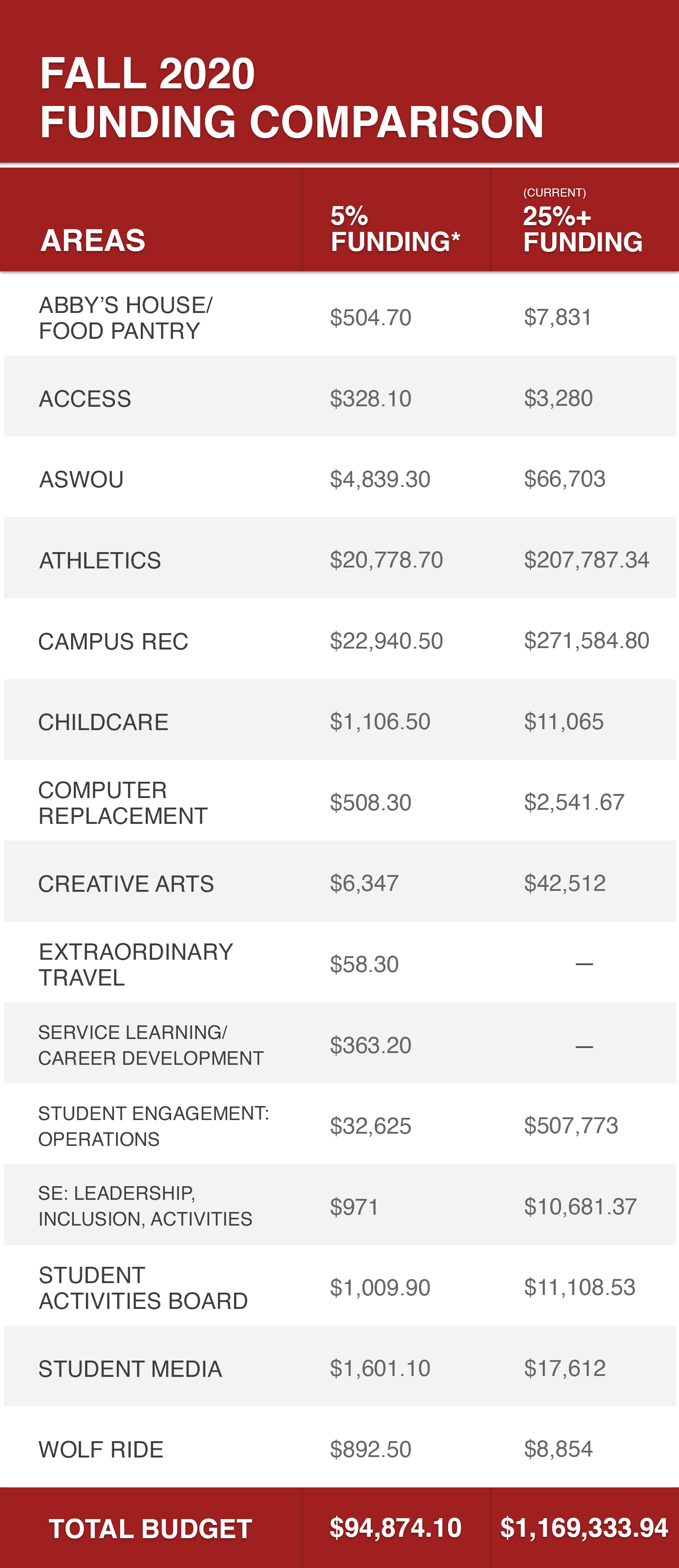
As a result of the online conversion, the Incidental Fee Committee estimated collecting only 5% of their anticipated 1.9 million dollar budget for fall term.

“I was on the committee … designed to reopen campus in a safe way, but I was the only student on that committee,” said senior public policy and administration major and ASWOU President N.J Johnson, “When we were putting together the email announcement…about classes being online I had expressed my concerns.” 

Johnson stated that the email indicated online students wouldn’t be paying a fee. He went on, saying he voiced to the reopening committee that the IFC was not consulted. Johnson said he was outvoted by other members of the reopening committee, resulting in no online students being charged incidental fees.

In the days following the email announcement, the IFC Steering Committee — a group tasked with reviewing and changing IFC bylaws — met on Aug. 31 to take action in response to the reopening committee’s decisions.

“We made two amendments to the bylaws,” said junior communications major and IFC member Makana Waikiki. “One of them was to allow a Special Committee to meet and it also specified who would be a part of the committee.” 

Waikiki voices how the committee felt it important to have more than one student in a room making decisions.

The second amendment gave the IFC control over defining what a fee paying student is. It is considered by the committee to be a historic change.

“We haven’t had the power to define a fee-paying student (until) recently,” said junior philosophy and English double major and IFC Member Nick Denning, “which is absolutely integral in us charging online students.”

After the bylaws were passed by the Steering Committee, the newly formed Special Committee sent out a petition to the student body, asking if they wanted to have a fee applied on the fall bill to fund the 15 programs covered by the IFC. On Sept. 2 the Special Committee convened to discuss applying applying a flat rate fee of $250. During the meeting Denning revealed the petition sent out by the Special Committee received over 300 signatures. Currently Western has 4,164 students registered for classes. 

On the same day of the Special Committee’s first meeting, Johnson reported he was contacted by President  Rex Fuller.

During their discussion , Fuller offered a one million dollar stimulus from the $53 per credit online tech fee approved back in April. According to the Business office the online tech fee is not new. In April when the Board of Trustees were finalizing billing, they took the difference of online tuition  — $228  —  and Oregon residency tuition  — originally $176 before the 4.55% increase in April — increased it by $1 and made it a separate fee for bill transparency.  According to Fuller, the $53 was originally intended for Western’s new Learning Management System called Canvas. However due to COVID-19, Western  entered a contract with Canvas that is funded by the CARES act until the end of 2020.

“Due to the unique situation of Fall 2020 being almost 95% online, I offered to ASWOU a $1M allocation of online course fee revenue to ease the revenue shortfall,” Fuller explained.

After talking with Fuller, Johnson said that he told the Special Committee about the million dollar deal immediately. However, the minutes from the Special Committee’s first gathering discussed applying a temporary flat rate fee of $250, and did not mention the conversation between President Fuller and ASWOU President Johnson. 

Although they were offered a million dollars, Johnson explained the fee application was still requested.

“We had two reasons we wanted to apply a fee,” said Johnson, “The first reason is to have a recognized student government.” 

The second reason Johnson cited for fee application was precedence.

“It’s about having your decision … through (the) proper process as stated in the IFC bylaws. We thought it was important … that those decisions were recognized.” he stated.

On Sept. 23, ASWOU posted a press release claiming the Board of Trustees were asked to meet in September to review the fee being discussed by the Special Committee. However, the Board affirmed they wouldn’t meet till Nov. 18.

“Chair Komp and President Fuller said it wasn’t advisable at the time. Because we have the million dollars from the tech fee that would buy us enough time to solve this problem collaboratively,” recalled Johnson.

In order to work with the Board of Trustees, ASWOU lowered the original $250 fee to $50 because the million dollar offer funded more than 51% of the IFC’s budget. Even so, ASWOU still wanted to establish precedence and the student body government as a legitimate power on campus.

Johnson went on to say that the Board of Trustees still did not want to meet, citing that they felt it would be better to apply a fee in the winter and spring. 

After being denied consultation, on Sept. 14 ASWOU submitted an appeal to the Higher Education Coordinating Commission, requesting a third party to evaluate the administrative rejection process of ASWOU’s request to collect incidental fees. 

Negotiations regarding the million-dollar agreement spanned two days following the Sept. 14 HECC appeal.

On Sept. 16, ASWOU and WOU admin reached an agreement; the three terms of the agreement were not released to the IFC funded area heads until Sept. 17. In the joint email sent by Fuller and Johnson, the three conditions of the agreement were as follows.

First, the University will assess fall term fees based on the course modality of classes offered. For remote/online classes, a technology fee will be assessed while the incidental fee will be assessed on all face-to-face courses. 

Second, the university will provide one million dollars from the tech fee and the remaining funds will be drawn from student reserves. 

Third, ASWOU would drop its appeal to HECC.

ASWOU complied to secure the million-dollar stimulus for the IFC funded areas. After the deal, the IFC received 61% of their projected funds. 

Currently, all areas are being funded 25% or more and the IFC does not intend to apply fees this fall. 

Johnson says that the full IFC will be meeting to discuss what took place this the fall in preparation for winter and spring term. More information will be released when there are developments in the story.

UPDATE (OCT. 28TH, 2020 @ 2:09PM)

For fall term, students did not see an Incidental fee on their billing statements. As a result, IFC was not able to fund the areas it covers until ASWOU President N.J Johnson and Western’s President Rex Fuller made a million dollar deal giving the IFC 52% of their previously anticipated $1.9 million budget. However, the deal was made with the intent to fund the IFC for fall term.

“The online course fee is not designed, as a general proposition, to supplement incidental fees,” said Fuller. “Due to the unique situation of fall 2020 being almost 95% online, I offered to ASWOU a $1M allocation of online course fee revenue to ease the revenue shortfall to support student services funded by incidental fees.”

The IFC met on Oct. 22 to discuss plans going forward. The committee decided to make decisions only for winter term due to the money being unknown so far in the future, feeling it was better to take it term by term, and being able to effectively allocate funds to what best serves students. Currently, all seven IFC area heads are being asked to be prepared to present a 50% budget proposal at their next meeting on Oct. 29.

For the budget proposal, areas are being asked to base 50% funding off of last year’s allocation. In addition to running cost estimation, each department is being asked to present a brief presentation on where the money is going and what has been prioritized in their budgets. The IFC did not give the areas restrictions on what the budget can or can’t be used for.

At this time, President Johnson and President Fuller are revisiting the definition of a fee-paying student — a power the IFC implemented to their amendments in September, but not fully recognized by the Board of Trustees at the time.

All decisions regarding budget proposals and definition of a fee-paying student must be finalized before the first subcommittee meeting for the Board of Trustees, which meets around Nov. 11.

The story will be updated as more information is released.

Contact the author at scarpenter18@mail.wou.edu

This week in completely made up horoscopes

[fruitful_tabs type=”accordion” width=”100%” fit=”false”]

[fruitful_tab title=”Aries 3/21-4/19″] Time to start my year-long backpacking adventure across the wilds of New Mexico! See ya on the flipside ∠( ̄^ ̄) [/fruitful_tab]

[fruitful_tab title=”Taurus 4/20-5/20″] What do you get when you mix a ladybug, a rabbit and a lizard?

Who knows, but I definitely do want to see it. [/fruitful_tab]

[fruitful_tab title=”Gemini 5/21-6/20″] I have no idea what day it is. I stay up until 6 a.m. working, go to bed, and then wake up at 2 p.m. to start the cycle again. Is today Friday? [/fruitful_tab]

[fruitful_tab title=”Cancer 6/21-7/22″] You’ve got that emotional sauce, man.

Go protest. [/fruitful_tab]

[fruitful_tab title=”Leo 7/23-8/22″] When life gives you lemons, give them back and say you want coffee [/fruitful_tab]

[fruitful_tab title=”Virgo 8/23-9/22″] How do I avoid stress? I just don’t write it down. If I don’t write it down, I don’t do it. And if I don’t do it, I don’t stress about it. [/fruitful_tab]

[fruitful_tab title=”Libra 9/23-10/22″] Bye [/fruitful_tab]

[fruitful_tab title=”Scorpio 10/23-11/21″] I should’ve known better. The year never ends easy. Good luck to everyone else. [/fruitful_tab]

[fruitful_tab title=”Sagittarius 11/22-12/21″] PLS DON’T LEAVE ME. I’M GOING TO MISS YOU. WHYYYYYYYYYYYYYYYYYYYYYYYYYYYYYY??!! [/fruitful_tab]

[fruitful_tab title=”Capricorn 12/22-1/19″] My mind has snapped like a stale breadstick. [/fruitful_tab]

[fruitful_tab title=”Aquarius 1/20-2/18″] I’d say I’ve already left the building, but I’m scared to go outside… hold me. [/fruitful_tab]

[fruitful_tab title=”Pisces 2/19-3/20″] Time to sleep through the entirety of summer bc I’m exhausted af. [/fruitful_tab]

[/fruitful_tabs]

Letter from the Editor

Cora McClain |  Editor-in-Chief

It’s strange, Western, I’m sitting at my desk at 11:58 p.m. and all is peaceful and quiet. Why is that strange? Well, the past 10 months acting as editor-in-chief has been anything but. From acting without an adviser in the fall to maintaining operations in the wake of a pandemic, it felt like I never began with a foothold and even when I got one, it slipped away. To be frank, my year has been a frightening one and I have learned a few lessons from it.

In my last letter, I wrote about how terrified I was to take the leap from copy editor to editor-in-chief. That terror never really ended. I constantly felt as if I was doing everything wrong. At one point I felt as if I was never doing enough, like I was letting everyone down. I wasn’t fit for the position. However, when I looked back at the goals I had made in the beginning of the year, I found that my team and I had completed almost all of them. I found some clarity. Perhaps I was being too hard on myself. Maybe I did do a good job. 

Don’t lose sight of your goals Western, so you have something to work towards, something to track your progress and something to feel accomplished.

Part of why I completed so many goals was thanks to my amazing staff. Despite the difficulties juggling classes and their own lives, they still managed to produce The Western Howl each week. I couldn’t have asked for a more dedicated and passionate staff to help me acclimate to the role of EIC and build my confidence. Graciously adjusting to new writing procedures, accommodating to staffing shortages and adapting to the production online issues — they did it all. Without them, this would not have been a successful volume of the Howl.

You can’t do it alone Western, make sure to surround yourself with people you can depend on. You’ll need them. 

One of the reasons why I was so terrified was because I had no adviser to guide me. Since then, we hired Jeff Robischon, who has lended a helping hand in navigating the uncertainties in the past months. Beyond that, he has been a great aid in pushing each of the medias to innovate. Currently, we are looking into further integrating with one another under the name Wolf Den Media and setting up a rentable podcast studio.

I urge you Western, find people who will keep you accountable and push you. They will know that you can do better, and sometimes that’s all the motivation you need.

Lastly, I would like to thank you, our readers. You have made this year of reporting worth-while, especially when the Howl received so many letters to the editor in the winter. Creating a platform for your voices is what the Howl is meant to do, so I implore you to keep utilizing us. And thank you for adjusting along with us in the wake of the pandemic to interact with more online content. I can assure you that we will be expanding upon our online presence next year and I hope you will enjoy the new mediums we will be trying out. 

I am happy to say that I will be returning in the fall, once again, as editor-in-chief. While this year has had many ups and downs and challenges, I plan to take all that I’ve learned and work towards an even better Western Howl next year. With my dependable staff, motivating adviser, and of course, you, the wonderful readers, I have a good feeling about Volume 3. See you soon, Western. 


There is another reason why I find this quiet and peace strange, Western. As I sit here cozy in my desk, with nothing but the distant train horn to disrupt the quiet night, our country is ablaze. Peaceful protesters responding to the unjust death of George Floyd, reigniting the #blacklivesmatter movement to end discriminatory police brutality, are being met with tear gas, strict curfews, and baseless arrests. As the seventh night of protests comes to an end, I feel helpless to aid in this historical discourse on human rights. If you are feeling similarly, know that there are other ways to get involved if you have no streets filled with people to protest with. Sign petitions, make donations, share information and talk about it. Change only comes when enough people care, so care, and do something about it.

If you would like to sign a petition or find other ways to get involved visit https://blacklivesmatters.carrd.co.

Contact the author at cmcclain17@wou.edu