Mount Hood

Western’s Dia de los Muertos celebration invited students to a night of fun and remembrance featuring traditional food and dance

Sage Kiernan-Sherrow | News Editor

“Our dead are never dead until we have forgotten them,” said Western’s Multicultural Student Union Representative, Paola Sumoza, during the Dia de los Muertos celebration on Oct. 30. The MSU hosts a Dia de los Muertos celebration every year; the event is free and anyone is welcome to attend and learn more about this important historical holiday.

Dia de los Muertos, or Day of the Dead, is an ancient holiday with its roots in Aztec culture. Later, it fused with Catholic beliefs when the Spanish conquistadores began colonizing the Americas. Today, Dia de los Muertos is a two-day celebration strongly celebrated in Mexico, and in some Latin American countries as well. It is celebrated on the first and second day of November; the first day is dedicated to the children who have died and is known as Dia de los Angelitos.

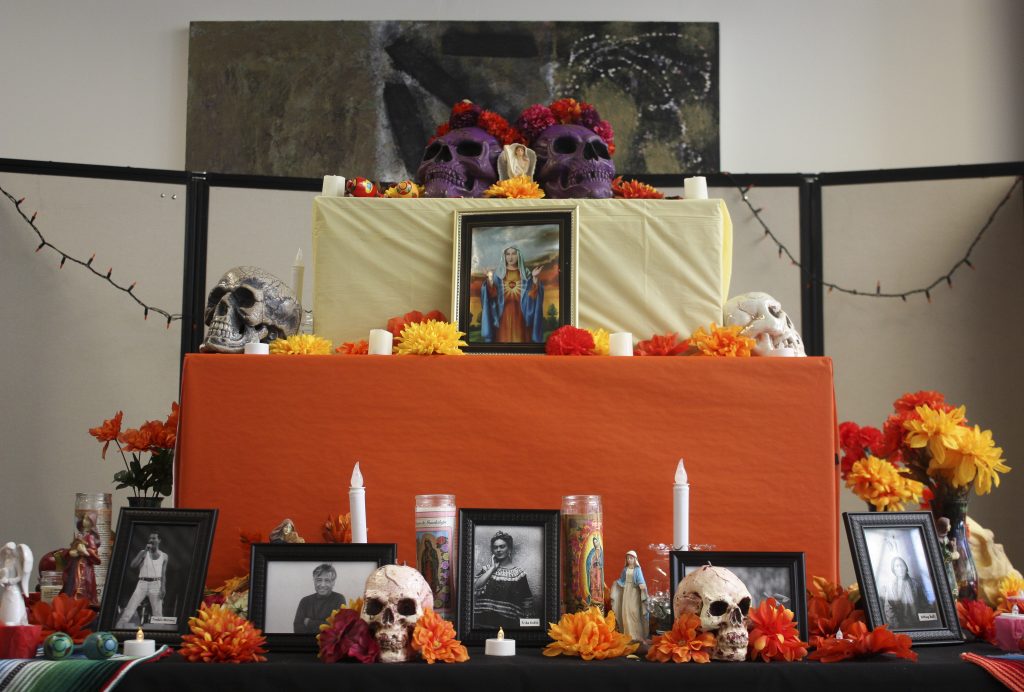
With a focus on honoring ancestors and loved ones, Dia de los Muertos invites the dead to come to the land of the living to reconnect with their families. Traditionally, the families of the dead set up altars — much like the one displayed in the Werner University Center paying homage to culturally-impactful deceased Hispanic and Latinx figures. The altars are decorated with ofrendas, or offerings, which provide ancestors with a safe passage back home. Most ofrendas carry symbolic meaning; while photographs of deceased loved ones are displayed, so too is water for the dead who are thirsty after their long journey and salt for purification.

An important figure representative of Dia de los Muertos is La Catrina, or the goddess of the dead. Donned in a feathered hat typical of the bourgeoisie, La Catrina was originally a political cartoon created by Jose Guadalupe Posada in the early 1900s to symbolize that death comes for everyone — even the aristocracy.

Dia de los Muertos was also represented in the 2017 Disney movie “Coco,” a film that gave representation to many people. During Western’s Dia de los Muertos festivities, Sumoza touched on this importance, saying, “now that I have my children, I’m teaching them these traditions and customs that we have and when we first watched “Coco,” something interesting that my daughter said was ‘Look mom, “Coco” celebrates it like we celebrate it.’”

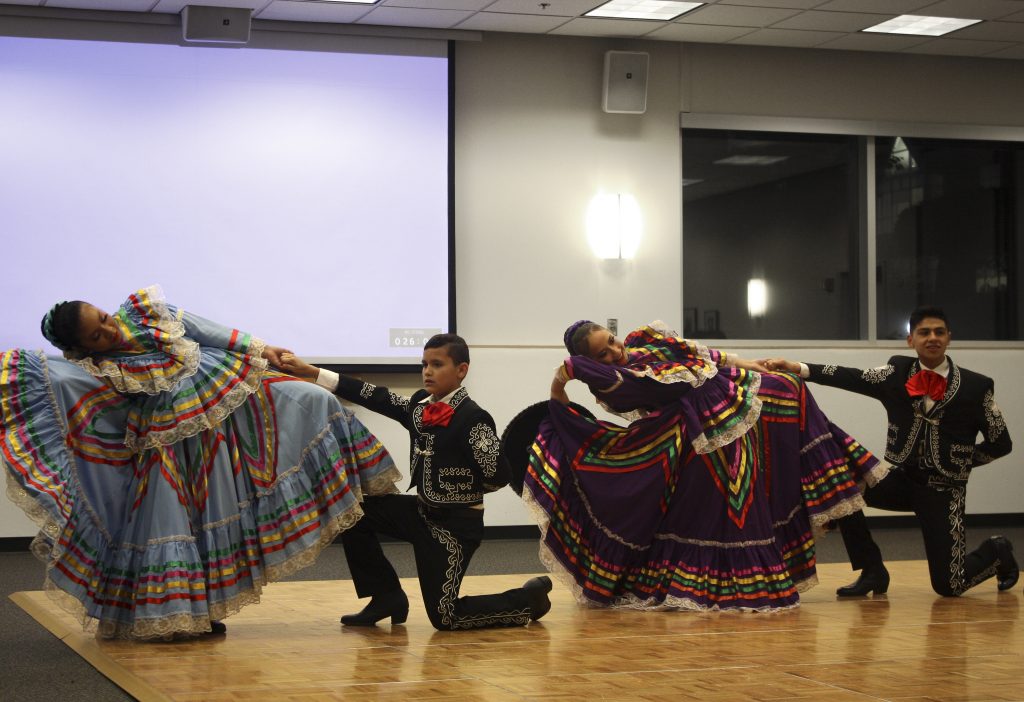
At Western’s Dia de los Muertos celebration, students were invited to participate in cultural festivities, such as consuming pan de muerto, watching traditional dances which featured performances by Ballet Folklorico Tlanese, and getting their faces painted in traditional calavera — or sugar skull — design. It was a bright and colorful approach to processing death and grief, and respecting the ancestors that came before. 


Contact the author at howlnews@wou.edu

Photos by Sage Kiernan-Sherrow

Take Back the Night shows support for student survivors and urges a continued conversation about sexual violence going forward

Sage Kiernan-Sherrow | News Editor

Taking place at the tail-end of Domestic Violence Awareness Month, Take Back the Night was hosted by Abby’s House on Oct. 26. Take Back the Night originated in the ‘70s after a cumulation of incidents, most predominantly, the nighttime murder of Susan Alexander Speeth. Today, Take Back the Night is usually organized as a march against sexual violence and violence against women. 

This year, Abby’s House invited Jackie Sandmeyer to speak at the event. Sandmeyer is the founder of TIX Education Specialists, an organization dedicated to working with universities, law enforcement, prosecutors and community-based service providers to identify and create some of the nation’s leading models in Title Nine and student victims’ services. 

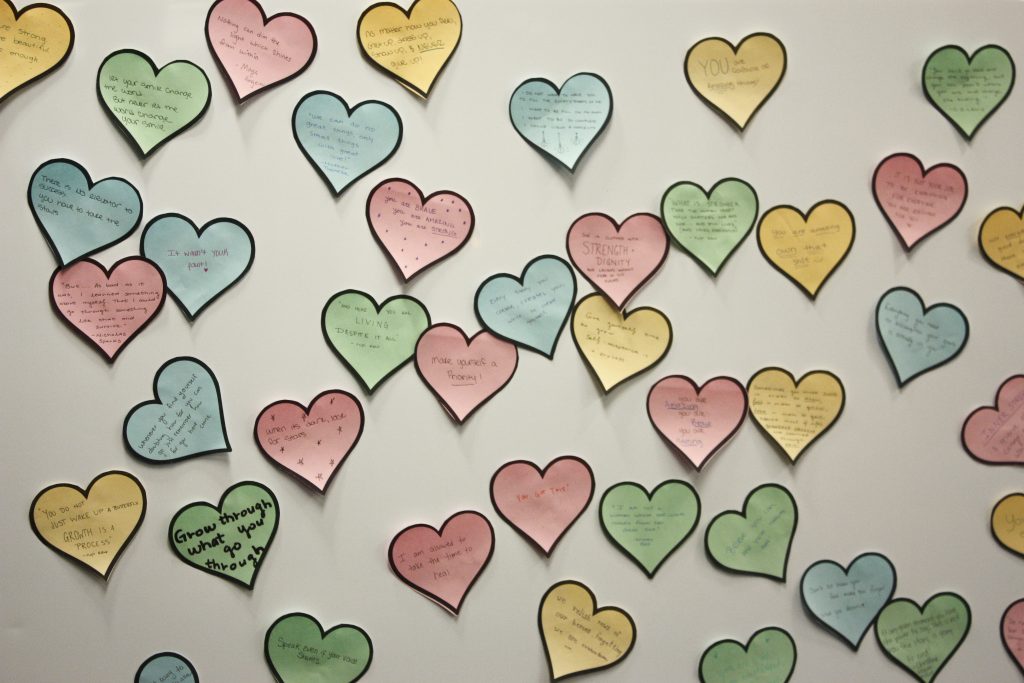
Western’s Take Back the Night began with time to reflect; a chime sounded off every nine seconds, representing the frequency someone is beaten in the United States. Students were encouraged to walk around and reflect on their own experiences, as well as observe comforting messages written on sticky notes throughout the room.

Afterwards, Sandmeyer began by asking students to participate during their presentation.

“I’m going to ask you today, not to sit here quietly … I find it interesting that we broach a topic that we feel uncomfortable talking about and then we hope that the bravest among us who have experienced the worst among us break that silence,” said Sandmeyer.

Throughout the presentation, Sandmeyer urged the audience to question themselves. Too often, Sandmeyer said, does dialogue end after the victim or survivor has told their story. Sandmeyer would rather everyone reflect on their own accountability as perpetrators, survivors, listeners and bystanders. Sandmeyer also acknowledged their own tendency for violence. After having spent much of their adolescence on the streets, they said that everyday they reflect on “if (they are) doing (their) part to, one, acknowledge that (they) are capable of that, and two, make a different choice.” 

When it comes to discussing violence, Sandmeyer admits that their advocacy makes strategic use of more palatable narratives — predominantly the stories of white women — to initiate change and get people to listen. Of course, that leaves many identities out of the conversation.

“If we acknowledge that violence is about power and control, what we know about people who experience violence comes down to we place different values on different people’s bodies,” said Sandmeyer. 

While it is a well-known statistic that one in five women are assaulted, those numbers steadily increase for minority populations, and don’t include the statistics for other genders. However, Sandmeyer believes that relying on these statistics to initiate conversation can be problematic because “we assign really dehumanizing rates to people who experience violence,” rather than focusing on their successes. They said that, “the more (they) tell college students (statistics), the less people get shocked … we’ve normalized this to a certain point.”

Equally normalized are the ‘accepted’’ and misleading narratives surrounding violence — such as the narrative that it is always committed by a stranger. Breaking free from those confining stereotypes requires talking about consent. 

“Are we having conversations with our partners, our friends, our families, our communities about sex, consent, pleasure, autonomy, agency and so on,” challenged Sandmeyer. 

Although much of the discussion was in regards to proactive dialogue, Sandmeyer finished their presentation by urging the audience to “hold space, compassion, and love for people who choose to remain silent … resilience is not linear and it does not always look the same way … not only is there a certain way that we expect victims to look, but there is a certain way that we expect them to heal.”

This was an affirmation before the speak-out portion of the event, in which the audience members were invited to tell their stories. Later, during the candlelit march on campus, students reflected on a question posed by Sandmeyer earlier that night: “we’ve heard their stories, now what will implementing change look like?”


Contact the author at howlnews@wou.edu

Photo by Sage Kiernan-Sherrow

UHaul partners with Western to provide additional transportation options featuring rental cars available to students

Sage Kiernan-Sherrow | News Editor

Western is a fairly isolated little campus. Students without a vehicle may find it hard to get from campus to another desired location. Cherriots — the bus system that runs through campus — has sparse hours of operation and doesn’t run on weekends; Wolfride — Western’s shuttle service — only operates from 5 p.m. – 12 a.m. within appropriate distances. Much of the student population, such as international and commuting students, depend on these sources of transportation for success.

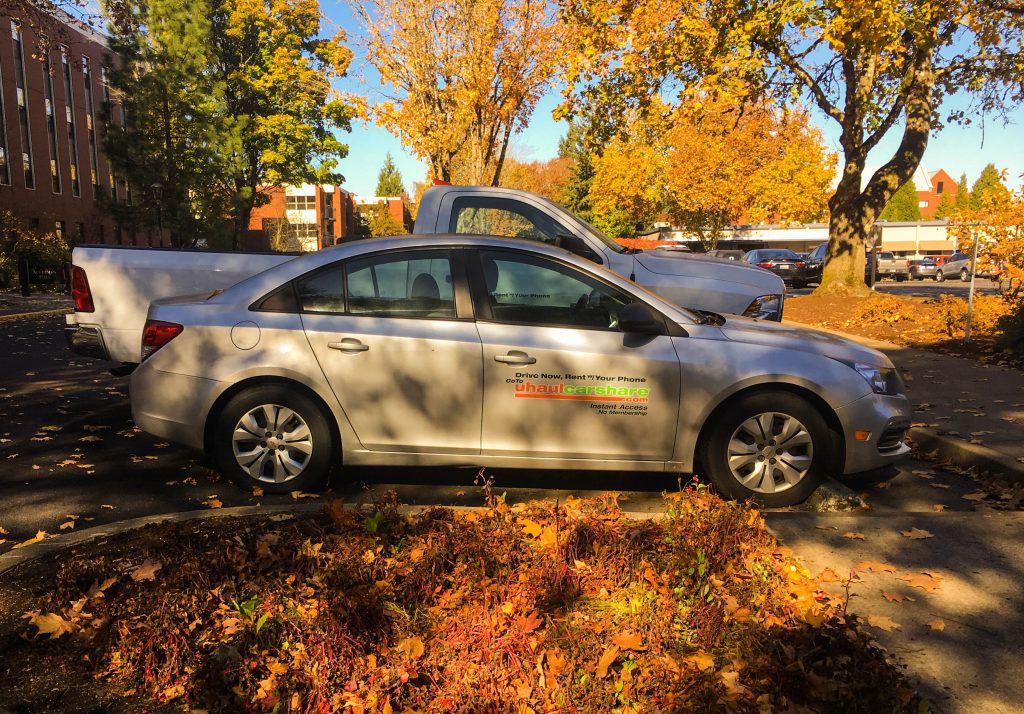
Luckily, Western has implemented a new means of transportation for the busy student — UHaul CarShare. It acts as a less complicated rental service; reservations are made on the website and the cars are parked behind the Werner University Center in Lot H for pickup. Students can reserve either a small sedan or a truck depending on their needs. Currently, the daily rental rates are set at $4.95 per hour with a .49 cent charge per mile. 

Emmanuel Marzias, assistant to the vice president for student affairs, commented that “we continue to have UHaul here because of that accessibility component … we don’t have the most convenient transportation options here … (and) it’s important that we have options for students.” 

Unlike Wolfride, UHaul CarShare is independent and does not depend on Incidental Fee Committee funding. Marzias said that the lack of transportation on campus is caused primarily by a lack of financial means from the IFC.

“Our enrollment is down, which makes it difficult … (because) it determines what types of services we can provide to students based on the financial side of things,” stated Marzias.

Marzias encouraged students to go petition to the IFC about their transportation needs, adding that he’s “thankful that students are prioritizing this.”

In the meantime, students can use the UHaul services or reserve the wolfride van for $40 — a lower rate than is charged by the Oregon State Motor Pool — as long as it doesn’t interfere with regular hours. And here’s the best part: “It’s (all) right here in our backyard,” stated Marzias.

For more information, visit https://wou.edu/student/services/ and uhaulcarshare.com.


Contact the author at howlnews@wou.edu

Photo by Sage Kiernan-Sherrow

Western is faced with a 4.5 million deficit after a 5% decrease in enrollment was reported for fall term

Sage Kiernan-Sherrow | News Editor

After an unpredicted low enrollment turnout, Western is having to financially restrategize in order to minimize the effect on students. Compared to fall of 2018, enrollment is down by 5%. The effects that has on the university is huge — more than 70% of Western’s revenue is based on student’s tuition and fees, while the state provides only 30%.

Currently, Western is facing a $4.5 million deficit despite their success last year in maintaining their objective to avoid tuition increases. 

According to Western’s Vice President of Finance and Administration, Ana Karaman, low enrollment is a nation-wide issue; fewer people are graduating from high school, but those who do find appeal in community colleges, especially here in Oregon where the Oregon Opportunity Grant benefits community college attendees. Karaman explained that Western is working on a plan with local community colleges which will make transferring credits easier and hopefully increase enrollment. 

Another cause of low enrollment is in regards to the international population which has dropped significantly due to the current political and social climate, regards Karaman.

“We would love to see enrollment grow,” stated Karaman, “but we want to take care of the students that we already have.”

That includes plans to become a Hispanic Serving Institution, to cater to the large population of Hispanic students on campus, as well as first generation, underrepresented and low-income students. The most important thing is “providing these students with opportunities,” Karaman said. 

While enrollment won’t affect tuition, it will have an effect on Western’s respective departments and organizations. The plan is to cut the supplies and services expenses for departments that aren’t directly benefiting students. Furthermore, positions in departments will heretofore remain unfilled in order to generate regular savings, which will then be returned to the university to help counter the deficit. 

However, the university is taking a holistic approach in deciding which programs deserve to be cut. The University Budget Advisory Committee is planning an office meeting with every department to “engage with people in conversations,” according to Karaman. The UBAC will present the board with different scenarios and the board will make a determination based on what will provide students with the greatest opportunities.

 “For students, our objectives remain the same — affordability and student success,” assured Karaman. 


Contact the author at howlnews@wou.edu

A fusion of art and technology

Sage Kiernan-SherrowNews Editor

On Oct. 18, the Natural Sciences building had its grand reopening, welcoming students and faculty alike to view the new premises after more than two years of remodelling the interior and exterior for student success. The renovations occured as part of Western’s Campus Master Plan and the project had a total budget of $6 million, according to a 2016 team logistics meeting report. The renovations to the 45-year-old building were funded by capital building funds from the state of Oregon. 

Students might have noticed the new pond outside of Western’s Natural Sciences Building, but that’s only the beginning of renovations that have been completed. 

“We’re installing new equipment in the classrooms: new document cameras, new sound systems, we’re installing laser-projectors now, which are fantastic…” said Equipment Systems Specialist, Nathan Sauer, in a WOUTV video titled “Natural Science Remodel.” 

Overall, the newly remodeled building now includes upgraded labs, study spaces, and the renovated greenhouse on the roof. This is just one of many ongoing changes shaping Western’s campus.  

Contact the author at howlnews@wou.edu

A wealth of resources at the Health and Wellness Fair

Sage Kiernan-Sherrow | News Editor

Walking into Western’s Health and Wellness center on Oct. 23, students were instantly greeted by a wall of positivity-related sticky notes, and invited to “take one, leave one” to encourage kindness and gratitude. This was the introduction to Western’s Health and Wellness Fair, where the basketball court in Western’s Health and Wellness Center was converted into a fair-esque setting, arranged with tables representing various local businesses and campus organizations dedicated to supporting student health and wellness. 

Students could walk from table to table to gain insight into different resources such as student support groups or local fitness-related programs. They were also able to take home free samples and score big prizes just for participating. Tables were giving out items like wolf-shaped stress balls, chapstick, supplements, coupons or free trials at various businesses and even essential oils.

Businesses like Dallas Health and Vitality Essentials were pioneering new technology, in this case, the BEMER, a chair designed to stimulates blood flow and oxygen supply. 

“We are no longer getting our essential nutrients from the food we eat, we have a severe lack of vital vitamins, and as a result our blood is not circulating like it should,” said owner of the business, Laurie Vail, “(but) everybody’s body is different.” 

Western students Chris Mizer and Daymon Stone were there representing the Monmouth Fitness Club. Both stated that they were “addicted to the gym.” Stone went as far as to say that he dedicates everything to his personal fitness and wants to open a gym in the future. Mizer said that his personal motto is “keep the first things first,” which translates to staying focused and not straying from your main goals.

Focusing more on the mental health aspect of overall wellness, Western’s Wellness Advocacy Group also attended the event, offering information related to their club, which meets Mondays from 4–5 p.m. in Todd Hall. According to Vice President Lea Sheldone and Social Media Coordinator Blanca De La Rosa, WAG orchestrates events like Paws for Positivity and the Out of Darkness walk for suicide prevention and awareness, which gathered over 140 people and raised almost $4,000 last year.  


Contact the author at howlnews@wou.edu

Stories from the children

Sage Kiernan-Sherrow | News Editor


Editor’s note: Content warning —


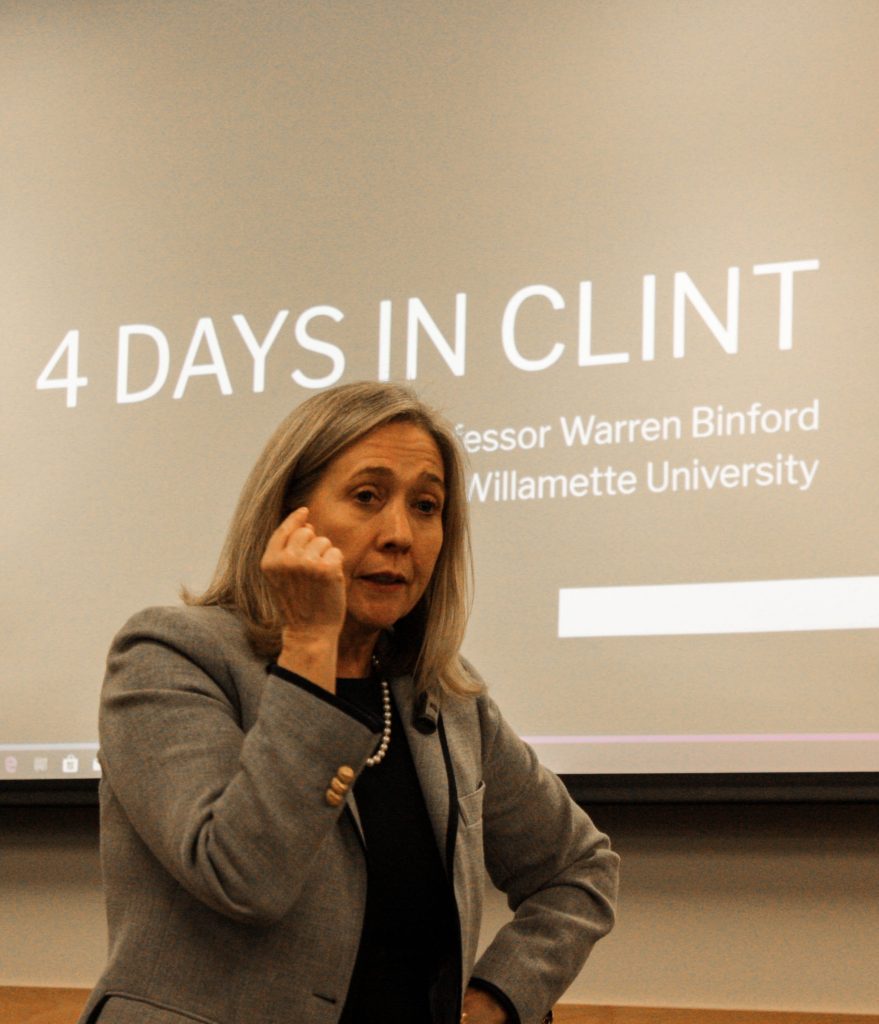
“The most painful thing you can do to a kid is separate them from the adult who cares for them,” said Willamette University Law Professor Warren Binford regarding the current United States Border crisis. Professor Binford was a member of a team who interviewed over 70 children currently being held at the U.S. border. She is a children’s law expert with a Masters with distinction in Education from Boston University and a Law degree from Harvard, and has been interviewed by various media outlets including CNN and PBS. 

On Wednesday, Oct. 23, Professor Binford was hosted by Western’s Model United Nations and the Salem United Nations Association to present a talk titled “4 Days in Clint,” which offered insight into the history of border control, included her accounts of the facilities detaining children separated from their loved ones, and proposed actions to increase awareness and support. 

Those in attendance were given postcards with direct quotes from children and mothers of children who are being detained at the border. Binford began by inviting the audience to read those quotes aloud. “We slept on a cement bench,” one quote read, pertaining to the conditions of the facility.

A room full of people sitting on padded seats listened while Binford said, “I wish that the quotes you read today were the exception, but the fact is that all along the southern border there are children who can testify to being treated the way that you just heard.” She then continued by explaining that the government has been involved in various child immigration issues since 1985, when the government would hold children as bait to try to get their parents who had illegally immigrated to reveal themselves by rescuing them. 

That prompted a 12-year fight for the children, which ended in the Flores Settlement Agreement of 1997 which granted children certain rights, primarily that children were to be provided with appropriate care and that they would be released first to their parents, then to another family member, another adult authorized by the family, and finally into foster care when there was no other alternative. 80% of the children in custody belonged to the first three categories at the time of the settlement passing.

However, Binford stated that it was “the Executive branch’s responsibility to implement those rights as regulations, but guess what happened? They never were promulgated, until just last summer.”

Binford also recounted the government’s verifiable entanglement in politics in the Northern Triangle, which represents the countries Honduras, El Salvedor and Guatemala, and how the U.S government’s conflict of interest in capital issues and ulterior motives to inhibit socialism from developing actually caused an influx in immigration. 

“We have been involved in Central American politics actively for 70 years and we know it,” said Binford. Families fleeing the gang violence caused by U.S. interference must travel over 1800 miles from the Northern Triangle to the border. During that journey, over 70% of girls report sexual assault, however this is a risk many are willing to take to escape the horrors of their homeland. Binford asserted, “generally, people don’t leave home unless they really have to.”

The U.S. government saw this influx in immigration and decided to come up with a plan that would deter families from crossing the border, which is why family separation has escalated into a crisis in 2019, Binford explained. However, “Research shows that if you want to deter migration, you don’t come down with strict migration policies, because that can actually increase migration … because people think … ‘this might be our last chance.’”

In 2017, when the government was first piloting family separation, Binford was a part of a team sent to inspect various border control facilities and assess their quality of care, and what she found was appalling. Despite the fact that border control standards maintain that they are only allowed to hold children for up to 72 hours, and the 20 days standard set by the Flores agreement, children were being held for months on end and separated from their families even in cases where the facility had the capacity to keep them together. In order to separate the family, mothers were told that they were “doing this to protect the child from trauma” regarding seeing the mother go through the court process. 

“Another mother talked about the fact that they told her they were taking her child away to give him a shower. I want you to think about that. I want you to think about the history of telling parents that they are giving their children showers, and the fact that U.S. government officials would say that,” said Binford. 

The children are being kept in abandoned military bases, or places like “The Walmart,” a previous Walmart superstore maintained by a non-profit called Southwest Key Programs and operated by a man called “Father Juan.” Father Juan, Binford stated, is an attorney from Harvard who is participating in the active displacement of children’s faith, culture, and language through acts such as separating indigenous children from each other, and having fundamentalist Christians teach the faith to a group of majority Catholic kids. 

Binford said, “we realized there is a type of cultural genocide going on in these facilities.” One wall of “The Walmart” is covered by “Juan-dollar bills,” which act as employee rewards for following “Father Juan’s” orders, and there is a mural dedicated to Donald Trump under which reads “sometimes, you have to lose the battle to win the war.”

Clint, on the other hand, is a tiny facility approved for 100 adults but currently holding 351 kids representing a range of ages. While Binford and her team were not able to inspect the facility itself, they were able to speak to the kids. 

“Many of them were sick, there was a lice outbreak, they were not being fed, they were not being given showers, they didn’t have soap, and most importantly, there was nobody taking care of them,” Binford said. The guards would make the older kids take care of the younger ones, but with no prior experience in doing so, they were disadvantaged. What’s equally as problematic, Binford said, is that this is being paid for by taxpayers dollars. 

“If you don’t want to believe that what we are doing is wrong ethically, then at least acknowledge that it’s a stupid thing to do financially.”

To conclude her presentation, Binford encouraged the public to take action through education, donation, engaging in conversation with legislatures, taking part in short-term fostering situations and most importantly, keeping the focus on telling the kid’s’ stories through art and through sites like amplifythechildren.org. 

“We don’t want them to whitewash the history and the brutality that these kids are experiencing,” Binford urged. 

At the very end of the talk, songwriter Kirsten Granger and guitarist Dan Wenzel of the band “True North” were invited to perform a song written on behalf of the children, in which the final verse conveyed, “abuelos hate to see us suffer, they’re out searching for our mothers, and they’ll bring our mothers soon.”


Contact the author at howlnews@wou.edu

Photos by Sage Kiernan-Sherrow

Made by students and for students, the ASWOU Book Exchange recognizes the perils of textbook costs and decided to do something about it

Sage Kiernan-Sherrow | News Editor

There is a general consensus among college students and that consensus is this: textbooks are extremely expensive. Luckily, Western’s student government, ASWOU, developed the ASWOU book exchange. Operating all year under the ‘My Programs’ tab in the student portal, it exists as a way to buy and sell textbooks for comparatively less than through the bookstore. 

According to an email sent out on Oct. 8, by ASWOU’s director of internal affairs, Danielle Campbell, “Selling a book is easy, fill out the info online and we will hold your book for up to 365 days. After that, you can come pick it up, or leave it to become ASWOU property. Once you choose to purchase or sell a book, you have 24 hours to either drop off your book or pay and pick up at the ASWOU office in WUC 122.” 

In a personal interview, Cambell suggested that searching by ISBN would be the most efficient way to find the right books through the portal.

The cupboards in front of ASWOU are filled with over 500 books. 

“Some are really outdated,” Campbell admitted, “there’s no way of really knowing what’s going to be used this year or next year because professors are always changing their materials, so we don’t want to get rid of any of them.” Campbell also stated, “the system that we have online was created only a few years ago for a senior project for the computer science program and it’s made by students, so it’s a very basic system.” She also hinted at a desire for the system to become more advanced in the next few years.

 Nevertheless, ASWOU book exchange exists as “a way for students to set their own price of what they think is fair,” and a way for “students … (to) help other students,” says Campbell.

For more information, contact ASWOU’s Director of Internal Affairs at aswou@.wou.edu.


Contact the author at howlnews@wou.edu

The history of homecoming on Western’s campus from 1939 to 2019

Caity Healy | Managing Editor

Homecoming — it’s common to see U.S. schools celebrating it, but the history behind the festivities isn’t usually made explicitly clear. As it turns out, the etymology of the term is about as literal as it gets. 

According to Vice, homecoming “got its start on college campuses as a fall celebration of the first football game of the season, for which alumni would return to their alma maters.” While the first homecoming allegedly happened in 1911 at the University of Missouri, the tradition as we know it now didn’t hit Monmouth until nearly two decades later.

“The first recorded Homecoming was in 1939,” said the 1968 edition of The Grove, Western’s 1940–1941 yearbook. With that said, this is likely talking about the festivities we celebrate now. The first mention of a Homecoming football game came in the 1930 edition of The Norm, the 1911-1939 yearbook, which means homecoming began in 1929. On top of this, according to the 1979 edition of The Grove, “the tradition at Oregon College of Education dates back as far as the 1890s,” and also added that “after World War I Homecoming was changed from spring to fall, with an added emphasis on football.” 

In the likely inaugural 1929 Homecoming game, Oregon Normal School — the name of Western at the time — went head-to-head against Southern Oregon Normal School, and it ended in a score of 0-0. However, in our next Homecoming game against Eastern Oregon Normal School, ONS capped an undefeated season, 50-0 under the leadership of Coach Wolfe — the inspiration behind Western’s mascot. Since then, several traditions aside from the football game have graced Western’s campus; some stuck around for years, while others phased out. 

The year was 1951. For the first time, the idea of a “Homecoming Court” hit campus. Since then, it’s been an integral part of the festivities — the announcement of the court was even televised in 1966. How the royalty was presented, though, has changed over time. For several years, the court, wearing their full homecoming gear, was driven onto the field in convertibles. In 1987, when the theme was “The Great Pumpkin Homecoming,” the royalty was driven onto the field in orange Volkswagen bugs to look like pumpkins. On top of this, the royalty used to be assigned by halls — there would be a “Butler Princess,” a “Landers Princess,” and so on.

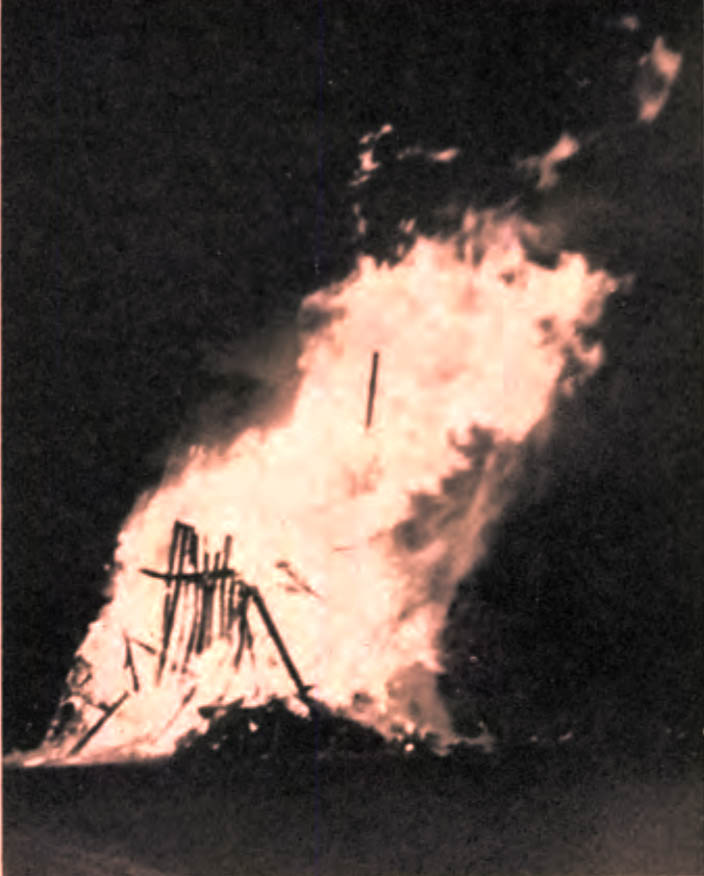
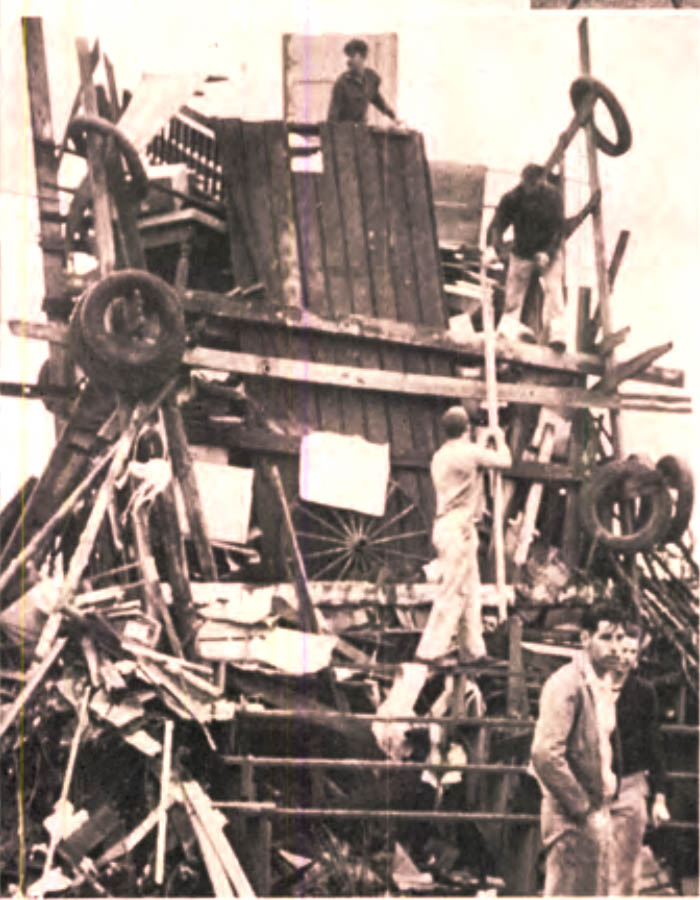
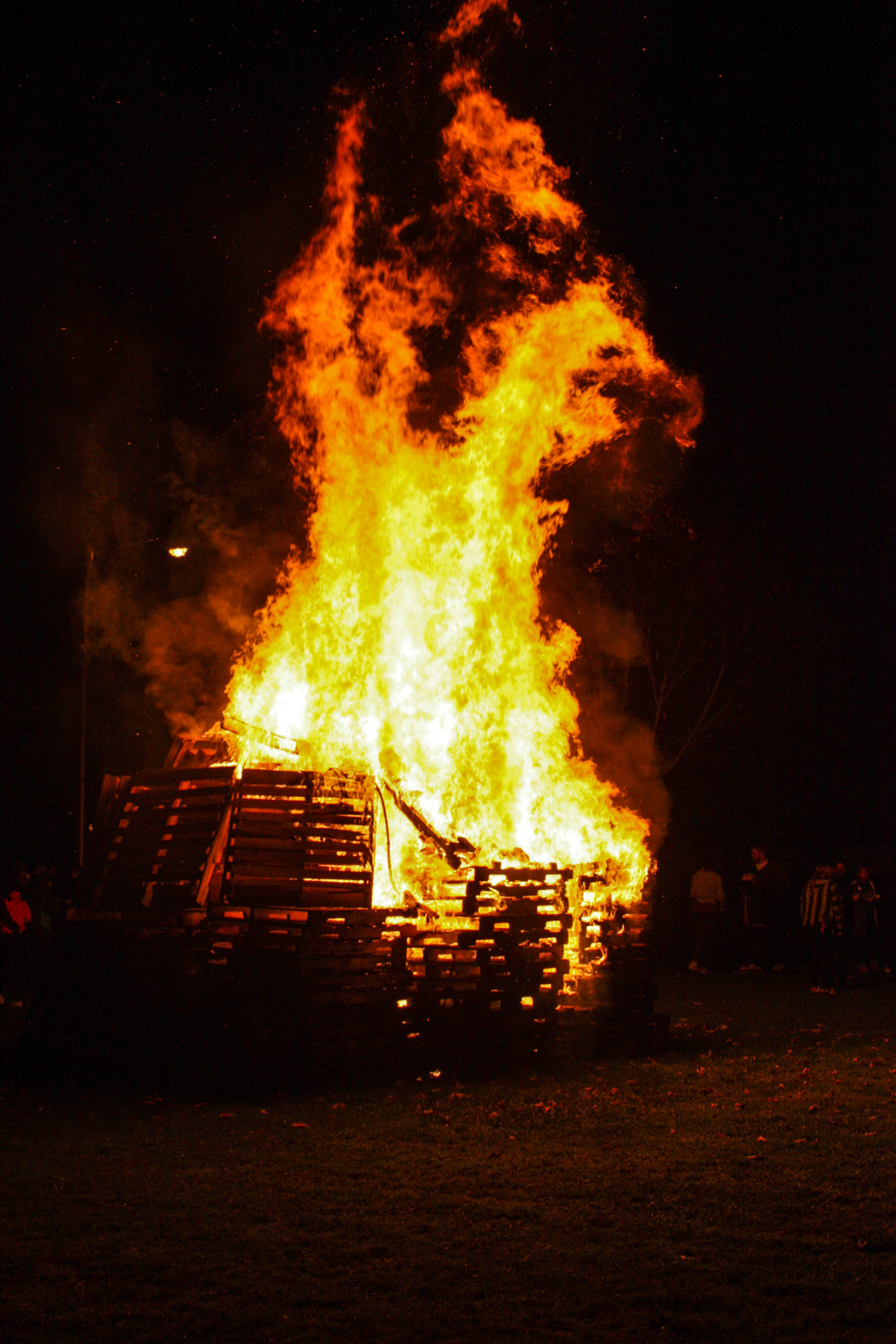
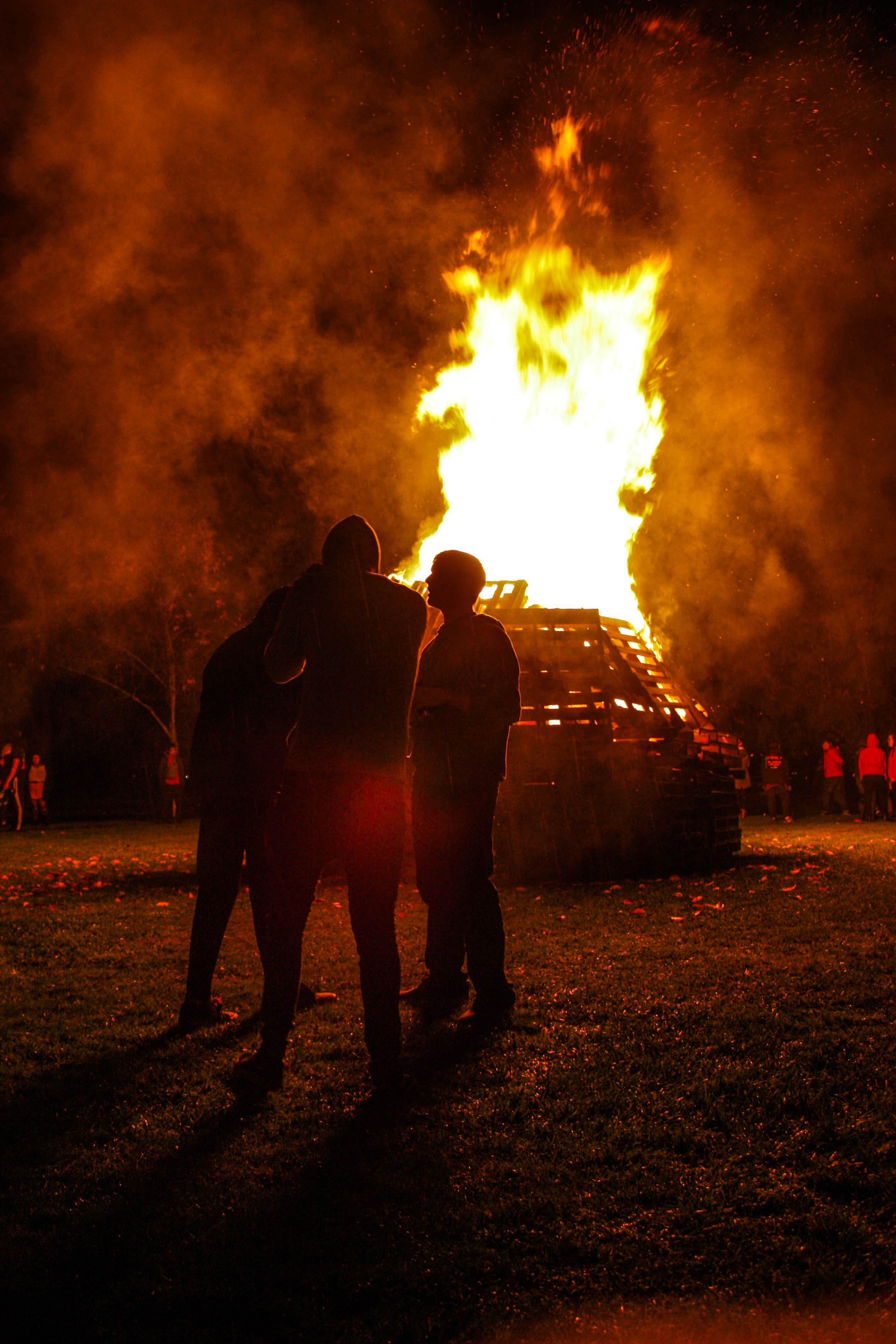
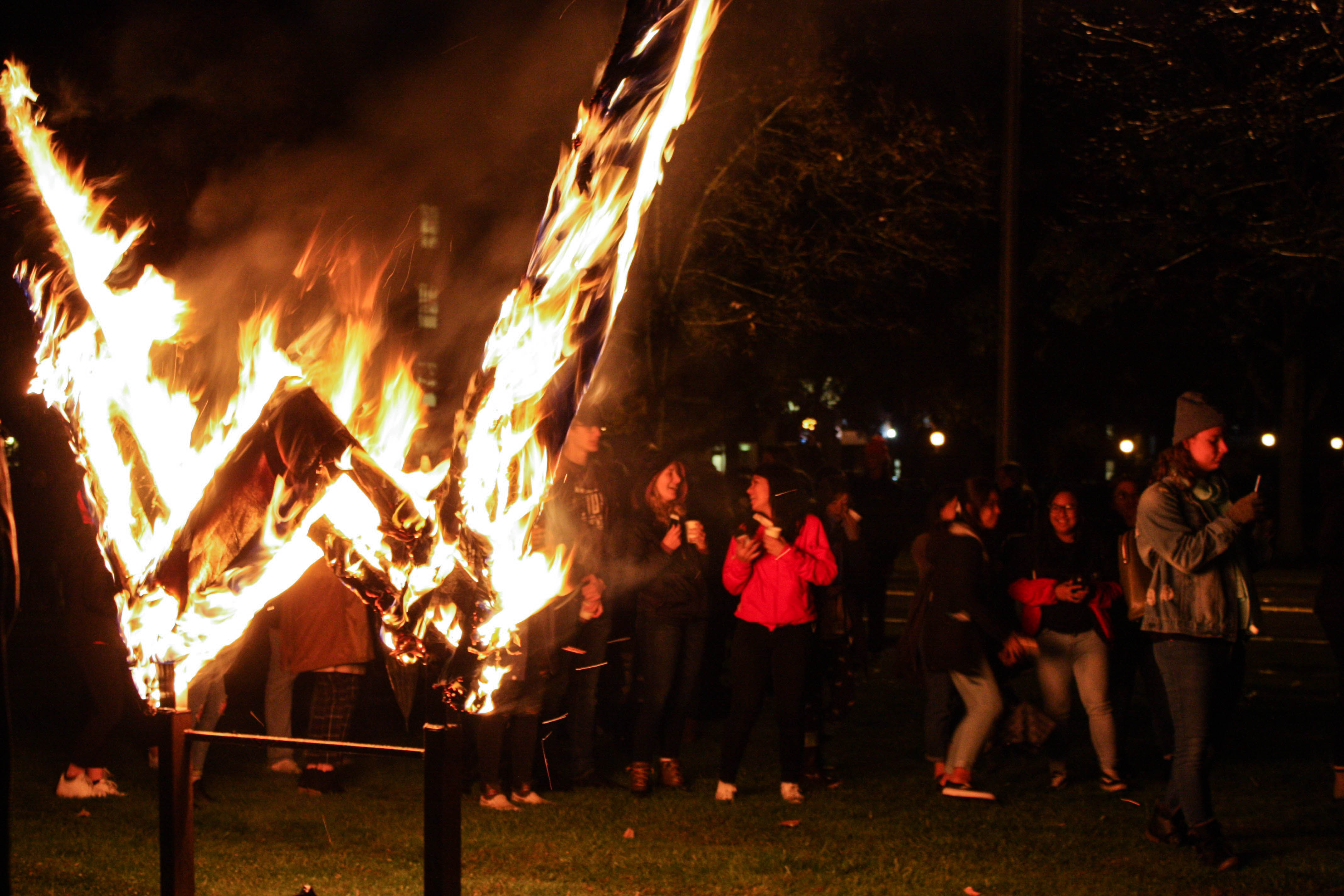
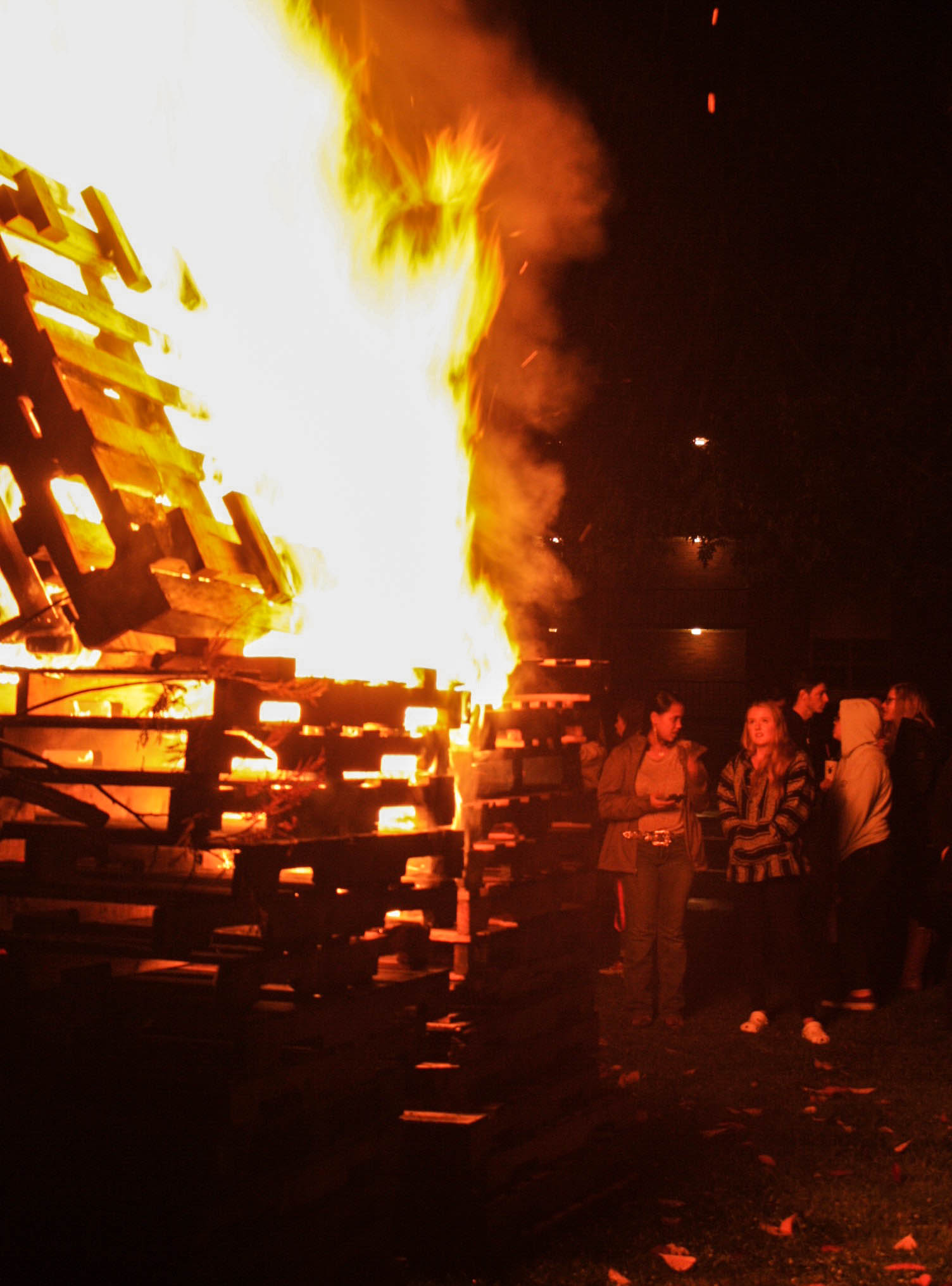
It’s been a theme in recent years to burn the “W” following the Power Puff game. However, this tradition is one that ages back to early days of Western. Although we burn the “W” now and usually a bonfire as well, back then, the goal was just to build a bonfire as big as they could. Competitions were held between different halls to see who could collect the most wood to keep the fire burning.

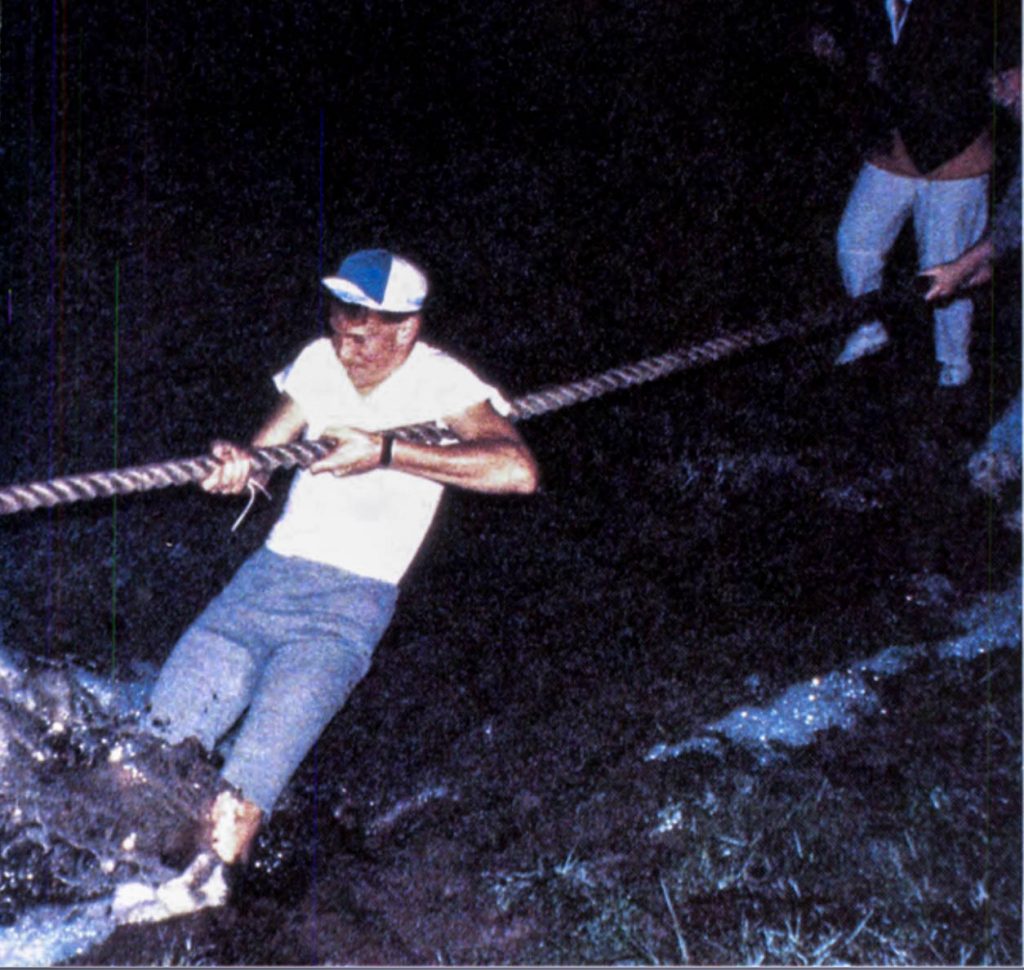
For years, students would also have tug-of-war competitions in the mud as part of the festivities of the bonfire. 

On top of these traditions, it’s clear to see how some have evolved. For years, each hall would participate in a “lawn display competition” to match the theme of the year — perhaps that’s how we have arrived at the current office decorating competition that occurs now. The rose planting that the Homecoming queen takes part in was a tradition started by Jessica Todd in the early days of Oregon Normal School. And the homecoming dance has always been around — though, in the ‘60s it was deemed the “All-American Ball,” and students also attended a “Grubby Dance” where they were asked to look filthy. 

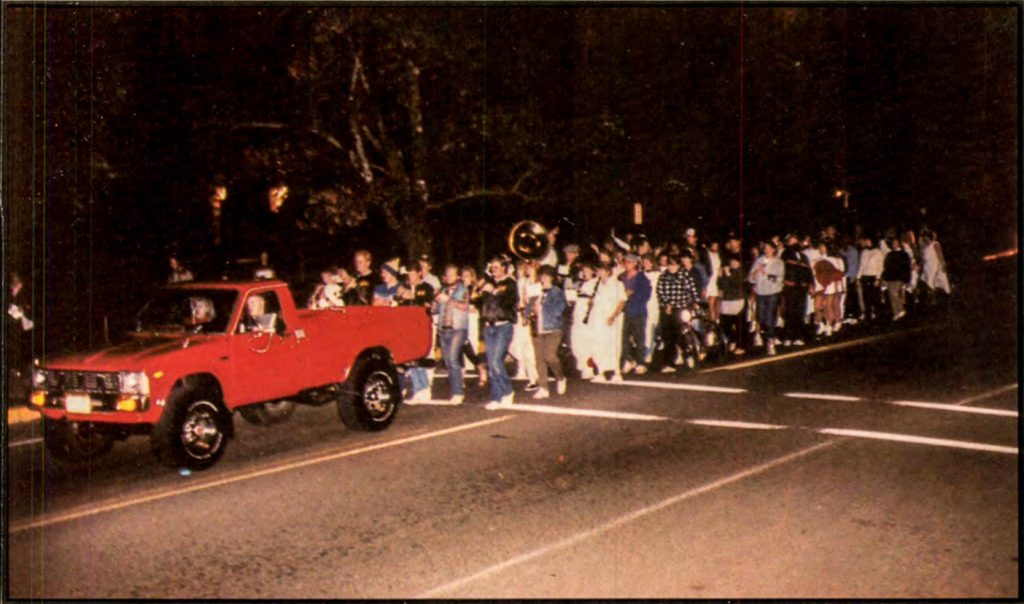
Some traditions didn’t make it to 2019. For years, the school put on a homecoming concert, often with a talent show preceding it. They’d bring speakers to campus — in 1986 the speaker was Adam West, the original “Batman.” For several decades, a much-loved tradition existed: the noise parade. Students would decorate their cars and ride all through Monmouth, making as much noise as possible until they reached the bonfire, and in later years, until they reached either the powderpuff game or the football game. Then, before the games began, fireworks would go off in Western’s colors to signal the start. 

Homecoming has been around this campus for longer than a good number of the buildings. 

While some traditions didn’t last too long or simply disappeared, some became an essential part of the week’s celebration. And each year, new history is made as new traditions are created and revered.


Contact the author at chealy16@wou.edu

Photos courtesy of WOU Archives


Western’s annual homecoming was full of “wild” delights with a Western-themed twist

Sage Kiernan-Sherrow | News Editor

Homecoming is an important week-long community-building event at the heart of Western’s traditions. This year, the homecoming theme was “Wild, Wild Western.” Western began their “wild” festivities with the 3rd annual Homecoming Kickoff Carnival and Paint the Wolf event on Monday, Oct. 14, and ended with the Western football game against Central Washington, where homecoming royalty was crowned during halftime. Although Western eventually lost during overtime, students had many opportunities during the week prior to participate in and enjoy the homecoming festivities. Here are some highlights:

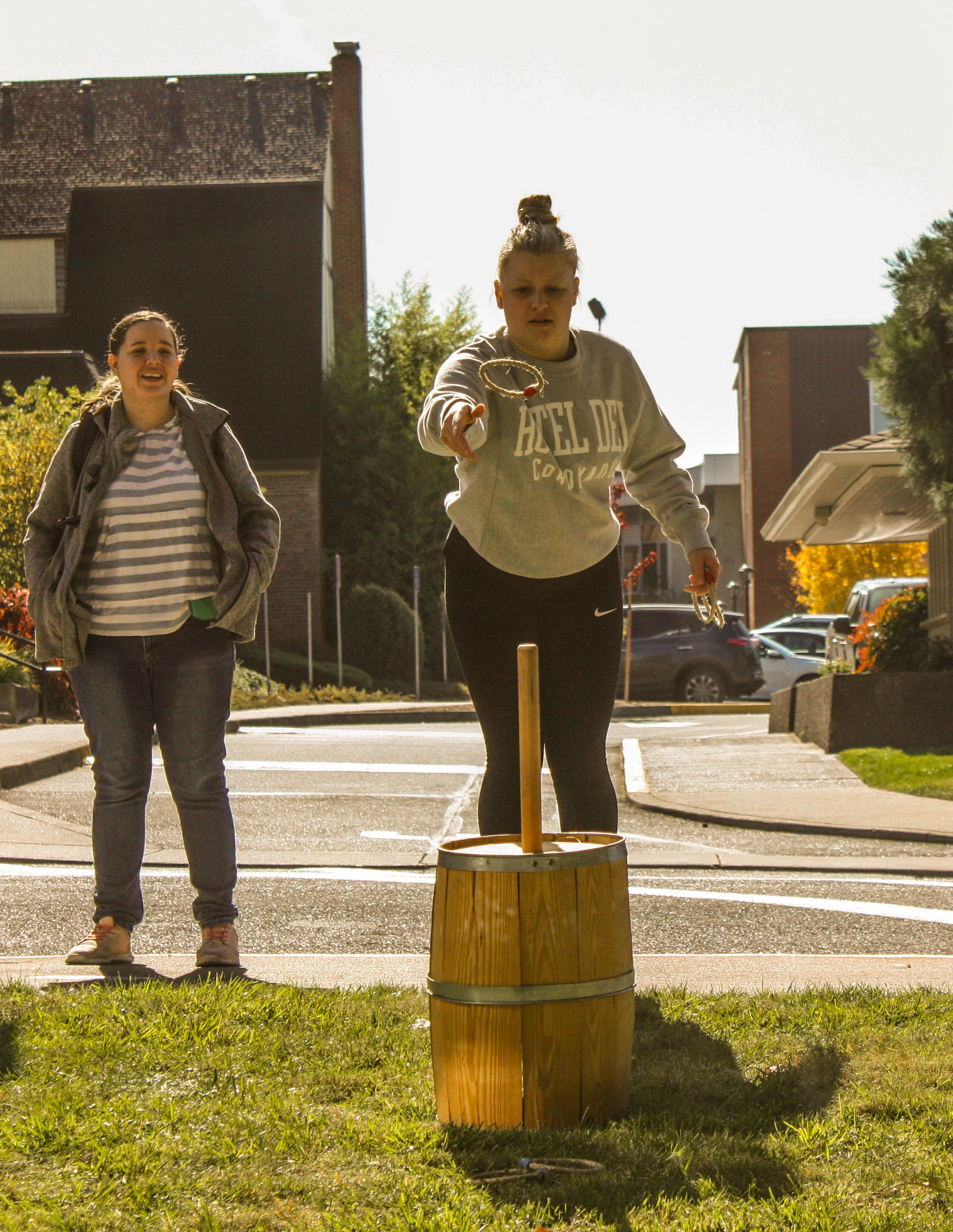
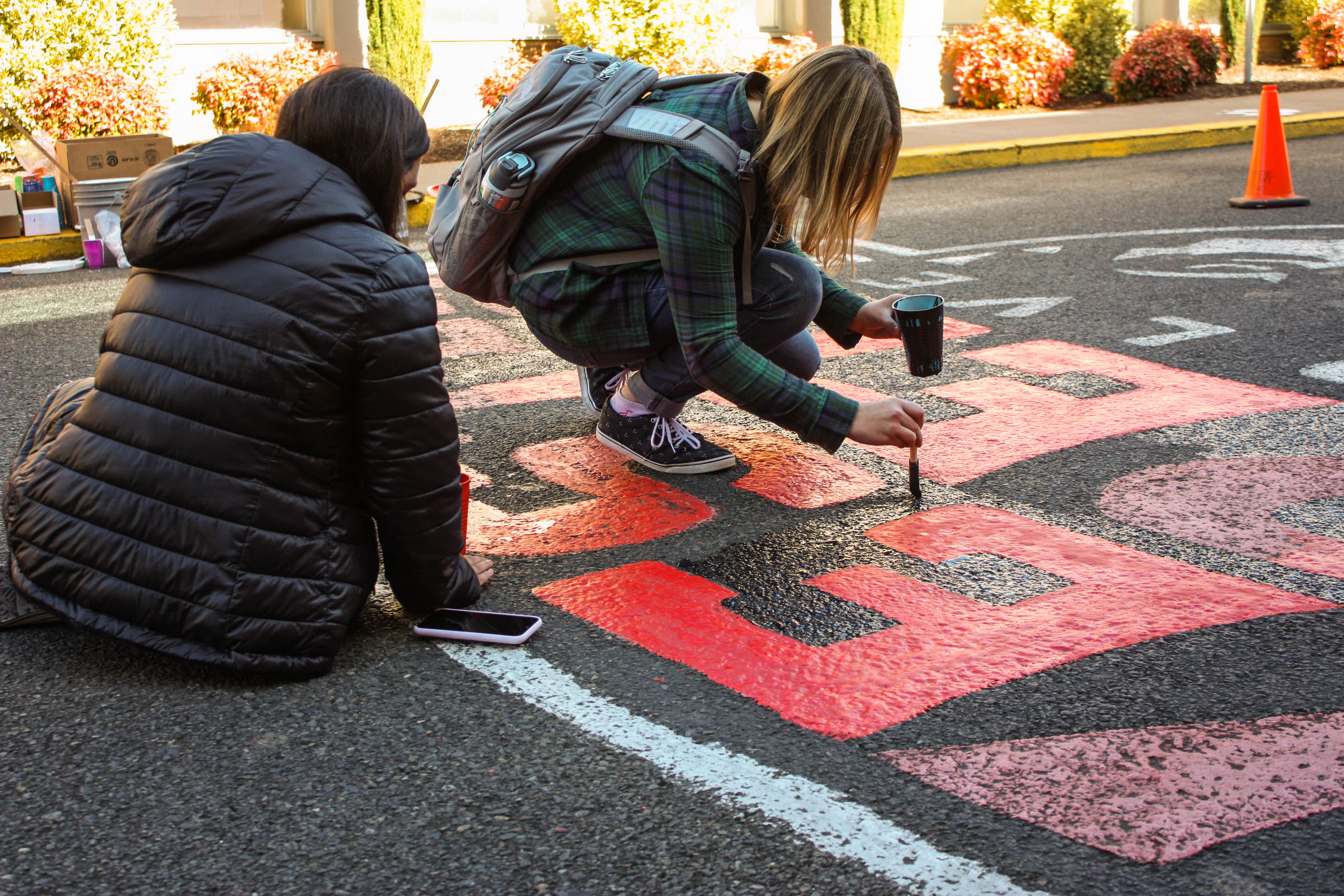
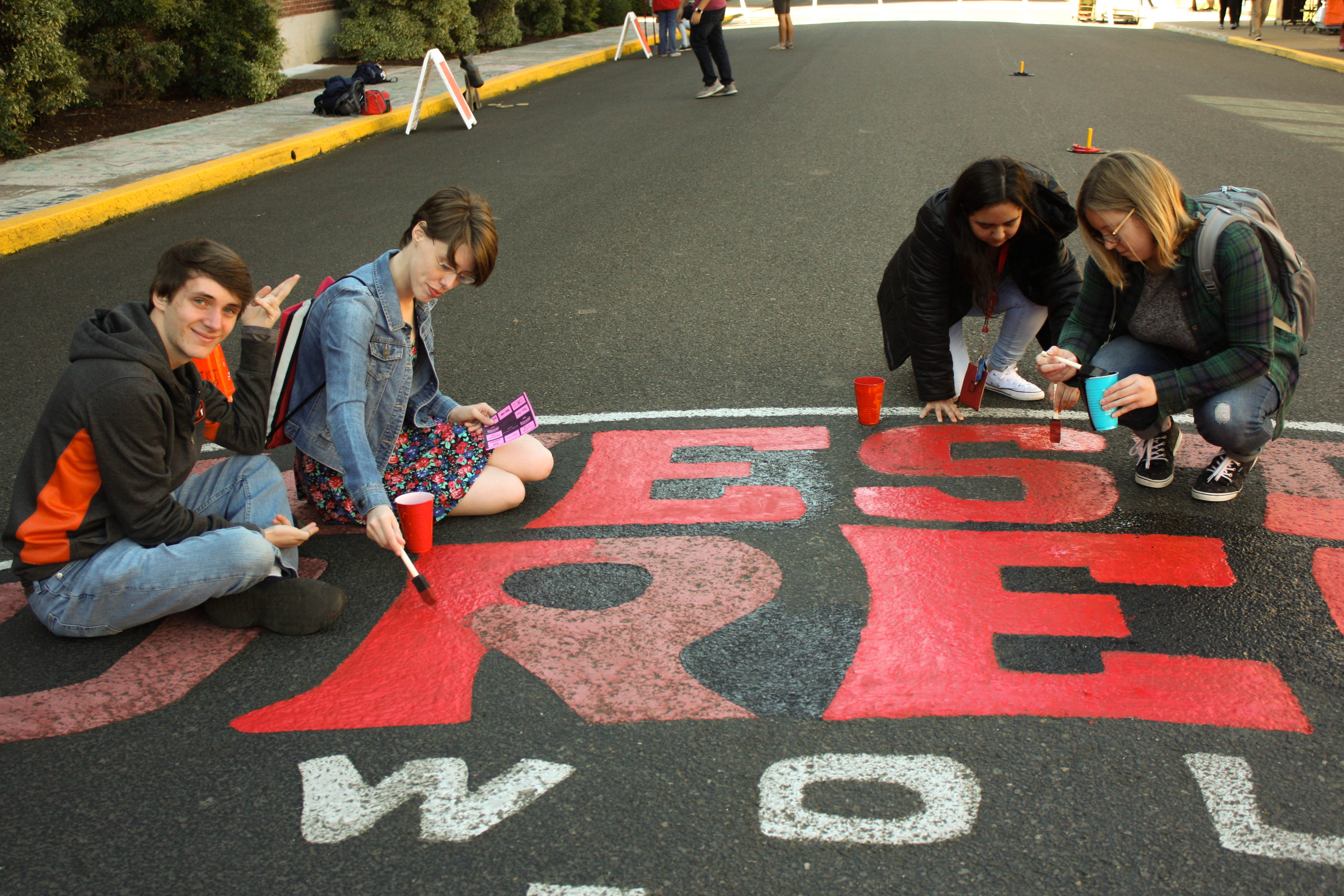
3rd Annual Homecoming Kickoff Carnival & Paint the Wolf celebration: Even though the air was a chilly 44 degrees on Monday Oct. 14, the sunshine filtering through the clouds brought groups of students to participate in the start of homecomings’s activities. The homecoming theme was blatant in the fair-like games — ring-toss and the high-striker — which drew students in. The free cotton candy put a smile on student’s faces and a few students were even brave enough to ride the bull (a mechanical one, of course).  Finally, the annual tradition of repainting the Western logo on Court street was a crowd favorite. 


Paint the Town Red: On Tuesday, Oct. 15, participating businesses in Monmouth allowed students to decorate their windows with window paint fitting the “Wild, Wild Western” theme. Using mostly shades representative of the school’s colors, students grouped together to collaborate on their masterpieces, which included several Wolfie caricatures dressed in their Western-style best (literally). Yee-haw! PLUS team was announced as the winner of the contest on Tuesday, Oct. 22. 


Office Decorating Competition Judging: The office decorating competition was a hit among students and faculty alike and took place on Wednesday, Oct. 16, ending with three offices winning for different categories. According to an email from Student Engagement’s Coordinator of Organizations and Activities, Kelly Welch, Student Engagement won the “best overall” prize, but it was given to the 1st runner-up, the Accounting and Business Office, to avoid bias. The other two prizes were “best incorporation of Homecoming theme,” which went to the Criminal Justice Sciences office and the “best display of WOU spirit,” which went to the Heritage Hall front desk. 


Hoedown: Keeping up with the theme, on Thursday, Oct. 17, Western held the “Hoedown” dance in the Pacific Room of the Werner University Center. Students donned primarily plaid flannels, bandanas and their best tattered jeans while they learned line-dancing choreography and enjoyed free popcorn. 


Bonfire Prep Rally: A personal favorite of many, the burning of the “W” took place on Friday, Oct. 18 during the Bonfire Prep Rally. Students gathered around to be awe-inspired by the flames and enjoy a sense of camaraderie while they discussed the upcoming football game hype. For more information on the Homecoming games’s results, check the sports section.

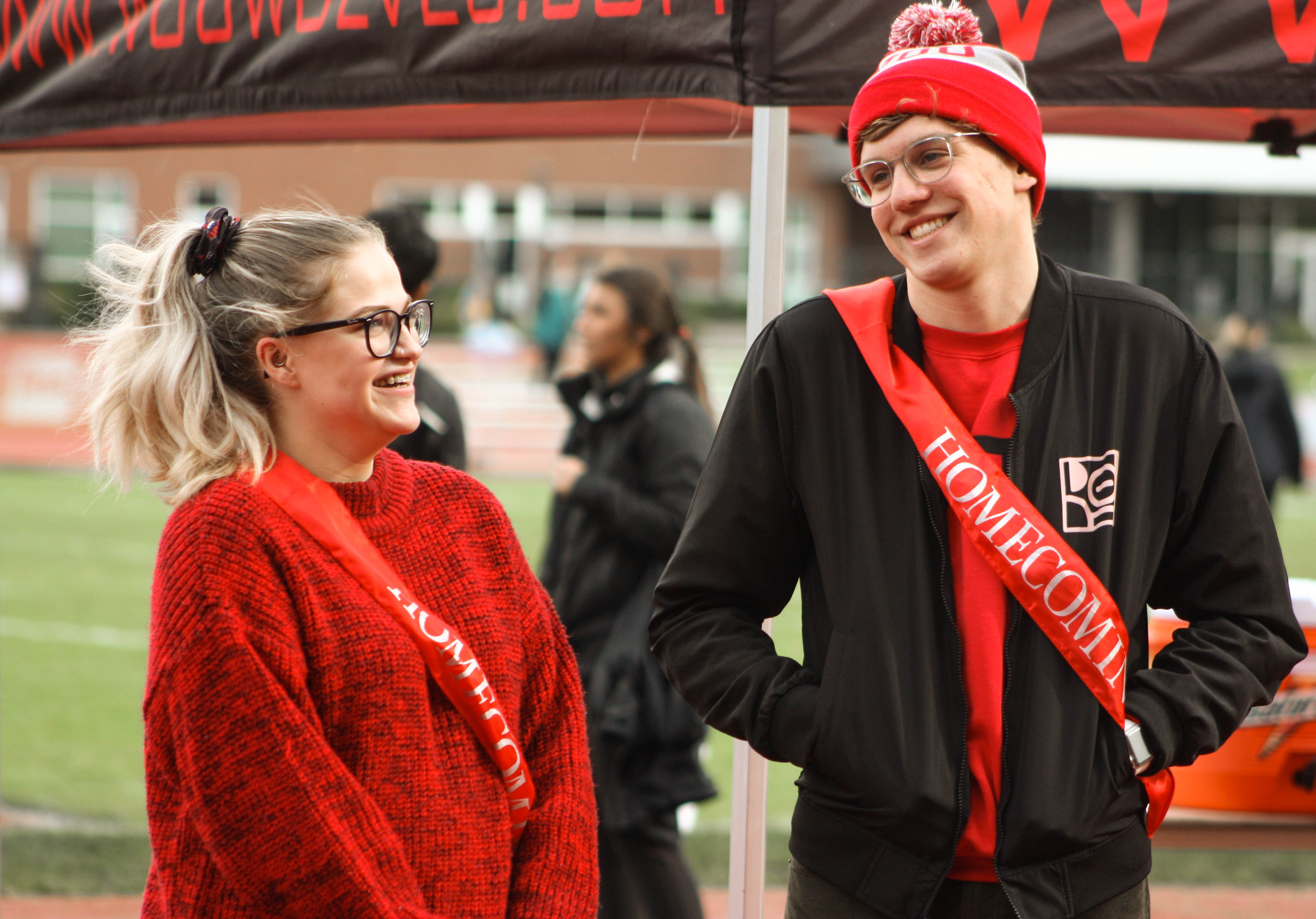
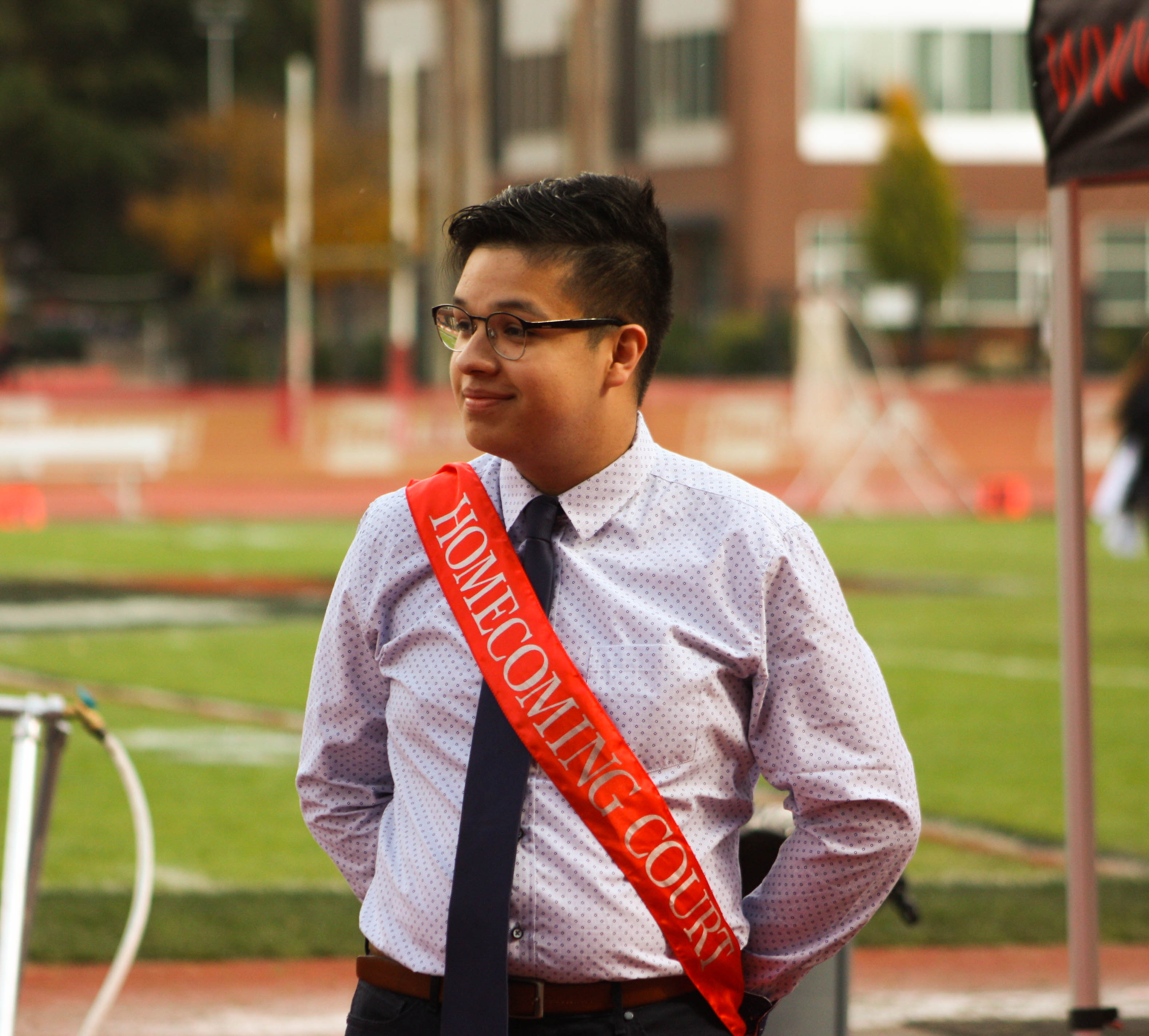
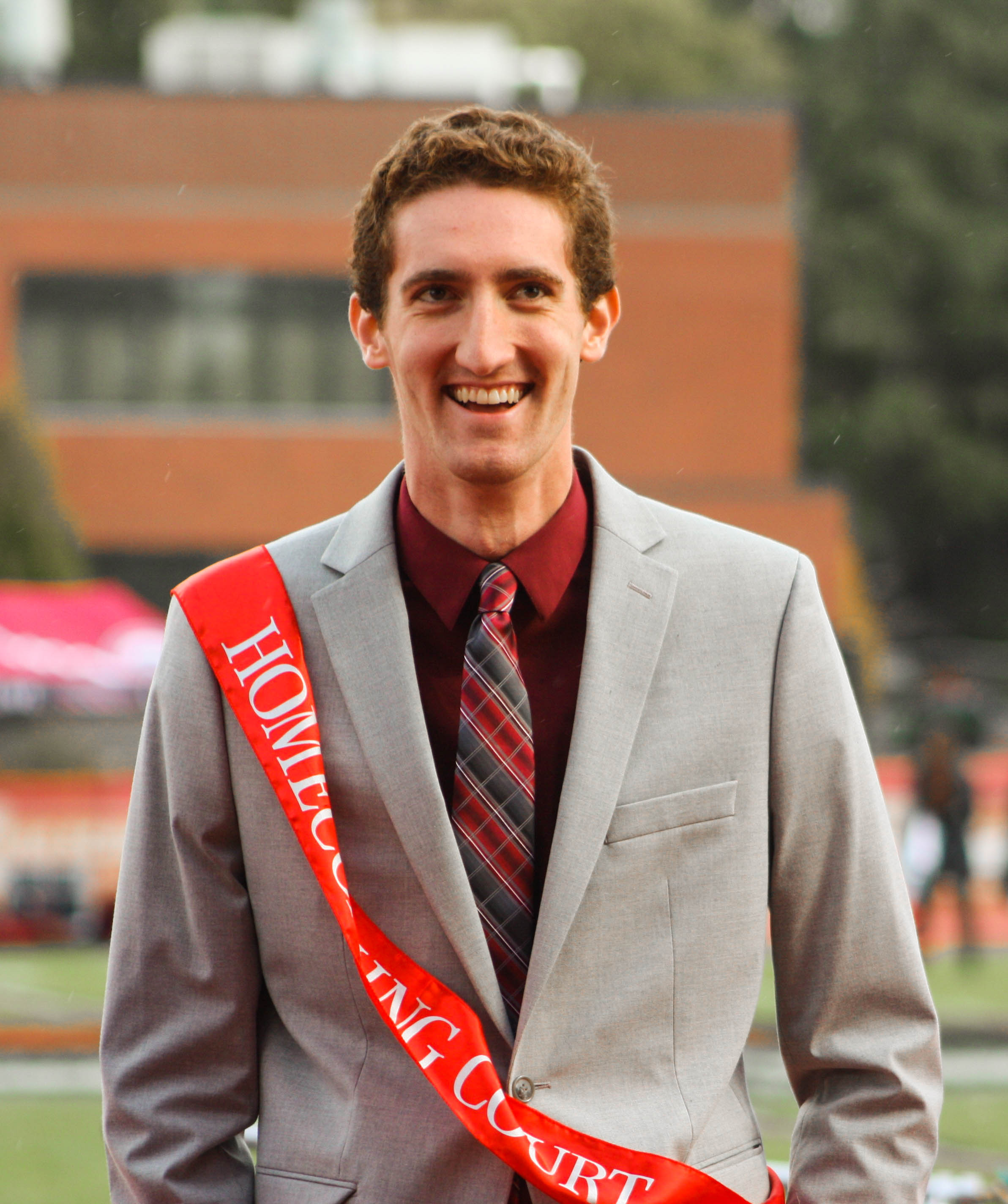
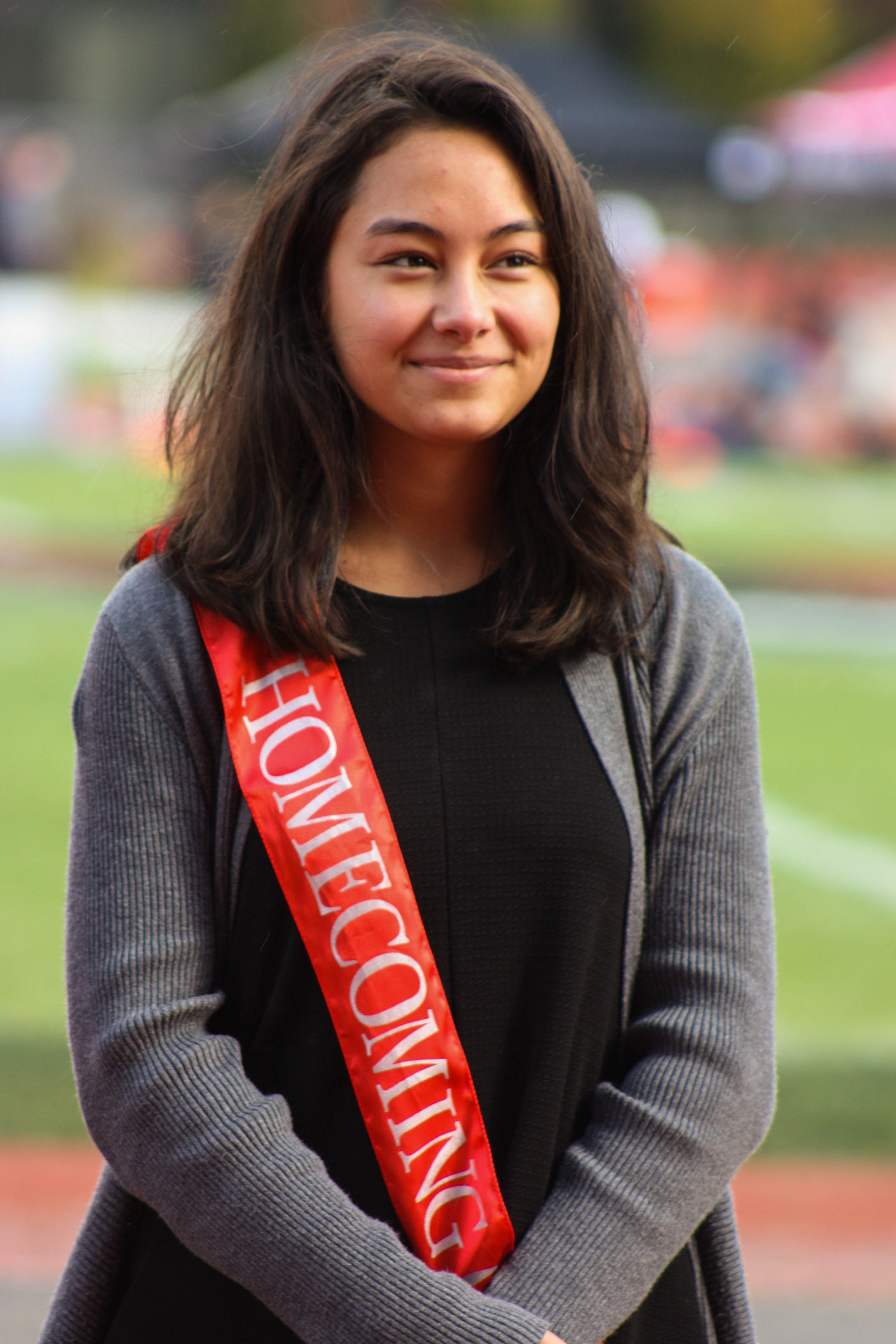
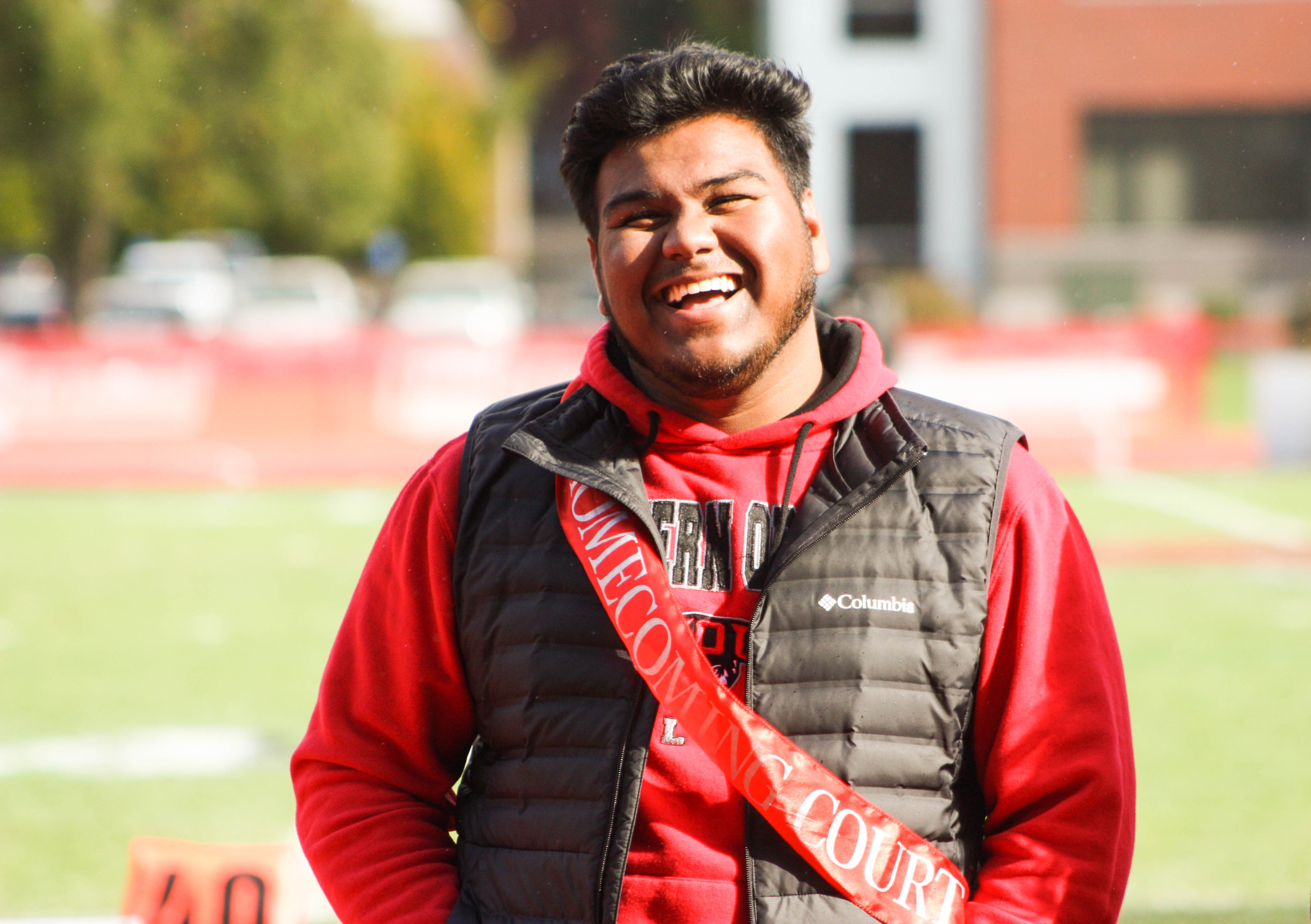
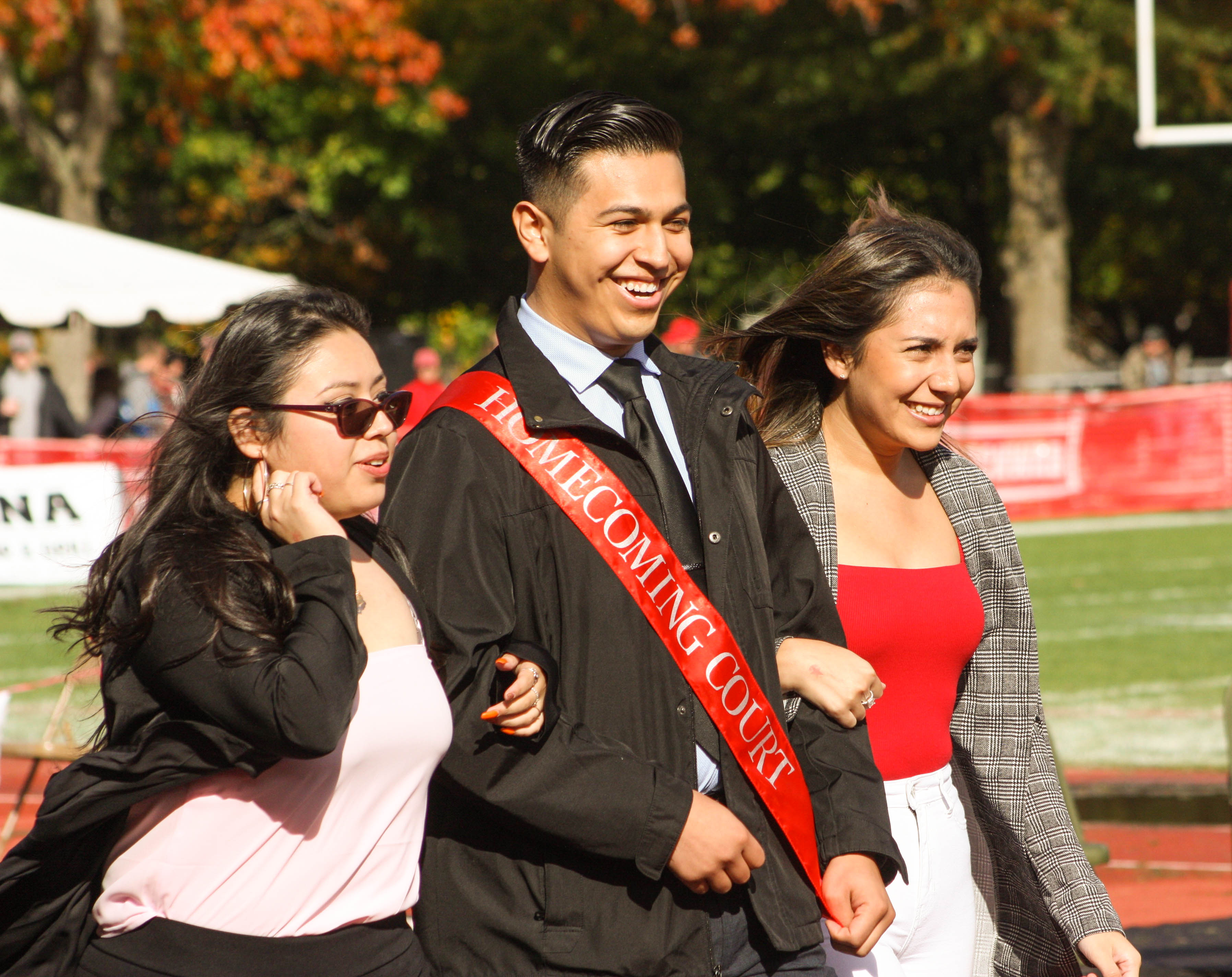
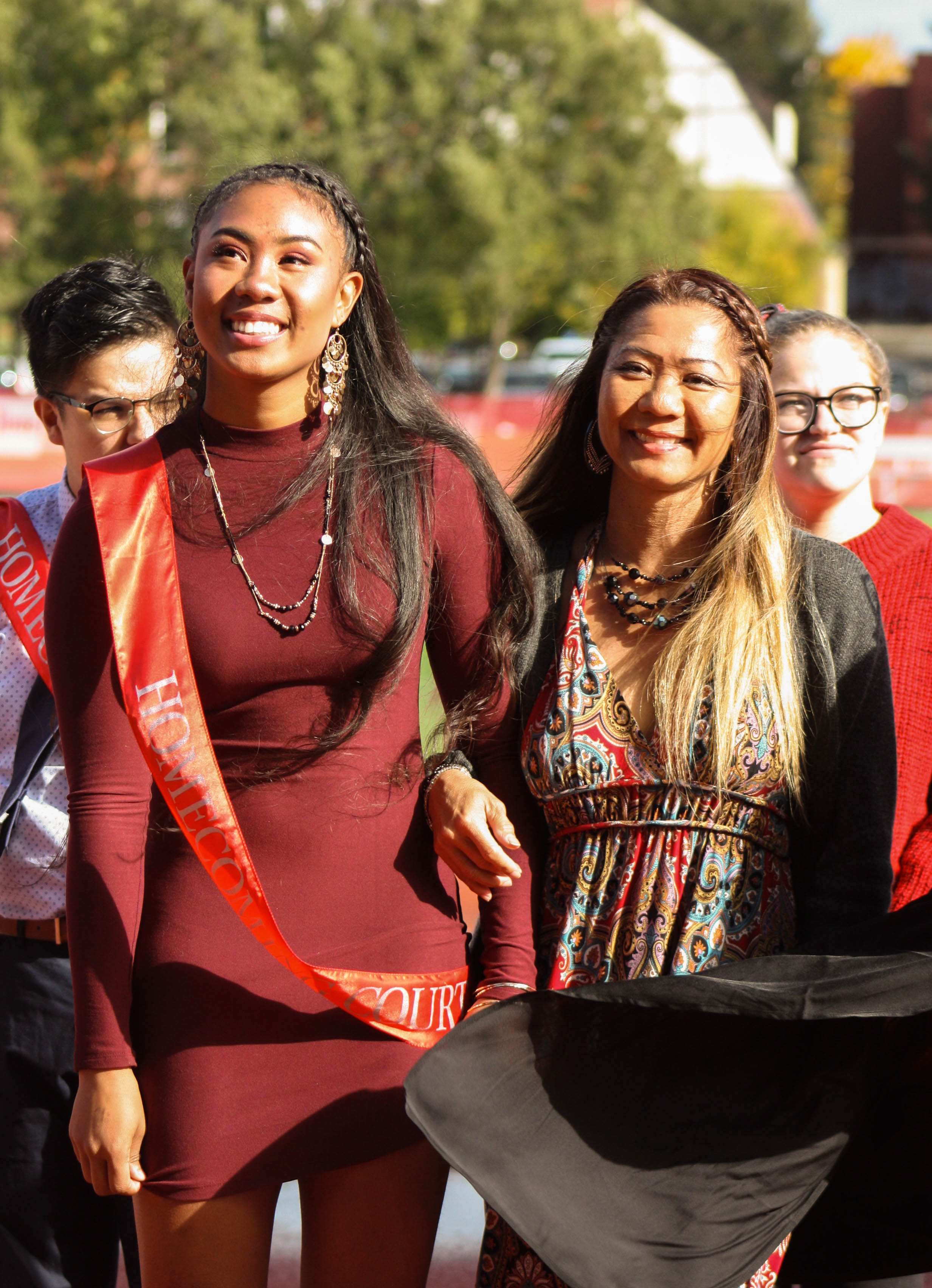
Wolf Royalty Announcement: According to Western’s Homecoming page, “Homecoming Court and Wolf Royalty are traditions at Western Oregon University that recognize and honor outstanding student leaders who exemplify our values.” This year, there were five nominees for senior Homecoming court and out of those five, two were officially announced and crowned as Wolf Royalty during the Homecoming game’s halftime — students D-Dre Wright and Monica Cerda-Ortiz.

Contact the author at howlnews@wou.edu

Photos by Caity Healy

Many of the renovations in Independence are a part of the Independence Vision 2040 Plan which is based around the community’s ideas and desires

Sage Kiernan-Sherrow | News Editor

Western students may have noticed the increase in construction and development currently changing the landscape in Monmouth’s neighboring city of Independence. Some of the renovations include apartment complexes, a new youth center and the Independence Hotel, which was just opened to the public last Thursday, Oct. 10. Many of these renovations came to be because of the Independence 2020 Vision plan, a plan developed by both the local government and the community to revitalize downtown Independence. Now that these goals have been or are in the process of being accomplished, the Independence Department of Economic Development has set its sights on starting the next chapter — the Independence Vision 2040 Plan. 

“Independence is growing. The Oregonian back in May published a story that said we were the fourth fastest-growing city in Oregon since 2010,” said Independence’s Economic Development Director, Shawn Irvine. “The cities faster than us were Bend, Happy Valley and Wilsonville, so kind of cities you would expect, and then there’s Independence.” 

Irvine said this growth can be attributed to the fact that “we’ve done a lot in the past 10-20 years to revitalize the community and make it a place people want to be, and that appears to be working.” 

In fact, the Independence Vision 2040 Plan marks the third time that the Department of Economic Development has sought community input on future renovations. 

“As far back as 1996, folks were worried that Independence was going in the wrong direction, so they took a year and went out, got everybody involved and just said ‘what’s working and what’s not working’ and ‘where do you want Independence to be in 20 years and what do we have to do to get there?’”

In the ‘90s, Independence was known as a “blue-collar, rough-and-tumble town where everybody went to drink,” Irvine explained. “It’s funny, because as we evolve, we don’t want to lose that and become all hoity-toity.” At the same time, safety was a huge concern. Independence locals wanted their town to be “vibrant,” so they realized they had changes that needed to be made. 

Now, almost 30 years later and after around 560 surveys were completed, the Independence Vision 2040 Plan focuses on new concerns. 

“Folks still want the town oriented around the river, but they want more recreation around the river and more trails … we’re hearing more about … concerns about making sure that housing stays affordable, concerns about the people in our community who are less able to care for themselves … and increased interest in healthy living and lifestyles,” said Irvine, who also noted concerns for Independence’s characteristically young population.

Now, Irvine said, “I’m going to take it on the road and basically go to every local group and community organization and get in front of them to talk about this,” and asserted that, “it’s better to go out into the community and have the community tell the government what needs to happen, because then we can take our guidance and figure out how to implement that vision … and it makes it a whole lot easier to work with the community, to find partners, (and) to get people excited about it.”

For more information, visit http://www.independence2040.org/.


Contact the author at howlnews@wou.edu

Photo courtesy of Independence’s Department of Economic Development 

Interested in broadening your horizons and making lasting connections? Consider the Conversation Partner Program.

Sage Kiernan-Sherrow | News Editor

How does one form community when they are on a foreign campus miles away from home? The conversation partners program at Western seeks to provide a solution by connecting international and domestic students together. 

Currently, the international students of Western represent approximately 2.5% of the campus community. For their first term living at Western, they are automatically enrolled in the conversation partner’s program. Director of International Student Academic Support and Linguistics Professor, Dr. Troyer, described the program as, “a wealth of information for international students.”

It works like this: domestic students either volunteer independently or participate as a part of certain classes to become partners with an international student or two. Students are paired together based on their schedules and interests and once paired, they meet on a weekly basis to discuss anything of particular relevance, from music taste to language-learning skills to events happening on campus or in the surrounding valley. The goal, according to Dr. Troyer, “is cultural connection … broadening your worldview and connecting with people, finding out why they are here, what their motivation is.” 

The program was established in 2007 and was much smaller then, almost doubling in size since its conception. However, the international student population has dwindled. Dr. Troyer cited “economic changes (and) U.S policy and immigration issues” as reasons, even mentioning gun violence as a consideration. 

Despite this, Dr. Troyer asserts that the conversation partner program is still making positive changes in student’s lives, recalling one particular student who “had always lived in Oregon and towards the end of her freshman year had heard about the conversation partner program, signed up, and … completely changed her college and career trajectory … (she) went to China to teach … and is now working on her masters in TESOL at UofO.” 

On a smaller scale, Dr. Troyer remembers a time where he went to Sing Fey’s — a local downtown Chinese eatery — and observed “a table with four girls talking and laughing, and it turned out they had all met through conversation partners.” Troyer said, “That’s the kind of thing that makes it worthwhile.”

Students interested in signing up to be a conversation partner can do so by visiting wou.edu/westernhowl/ and clicking on the link for more information.


Contact the author at howlnews@wou.edu

Western has a new mobile app letting students carry campus with them wherever they go; plans for a future more advanced app are underway

Sage Kiernan-Sherrow | News Editor

Through the new MyWOU mobile app, Western’s students now have a way to carry campus with them wherever they go. As of now, approximately 1,200 students have downloaded the app, with 990 of them using the app through iOS and the rest through Android.

Director of University Computing Solutions Bill Kernan, and Web, Mobile and Systems Programmer Tony Manso are two of the people responsible for cultivating and modifying the app to give it that “Western look.”

“The idea actually started maybe 2 and a half years ago … Elucian, the provider of Banner, approached Western, Southern, Eastern and OIT and asked if we were interested in a mobile app and I said ‘we are,’” Kernan said.

MyWOU functions much like portal — students can find all of the information on portal built into the app but Kernan said, “the current portal isn’t responsive, so we are in the initial planning stages for portal 3.0 … MyWOU isn’t ever going to be a replacement for portal, but will hopefully work in a similar fashion.” 

However, unlike portal, MyWOU is customizable, more accessible for daily use and has a few unique features currently in development. 

One “cool feature is College Scheduler … (a) mobile app to do planning with. You can put your schedule in and then say ‘I want to take these types of classes’ and then it will fill it all out so you can use that when you apply for classes,” Kernan commented. That will be linked into the MyWOU app within the coming months. 

“We also have the campus map,” Manso added, “since it’s running on a mobile device, the device has GPS capability, so we could actually do things according to your location on campus, so as soon as somebody comes up with a reason to do that, we will probably have that functionality on the app.” This function could serve to give students information about events being held in different buildings on campus, or interesting fun facts about the art and architecture of Western. It’s like Pokemon Go, but for learning about the campus.

The biggest feature that has already been implemented, however, is notifications. 

“It’s really hard to get ahold of students because it seems like the current generation of traditional students that are in college don’t use email much anymore, they use social media more,” Kernan said, “we’re thinking this is one more communication tool to get information out to students in a timely manner, such as reminders that it’s time to see your advisors.”

However,  MyWOU is still in its early stages of development. 

“We’re hoping it can be a tool for success,” Kernan said, but “if students have feedback about the usability or additional functionality they’d like to see … we’ll take it to that subcommittee in UTAC and we can go from there.”

Manso concurred, “there’s a lot of possibilities … once the students get ahold of it, we need to learn from them, what they want to see it do and let them define it from there.”

For students interested in providing feedback, contact Tony Manso at monsot@wou.edu.


Contact the author at howlnews@wou.edu

Photo by Sage Kiernan-Sherrow
The Government proposes amending current SNAP eligibility; Oregonians and students may feel the effects.

Sage Kiernan-Sherrow | News Editor

Under the Trump administration, the Food and Nutrition Service department — a subset of the U.S Department of Agriculture — proposed a revision of the categorical eligibility in the Supplemental Nutrition Assistance Program on July 24. The proposal called for stricter criteria when determining eligibility as well as a nationwide program consistency. It would eradicate “a loophole that allows states to make participants receiving minimal Temporary Assistance for Needy Families benefits automatically eligible to participate in USDA’s Supplemental Nutrition Assistance Program (SNAP),” according to the USDA website, and is portrayed as a system that will heretofore ensure universal fairness. 

This proposal would have a particularly strong effect on Oregonians as Oregon is the fifth state with the highest number of SNAP recipients. In 2017, 16% of Oregon’s population was reported to be on food stamps; that accounts for 681,000 individuals, of which 55% of participants are in families with children, according to the Center on Budget and Policy Priorities’s website. Under the proposal, an estimated 35,000 families would be losing their benefits in the state of Oregon. 

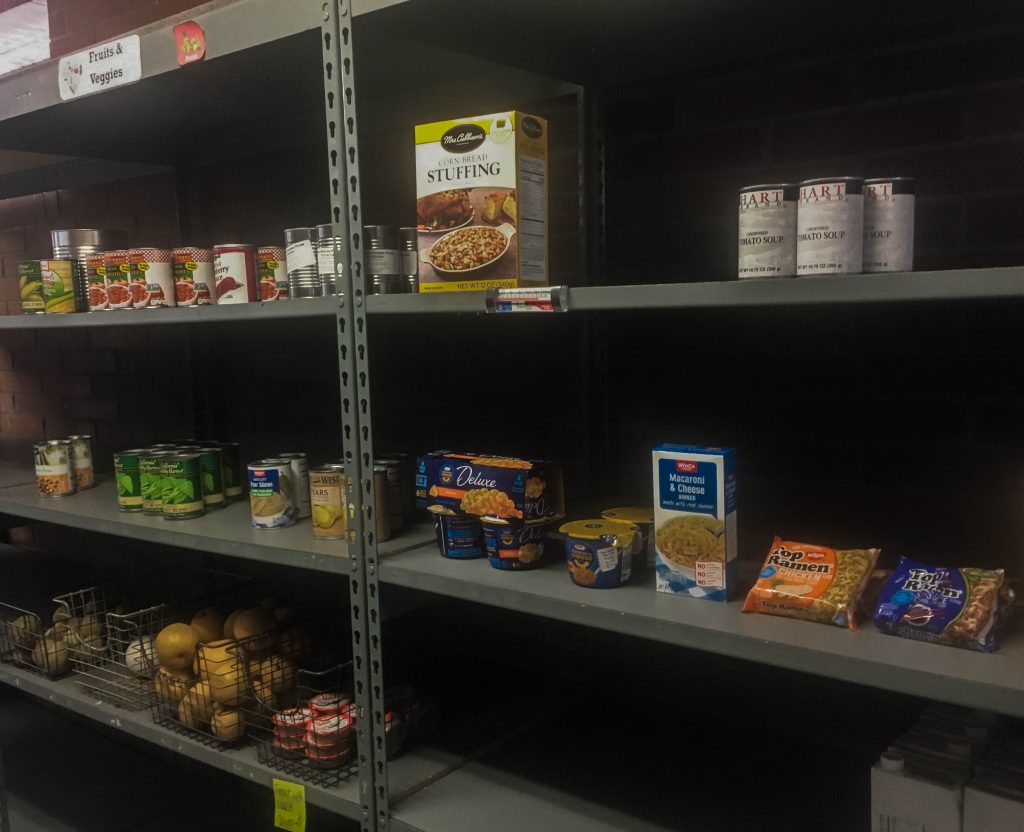
This affects students at Western, too. Bilingual Advocate Outreach Coordinator and Supervisor of the Food Pantry, Lisette Servantes, as well as two of the Coordinators from the Food Pantry, Josh Salisbury and Rachel Bayly discussed food insecurity on campus and how this new proposal might affect Western’s students. 

The Food Pantry is a free resource dedicated to alleviating food insecurity on campus. 

Servantes stated, “food insecurity happens at every college and we see that need … some students are missing meals to pay for books or classes. We definitely don’t want that to happen.” Of Western’s student population, Bayly had mentioned that “monthly we average around 900 visits and 350 people … if you break it down to students specifically, about 60% of people coming in are students, so about 200 people per month.”  

However, Servantes also wanted to highlight some of the positive changes made within the Western community to address and provide assistance to those suffering from food insecurity including “a new student voucher program” where if “Western students come have a quick conversation with (her) just to assess their needs and determine if it’s more of a long-term or short-term solution that we need to find … (students) are able to get a $25 certificate to Waremart or WOU Dining.” In addition to that, there is a “new student criteria where if students go meet with the DHS representative … and state their specific intentions and career goals … that waives their student criteria, (making) it easier for students to get approved for SNAP benefits.”

As a parting thought, Salisbury commented, “In our country for college students, we expect them to sacrifice a lot to go to college in terms of time, money, and energy — you shouldn’t have to add your nutritional health to that list. I think that even if our country as a whole doesn’t support our college students as a whole that doesn’t mean that we can’t try to make a difference on our campus.” 


Food Pantry hours and information: wou.edu/foodpantry

Contact the author at howlnews@wou.edu

Photo by Sage Kiernan-Sherrow
“Zones” are a new parking strategy created by public safety in response to affordability concerns.

Sage Kiernan-Sherrow | News Editor

Many changes have been made to Western’s campus, including a new parking system that has left Western’s students with mixed opinions.

The director of Campus Public Safety, Rebecca Chiles, released an email on Sept. 17 which introduced Western students to a newly-established parking system. Under this new system, students will be required to buy parking permits as they have been in the past, except this time there is more than one permit option. The system is based around parking zones, with  “Zone 1” — zones with higher demand — or “Zone 2 — which are zones with lower demand — representing the type of permits that students can choose from. 

Students wanting to park in higher demand Zone 1 areas will pay $150 dollars for a resident permit, a considerably higher rate than those who prefer lower demand Zone 2 areas, with their permits costing half the price at $60. Non-resident permits for “Zone 1” will cost $125, with “Zone 2” permits remaining $60. New parking rules also include free parking between the hours of 6 pm-6am, making campus events more accessible for all students. 

The email cites affordability and community solidarity as reasons behind the change. Campus Public Safety was put in charge of parking just last year, according to Rebecca Chiles, who asserted that she was charged by President Fuller with coming up with a new strategy that would prioritize “affordability for our students.” 

After attending multiple conferences including a “parking and transportation summit at OSU in March” and “talking to other universities,” Chiles stated that they were forced to accept that Western was “in the dark ages” in terms of how they were executing parking. 

Regarding the process of approval for the now newly-implemented system, Chiles said that there is “a parking review committee… (with) students on that committee,” and that they “presented the whole entire concept to them with maps and zones and layouts … and it was unanimously accepted.” 

Despite approval from the committee, Chiles cited that there have been some “growing pains” and acknowledged that there has been some lashback from students, particularly regarding accessibility. To set matters to rest, Chiles admitted that, “maybe (she had) not done a good enough job talking about disabled parking,” and wanted to clarify that, “anyone who has a state-issued government placard … can buy the cheapest permit and be able to park in any of the zones on campus.”

Chiles also expressed some frustration that there is an overall lack of understanding of the system, despite the university’s and Campus Public Safety’s best efforts to keep students informed. 

“We added a new thing on Portal this year where, to get your permit, you have to click that you have read the rules and regulations,” said Chiles, who also mentioned a brochure attached to the permit with the same information that she says often gets ignored. “We wish people would educate themselves with the materials that we have provided for them.” 

The consequences of ignoring such information can be huge, Chiles stressed. “You can get a citation… if you get enough citations, your car can get booted.” However, Chiles also encouraged students to know their rights and “take part in the appeal process” should they “believe something (has) happened unfairly.”

In the future, Chiles divulges that she would like to see the use of pay-stations on campus. She believes they would be helpful in cutting down the time spent on getting “permits for every single visitor” in a large group, something that they have to do every day. 

For the full Q&A, visit wou.edu/westernhowl


To read the full parking rules and regulations, refer to https://wou.edu/safety/parking-services/parking-brochure/

To contact Parking Services, call 503-838-8267.


Contact the author at howlnews@wou.edu

Photo by Caity Healy

Students may have noticed that former student involvement and outreach program Orgsync was replaced by WOU:Engage. Here’s what happened:


Sage Kiernan-Sherrow | News Editor
Fall term has ushered in many changes for the students of Western. One such change began over the summer when the student engagement portal formerly referred to as “Orgsync” was disbanded after the company was bought out by CampusLabs. Following the disbandment, a new portal deemed “WOU:Engage” has replaced Orgsync as the main mode of relaying information regarding clubs and organizations on campus. 

Students are encouraged to use WOU:Engage to “find out where club meetings are, events, updated info on clubs and organizations,” explained Megan Habermann, who is the associate director for Student Engagement. However, she noted that “it’s different (from Orgsync) in the fact that it’s a lot simpler and because it’s simpler,” adding that “it does things … more efficiently.” 

One of the previously popular features of Orgsync was the blog designed to help students connect with one another regarding subjects like finding a roommate. Habermann assures that this feature still exists and is now being called a “news post.” Students wishing to make one of these posts can find more information on WOU:Engage by following the “latest news” category and then clicking on “classified ad.” 

The function of the WOU:Engage is almost identical to the original but, as Habermann points out, there are a few unique differences. One of the primary differences is an app called CORQ which is situated within WOU:Engage which allows students to make events open to the general public should they choose to. Another difference is the ability to use filters and keywords to get more precise search results; entering in the keyword “free food” will show students every event with a free food component. Lastly, WOU:Engage boasts a “really robust form system” that Habermann remarked will become an asset to clubs and organizations as “future execs will have access to (any form created) because it will attach to your organization,” adding that there’s “no more starting from scratch.” Despite these positive changes, Habermann says that Student Engagement “appreciates feedback” regarding the site, as it is still in its early stages. To contact Student Engagement, email seoofc@wou.edu.


Contact the author at howlnews@wou.edu

Tucky’s food truck review

Rylie Horrall | Lifestyle Editor

Tucky’s Southern Kitchen and Pantry is a food truck located across the street from City Hall in Monmouth. It’s owned by chef Brian Etienne, who opened the food truck here in early 2019.

Etienne initially wanted to create a brick and mortar style eatery that would be located in a refurbished gas station, but decided to put the idea on the back burner in order to branch out. He began doing catering along with focusing on wineries and craft breweries, however felt he was still lacking a connection to his own food.

Etienne decided to set up Tucky’s in Monmouth after moving here in December 2018. Monmouth itself houses many different small businesses that are supported wholly by the town’s locals, which is one of the things he loved about the town. 

“I’m a city boy by nature but have always held a place in my heart for country living, simpler things and that storybook small town. I felt Monmouth was that town,” Etienne said.

Tucky’s is a food truck that sells southern style comfort food that is made to “warm the heart and feed the soul,” according to their website’s philosophy statement. According to Etienne, their signature dish is all around their fried chicken ⏤  which you can get on its own, in a sandwich or combined with the mac & cheese bowls.

For first time customers, Etienne recommends both the Crazy Rooster Sandwich and the Mac & Cheese. The Crazy Rooster is a unique take on classic southern fried chicken, thrown together into a sandwich with a “light and bright” slaw and house made pickles. The Mac & Cheese is made with a gluten-free cheese sauce that’s rich and creamy. In the future, completely gluten-free mac & cheese will be available.

Tucky’s offers a secret menu that gets posted only to their Instagram, however Etienne prefers for the secret menu items to be passed around through people, saying that it’s more fun that way. A previous item they had on this menu was the Wolf Pack Attack, which is a 10” tall burger made with grilled mac & cheese buns, meatloaf, barbeque, pulled pork, sweet onion jam, sriracha pimento cheese, fried chicken skins and house pickles served with a five cheese dipping sauce. Currently, there’s no new secret menu items, but he hopes to have some more in the near future.

Along with serving food, Tucky’s also gives back to the community through drives and small things for customers. Right now, they offer a Redemption Card program that allows customers to get discounts on their food. In addition, Tucky’s will also be doing a Food for Food program where customers will get a discount on their meal in exchange for donating non-perishable foods that will be donated to Western’s Food Pantry. 

“I am all about giving back to my community,” Etienne said. “We always post on social media our current goals or drives we create to give back.”

Tucky’s can be found on Instagram with the handle @tuckyskitchen, on Facebook and on their website tuckyskitchen.com. The business is open Monday–Friday from 11 a.m. – 2 p.m. while supplies last.


Contact the author at howllifestyle@wou.edu

Photos by Cora McClain

This week in completely made up horoscopes

[fruitful_tabs type=”accordion” width=”100%” fit=”false”]

[fruitful_tab title=”Aries 3/21-4/19″] Second week, you’re already wishing school was done… but wait, there’s more.

 [/fruitful_tab]

[fruitful_tab title=”Taurus 4/20-5/20″] Only one week in, and you’ve already lost all your new pens and pencils huh, Taurus? [/fruitful_tab]

[fruitful_tab title=”Gemini 5/21-6/20″] The stars know you’re not really into school spirit, but would it hurt you to say “’Sco Wolves” every now and then? [/fruitful_tab]

[fruitful_tab title=”Cancer 6/21-7/22″] I know you’re full of salt, Cancer. Just remember that some people are slugs. [/fruitful_tab]

[fruitful_tab title=”Leo 7/23-8/22″] It’s time for some “you time” — eat a burrito if you need to. [/fruitful_tab]

[fruitful_tab title=”Virgo 8/23-9/22″] Do you have all of your notebooks color coordinated for classes? Of course you do, you’ve had this planned for weeks. [/fruitful_tab]

[fruitful_tab title=”Libra 9/23-10/22″] You’re still mad that someone stole your seat, even though it’s only the second week of class. [/fruitful_tab]

[fruitful_tab title=”Scorpio 10/23-11/21″] Should you have listened? Maybe. Did you? No. [/fruitful_tab]

[fruitful_tab title=”Sagittarius 11/22-12/21″] Don’t forget to drink water responsibly. [/fruitful_tab]

[fruitful_tab title=”Capricorn 12/22-1/19″] Do you remember? The 21st night of September? Of course you don’t. [/fruitful_tab]

[fruitful_tab title=”Aquarius 1/20-2/18″] You wish you had that Beyonce vibe right about now… But you don’t. #farfetcheddreaming [/fruitful_tab]

[fruitful_tab title=”Pisces 2/19-3/20″] Me: Just trying to get through Week 2.

My last two brain cells: HE WAS A ONE-EYED ONE-HORNED FLYING PURPLE PEOPLE EATER ONE EYED ONE-HORNED FLYING PURPLE PEOPLE EATER ONE EYED ONE-HORNED FLYING PURPLE EATER suuuRE LOOKS STRANGE TO ME!!!! [/fruitful_tab]

[/fruitful_tabs]

Navigating Handshake and career help

Rylie Horrall | Lifestyle Editor

During my first year of college here at Western, one of my biggest concerns was trying to find a job on campus. I had only worked two jobs in my lifetime, and the idea of applying for one in a new and unfamiliar area was extremely nerve-wracking. Luckily, I was able to find one ⏤ but it didn’t pay much, which lead me to try finding other opportunities here on campus.

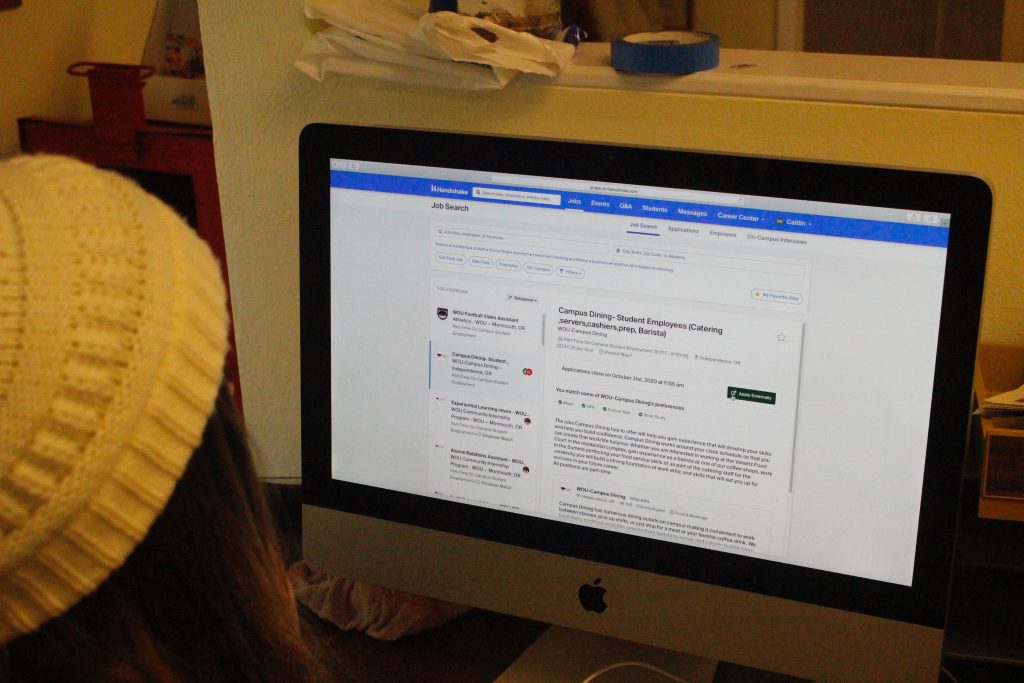
Handshake is one of the options all students have available on their Portal accounts. It’s an easy opportunity to see the events happening not only at Western, but at many other public universities in Oregon. Setting up an account instantly provides suggestions for jobs and internships in Monmouth and surrounding areas.

To access Handshake, students need to log into their Portal accounts. Once in the system, click the icon that looks like a wolf’s head labeled “WolfLink” in the row of icons in the left corner. This will redirect students to the website where it starts creating the account. Fill out each question and section completely, and Handshake will bring up suggestions based on the completed profile. 

If you have any trouble with Handshake, you can head over to the Service Learning and Career Development Center (SLCD) located in the Werner University Center in room 119 on the first floor. The SLCD is a not only a great resource for Handshake, but also for anything pertaining to job searches and post-graduation career preparation. 

One option the SLCD has available to students are mock interviews, which have proven helpful. Jennifer Hansen, the career development coordinator, stated the mock interviews were helpful to students who may fidget during interviews but were unaware of it. 

“(It’s) something that we can point out so that the employer can focus on your answers and your personality, as opposed to whatever that tick may be,” stated Hansen.

The SLCD is open from 8 a.m. – 5 p.m. Monday – Friday, and provides times from 9 a.m. – 4 p.m. for anyone to drop in and have resumes or cover letters reviewed.


Contact the author at howllifestyle@mail.wou.edu

Strike Cancelled: Oregon public university workers succeed in reaching settlement

Sage Kiernan-Sherrow | News Editor
After many months of debate, the Service Employees International Union (SEIU) has reached a temporary two-year agreement with university management, narrowly avoiding a strike that was authorized to occur on Monday, Sept. 30, which would have otherwise clashed with the first day of classes for many of Oregon’s public universities, including Western Oregon University. 

The strike was set to ensue should university management not agree to the demands of their workers, which includes over 4,500 classified workers representing the lowest-paid faction. The terms and conditions of the settlement are detailed in a document published by Di Saunders, a spokesperson for Oregon’s public universities; they include a commitment to keeping all universities’s entry-level wages above the minimum wage of Portland-metro area universities by eliminating steps of the salary schedule that are below that rate, as well as a 3.0% cost of living adjustment (COLA) increase for all classified employees which goes into effect July 1, 2019. 

“This is the highest increase in over a decade,” remarked Western Oregon University Union Representative and Hamersly Library Resource-Sharing Coordinator Lori Bullis. “The cost of living in our region has increased, but we are met with constant tuition raises and pay cuts…we would rather not get to this point because we like what we do and recognize our promise to public service…but everyone deserves to be paid a living wage,” she continues, asserting that many of the classified employees that she works with rely on government aid.

Analogizing the university system’s structure to a three-legged stool, representing the administration, faculty and classified employees, Bullis called the unification of all three elements “essential to students receiving their education,” as the loss of one would cripple the entire foundation, and affirms that this philosophy was central to the negotiations. 

In fact, the quality of education was a primary motivation of the settlement as both sides were eager to reach an agreement before the beginning of classes. A statement released via email on Saturday, Sept. 28 on behalf of President Rex Fuller announced that, “Monday, we will welcome students to campus for the first day of classes of the 2019-20 academic year. I am proud that we will be doing this as a united campus…,” and went on to thank “members of both bargaining teams for their long hours, late nights, and hard work.”

However, despite the President’s message of unification, Western Oregon University’s Chief Steward for the Classified Staff, Jackson Stalley, remained critical, stating that the situation had reached a level of such high severity that, “even people who were previously anti-union said ‘I’m done.’” Stalley called the administration’s use and distribution of money, “disturbing,” and commented that, “WOU has the largest budget it ever has. Where is that money going? I can look back over the course of the last ten years and see a burgeoning of admin positions being paid significantly more than the rest of us…we get paid less compared to other state employees because we work in higher education…and this is public information.” When asked how the university could better utilize the budget, Stalley asserted that he, “would prefer to see a reinvestment of time and money into student services and faculty in order to foster student success.” 

Nevertheless, this is an accomplishment for the SEIU and the settlement will remain in place at least until 2021. For the full Q&A with both Bullis and Stalley, visit wou.edu/westernhowl


Contact the author at howlnews@wou.edu