Mount Hood

Review: “Oculus”

Chrys Weedon | Entertainment Editor

“For all my sisters” reads the dedication of Sally Wen Mao’s newest collection of poetry, “Oculus.”

In this her second collection of poems, released Jan 15, Mao weaves a complex story of technology, patriarchy, racism and time. Each poem is well-researched — not a single poem stands alone, but fuses into the landscape and context of a much bigger picture. Whether it be how technology has grasped our lives or describing the history of racist Asian caricatures in American cinema, every poem is carefully penned and laced with morbid imagery.

A series of poems throughout the book follows the imaginary journeys of actress Anna May Wong, considered the first Chinese-American actress in the United States, through time. Given the power of a time machine, Wong migrates through time and the history of American cinema, witnessing the way the industry typecasts and violates Asian people through racism.

Wong sees how Chinese women’s bodies are objectified and rejected simultaneously. Different Asian cultures are often appropriated in American shows and movies, but, as Mao focuses on in her writing, many Asian characters are portrayed by white actors in yellowface. Over the course of her journey, actress Wong travels beyond her death, and through Mao’s wit and style, calls for a reclamation of her culture and narrative.

In a poem that gives her book its title, Mao described how a young woman in Shanghai posted her suicide to Instagram in 2014. In the last section, Mao wrote a second poem under the same title, cataloging her experience watching Solange perform at the Guggenheim museum, the most photographed place in the world. Mao intricately analyzes, in these and other poems, how technology has morphed into a third limb for many, turning society into a sort of cyborg which catalogs everything.

In her poem “After Nam June Paik,” Mao wrote: “On the LCD screen, I offer light but no breath/ I author breadth but no depth/“… the surveillance camera records our prettiest nightmares.”

Mao’s poetry is eerie, brutal, futuristic and stunning. Mao writes on topics many find difficult to discuss, but shifts focus on what could be and what is to come. This collection truly is unique.

Overall rating: I would strongly recommend this book.


Contact the author at howlentertainment@wou.edu

Photo courtesy of graywolfpress.org

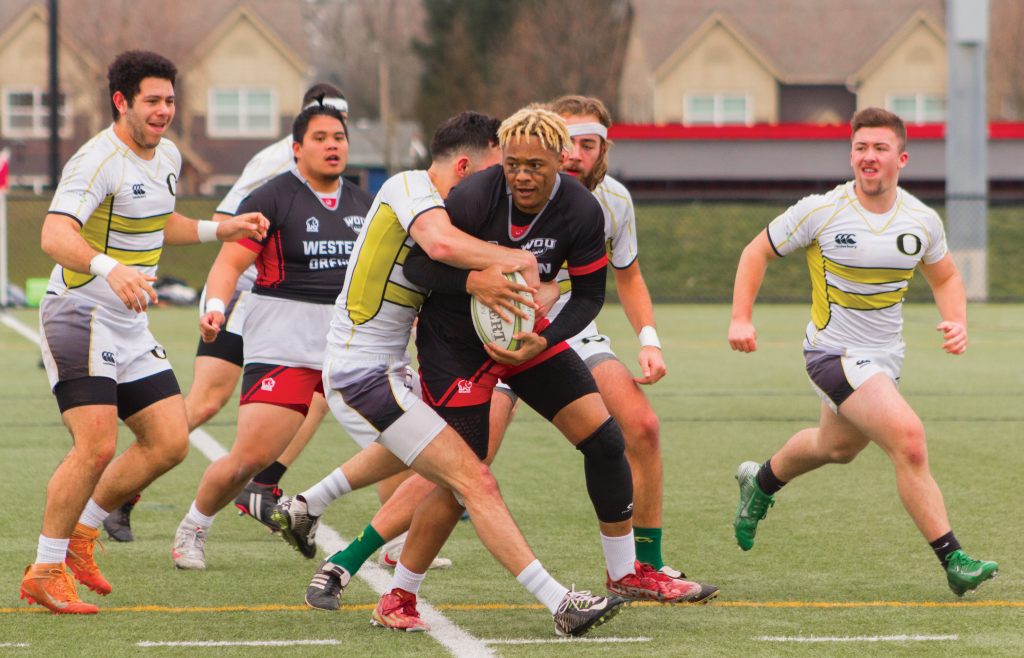
Men’s Rugby tramples University of Oregon

Lake Larsen | Sports Editor

Clouds blocked out the sun and the winds picked up as the men of Western’s rugby team lined up. With the memory of losing to the Beavers on Jan 26. in mind, the Wolves were ready to take on the Ducks on Feb. 2. In their home debut of 2019, Western looked to not only redeem themselves, but to dominate.

The Ducks quickly jumped ahead of the Wolves. In the opening minutes of the match, University of Oregon scored a try and was unsuccessful on the conversion to bring the score to 5-0. But this was nothing to the Wolves. A tenacious Western defense made mincemeat of the Ducks offense, forcing chaos amongst the team.

Taking advantage of the frantic Oregon offense, Western pounded their way to back to back tries with a pair of successful conversions. These scores catapulted the Wolves to the lead and shifted any momentum Oregon had right over to Western. The quick scoring seemed to be a trend for the Wolves as the game started to become out of hand with breakaway after breakaway.

By midway through the first half, Western had developed a blitzkrieg-style attack on the Ducks. A powerful defense was complemented by lightning fast offense from the Monmouth team. By the time the horn for the half sounded, the Ducks hadn’t been able to come within 20 yards of a score.

The fireworks of the first half were quickly followed up in the second half as Western’s relentless assault on the Ducks forged on. With a fresh set of legs taking the field for the Wolves, Oregon looked visibly shaken. While the Ducks attempted to fight back, Western’s men never let Oregon back into the game.

In response to playing at home again, sophomore Drew Reyes commented that, “It feels great … we love playing on this field. We wanted to hold ourselves accountable to the mistakes we made at OSU. We wanted to fix the mistakes while having fun … I think we played well today, but there’s still a lot to work on.”

Western heads on the road to take on Pacific University on Feb. 9.


Contact the author at howlsports@wou.edu

Photo courtesy of Ashlynn Norton

Western’s newest club sport: Men’s Basketball

Mikaela Wong | Staff Writer

Students around the Health and Wellness Center may have grown accustomed to seemingly common pick-up basketball games involving a variety of students. This popularity has paved the way for a pool of potential candidates to start a new club sport — the Men’s Basketball club.

The Men’s Basketball club adds to the basketball opportunities for Western’s students offered by Campus Recreation. This club gives students the ability to play in competitive games with other schools in the region. By communicating with other school’s administrations, Western has been able to be a part of the creation of a new club league that includes schools such as the University of Oregon, Portland State University and University of Portland.

“The idea of this club actually started around three years ago when we initially joined the NIRSA tournament,” said Noah Jones, a senior business major and club founder, on when the club was created.  “We ended up doing really well consecutively (in the tournament) and that laid a foundation for the next couple years to start this club this last summer.”

The clubs season extends from February to the beginning of April. Every weekend, the team travels to various schools, playing multiple games a day. These games are a pathway leading to a playoff. The post season concludes with a single championship game, held at Western in early April.

Currently, the club is comprised of nine members. The majority of these members are seniors, just like the founder. But Jones has strived to ensure the longevity of the team.

“I’ve made sure to recruit some underclassman so that when (the seniors) leave, they will know where to take the program,” said Jones. “(I want them to) have all the contacts and tools to keep the league going and maybe even add more teams to it in the future.”

Jones hopes to have the team continue to stay around the school for years to come.

“Having multiple club teams at WOU would be great so that the culture could grow,” mentioned Jones. “I know it’s a bit of a stretch, but maybe eventually they could even hold games in the New PE Gym. Ideally, I would want enough students to participate in the club teams that we could hold our own tournaments at the school and make it an annual thing.”

The team practices every Tuesday from 6-8 p.m. in the Health and Wellness Center. Visit IMLeagues.com/wou to learn more about how to join.


Contact the author at mwong16@wou.edu

Photo courtesy of Ashlynn Norton

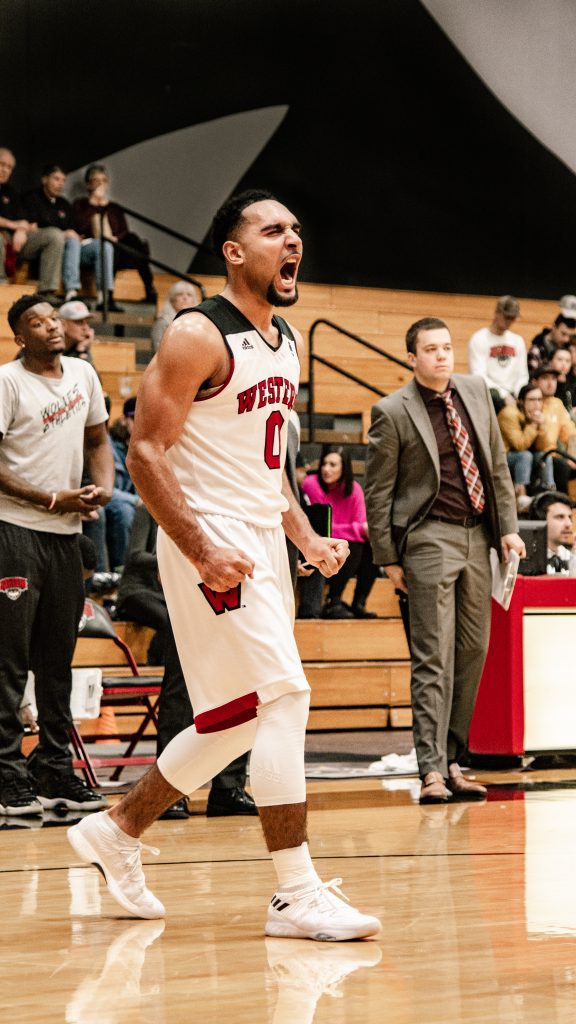
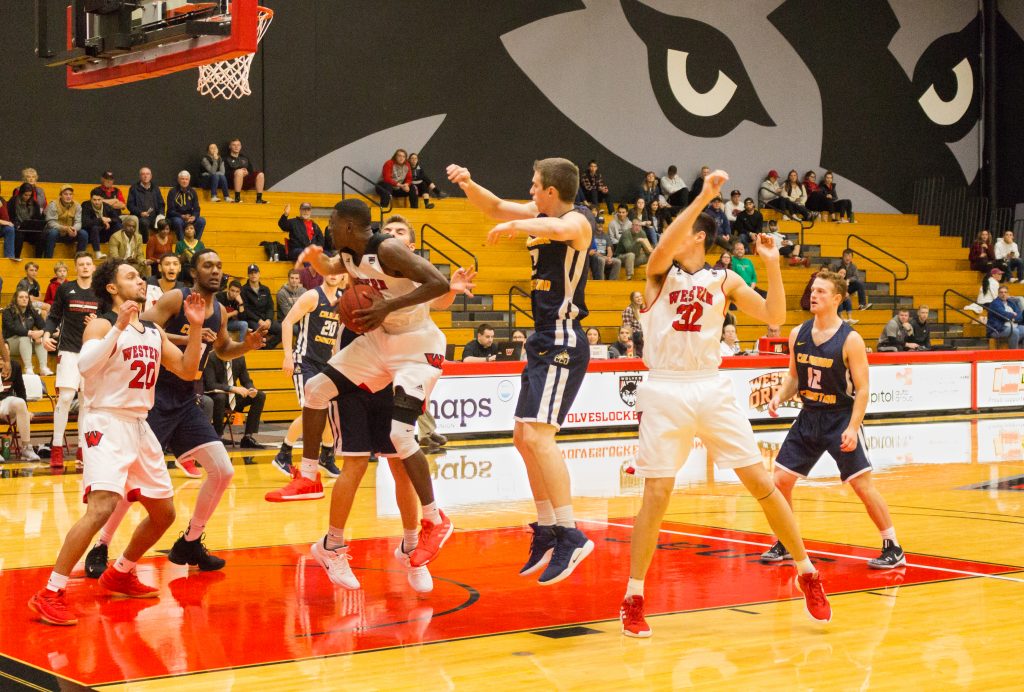
Men’s Basketball smashes Alaska Anchorage

Lake Larsen | Sports Editor

After falling to the Seawolves in their previous meet up on Jan. 3, Western was suited up and ready to battle back on Feb. 2. Recently, Alaska Anchorage had been mentioned in an article in the GNAC news as a hot team late in the season due to their daunting play. While this may have been worrisome to some teams, the Wolves looked unphased.

The opening minutes of the game showed signs of what would look like an all out war on the court. As time ticked away on the clock, neither team could hold a manageable lead. The Wolves would quickly jump out ahead only to see their lead vanish and find themselves in the hole. But this back and forth didn’t last long.

By the midpoint of the opening half, the Wolves seemed to have finally established a solid lead to which they could expand on. The swish of the net began to echo on the Wolves’s side as they grew their lead two points at a time. By the buzzer, Western was ahead of the Seawolves by a firm seven points.

In their last match up, the Wolves looked outclassed by the Seawolves. But this time around, Western was ready for their revenge. Immediately into the second half the Wolves pushed their single point lead to double digits. While Alaska Anchorage fought back, their efforts proved futile. The Wolves kept adding to their lead, growing it to 20 points at times.

With only a handful of minutes left in their match, Western’s lead hovered steadily in the high teens. No matter what the Seawolves did, Western was there to not only match their push, but force their lead even higher. After dropping their first matchup 57-61, the Wolves finalized their revenge with a commanding 81-61 win.

Western remains at third place in the GNAC standings. The Wolves have only seven matches left in their season, two of which are against Western Washington and Northwest Nazarene, the top ranked opponents. Western takes the home court again Feb. 9 against Montana State Billings.


Contact the author at howlsports@wou.edu

Photo courtesy of Paul F. Davis

Mental health grant brings resources to Western

Bailey Thompson | News Editor

Beginning on Nov. 7 and into mid-December, Tim Glascock — the project director for WOU CASA and Suicide Prevention — encouraged Western students to participate in the Healthy Minds Survey. Having received the three-year Garrett Lee Smith Campus Grant in Fall Term of 2017, Western sought to use this evaluation tool to better understand mental health and service utilization on campus.

“This gives our campus a better understanding of the health issues that need to be addressed on campus,” said Glascock. “This initial use of HMS was meant to provide a baseline on these topics.”

In the future, Glascock imagines that the data collected in this survey will be used to better serve the mental health needs of those in the Western community.

According to Glascock, specifically, there are four main areas that are focused on with the grant: “Increase gatekeeping behaviors,” or in other words, encourage bystanders to notice and reach out to someone struggling, “increase educational events that focus on mental health or life skills … increase marketing and campaigns that focus on addressing many of the topics that HMS addresses, and finally updating or proposing new policies or procedures related to suicide and mental health.”

With this grant in place, Glascock expressed that one of the most significant accomplishments that has resulted from it so far is “the implementation of a new website focused on suicide prevention and mental health promotion.” Students can explore the website wou.edu/mental-health and the variety of resources that it has to offer.

Another success that has come from this grant is the creation of a new campus organization.

“A new student club called Wellness Advocacy Group (WAG) formed at the beginning of this year and will focus on mental health promotion efforts,” said Glascock. Amongst these efforts, this group is in the process of organizing an Out of the Darkness walk in May.

An additional outcome of this grant is that 14 staff members on Western’s campus have been trained to conduct trainings on QPR, which stands for Question, Persuade, Refer.

“QPR is a bystander intervention training that teaches folks how to recognize someone in distress, how to reach out to them, and how to refer them to services,” said Glascock. “It is just like CPR — the more people who are trained to recognize someone in distress, the higher the chances of folks being recognized and utilizing services.”

Upon reflecting on these changes, Glascock also had a few words of practical advice for any individuals in Western’s community. A couple of the major things that he emphasized are that it is important for people to continue working on their own mental health and to continue talking about these issues so that they are normalized in our society.

“There is a difference between mental health and mental illness,” said Glascock. “Mental health is a generic term just like physical health; it can be good or bad, regardless of whether there is a mental illness present.  It is also worth mentioning that someone with a mental illness can be just as successful as someone who doesn’t.”

Finally, Glascock encouraged any students to seek help if they or someone they love needs it.

“Reach out, both if you suspect that someone is struggling, but also if you are struggling,” said Glascock. “The worst thing that can happen if you reach out to someone is that they may get mad, but at least they know you care about them.  Saving a life is more important than saving a relationship.”

If students are interested in learning more about the mental health resources available on campus, they can go to the new webpage or email Glascock at glascockt@wou.edu.


Contact the author at howlnews@wou.edu

How to protect yourself from measles

Bailey Thompson | News Editor

In the first month of 2019, 79 cases of measles have been confirmed across 10 states in the U.S., according to the Center for Disease Control and Prevention. Amongst these states, both Oregon and Washington have had confirmed cases.

Before attending school at Western, students are required to have two documented doses of the measles vaccine, which must be reported in the health history form that is submitted to the Student Health and Counseling Center. This requirement can be waived if a student has a medical reason, such as pregnancy or breastfeeding, or a religious or personal conviction.

However, Beth Scroggin, the director of the SHCC, sent out an all-student email on Feb. 1 explaining that this waiving of the requirement could impact students if there were to be a local outbreak.

“Please be aware that waived students may be removed from classes if an outbreak of the disease occurs,” stated the email.

If students are unsure of their vaccination status, they can go to the SHCC and check their immunization records. There are also vaccinations there for students who would like to get one.

“(We) encourage you to be vaccinated not only protect yourself but to protect others that are unable to receive the vaccine as well,” said Scroggin.

For any who are unaware, measles generally starts out with a high fever, cough, runny nose and irritated eyes, according to the CDC. Furthermore, within a few days, tiny white spots may appear inside the mouth, and later on a rash develops and spreads throughout the body.

“Measles is a serious respiratory disease (in the lungs and breathing tubes) that causes a rash and fever. It is very contagious. In rare cases, it can be deadly,” said Scroggin.

Although measles is most dangerous for younger children, the CDC reports that one in every four people who get measles will be hospitalized, so it is something that ought not to be taken lightly.

If anyone has questions about measles and how it could affect them, visit www.cdc.gov/measles or call the SHCC at (503) 838-8313.


Contact the author at howlnews@wou.edu

Opinion: Only YOU can avoid highly-preventable disease

Caity Healy | Editor-in-Chief

As of Tuesday, Feb. 5, the list of confirmed cases of the measles in Washington since the first day of 2019 reached 50, according to doh.wa.gov. Of those 50, 34 were between the ages 1 to 10. And, of those 50, 42 were unvaccinated. On Jan. 25, Washington Gov. Jay Inslee declared a state of emergency. If only there were some way this could have been widely prevented.

The Measles Mumps Rubella (MMR) vaccine is about 97 percent effective after receiving both doses, per cdc.gov. Despite this statistic, people are still choosing not to receive the vaccine. And, in some cases, these people are also choosing not to vaccinate their children.

The measles are highly contagious; it can be contracted by entering a room that someone with measles left up to two hours prior, according to cdc.gov. As the list of exposure locations continues to grow and grow, I can’t help but worry. I worry for the child who had no choice. I worry for the infant who is not old enough to get their vaccine yet. I worry for those who are already ill who, if infected, could face serious complications. I worry for those who are pregnant, who, if infected, could also face serious complications. I worry for those who simply cannot afford the vaccine for themselves or their child.

I might sound like I’m being dramatic, but let’s be honest. This is ridiculous. It’s 2019, the MMR vaccine has been around since 1967. How this is still a problem, especially to this extent, blows my mind. While it’s uncommon to die from the measles, it can lead to other serious illnesses, such as pneumonia, which could be deadly for children or those with compromised immune systems.

When I heard of the outbreak, my first thought went to my sister Meagan Hess, who has an 11-month old baby — too young for the MMR vaccine.

“I have to constantly check the exposure sites to make sure it wasn’t somewhere I’ve been with my daughter,” Hess said. “Anytime we go anywhere, out to dinner for example, it’s in the back of my mind — what if someone with the measles is here and we just exposed our daughter because we wanted to go on a family date?” Among the list of exposure sites: Hess’s workplace. She couldn’t even go to work without worrying that she or someone else had been exposed.

Hess explained what she wished she could tell someone who chooses not to vaccinate: “Everything has risks … but think about the greater risks of not getting the vaccine … think about how this will impact your child.”

Hess’s final thought on the situation was, “Yes, it’s your choice. But when your choice is impacting all those babies whose parents don’t yet have the option to give their child the vaccine, it becomes a greater responsibility than your own choice for your child.”

Personally, I can’t understand why someone would choose to not vaccinate their children. I have yet to hear a single reason why this would be okay.

Another mother I know explained that she didn’t want to “infect” her child through the vaccine. And, instead, said she would rather risk them getting the disease and dealing with that afterwards. I was in awe. She added that she didn’t trust the hospital. If you don’t trust them to give your child the vaccine, are you going to trust them to save your child’s life when they contract a highly-preventable disease?  

Other people choose not to vaccinate because of a fraudulent study that linked vaccinations to autism. This study has been disproven. No links have been found between the ingredients in vaccines and autism. Yet, people still make this connection. Based on their own experiences or by coincidental occurrences? Maybe. But still not worth risking a life over. And, even if this were true, using this as your reasoning would mean that you would rather your child contract deadly diseases that could literally kill them than have them get a life-saving vaccine that you believe could lead to autism.

For those who are considering the vaccine but haven’t received it yet, don’t just take my word for it. Do your own research. What you’ll find is that it is incredibly rare for a vaccine to cause any complication.

As of Feb. 5, the number of confirmed cases in Oregon still sits at one. But even that is one too many. On Feb. 1, an email was sent out to all Western students from Beth Scroggins, the Director of the Student Health and Counseling Center, stating that waived students could be removed from classes if an outbreak occurs. Let’s hope it doesn’t actually reach this point.

Please vaccinate. I know I sound like a Bob Barker “spay and neuter” PSA, but it’s true. Vaccinations can and do save lives.

For the most current list of exposure sites, visit clark.wa.gov, which is updated frequently.


Contact the author at chealy16@wou.edu

Western hosts annual Chinese New Year celebration

Bailey Thompson | News Editor

The final year in a 12-part cycle, 2019 marks the Year of the Pig in Chinese culture. In order to commemorate this occasion, the WOU Chinese Students and Scholars Association and the Office of International Education and Development hosted Western’s annual Chinese New Year Celebration on Jan. 31 in the Pacific Room of the Werner University Center.

Having thoroughly packed the room and fed their guests an authentic Chinese dinner, the organizers of the event started off the night’s performances with a lion dance by visiting performers from White Lotus Crew in Portland. Emerging from the back of the room, the two lions made their way into the room while dancing and interacting with the crowd. They launched oranges and lettuce out at the audience, and their performance concluded with confetti and banners saying, “Happy New Year” and “Best Wishes To All.”

With the audience engaged, the emcees then took the stage and introduced themselves as Jenny Yang, Ankit Shrestha, Jingxiong Soh and Qiong Luo.

While sharing the traditions she remembers of celebrating the new year in China, Luo said that her experience involves eating, spending time with family and one other notable thing.

“The fun part is the younger kids can get a red envelope which is always filled with money from their parents or relatives,” said Luo.

Before the other performances would begin, the emcees introduced President Rex Fuller, who made a few remarks about the significance of this particular year.

“This year, 2019, is especially important that we take a moment and really thank and welcome our visiting students and scholars from China and Nepal and other parts of the world,” said Fuller. “You make our lives brighter, you make our campus better and you portray a global atmosphere for all our students, faculty and staff.”

Dr. Fuller also went on to talk about the personalities of people who were born in pig years: 1947, 1959, 1971, 1983, 1995, 2007 and 2019.

“What are some of the characteristics of those born in the years of the pig? They may not stand out in the crowd, but they are very realistic,” said Fuller. “Others may be all talk and no action — pigs are the opposite. Though not wasteful spenders, they will enjoy life. They love entertainment and will occasionally treat themselves. They are a bit materialistic, but this motivation for them is to work harder.”

Fuller then concluded his description of those born in pig years by highlighting the harmony that pigs strive for, which is also something he also emphasized that our world needs.

“Pigs are gentle and rarely lose their temper, and when they do, it’s never dramatic. They’ll always try to compromise and settle things quickly because their goal in life is for everyone to live in harmony,” said Fuller. “What a nice thought, everyone living in harmony.”

After this speech, the main entertainment of the night began. Moving through the program, there were fourteen different songs and dances that were performed, ranging from Beijing Opera to a modern hip-hop routine. And, while many of the performers were traditional college-aged students, there were also a couple of routines that featured Chinese women of a variety of ages dancing together.

Another highlight of the performances was a dance called “The Journey of Chasing Dreams,” which was accompanied by an artist creating Chinese calligraphy onstage. As the dancers moved around her, the artist wrote out four Chinese words which she said could be translated to say “better wishes for all in the pig year” in English.

“As you know, the calligraphy is a very big part of Chinese culture,” said the artist. “The words I write today is called official script. This is a very well-known and classic style of words, but in China most people now write with regular script — from left to right — but in ancient times people would write their names in right to left.”

One dance which had a familiar story for many was titled “Butterfly Lovers,” a dance with a story that was similar to one very well-known in America.

“I heard it was like the Chinese version of Shakespeare’s tragic classic Romeo and Juliet,” said Soh.

As a finale to the night, a number of Western’s current Chinese students and scholars came together to sing “Love My China,” donning matching Western t-shirts.


Contact the author at howlnews@wou.edu

Photo courtesy of Ashlynn Norton

From the archives: Classic knee-slappers

Lake Larsen | Sports Editor

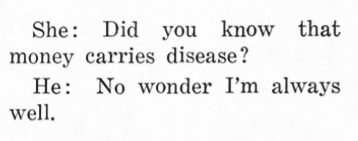
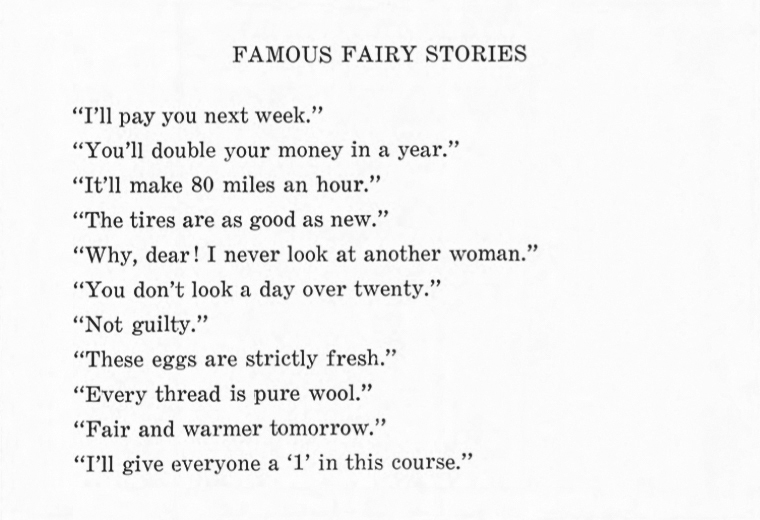
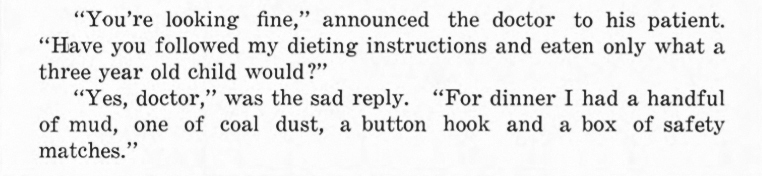
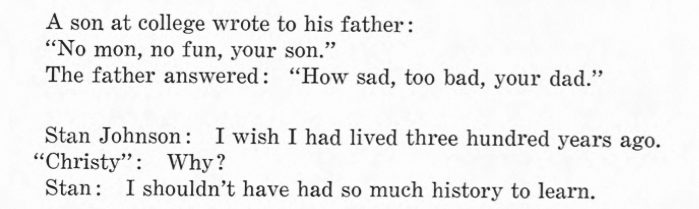
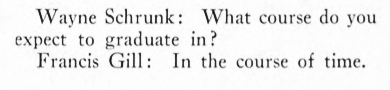
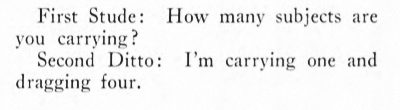
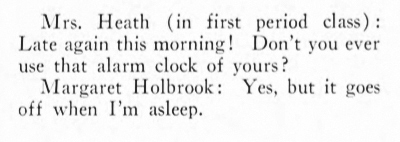
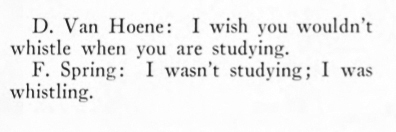
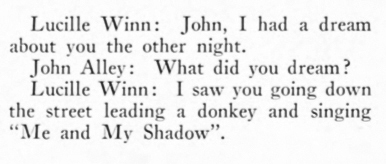
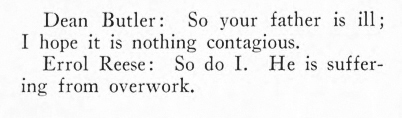
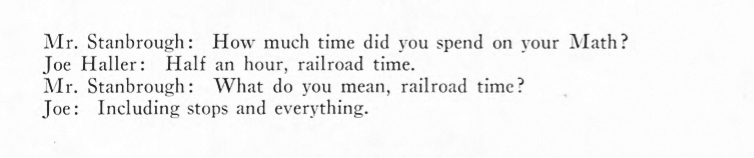
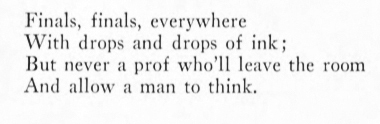
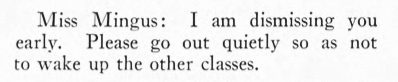
After pouring through some old copies of “The Norm”, Western’s old yearbook, I came across a section filled with jokes from 1927 and 1928. Most of these jokes made our staff go, “wait — what was the punchline?” So, naturally, we had to share them with our readers.

Here is a taste of comedy from the 1920’s… I’m sorry.

[fruitful_sep]

[fruitful_sep][fruitful_sep][fruitful_sep][fruitful_sep][fruitful_sep][fruitful_sep][fruitful_sep][fruitful_sep][fruitful_sep][fruitful_sep][fruitful_sep][fruitful_sep][fruitful_sep][fruitful_sep][fruitful_sep][fruitful_sep][fruitful_sep]


Opinion: Should everyone be involved in team sports?

Recently, a staff member mentioned that they believe every student should be involved in a team sport. Some staff members decided to follow up by adding their arguments for or against this opinion.

Lake Larsen | Sports Editor

Before speaking about the benefits of sports, it’s important to keep in mind that athletic side of intramurals or club sports might not be an option for everyone. Whether it be a disability, injury or something else that impedes a students ability to perform on a team athletically, this does not exclude them from participating. Coaching or managing are both options that most can take advantage of.

There are many major lessons that sports teaches that a student cannot learn in a classroom. The most valuable of these lessons — how to effectively work with a team. Obviously you can learn this outside of sports, but the teamwork within a sport is a very unique trait that every student needs to learn.

Competitive intramurals and club sports can bring people to their mental and physical breaking point. Hard fought games against more talented opponents can bring a team closer than any school assignment could. From the star player to the team manager, every person on the team is given a lesson on how to keep fighting no matter what the odds.

The competitive nature of sports puts the team into an environment where the only way to be successful is to trust each other. Due to unpredictability of every game, the team has to learn to adapt both mentally and physically to their environment. By joining sports in school, no matter what level, students can learn how to adapt and overcome.


Contact the author at llarsen13@wou.edu

Photo courtesy of Paul F. Davis

Chrys Weedon | Entertainment Editor

I would not disagree that participating in a team sport can be a positive experience for some. But I would argue that declaring that everyone should participate in an intramural or club sport in some way or to insulate that a person’s experience is somehow lacking if they do not play a sport in college is painting with too broad of a brush.

As a person who lives with a disability, I do not feel that my interpersonal skills or social fulfillment are in any way impeded by the fact I do not play/manage/coach a club sport. I do not mean to state that sports teams do not have their own specific dynamics, but to say that everyone “must” play a team sport in order to truly understand how to work and play well with others is an oversimplified and narrow way of thinking, in my opinion. I would dare to say that anyone with a disability who isn’t involved in sports either because of their disability or because their interests lie elsewhere is not, in any way, “missing out.”

Looking back on the period of my life that I played sports, I do not feel as though I learned something so profound about teamwork or group dynamics that I haven’t also learned by being involved with other, non-sports-related groups. To say that the only environment that demands a physical and mental adaptation is one that is explicitly linked to sports, is simply untrue.


Contact the author at cweedon16@wou.edu

Photo courtesy of Paul F. Davis

Bailey Thompson | News Editor

My perspective on this issue comes from a place of someone who likes to be active, but who has never really considered herself an “athlete” — at least in the regard that I didn’t grow up playing on sports teams. With that said, I do see tremendous value in trying something like intramural sports here at Western.

Although I acknowledge that it isn’t for everyone, I believe intramurals can be a great way for students to engage in a low-pressure activity and bond with a group of people that they may or may not already know. As a senior, I have been on three different intramural sports teams during my time here, and I can attest to the fact that it is a supportive, low-risk environment. Both as a first-year student and as a Resident Assistant, being a part of intramural teams with my residence hall communities was a great way for our whole hall to bond and get involved. So, even though some groups choose to be more competitive than others, people who consider themselves “beginners” can still feel comfortable and have fun.

My advice to anyone who is contemplating joining an intramural team: try it. While it may not be everyone’s cup of tea, it can be a fun and easy way for a wide variety of people to come together, laugh, be active and enjoy some friendly competition.


Contact the author at bthompson15@wou.edu

Photo courtesy of Paul F. Davis

Cora McClain | Copy Editor

As a person whose teenage years were defined by the year-round sport I played, I can attest to the fact that sports can help develop important leaderships skills and encourage camaraderie between players. However, high pressure situations and the need to win can also do a number on a person’s mental health. All too often athletes struggle under the detrimental effects of continually being told that they’re not good enough across the spectrum of sports.

For those athletes, intramurals can be a good outlet to get out on the court or field again, without having the looming pressure. On the other hand, intramurals can also fall a bit short for an athlete who played so competitively for so long. For instance, most intramural teams don’t want any freelance players; so, if you don’t personally know any experienced players, you can end up playing games that don’t let you properly demonstrate your skill. Without proper practices and a coach’s guidance, the league to feel a bit slow and unstructured compared to the fast paced lifestyle surrounding high school and year round sports.

If you still want to play, but feel the intramural league lacking, then I would highly suggest looking into joining a club sport. Most of them meet on a regular basis for practices and have a coaching staff to help you continue to grow as a player and even have a league that they compete in without the looming obligation to play. They simply offer a more competitive and structured way to itch the metaphorical sports scratch.


Contact the author at cmcclain17@wou.edu

Photo courtesy of Ashlynn Norton

Paul F. Davis | Managing editor

Although I agree with what is being said, I think all able-bodied people can benefit from sport. But the previous responses are missing the real point of why a person should get involved in sport — the actual exercise that is involved. If a person who doesn’t currently exercise but enjoys playing sports starts to move because of sports, it will help them in so many facets of life. According to American College of Sports Medicine, they will not only see an increase in mood but they will also experience intangible benefits such as reduced stress and reduced chance of heart disease, as well as increased self confidence and quality of sleep.

Once the person gets over the initial struggle that is becoming physically fit they will see how wonderful it feels to be able to compete at your highest level for a prolonged period of time and how wonderful it feels to be free to do whatever you desire to do in your body. When you experience such a freedom it can have such a positive domino effect. But that domino effect isn’t just reserved for a person participating in sports. Rather, it’s reserved for anyone who routinely moves. So if you take anything from all of this writing, find what you enjoy to do that makes you move so you too can be free in your own body.  


Contact the author at pfdavis14@wou.edu

Photo courtesy of Ashlynn Norton

An interview with one of Western’s YouTubers

Rebecca Meyers | Lifestyle editor

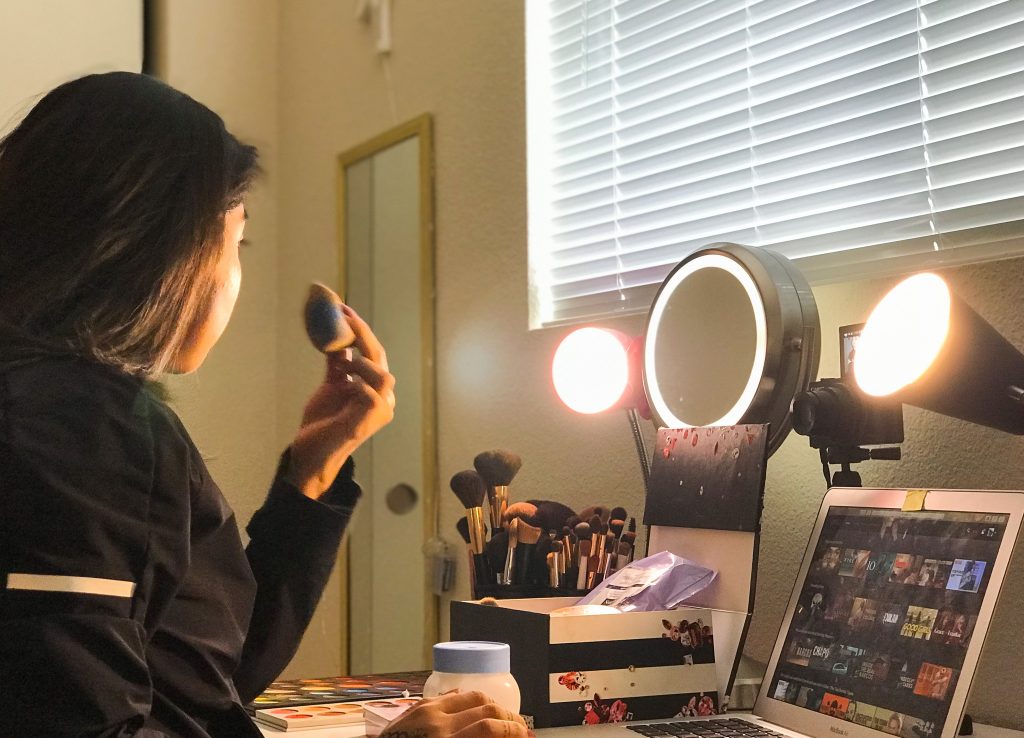
Western on Instagram is full of posts of school spirit, friendships and everyday life in Monmouth. It’s also where to find first-year Melinda Ortega, who goes by Mel on social media.

On @makeupbyymel_ and @hennasbymel, Ortega showcases her makeup and henna skills in short tutorial clips and photos. Ortega also has a YouTube channel where she vlogs. In a time where social media is so saturated with people making content, I was curious to hear about the process from a Western student.

Talking with Ortega, I learned that she is from a small town in California.

“Most people don’t know where it is,” she explained with a laugh, saying she usually had to explain its relativity to Los Angeles. She got to Western through her sport, soccer, and is deciding between being an education or a communications major.

Her content, however, is something she’s more sure about.

“I’m less comfortable talking at a camera,” she explained in relation to the style and presentation of her content. This is largely why her makeup tutorials are shorter and posted on Instagram rather than YouTube.

For Ortega, her activity on social media began just for fun during her senior year of high school. She drew inspiration from famous YouTubers like James Charles and PatrickStarr. However, as she developed her filming and editing skills, she said she began to think, “maybe this can go somewhere.”

For now, her following is small.

“(The comments) are mostly my friends and family encouraging me right now,” she told me. However, she’s preparing for the opportunity to grow her brand and her presence on social media. So far, one success she’s had is that some lash brands have asked her to promote them. She’s also slowly developing her filming and editing skills.

“At first it took me three hours to edit a one minute video,” she revealed.

However, if she does gain more of a following, she knows the internet trolls will inevitably come as well. That doesn’t mean she intends to slow down, though: “I’m curious and nervous to see what the mean comments say.”

To any others who are considering starting their own channel, Ortega advised, “Just do it! They always say to just do you, so that’s what I try to do and what my advice is.”


Contact the author at howllifestyle@wou.edu

Photo courtesy of Melinda Ortega

Students give advice on preparing for midterms

Rebecca Meyers | Lifestyle editor

Armed with caffeine and study guides, students of Western are starting to take on their first midterms of 2019. If anyone made new year’s resolutions to study more, they will be tested starting this week.

In order to help everyone breeze through their midterms, or maybe just survive them with minimal panic involved, some of Western’s students offered their advice.

Grad student group Tanya Stanley, Mackenzie Gallo, Sara Chavez and Jonathan West-Gray had an abundance of tips from years of experience.

Chavez: “Don’t panic. Get organized, set up a schedule.”

Stanley: “It may seem obvious, but sleep. And eat. It’s important.”

Gallo: “Use the rentable study rooms in the library.”

West-Gray: “Use a planner; space out your studying.”

Keith Macadangdang, a business major: “Persevere! Power through, even when all you want to do is watch Netflix.” Macadangdang, who is minoring in dance, has five finals this term.

Rebecca Chadd, a Western alumna: “Actually write out the practice essay questions on the study guide. Don’t just read over the questions and assume you know it all. Writing it out will help you find gaps in what you know and make you more confident.” Chadd graduated with a double major in dance and Spanish, and is still active in Western’s community.


Contact the author at howllifestyle@wou.edu

Photo courtesy of Rebecca Meyers

How to start a new club

Rebecca Meyers | Lifestyle editor

Western is home to a wide variety of clubs and organizations, from Unidos to the Communication club to the Triangle Alliance. There’s something for just about everyone. However, there’s always room for growth, especially when there are so many topics and interests to cover. For those considering adding to Western’s collection, here’s the basic steps needed to create a new student organization.


Step One: One of the first things a club needs, aside from its founder, is an adviser. Advisers aren’t students but are often professors in topics related to the club. Before moving onto the next step, the club will also have to recruit a minimum of five student members.

Step Two: The founder(s) can start the registration process on OrgSync through Portal, where other students can join the club. The application requires a name for the organization and a categorization of the club — Greek, academic, student government, etc. It also has a place for the founders to give a brief description, a website, and keywords to help other students find the club based on their interests. The organization will also need some way for others to contact, such as their own email address and someone to be in charge of said address.
Step Three: All the organization will then need before becoming official is a meeting time and place, as well as a president and any other positions needed by the club.

Step Four: The organization will also require someone to write a constitution outlining the guidelines and a mission statement to inform potential members of the organization’s purpose.


The process may be long and difficult, but worth it in the long run to help more students find a group they find interest and belonging in.


Contact the author at howllifestyle@wou.edu

Photo courtesy of Ashlynn Norton

Clubs from Western’s history

Rebecca Meyers | Lifestyle editor

Today, Western has grown to around 5,000 students, and with the population the number of clubs has grown. We have a number of clubs that are more recent additions, but some, like some of the fraternities and the Black Student Union, have been around for a few decades. Others have come and gone.  In the 1940’s, Western had many clubs that have since died on campus.

International Relations Club: Before Model United Nations — and not too long after the real United Nations was formed — there was the International Relations club. At first it may not seem so long ago, until reading the yearbooks that stated a “tour of Hawaii” speech was given 1948, before Hawaii even joined the United States.

Archery Club: An all girls club, the archery organization advertised in a yearbook from the 1940s as the embodiment of Robin Hood and Sherwood Forest. The team practiced in an indoor shooting range in the basement of Campbell Hall, or in an open field near campus. They also competed in the National Archery Tournament.

The Campfire Girls: Another all girls organization from 1940, the Campfire Girls sponsored a number of school events and guest speakers — including a monthly Charm School. In one case, the guest speaker was a Native American woman from another school who talked about the meaning behind certain Native crafts and traditions.

Wolf Knights: A men’s service organization that lasted from the 1930s through the 1970’s, the Wolf Knights volunteered as the “official welcoming” and student advisors to Western’s campus.

La Danza Club: Meeting twice weekly in the 1950s, La Danza was a club that encouraged enthusiasm for creative dance.

Forensics: Created in the 1960s and lasting through the 1970s, the co-ed Forensics club went to annual competitions to test their public speaking skills and brought home a number of trophies and awards.


Contact the author at howllifestyle@wou.edu

Civil rights film series on campus

Chrys Weedon | Entertainment Editor

Civil Rights Film Schedule:
Jan.30 Eyes on the Prize (Continued episodes)
Feb. 6 Freedom Riders (Famous bus trips across the South in support of desegregation)
Feb.13 The Black Panthers (A documentary on the Panthers and their demise)
Feb. 20 A Good Day to Die (The story of Dennis Banks and the American Indian Movement)
Feb. 27 Incident at Oglala (The Leonard Peltier story of injustice on the Pine Ridge Reservation)
Mar. 6 American Outrage (The struggle of Western Shoshone women for tribal rights)
Mar. 13 The People Speak (Howard Zinn and friends provide a critical, social movement based history of the  U.S.)

The three months that make up winter term hold within them many significant dates: the anniversary of the women’s march (Jan. 20, 2018), Martin Luther King Jr. day (Jan. 21) and Black History Month (February), to name a few.

Winter Term also offers a class that focuses on film from the civil rights movement. For six years, Dr. Dean Braa has been teaching Sociology 407.

“I invented it, sort of. Years ago (the sociology department) had a discussion and we discovered that a lot of students, most students, didn’t know anything about the civil rights movement,” commented Dr. Braa. “Not many students have that opportunity, and we have looked at US history books … and most of the US history books I use, even around here, say little or nothing about civil rights.”

The film series is open to everyone, no matter if they are registered for the class or not. Participants watch 12 films across the term, including the documentary series “Eyes on the Prize” and documentaries following the Native American civil rights movement.

“We try to make it fun, I tell people ‘bring popcorn, bring snacks, bring your dinner if you want to,’” said Dr. Braa.

In the 50 years since Dr. Martin Luther King Jr’s death and the 37 years since the end of the Black Panther Party, civil rights film has been replayed in educational settings across the country. But why is rewatching this film so important?

“Well (the class) raises consciousness about social movements, it raises consciousness about racism and how terrible it is … this racism wasn’t just in the south,” explained Dr. Braa. Watching films from and about the civil rights movement is not only educational, but can teach about present-day movements as well. Dr. Braa discussed, “(injustice) is still going on now. We haven’t fixed it … (the film series) serves to show a connection; we gotta keep this movement going.”

Film and other art that was born out of the civil rights movement can show how successful social change happens.

“You want people to understand, positive change doesn’t usually come from within government, it comes from outside,” said Dr. Braa. Film from this specific period of American history shows that change usually happens when the status quo is upset.

“Social movements that kind of threaten government or put government under duress, that’s where positive change comes from,” remarked Dr. Braa.

A film is shown every Wednesday night from 5:30 to 8:00 p.m. in the Health and Wellness Center in room 203. All are welcome to attend.

“What we hope you’ll take from this: to see (America’s) past but apply it to the present and see we still need to make some big changes,” concluded Dr. Braa.


Contact the author at howlentertaiment@wou.edu

Photo courtesy of Ashlynn Norton

Dodie Clark’s “Human” EP review

Chrys Weedon | Entertainment Editor

Back in 2007, Dodie Clark started started posting her original songs — and covers — onto her Youtube channel, doddleoddle.

Since the its birth, Clark’s main channel and second channel, called doddlevloggle, have blown up, becoming a staple on Youtube. Hailing from Essex, England, Clark writes and performs on a variety of instruments, including ukulele, guitar and piano. On her first channel, Clark has over 1.7 million subscribers and has surpassed 200 million views; her second channel has seen similar success, with more than 900,000 subscribers and 100 million views, according to socialblade.com. Clark also has a VEVO channel, dodieVEVO.

Clark has released three EPs over the years, including “Intertwined” and “You.” Her most recent EP, released on Jan 18, is titled “Human,” and like her other EPs, was self-released. The title track to the album was released in September as a single and a teaser for her new project.

“Human” includes seven songs, most of which are studio-recorded versions of acoustic songs that Clark has posted on her Youtube channel previously.

The EP has a newly recorded version of Clark’s song “She,” which is arguably her most well-known song. “She” tell the story of Clark’s infatuation with a female friend and her struggle with accepting her sexuality.

This very personal collection of songs analyzes complex emotions and themes such as falling back in love after being hurt, losing friendships and the crushing pressure and guilt that often comes with internet fame. Clark’s intense vulnerability and her superb writing ability have only gotten better with age. When an audience gets to witness one of their favorite artists grow and mature through their music, the bond between them grows stronger.

The stringed instruments layered into the background and the vocal harmonies add a new depth to Clark’s songs. Clark has managed to keep the simplicity in her music that attracted her fanbase in the beginning, but she has also incorporated a new complexity that keeps her EP fresh.

Overall rating: I would recommend this album.


Contact the author at howlentertainment@wou.edu

Photo courtesy of dodie.co


Art on campus: “Soliloquy”

Chrys Weedon | Entertainment Editor

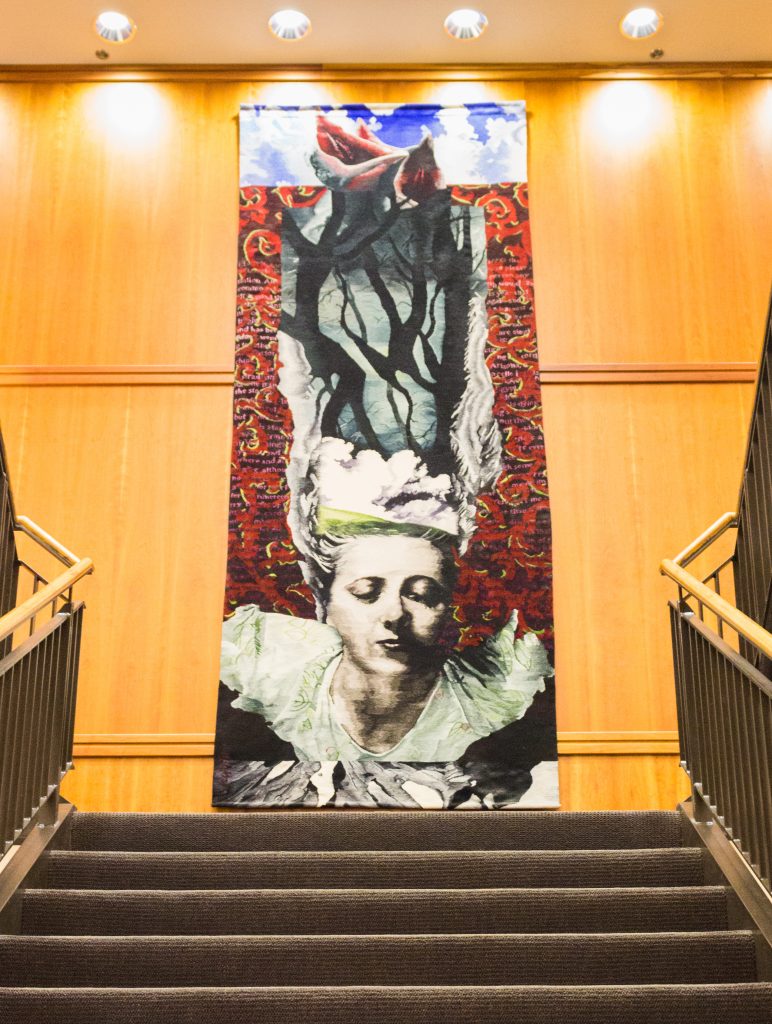
In the first stairwell of Hamersly Library hangs an intricate tapestry that many students may not give a second glance. “Soliloquy” by Shelley Socolofsky has been living in the library since it opened its doors. The art piece was commissioned specifically for the library as a part of the Percent for Art program.

The Oregon Arts Commission started the Percent for Art program in 1975, when it applied only to Marion and Polk counties. The program legislates that any building with a budget of $100,000 or more must set aside one percent or more of their budget for public artwork. In 1977, the legislation took effect in all Oregon counties.

Shelley Socolofsky is currently based in Portland, Oregon. According to her website, shelleysocolofsky.com, “informed by long histories of textile production with its orientation to pattern and decoration, her work explores the material, conceptual and poetic nuances of ‘craft’ through a hybrid practice incorporating both digital technology and analogue hand processes.”

“Soliloquy” is a tapestry in Gobelin Tapestry style, a technique born from Les Manufactures des Gobelins in Paris and Uzes, France, where Socolofsky completed an apprenticeship. According to Hamersly Library’s website, Gobelins is a tapestry style that was developed during the middle ages in Europe from cloth making traditions developed over centuries.

“Part of why I like it so much is that it’s huge, and it represents so much work,” said Paula Booth, an art professor and director of the Cannon Gallery of Art in Campbell Hall, “I also find that it looks totally different when you’re standing at a distance.”

The tapestry features a woman whose head opens into a cloudscape. Flowing upward, clouds turn into tree branches and finally the top of the tapestry sits baby birds, mouths agape. The pieces represents the hunger for new knowledge, open-minded thinking and the search for new ideas. Woven behind the image of the woman are excerpts from an Anne Sexton poem; the words are very subtle and visible only at a semi-close distance. The tapestry captures the mission statement and vision of a library — the pursuit of knowledge and exposure to new ideas.


Contact the author at howlentertainment@wou.edu

Photo courtesy of Ashlynn Norton

A look inside intramurals: Female participation

Mikaela Wong | Freelancer

Intramural sports have become a well known opportunity for students to take part in organized sports without the need to commit to the high-levels of competition that student-athletes do. It’s a common way to meet friends, get some physical activity in or just take a break from studies.

From Fall Term of 2017 to Fall Term of 2018, the three most popular intramural sports at Western were volleyball, basketball, and flag football per IMleagues.com/wou. According to the participation by class, first-years and seniors were the most active students to sign up for IMleagues. However, the biggest disproportion of participation was the female vs. male statistics. Out of 1429 participants in the 2017-2018 school year, 975 (68.2%) of them were male and only 454 (31.8%) of them were female.

While some may argue that this lack of participation from females is due to lack of opportunities, Western offers equal opportunity to males and females. Basketball, for example, offers a women’s, men’s, and co-ed league. Also, the co-ed league offers some different rules such as female players getting awarded more points per basket.

When asked about this rule difference, senior exercise science major Tori Cambra weighed in.

“The fact that girls get more points per shot makes it more fun for us because everyone wants us to score. And the men’s ball is heavier than the women’s ball anyway, so it evens it out,” said Cambra.

Another potential cause for the disproportion may just be that some women enjoy playing pick-up games at the Health and Wellness Center more rather than joining intramurals.

“I like playing for fun and I feel like a lot of people’s mindset is to be competitive … I wish there were more teams who just wanted to have a good time, or at least made that clear in their team name when we want to sign up,” said junior communications major Mia Medina.

On the reverse side, there are girls who play multiple intramural sports per season and love it. Emily McMillian, a junior education major, is one of those girls. When asked why she thought the female participation within Intramural sports was so different, she offered her personal insight.

“I think girls do a lot of things in groups and it’s either everyone does it or no one does,” said McMillian. “But if you have the mindset of just wanting to have fun and put yourself out there, you’ll make a lot of new friends who love doing the things you do. No one is going to force you to do anything in college, so if it’s up to you to make that jump and just do it.”

Compared to some national averages, Western does an above average job at getting females to join and play, per researchgate.net. However, there is always room for improvement and Western’s Intramural Department is looking for suggestions to help grow the options for all athletes.

“We are always open to suggestions on how to improve IMs and how to get more IM participants. In fact, most of of the changes we have made are a direct result of participant feedback,” said Assistant Director of Intramural and Club Sports Andy Main. “To make such suggestions, simply contact me at: maina@wou.edu

To join or start a team, visit IMleagues.com/wou.


Contact the author at mwong16@mail.wou.edu

Photo courtesy of Ashlynn Norton

Club sport statistical breakdown

Lake Larsen | Sports Editor

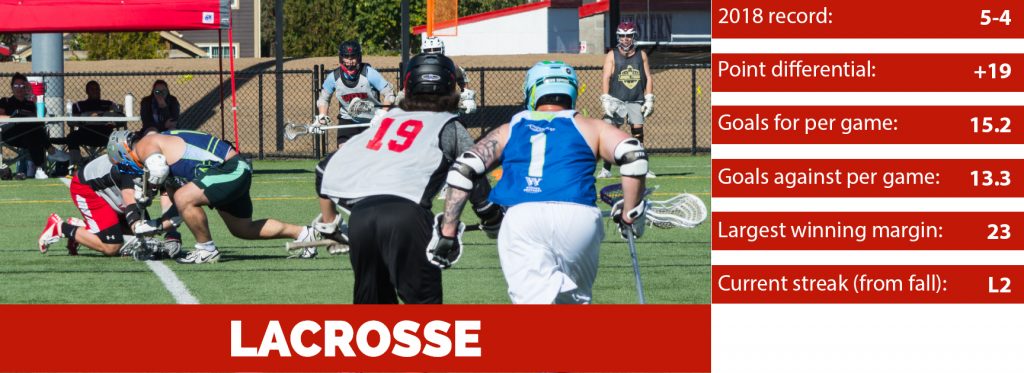
In the previous season, Western’s lacrosse team missed the conference playoffs by a razor-thin tie-breaking vote. However, the team only graduated two seniors while they brought in a slew of first-year players for the upcoming season. This new youth in the program have a chance to set a foundation for success over the next few seasons. The Wolves take the field for the first time on Feb. 9 against UC Davis at a neutral site in Ashland.

Photo courtesy of Paul F. Davis


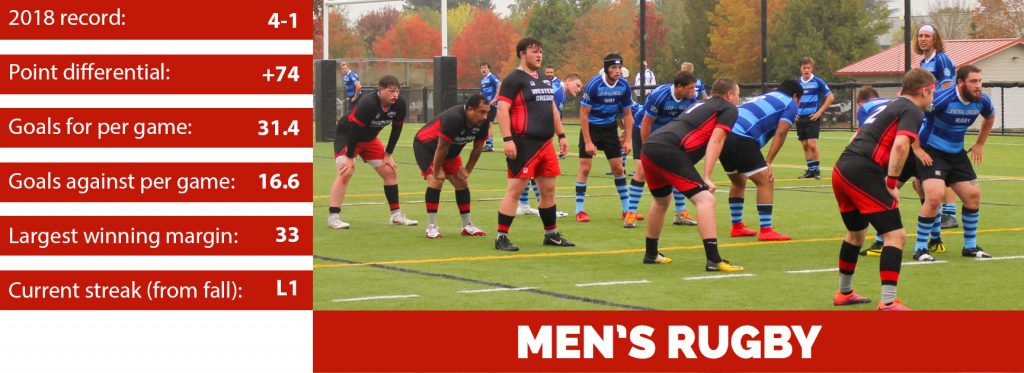
The 2018-19 season for the Men’s rugby program has been a historic year for the club. During the fall season, the Wolves were unstoppable after rebounding from a narrow loss on Oct. 7 against reigning conference champions Central Oregon Community College. While there is still a lot of rugby left to play, the Wolves have already obtained a bid to the Challenge Cup for the regional championships after being chosen to host the tournament. The Wolves hope to right the path on Feb. 2 after losing their first match in over a month on Jan. 26 against Oregon State

Photo courtesy of Ashlynn Norton
 

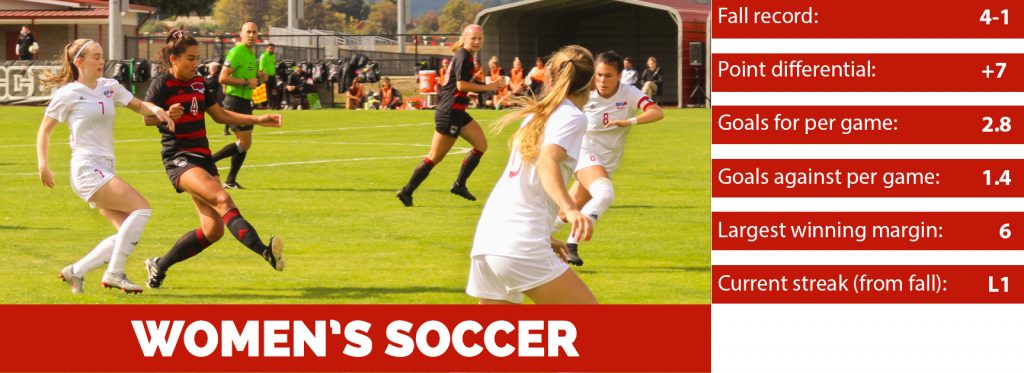
After being a club for barely one year, the women’s soccer club has already shown they’re not too young to dominate. The club was started during the middle of the 2017-2018 school year and only played a handful of matches before the end of the season. However, during the fall of 2018, the Wolves showed they meant business. Western dominated their opponents in every game, earning them an undefeated record as well as a small school championship win before losing in the overall championship game. The Wolves first spring match is set for Feb. 9 against Portland State University.

Photo courtesy of Ashlynn Norton
 

Contact the author at howlsports@wou.edu

Men’s Basketball falls to Northwest Nazarene

Lake Larsen | Sports Editor

After a huge win over Central Washington on Jan. 24, the Wolves continued their road stint against Northwest Nazarene University. The Nighthawks sat just above the Wolves in the GNAC standings at second place. With a chance to move ahead in the conference, the Wolves took to the court on Jan. 26.

In the opening minutes of the first half, the Wolves pulled ahead of the Nighthawks. However, this lead was short lived. What was once a multiple possession lead was quickly erased as Northwest Nazarene shot ahead. As the minutes ticked away on the first half, Western fell deeper and deeper into a hole with seemingly no way to fight back. At the half, the Wolves were down by 14.

In the opening minutes of the second half, the Wolves again fell victim to precise shooting and suffocating defense. The Wolves looked outmatched and out-classed as the Nighthawks put the pedal down and began to run away with the game. Finally, with the final half reaching the midpoint, the Wolves fought their way to a single-digit deficit. Unfortunately, this seemed to only be a minor speed bump to the Nighthawks as they quickly shot back ahead.

In the waning minutes of the match, Western again had brought the game to only being a few points down, but the match was all but over. Western hadn’t seen the lead beyond the opening minutes of the first half and as a result lost 70-78. The Wolves remain at third in the conference and still have chance at a postseason.


Contact the author at howlsports@wou.edu

Photo courtesy of Ashlynn Norton