

Mount Hood

The rebirth of bookstores

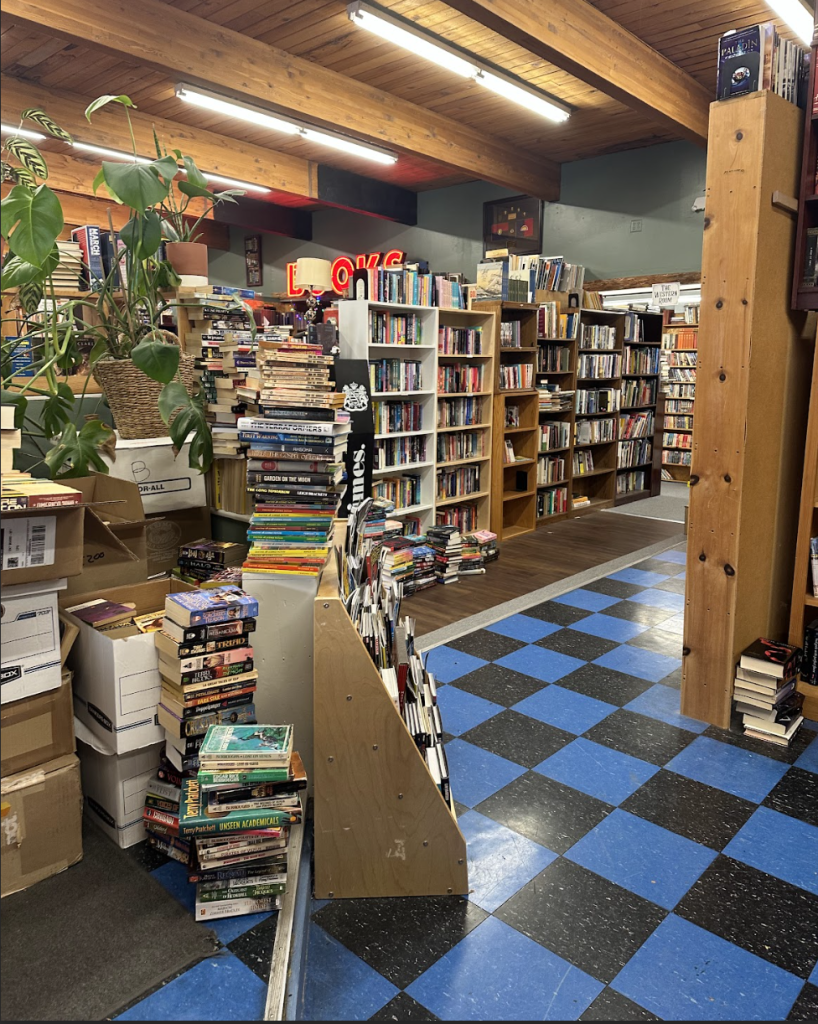
A photo of the inside of Browsers’ Bookstore. | Photo by Hannah Field

Jan. 21 2026 | Hannah Field | Editor-in-Chief

Recent bookstore statistics prove that popularity for local businesses in the US is climbing rather than subsiding five years after the coronavirus shutdown, with communities rallying and the landscape of bookstores adapting to meet modern demands.
The American Booksellers Association, or ABA, reported a membership increase of 18% and 323 new brick-and-mortar, pop-up and mobile stores opening across the United States in their 2024 annual report. They noted that 2024 had “the most successful Independent Bookstore Day to date.”
According to Harvard Business School, despite local bookstores struggling to remain afloat during pandemic regulations that limited business operations and corporations like Amazon dominating the industry, localism has become a social movement that has been steering indie bookstores back to the forefront. Communities have emerged to shop small and support local businesses in the wake of recent corporate boycotts against companies like Starbucks, Target and Amazon for their various methodologies, including anti-union sentiments alongside a lack of corporate accountability and diversity inclusion.
Abe Richmond, owner of Browsers’ Bookstore located in Albany, Oregon, said, “I was working here during the pandemic. It was obviously bizarre, and we closed for several months, but the customer base rallied behind us. So we would do sidewalk drop-offs, they would pay for it over PayPal or whatever, Instagram, and then we would package their books and put them on the porch.”
Richmond bought Browsers’ from the previous owner after graduating from Oregon State University, having been an employee of his, and has been at the forefront for more than three years. While Browsers’ Bookstore handled the precarious nature of being a small business during the pandemic, the customer base has also adapted to new ownership — and adapted well, with Richmond being recognized across town as the owner of Browsers’ and building a solid rapport with customers who seek out his services specifically.
When it comes to Amazon and Barnes & Noble, resale bookstores like Browsers’ suffer less than one might think. “I like them because people will spend $40 on a new hardcover in Salem and then read it, and then not know what to do with it, so then they bring it here. And I have a fairly new, good-shaped book.”
Customers who drop off books may receive in-store credit at Browsers’ to spend. Beyond that, Richmond also displays local authors and merchandise drawn by nearby artists. “It’s counterintuitive. Because who is this person, you know? But then, if you point it out, like, ‘Hey, they live in Albany or Corvallis,’ people are like, ‘Oh, I’ll read it almost just for that sake.’ Whereas if it was some other book that you’d never heard of, they’d probably pass over it.”
He also noted the enjoyable community aspect when authors host signing events at Browsers’, bringing a sense of life to local stores. Richmond also instrumented a film drop box through Light Rider Studios, meaning customers can drop off their film to get developed on their behalf and delivered.
Bookstores have been changing since the 1970s, with 43% of local bookstores closing between 1995 and 2000, reminiscent of the decline in physical bookstore sales through the Kindle push in the late 2000s and 2019, when Amazon had sold more than half of all books in the United States. Jeff Bezos, owner of Amazon, stated, “Amazon isn’t happening to the book business. The future is happening to the book business.”
Amazon was founded in 1994 as an online bookseller by Bezos. Since then, the ABA has labeled it an unchecked monopoly, claiming that it stifles competition and that it has an enormously negative impact on the bookselling market. Amazon was able to expedite growth, printing an effective blueprint to attract customers and obtain and keep wealth by failing to comply with tax regulations and offering duty-free purchases.
Amazon also regularly offers discounted books, undercutting businesses that have to sell at full price in order to stay afloat. Booksellers have been forced to drop employees in order to stay profitable — which could also be a part of why Richmond and Sydney-Anne Graves are the sole paid workers as owners of their respective businesses, Browsers’ Bookstore and Monarch Books.
Regardless, Richmond and Graves have found success. And, according to the Associated Press, others are too; more than 200 local bookstores were predicted to open across the country between 2023 and 2025.
Monarch Books only just started in April of 2024 out of Lebanon, Oregon, owned and founded by Sydney-Anne Graves, who was a senior in high school when she encountered at a coffee shop the landlord of the building in which Monarch Books resides. That conversation alone spurred Graves to tell her mom later that night: “Mom, I’m buying a bookstore.”
After touring the building — reportedly falling in love with it — and dedicating multiple weeks to deep-cleaning, Monarch Books came to life under Graves’ new ownership and keen eyes.
“We opened, and (that) first day, it was really busy,” said Graves. “And I was like, ‘Okay, this might work out.’ It was really busy. And then, ever since, I’ve been slowly getting more inventory in, decorating, getting it to my vibe. I really love a lot of colors and plants, and there’s still a lot of ideas I have for in here, but it’s come so far from where it originally was.”
Richmond expressed appreciation for the anti-corporate push in 2025, leading to more local shoppers steering clear of Amazon and other corporate sellers. In the current political and social state of the US, local businesses may be inclined to further build queer-safe communities and book selections as opposed to corporate booksellers — potentially building a reliable customer base seeking a supportive book hub and shared community.
Browsers’ Bookstore remains open consistently under Richmond’s new ownership and maintains a loyal clientele across nearby cities. A good chunk of customer interaction relies on online postings and website sales through Browsers’ Bookstore’s virtual pages.
“I sell a lot (from what) I post on Instagram, and then people will be like, ‘Hey, I’ll take it.’ And so they come in and pay for it,” said Richmond. “It’s weird, though, because say you wanted a book we don’t have. It shocks me every time how many people are like, ‘Hey, can you order it for me?” Instead of them hopping on Amazon, because we go through a new book distributor. But I think it’s because people want to support. I think people like having bookstores.”
“It’s just so awesome, and it’s really cool to see that so many people still support the book community,” said Graves. “I was really nervous about that. I know I read and I know some of my friends read, but I don’t know how many people actually still buy books or shop downtown — so I think that was the most nerve-wracking part about it. But it’s been really great.”
Another aspect of the resurgence of bookstores is the online platforms Instagram and TikTok, cultivating an online community of book lovers. Dubbed “bookstagram” and “booktok,” readers and writers participate in hashtags, giveaways and online sharing, creating trends and catapulting books onto bestseller lists through sheer word of mouth via the internet.
“I feel like I get new customers every single week,” said Graves. “There are so many people who still love reading and that’s (been) helped a lot with bookstagram and booktok, different things that have really kind of inspired people to get back into it, which is so cool.”
“Taylor Swift — I’m not sure what — did something with Shakespeare,” said Richmond. “I’ve had so many women, and girls, college and under, be like, ‘I need Shakespeare.’ … It’s the same, if a movie comes out of a book, people flood the place, like when ‘Dune’ came out. Yeah, I couldn’t keep ‘Dune’ to save my life.”
“I was like, ‘Why is my Shakespeare selling all of a sudden?’ Nobody cared about this before,” Graves joked.
Taylor Swift’s most recent album, “The Life of a Showgirl,” features imagery, lyrics and photography modeled after Shakespeare’s character Ophelia in “Hamlet,” no doubt causing the wave of Shakespeare-mania that Richmond and Graves both experienced. “Dune” amassed a box office of more than $400 million in 2021 and “Dune: Part Two” grossed $715 million in 2024, with the “Dune” franchise built off of six core books written in the 1960s through the 80s.
However, there is a catch to the media frenzy. Allison K. Hill, CEO of the American Booksellers Association, blames Amazon: “Amazon is now the water we swim in … There are multiple ways that an independent bookstore is forced to not only interact with Amazon, but support them — books made into shows streaming on Prime Video are printed with Amazon stickers on the cover.”
Regardless, books have long since had movie adaptations, and well before Amazon and other corporations took hold. Much like local bookstores, movie theaters are becoming increasingly popular — for the second time. Upcoming releases like “Wuthering Heights,” “Project Hail Mary” and “Sunrise on the Reaping” are all 2026 book-to-movie adaptations spanning classic literature, sci-fi and the famous Hunger Games franchise. Show adaptations are equally successful, with notable pop-culture stars of book-to-show adaptations being “The Summer I Turned Pretty,” “Heated Rivalry” — currently thriving on HBO Max — and “Bridgerton.”
With books inspiring much of modern media turnout, it’s unlikely that books and bookstores will succumb to the strains of aging. In a way, books are trendy again, as the statistics prove — Barnes & Noble opened almost 70 new locations in 2025 and has more on the way.
Hill said in a statement in the 2024 annual report, “The numbers only tell part of the story. This momentum occurred despite significant challenges: the usual ones like thin margins, rising costs, and Amazon’s chokehold on our industry, and urgent threats that shook the very foundation of our work as the right to read and access books faced sustained, coordinated attacks.”
The current presidential administration has made a dedicated effort to place bans on books that affect educators and librarians, limiting access to certain content, especially that which discusses gender, race and sexuality. While that’s less likely to impact independent booksellers, the pressure remains to conform as book access limits book readers and their interests. Additionally, independent bookstores can rely on author visits and community involvement; divisive political action can split a customer base or turn away potential author-bookstore collaborations. The ABA, when discussing concerns for people interested in opening a bookstore, cited “free expression challenges.”
Portland’s own Powell’s Books — the largest independent and used bookstore in the world, spanning one city block and containing over a million potential reads — participated in the ABA’s Banned Books Week event in 2024, discussing the right to read, spreading awareness about book bans and hosting panels.
ABA also conducts the yearly Independent Bookstore Day. In 2024, when the ABA reported the highest participation numbers to date for the event, ambassador Amanda Gorman stated, “Independent bookstores are vital hubs of creativity and community. They offer curated selections that foster discovery for readers, while providing vital support and a platform for diverse voices for writers and other creators. They are the true modern-day town square, the beating heart of our communities, and a place for meaningful interaction and human connection.”
The day involved 1,216 stores from across all 50 states.
“Our mission — to help independent bookstores survive and thrive — remained at the core of everything ABA did,” said Hill.
While the 2025 annual report from the ABA won’t arrive until mid-2026, the expectation is that the indie bookselling industry will only continue to grow in spite of the last decade’s challenges, with Graves adding, “I don’t think books will ever go out of style.”

Contact the author at howleditorinchief@wou.edu
Independence launches another month of scratch its

Spring into supporting Independence’s local businesses with April scratch its

Sydney Carpenter | News Editor

Spring has sprung in Oregon and the city of Independence is celebrating the start of the season with scratch its, ending on April 25. Locals who spend $5 to $100 can earn money off their next purchase by buying from these 22 participating businesses:

  • Ovenbird Bakery
  • Parallel 45 Brewing
  • Jubilee Champagne & Dessert Bar
  • Independent Ice Cream Shop
  • The Tap Station
  • Starduster Cafe
  • Mendi’s Pizza
  • Mangiare Italian Restaurant
  • Pink House Cafe
  • Melting Pot Candy
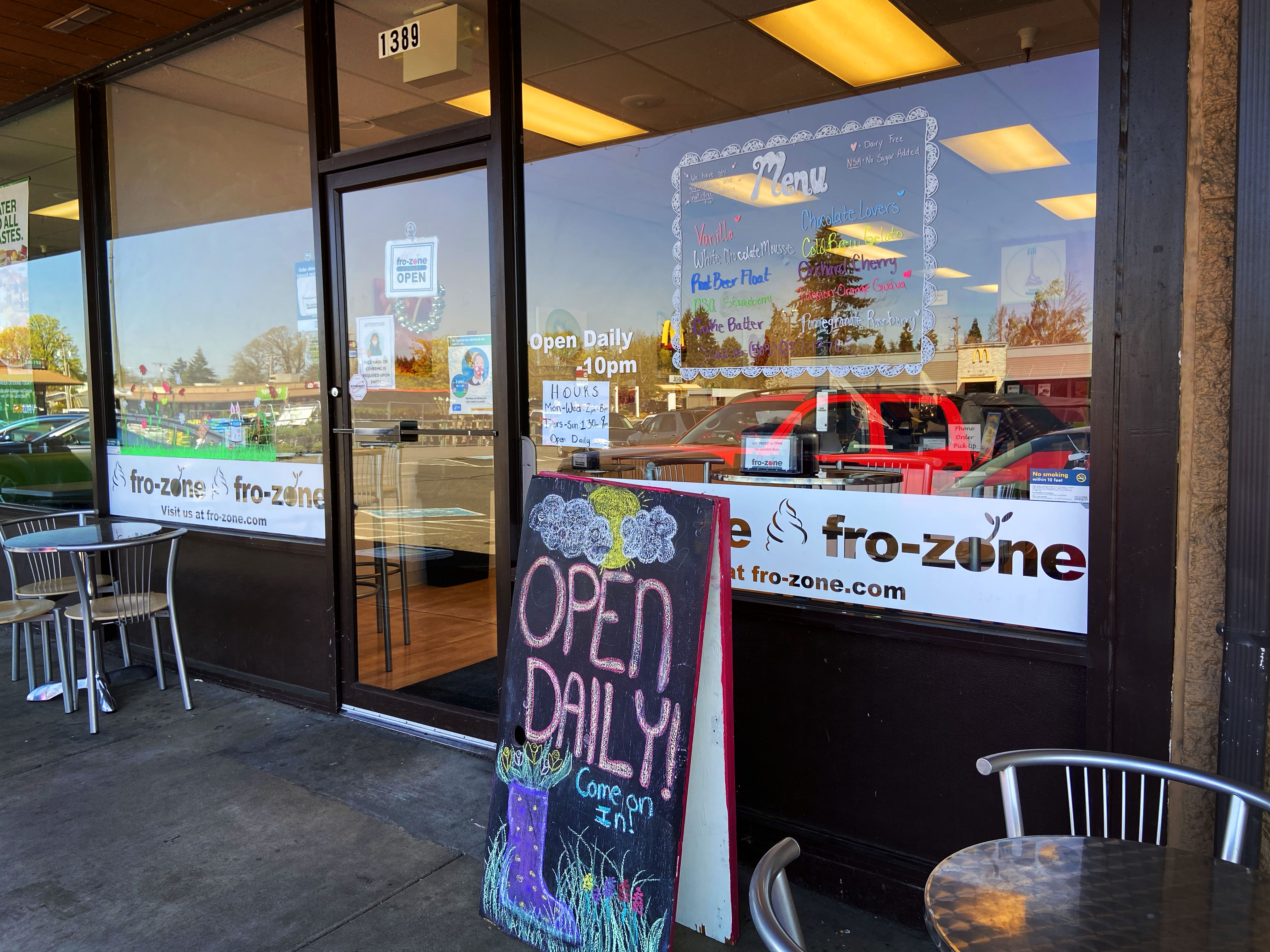
  • Fro-Zone Yogurt Co.
  • San Antonio Mexican Restaurant
  • Chase Bar & Grill
  • Gilgamesh Brewing: The River
  • Arena Bar & Grill
  • The Naughty Noodle
  • Musical Independence
  • The Picken Chicken
  • Green Gables Home Store
  • Same As It Never Was Vintage
  • Miss 9A’s 

Additionally, throughout scratch it season, every Saturday at the Riverview Park Plaza from 4:30 to 6:30 p.m., residents can listen in on live local music courtesy of Musical Independence.

Contact the author at scarpenter18@mail.wou.edu

Right and left wing supporters clash at the Capitol

Protesters in Salem cause conflict in anti-fascism demonstration 

Sydney Carpenter | News Editor

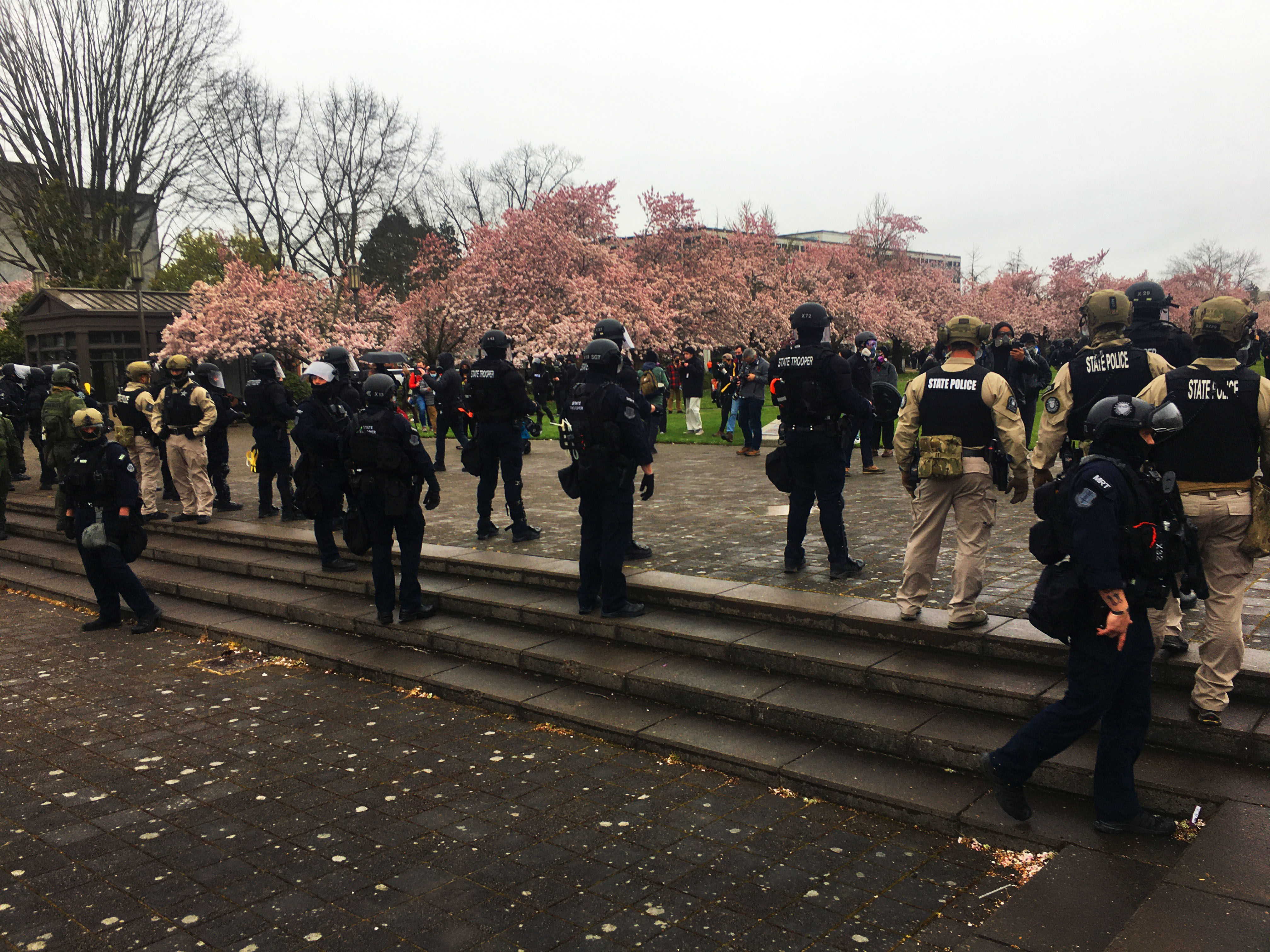
On March 28, over 100 anti-fascist demonstrators contested with right wing supporters and police at the Oregon State Capitol after learning of a right wing Freedom Caravan’s plans to drive through the Capitol to “honor those who fought for our freedoms,” as stated in the rally advertisement.

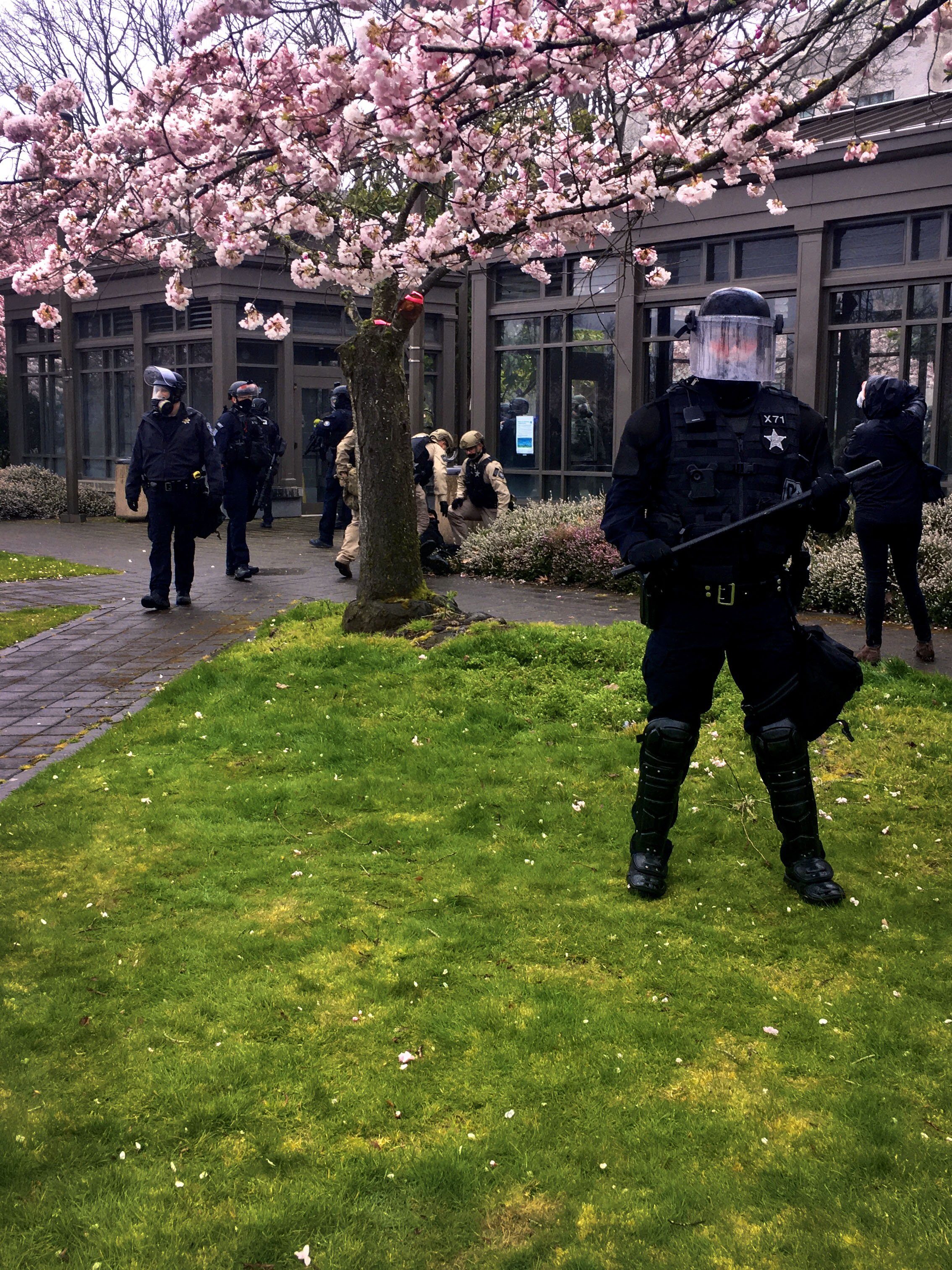
Initially, the counter protest, labeled by the groups as “Fascist Free 503,” intended to deter the rally from reaching the Capitol. However, after a Salem police report claimed there were ongoing reports of criminal activity, Court Street was closed at around 3:45 p.m. and the gathering was declared unlawful. Police began migrating the groups north of the Capitol, announcing any lingering people would be subjected to arrest and potentially impact weapons, munitions and tear gas.

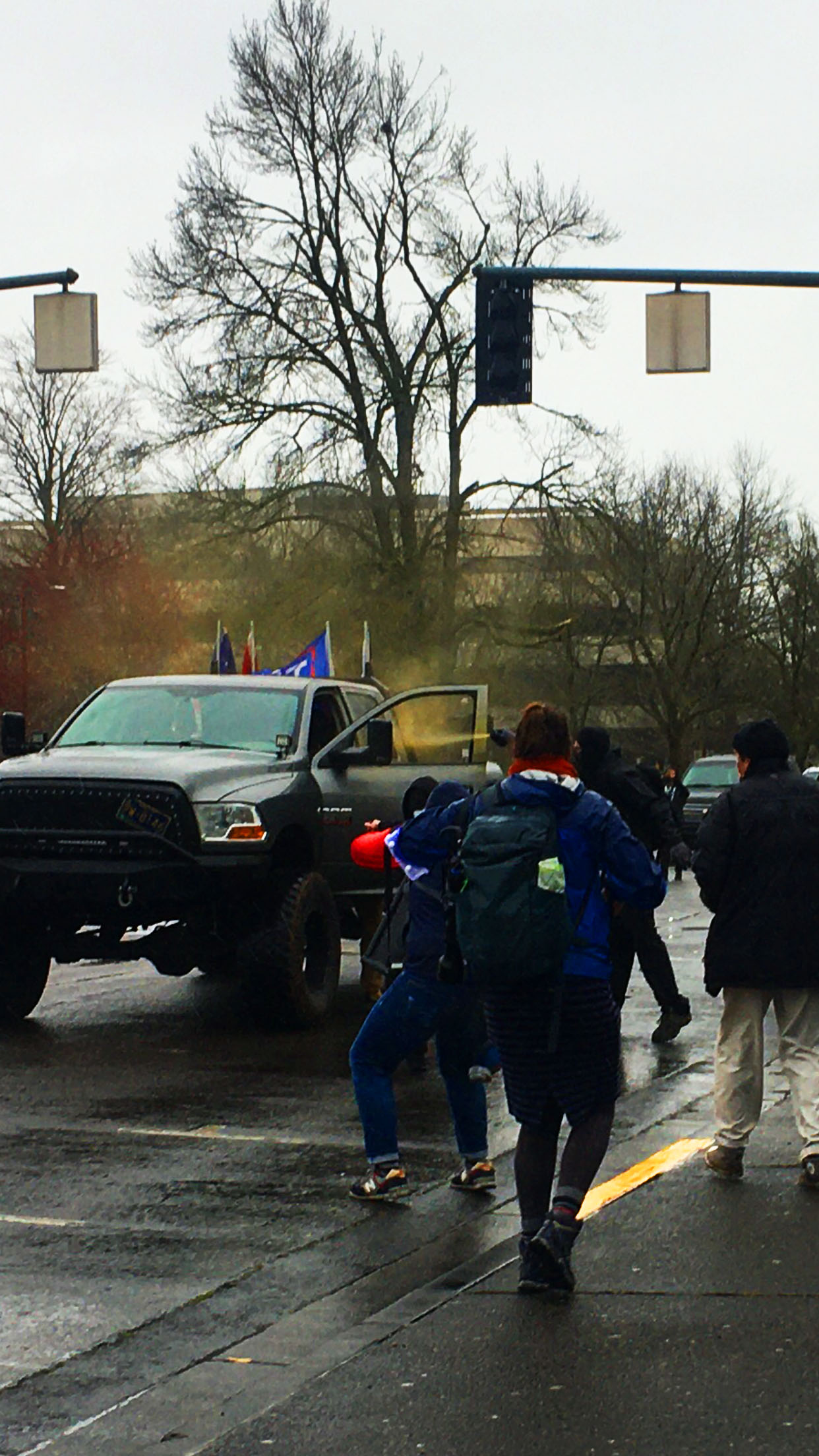
The group dressed in bullet proof vests, gas masks and armed with shields or bats continued to throw paint balloons or rocks from the sidewalks or the street at oncoming vehicles bearing Trump flags or American flags, breaking some car windows and tail lights. One vehicle was damaged after a fallen tree branch from the Oregon ice storm was thrown into the windshield, according to the Salem Police Department. 

In some instances, the counter gathering approached the driver side of a targeted vehicle and maced the drivers in the eyes. One vehicle owner had their car paintballed, and after coming out to check the damage done to his car, “ Fascist Free 503” pepper sprayed the vehicle owner’s eyes and bashed a car window in. The owner drew a gun and yelled at the group to get away from the vehicle following the incident, and police detained and questioned the owner. The vehicle owner was ultimately released for cooperating with the SWAT team and for having a concealed carry license, according to the police report. Onsite police officers said the gun owner never pointed his weapon at demonstrators. 

In total, four demonstrators were arrested: Andrew Alan Foy, 34, was charged with second-degree disorderly conduct and second-degree criminal trespass; Nathan McFarland, 33, was charged with second-degree disorderly conduct; Anthony Villaneda,18, faces five counts of pointing a laser; and William Lloyd Isham, 34, was charged with interfering with a police officer. 

As of Apr. 6, McFarland bailed himself out for $250 while Foy and Villaneda  — for $350 and $5,250, respectively  — were bailed out privately. Police are still investigating and ask anyone with more information to call 503-588-8477.

Contact the author at scarpenter18@mail.wou.edu

Heritage Programming and Activities Committee protests racial injustice

HPAC holds Western leadership responsible for silence against hate crimes towards Asian Americans and Pacific Islanders

Sydney Carpenter | News Editor

Since 2020, there has been a 149% increase in hate crimes towards people within the Asian American and Pacific Islander community, according to the Center for the Study of Hate and Extremism.

Student leaders from the Heritage Programming and Activities Committee were the first to take to social media last Wednesday. Citing Western’s leaders, including University Housing and University President Rex Fuller, HPAC found their silence around hate and discrimination towards AAPI community members disheartening, frustrating and disappointing. After a Feb. 28 hate crime reported by the Collegian towards a Willamette University student and the March 16 mass shooting in Atlanta, Georgia killing a total of eight people, six of them being Asian American women, HPAC expected some acknowledgment or condemnation of AAPI hate.

We as your student representatives (refuse) to stay silent,” said HPAC’S March 31 Instagram post. “We stand in solidarity with all of our fellow residents and (will) continue to actively advocate and fight for our voices to be heard. Black lives (still) matter, and that will not be ignored or pushed aside.”

Within the comment section of the post, University Housing was the first to reply with “Love this!!!!” with students replying the response was not enough or asking why they had not made an official statement of their own. 

“This campus has an atmosphere that creates silenced violence among students, especially student leaders,” said HPAC members. “The current administration flaunts instances where they did the bare minimum and hides instances where they exhibited gross insensitivity, and where they took the credit for things that others did. Western Oregon University’s administration must dedicate itself to reevaluating its responses and responsibilities towards its students, the staff, and the future.”

A day later, University Housing sent out an email to students living on campus and made an official statement via their Instagram page. 

“Hate has no place here,” said the April 1 Instagram post. “University Housing stands with all of our students in condemning the recent violent racist attacks perpetrated against the Asian American community.”

Housing “applauded” the student voices that had taken to social media and thanked students for challenging them to do better. Following HPAC and Housing, other university leadership groups released statements of their own, including Student Engagement, ASWOU and the Student Activities Board.

The Western Howl reached out to Strategic Communication and Marketing last week, inquiring whether administration intended to make a response to the discrimination and violent acts towards people in with the AAPI community. MarCom replied stating the university marketing team published an email sent out by Provost and Vice President of Academic Affairs Rob Winningham to university staff only on March 18 in response to the Atlanta, Georgia shootings. Originally the statement was not intended to be representative of the entire university. However, as of April 6 an email under the Provost address has been sent out to students apologizing for the inadequacy of the original statement released.

Although HPAC acknowledged other statements that had been made, the committee is dedicated to holding the university to its promise of inclusion and its pride of diversity.

“The inaction of campus leadership has caused the student-body to feel frustration, fear, and isolation,” said HPAC. “As student leaders, we acknowledged the experiences of others and ourselves and worked to push towards change that will benefit the future. Incoming students must be willing to learn as individuals how they can make a difference, challenge themselves to critically examine societal norms, even when it’s uncomfortable and push to compassionately advocate for all.”

Going forward, HPAC says it intends to not stop until the university acknowledges and fulfills its promises of fighting against injustice, and prioritizes inclusion and diversity.

“Both AJ Owens, my co-adviser, and I are proud of our students for speaking out against injustices and violence against … AAPI communities,” said Heritage Resident Director and HPAC Advisor Michael Carroll. “We’re grateful to have student leaders who are thinking of other students’ needs and who advocate for support for all of our students, especially those from marginalized identities and backgrounds.”

Contact the author at scarpenter18@mail.wou.edu

2021 graduation ceremony decided

Western’s Commencement Committee finalizes graduation plans  

Sydney Carpenter | News Editor

Over Spring Break, the Western Oregon University Commencement Committee completed their discussion on how the 2021 Commencement ceremony will be hosted.

According to the email sent out to seniors on March 29, the committee has decided to hold both a virtual and an in person celebration. 

For the in person celebration, students and their families will decorate their cars and drive along a designated “celebration route.” At the end of the drive, each student will be able to walk across a graduation stage while being photographed by a professional photographer and their family, if desired. These celebrations will take place on June 12 and June 13.

For students who are living off campus due to the pandemic, the committee has decided to host a virtual Commencement ceremony where all of the graduates’ names will be read. The virtual ceremony will be available on June 11 at 6 p.m.

Students interested in participating in both events will need to RSVP by visiting wou.edu/graduation/ by May 4 in order to participate. 

For all other questions email the registrar at clarkaj@wou.edu.

Contact the author at scarpenter18@mail.wou.edu

Independence Cinema showings begin April 9

Independence Cinema reopening after COVID closures

Sydney Carpenter | News Editor

In February, movie theaters in Oregon were permitted to reopen under the official Center for Disease Control and Prevention guidelines. However, some movie theaters such as the Independence Cinema delayed their reopening, citing concerns for the new strains of COVID-19 and wanting more viable movies to showcase in the theaters.

The hardest thing on a small business so devastated by these closures would be to reopen only to have to close down again,” said Independence Cinema in a Feb. 23 Facebook post. “We did it this fall, and we could not repeat that scenario and survive.”

However, on March 10 the local theater announced that it would be reopening its doors on April 9. 

“This was a very careful decision,” said a March 10 Facebook post, “with lots of planning, waiting and watching. We feel confident that everyone is ready to safely enjoy family entertainment again.”

The current plans for reopening entail operating daily with limited showtimes and adhering to industry-wide safety standards called CinemaSafe. Under these guidelines, all theaters are expected to require staff and patrons to wear masks, social distance audience members, increase ventilation where possible, provide hand sanitizer with at least 60% alcohol content, disinfect the auditorium between showings, train staff on COVID-19 symptoms, make online tickets available for patrons and minimize cash transactions. In each state, theater capacity size varies depending on state governments mandates; in Oregon, it is contingent on a county’s COVID risk level. 

As of March 26, Polk County Health officials reported the county qualified for the moderate risk level by having a 2% positivity rate and 72.3 cases per 100,000 people over the course of 14 days. As a result, Independence Cinema will have a maximum capacity of 50%.

At this time, the theater does not have an official schedule for their showings, but according to their Instagram page, they plan to open with “Voyagers,” “Godzilla vs. Kong,” “Nobody,” “Chaos Walking,” “Raya and the Last Dragon” and “Tom & Jerry.” 

To ensure patron safety, the theater is implementing an RSVP system that can be done either online at www.independencecinema8.com or in person at the ticket counter located outside the theater.

If patrons are not comfortable with watching movies in person, the theater is still offering to-go concessions.

For further information or questions, visit their Facebook page @independencecinema8 or their Instagram @indycinema.

Contact the author at scarpenter18@mail.wou.edu

Northwest Housing Alternatives finishes College Manor renovations and mural

Northwest Housing Alternatives hosts big reveal of Monmouth project

Sydney Carpenter | News Editor

During Spring Break, Northwest Housing Alternatives ⏤ a not-for-profit developer of affordable housing in Oregon ⏤ completed the renovations on College Manor apartment complex.

Starting back in Aug. of 2020, the organization began revamping the interior design, mainly with the replacement of existing, domestic and wastewater systems and updating the bathrooms. External renovations included siding and window replacements on North and South elevations, exterior stairs and enclosure replacements, adding accessible ramps and walkways, mow strips, sealcoat and restriping the parking lot. 

“Affordable housing that is well cared for is an increasingly rare resource all across Oregon, especially in smaller/rural communities,” said Northwest Housing Alternatives housing developer Clayton Crowhurst. “Ensuring that this property continues to be … affordable for many years to come and isn’t sold to a market rate developer that will raise rents and let housing vouchers expire is critical.”

Over the course of the build, the update encountered setbacks, including a four-week delay due to COVID-19 and the Sept. Oregon wildfires, replacing moldy refrigerators and collecting funding.

“The most challenging part of any project like this is obtaining the funding to do it and then getting the many different funders and attorneys involved to all sign off on the project,” said Crowhurst. “The closing process occurred right at the start of COVID and came in right under the wire as several other projects had major funders pull out at the last minute due to fear about what the economy was going to do.”

However, the project was able to be fully funded by the Low-Income Housing Tax Credit, Housing Partnership Fund and a perm loan with Oregon Affordable Housing Tax Credit. During COVID and the wildfires, Crowhurst stated the cost of materials rose significantly, causing a challenge to remain within budget. According to Crowhurst, the construction team of 80 to 100 people remained within budget, totaling $4,553,747 for labor and cost of materials. 

In addition to the construction, Northwest Housing Alternatives implemented a mural ⏤ painted by Portland artist Heidi Schultz ⏤ to showcase during their small presentation to the public. 

“The two of us just kicked back and forth a few different design ideas,” said Crowhurst, “and we really settled on the oak tree … It encompasses the themes of growing but also being sturdy and providing shelter during changing times. It captured a bunch of those things that embody our organization.”

Crowhurst explained that the organization is not out to make a quick dollar, and genuinely cares for its people. Being able to provide 3,000 Oregonians with a place to call home every single night ⏤ because housing is a human right and no one should have to choose between food, housing or healthcare ⏤ makes him proud to be affiliated with Northwest Housing Alternatives. 

Although there were renovations done to College Manor, current rents will not be increased. For more information about the organization, visit their website at https://nwhousing.org/#.

Contact the author at scarpenter18@mail.wou.edu

IFC and ASWOU Senate finalize budgetary plans for next school year

IFC plans for 2021 to be approved by the Board of Trustees

Sydney Carpenter | News Editor

The Incidental Fee Committee has concluded its open hearings and finalized the budgetary allocations and fee application for the next school year.

In their preliminary decisions, the IFC had a total of 34.77% budget reductions for all 15 of the funded areas, and 27% of the reduction was taken from the Athletics department’s funding. However, 100 students ⏤ primarily athletes ⏤ attended the open hearings advocating for a reduction on the Athletics budget cut. 

In the final plans, budgetary reductions for Athletics was reduced and some of the weight was spread into other departments. In the finalization meeting, department heads voiced they were willing to have greater reductions to their own personal budgets. In total, six areas volunteered to have budgetary reductions: Associated Students of Western Oregon University with 2%; Campus Recreation 0.5%; Creative Arts 3%; Student Engagement 1%; SE: Leadership, Inclusion, Activities 2%; Student Activities Board 1%; Student Media 0.5%.

Because other departments took on the burden of reducing their budgets, the Athletics department budget currently only reflects a 13.5% cut. Athletic Director Randi Lydum has not put in writing what types of cuts the department will face under this budget

Students can anticipate seeing a $355 flat rate fee on their bill for the 2021-22 year, regardless of modality. Under the current projections, the IFC anticipates collecting $4,106,640 from the fee in the upcoming year, and will be drawing $373,781.09 from the reserves to meet budgetary needs.  

Contact the author at scarpenter18@mail.wou.edu

Giving Day continues to draw in donations in 2021

Giving Day at Western quadruples in gifts

Sydney Carpenter | News Editor

The Western Oregon University Foundation surpassed 800 gifts from donors on March 2 from this year’s Giving Day, totaling an estimated $175,000 in donations despite financial challenges brought on by COVID-19. Since its establishment in 2016, Giving Day has brought in approximately $460,000 for various departments, scholarships and programs on campus.

The 2021 WOU Giving Day was like past years,” said Executive Director of Advancement and WOU Foundation Erin McDonough. “We sent out a mailing to about 10,000 friends and donors to the university, spread the word via social media, emails and had an all-hands-on-deck approach in the Student Philanthropy Center phone-a-thon.”

One of the larger changes for this year’s Giving Day was the Foundation licensing new software known as FundRaker.

“This software … allows for groups to engage friends and family in giving to their program, club or team,” McDonough explained. “It also allows for text messaging and social media outreach.”

For the pilot version of the software, the Foundation had eight groups voluntarily participate. According to Mcdonough, the groups that participated raised over $40,000. In contrast to Giving Day spanning only one day, the FundRaker software will be available for use by campus groups from April 1 through Dec. 31.

“We think this day has been critical in strengthening (Western’s) culture of giving and is a reminder to everyone that it does not matter the size of the gift,” said McDonough. “When they are added together, they become something truly inspiring and impactful.”

In addition to new software, the Foundation has implemented a new scholarship known as the Budding Neighbor Alumni Presidential Scholarship. What makes this scholarship unique to Western is that the donor is a Gold Alumni — a graduate of the last decade.

“Special thanks to April Lindsey ’15 and her husband Aaron,” said McDonough. “By leveraging Nike’s generous employee giving match program, we believe she is the youngest person to ever endow a scholarship at (Western)!”

Contact the author at scarpenter18@mail.wou.edu

Campus cleanup in the works

Facilities spread thin during campus wide repair efforts 

Sydney Carpenter | News Editor

Over the course of the year, Western Facilities Services Department has been challenged with layoffs and unexpected projects due to inclement weather and general infrastructure failures. Currently, facility workers are replacing steam line pipes running underneath the university, cleaning up ice storm damage and repairing DeVolder Science Center after a pipe gasket on top of the building exploded causing an estimated $1 million worth of damage.

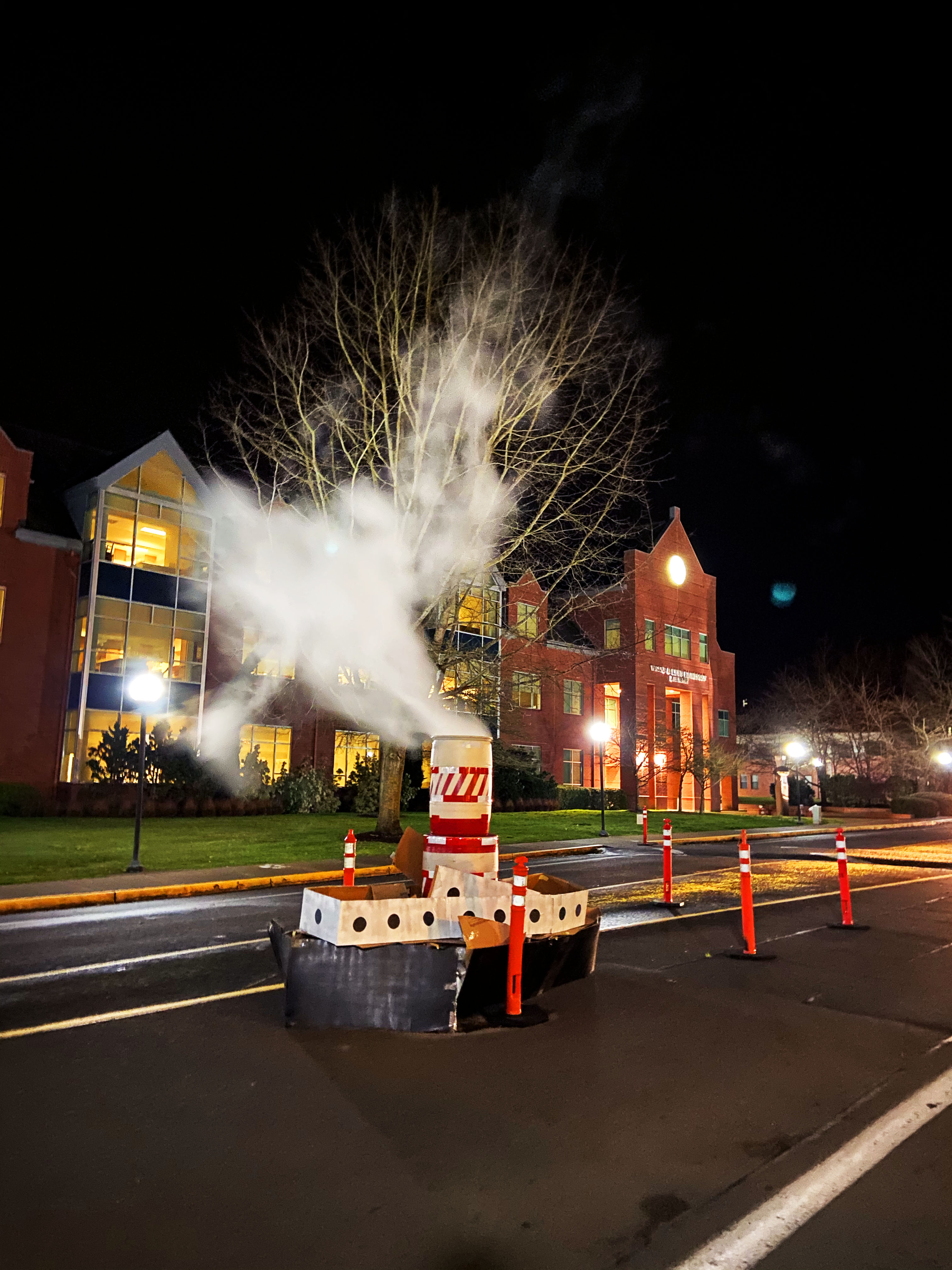
Underneath the university, the steam line pipes run from the boilers and lead out to the rest of campus. On Monmouth Ave. N, facilities are currently in the process of replacing cracked pipes, as evident from the white steam streaming from the man holes. 

“We’re estimating right now it’s going to be about $450,000,” said Director of Facilities Michael Smith. “It’s a pipe within a pipe so it’s hard to identify where the crack is. We don’t know if it’s at the joints where it’s bolted together or if there’s a large crack in both of the pipes.”

According to Smith, the double insulated pipes in use regularly need maintenance, citing large universities such as Oregon State University having a designated budget for the specific repair. However, Western’s Facilities will be using a portion of the $3.2 million Deferred Maintenance money given to them every biennial by the state of Oregon instead of their insurance because the damage was not caused by outside interference. At this time, facilities is looking for contractors ⏤ a process that takes around two weeks.

“We’ll have (repairs) done hopefully before students return or hopefully by the summer,” said Smith.

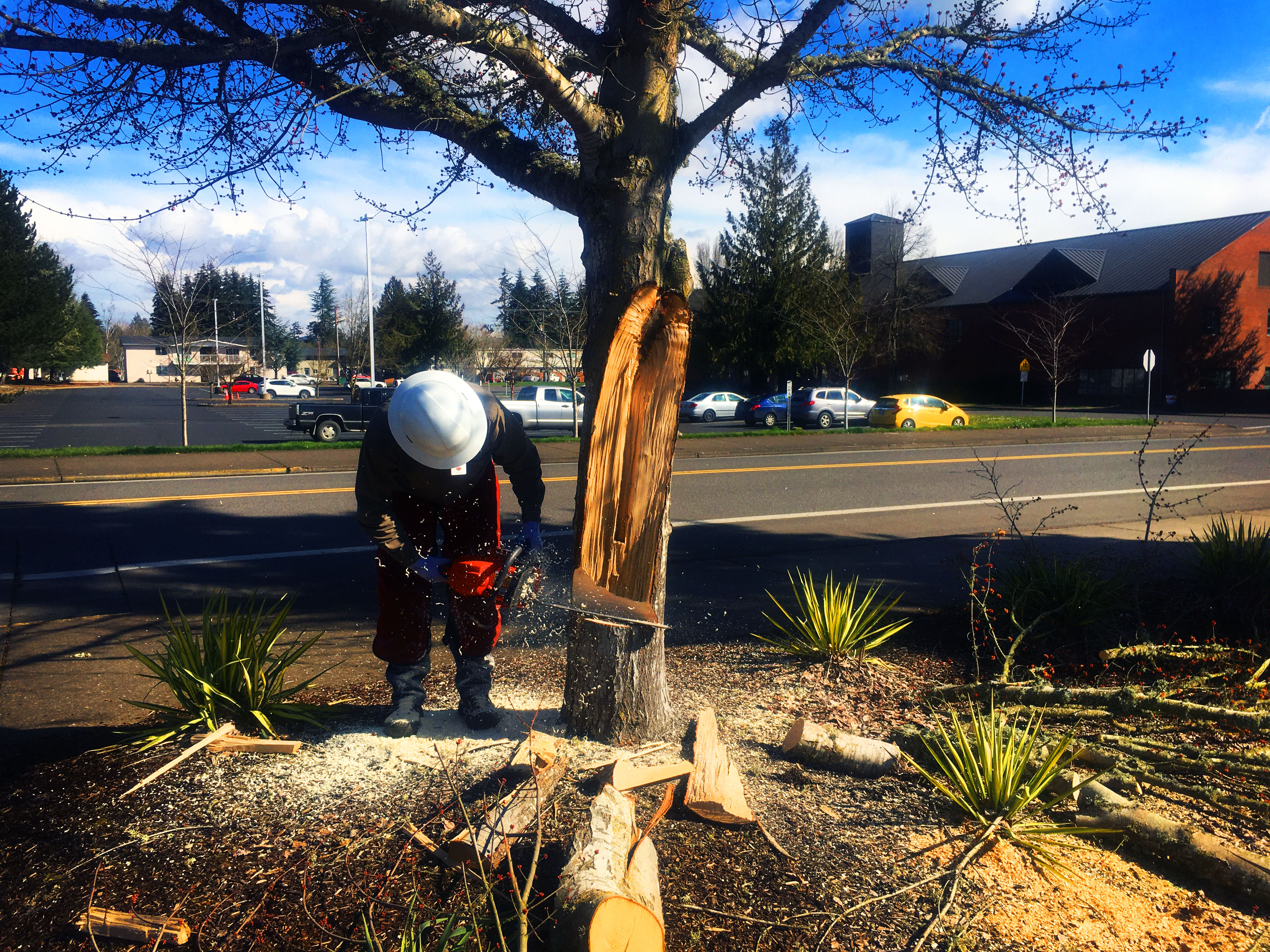
An ongoing project Smith anticipates taking four to six months is the remaining tree cleanup caused by the ice storm. In total, 75% of Western’s trees were damaged by the storm. 

“We’re a Tree Campus USA,” said Smith, “and getting hit that hard was really rough.”

At this time, workers are still cutting down trees and removing fallen branches. Smith says general clean up could take up to two weeks, but over the course of the next few months he anticipates more hidden loose branches will be knocked down by wind. Outside of tree damage, the university saw minimal damage to buildings. 

“Most of the damage that we could see that were exterior were some fences and a retaining wall that got hit … I have to meet with the insurance person about the ice storm stuff (this) week,” said Smith. “On top of that we’ll be doing the DeVolder stuff. I think the DeVolder stuff will be more expensive than the ice storm stuff.”

Two weeks ago, a gasket on the roof of DeVolder malfunctioned causing water from the hot water line to flow out. According to Smith, workers were able to shut the pump off and stop the water from further flooding the building. Most of the damage done was inside various classrooms such as the Cadaver Lab, which suffered ceiling damage.

“We have to find out what equipment got damaged or didn’t get damaged,” said Smith. “The professors have to take their time and go through it and that could be a quarter of a million dollars … We have a whole group of professors and facilities guys working through it and working with the insurance company.” 

While Smith anticipates the insurance will cover a majority of the damage done to DeVolder, he said the university still has a $5,000 deductible for each incident that occurs on campus. However at this time universities are pooling together insurances and Smith hopes that it will cover the deductible.

Contact the author at scarpenter18@mail.wou.edu