Mount Hood

Online courses: yea or nay?

February 26, 2025

Written by: Sadie Latimer | News Editor

Western prides itself on its campus community, where students are supported and uplifted. Part of that support comes from in-person classes, with small class sizes and personalized experiences for students. 

Western’s provost and Vice President for Academic Affairs Dr. Jose Coll is leading the charge in reducing the amount of online classes offered at Western in favor of in-person instruction. He created a working committee — the Undergraduate Course Modality Task Force — to conduct research and ultimately recommend what percentage of courses should be taught online. 

The task force is being led by Chelle Batchelor, dean of library and academic innovation. 

According to Batchelor, “The task force is currently in the process of gathering information to inform the recommendation we have been asked to present to the provost and Faculty Senate in spring term.” 

Fall and Winter terms were dedicated to determining what would be best for students when it comes to online classes. The task force will share their findings in the Spring term, which will help the university move forward with the change.

The task force is concentrating on all aspects of online learning. “The recommendation of the committee will consider all modalities with an online component: online asynchronous, online synchronous (Zoom classes) and hybrid,” Batchelor stated. 

As of now, the task force isn’t focusing on the fully online majors, such as the ASL interpreting program. The provost’s goal is to limit first-year students to only in-person classes starting Fall 2025 unless their declared major is fully online. 

This potential decision will only affect the mode of the coursework, and won’t result in faculty cuts. “Teaching a course in person requires the same amount of FTE as teaching a course online,” according to Batchelor. FTE — full-time equivalence — indicates and measures the workload of faculty.

The potential reduction in online courses has been one focal point of the Faculty Senate, which is made up of representatives from the different departments at Western.

“In the December meeting of the Faculty Senate, faculty discussed concerns about program needs, student needs, student engagement and success, and faculty representation on the task force,” Batchelor stated. “After that meeting, Faculty Senate identified a faculty member to serve on the task force.”

Not only has the task force started working more closely with the faculty, but they have also begun to work with ASWOU in order to engage with Western’s students. Specifically, they are working with Senate President Maggie Bartosovsky and Senator Briana McNeel to bridge the gap between the committee and Western’s students. 

Batchelor and the committee are also reaching out to students through Wolfie, the chatbot that sends messages to the student body. Wolfie’s text was sent out Feb. 17. The text also included a short survey that students are encouraged to complete. 

The survey and other student input is important for making sure that the university’s decision reflects the needs and wants of all students. 

Any decision of the university comes with concerns and opinions from Western’s community. Some students are concerned with how class availability will be affected. Students with full-time jobs are concerned with how they will fit in-person classes into their busy schedules. These concerns are being addressed by the task force, and it is up to them and the university to identify solutions that will benefit the students and the community.

“Over and over and over, I hear comments from students about how important the WOU community is to their success,” President Jesse Peters stated in his report during a Board of Trustees meeting. “And when they talk about it, they talk about being physically here on campus and interacting with peers and faculty and staff. Whatever the college experience is, it simply can’t be replicated on Zoom. And the strength of Western has always been, it seems to me, the way that the campus functions to support students and build community. I will continue to focus on restoring our campus to the physically present, active and engaged community it was before the pandemic.”

The COVID-19 pandemic was a major setback for many schools, including Western, and it will be difficult to rebuild the in-person community to what it was previously. President Peters, Provost Coll and the Undergraduate Course Modality task force have a massive undertaking, but are starting relatively small with hopes to reduce the online courses that are offered to first-year students.

It remains to be seen whether or not the provost and the president’s vision of the upcoming fall term will come to fruition. First, the task force must figure out what percentage of courses should be online, taking into account what opinions the students and faculty have voiced. Then, once they present their findings, the university can come to an informed decision that will ultimately benefit Western’s community. 

Contact the author at howlnews@mail.wou.edu

ASWOU

February 5, 2025

Written by: Sadie Latimer | News Editor

The Associated Students of Western — ASWOU — is Western’s official student government. It is run by students, for students. 

ASWOU is extremely active on campus, representing students’ interests and needs, overseeing clubs, putting together programs on campus and ensuring that students have their voices heard. 

ASWOU President Brenda Rocio Martinezis a fourth-year student at Western, double majoring in communications and public policy and administration. 

“My role is (mainly) representing students in general and having their best interest in mind,” Rocio Martinez said. As a student herself, Rocio Martinez is always looking for ways to support her peers. “We always like to put our ear to the ground and see (what students want and need.)”

ASWOU not only supports individual students but student clubs as well. Joining a club is how Rocio Martinez first got involved on campus, followed by her becoming a justice in the judicial branch of ASWOU. After that, she was ASWOU’s director of PR, then, finally, the president. 

Rocio Martinez knows the importance of getting involved through clubs on campus, so she strives to make sure the clubs have the resources, training and support they need. One of her goals is to allow the clubs to collaborate and connect with each other. 

“I just want to be able to serve students,” Rocio Martinez said. “We are student-funded, so we’re here for (students).” ASWOU is funded by the IFC — Incidental Fee Committee. Students pay a set amount as part of their tuition and fees, which goes towards several student activities on campus, including but not limited to ASWOU, student media, Abby’s House, WOLF Ride, athletics, campus recreation, childcare and more.

Every person involved in ASWOU is dedicated to making their fellow students’ voices heard. “People in higher positions like faculty and staff are wanting the students’ perspective, and ASWOU can give that perspective,” Rocio Martinez said. 

“Elections should be coming pretty soon for anyone who wants my position in the future. And I will say this: it’s not hard, it’s fun,” Rocio Martinez said. She loves getting to be more involved in her community as ASWOU president. According to Rocio Martinez, the position has helped her become a better leader. It has also been helpful for her field of study and will likely apply to the career path she wishes to follow. ASWOU elections will begin at the start of spring term. For students who wish to run for election, applications open March 8. 

ASWOU has weekly public meetings on Fridays in the Calapooia room of the Werner University Center. The executive branch of ASWOU holds their meeting at 12 p.m. and the senate meets at 2 p.m. 

The judicial branch’s meetings are not weekly, instead they are held “when there’s work to do,” Rocio Martinez said. “That entails rules being broken by any clubs or any students, if there are any concerns or if people just want an interpretation of a law.”

For students who have concerns, comments or questions, an ASWOU senate meeting is the place to be. The senate focuses on things such as bylaws, getting involved with the clubs they oversee and the needs of students. 

If students have large concerns, they can fill out an ASWOU student feedback form, which goes to the senate. The form is located on the student portal under the My Programs tab. 

Rocio Martinez knows how difficult it is to advocate for every student, which is why it is important for students to bring their concerns and feedback to ASWOU’s attention. A community thrives when everyone supports each other and works together to make positive changes. 

“We ensure that students are well represented if they feel anything should change,” Rocio Martinez said. “Change comes with many people. It takes a village to make true change.”

Contact the author at howlnews@mail.wou.edu

Who is Morgan Pemberton?

February 5, 2025

Written by: Sadie Latimer | News Editor

If there is an event occurring on Western’s campus, one student will surely be there: Morgan Pemberton. Pemberton is a junior at Western, double majoring in psychology and ASL studies and minoring in social science and is involved in many clubs and organizations on campus. 

Pemberton took ASL classes all through high school and decided to pursue it in college. Western has a notable ASL program, which positively influenced her decision to enroll. She decided to study psychology and social science because of the classes she took that were outside her major being surprisingly enjoyable. “I like to dabble a little bit,” Pemberton said. “I like to take random classes.” 

Pemberton is an out-of-state student and has moved around the US. “I was born outside of Chicago. I’ve also lived in Colorado, and I graduated high school in Arizona,” she said.

By nature, Pemberton is a very outgoing person. “I really like to talk,” she said. “I’m very social. I just like to be around people.” On the flip side, she also loves tuning out the world and listening to audiobooks.

“If you ever see me with my AirPods in, just know an audiobook is on full volume,” Pemberton joked.

Along with being a student, Pemberton also has multiple jobs on campus. She works as ASWOU’s judicial administrator, overseeing the justices, holding disciplinary hearings, interpreting rules and adding new rules to the constitution. 

Pemberton works the front desk for academic advising, where she “(answers) a lot of phone calls and (connects) people to different places on campus.” She also leads tours and participates in panels as a campus ambassador, and is the coordinator for Destination Western — a two-week-long orientation program for incoming students. 

“I’ve been invested in (Destination Western) since I was a participant when I was an incoming freshman, then I was a peer advisor my sophomore year and then last year I was a lead peer advisor,” Pemberton said. Now, she gets to supervise the peer advisors and lead staff training.

Pemberton is involved in many of the campus’ clubs, being the vice president of the ASL club, the social media manager for the Native Indigenous Culture Club as well as a member of Kappa Delta Chi — Western’s first-generation student sorority. She is also a multicultural representative mentor. 

Pemberton is passionately involved with everything she has committed to. According to Pemberton, she is “just naturally a very cognitively high-energy person.” She thrives with lots of mental stimulation from her hobbies, work, clubs and her other involvements. 

“My biggest tip for people if they want to do more is: you (have) to take care of your biological needs.” Sleep is very important to Pemberton, and she makes sure to get at least eight hours of rest every night. She also makes sure to drink plenty of water and eat nutritious food to keep herself energized for her many activities and responsibilities. 

Pemberton keeps busy but still takes care of her mental health by making sure she is happy and fulfilled by everything she does. “I try to align what I do with what I want to do in the future and what aligns with my personal goals,” Pemberton said.

As for the future, she has plans after she graduates to continue her education and get her master’s degree. Pemberton, like many students, is apprehensive about what the future holds. She has fostered a great community at Western, but she knows that eventually, it will be time to move on.

“I am one of those people who’s always seeking out something new,” Pemberton said.  

Before Pemberton goes on her post-education journey, she still has the rest of her junior and senior year to look forward to. This year, she’s especially excited for the annual Pow Wow, hosted by the Multicultural Student Union — MSU.

“This year (the Native Indigenous Culture) Club and MSU are teaming up,” Pemberton said. “We’re doing the Pow Wow this year. It’s been a lot of work and we’ve been really trying to put it together.” The 2025 Pow Wow is scheduled for April 19. 

Pemberton may only be a junior, but she has sage words of wisdom for her fellow students: “Be open and rely on each other.” Pemberton wants students to know that they shouldn’t be afraid to open up and share things with each other.

“We live in a world where we are taught to not impose on each other or not be too much for other people,” Pemberton said. That, however, is what a community is for. Pemberton advised that people in a community are meant to rely on each other. Students shouldn’t be afraid of being “too much” for the people around them. 

“That starts with you; you can’t just expect people to rely on you. You’ve got to open the door.” 

Contact the author at howlnews@mail.wou.edu

ASWOU elections

Written by: Hannah Field | News Editor

The Associated Students of Western are expecting to elect President Brenda Rocio Martinez, Vice President Fernando Robles and Judicial Administrator Morgan Pemberton into office for the 2024-2025 academic school year. The trio is running as a team and remains unopposed.

Expected incoming president, Rocio Martinez, described herself as a proud first-generation Latina student at Western. “I am running for ASWOU President to represent and support all students who want their voices heard. My candidacy is driven by my understanding of the unique challenges and aspirations of being the first in my family to pursue higher education,” she wrote on Presence, the website permitting for the ASWOU election.

“I am committed to using my and others’ perspectives to advocate for crucial changes that support our diverse student populations, ensuring that all voices are heard and valued.”

Rocio Martinez explained her initiatives to be primarily focused on bridging connections between students and higher-ups in attempts to “enrich the university experience.” Simultaneously, Rocio Martinez pledges to expand relationships, resources and support for everyone.

Robles, running for Vice President, left a statement as well: “I’m running for vice president because I would want to make an impact on campus.”

Judicial Administrator candidate Pemberton stated, “I’m running for judicial office because I care deeply about our campus community and making sure everyone’s voice is heard… One thing you should know about me is that I’m all about diversity and inclusion. I truly believe that embracing our differences makes our community stronger and more vibrant.”

Pemberton also promoted creating a collective judicial system that properly reflects the campus’s values and promotes fairness and equality in the community.

ASWOU opened elections March 8 and cannot conclude until 10 percent of the student body has voted — allowing for enough student voices to be heard so that the results can be deemed fair.

All other open positions allow for write-in candidates, meaning that anyone may be named to potentially fill the position. The write-in positions include the following: Senate President; three openings on the Incidental Fee Committee; 11 openings for ASWOU Senate: Senate Candidates; and three openings for the ASWOU Judicial Board: Judicial Candidates.
As of May 29, voting is still ongoing. To vote, students must list their V number and certify that they are Western students and will abide by the election results.


Contact the author at howlnews@mail.wou.edu

Meet Hunter Hall

Written by: Hannah Field | News Editor

A few things to note about Hunter Hall, the Associated Students of Western Oregon University President: his love for Western is reflected in a Naruto headband engraved with the Western logo, he works with graphic design and used to be deathly afraid of clowns.

Only two of those topics are relevant to his time at Western. 

Hall began his college career at Portland Community College and transferred to Western in 2020, with three years of experience in student government under his belt. During the pandemic, learning was online, and Hall was merely a virtual student. He had little resources and company on campus, but he knew one thing: he wanted to be involved with student government at Western.

His first and second years consisted of student work at the entry level: Destination Western and tutoring at the Math Center. Eventually, he found ASWOU, climbing the ranks to his current position as the President.

“I just slowly integrated myself and started working toward the things I wanted to do here,” said Hall. “I needed to be in a position of power so I could better help support the students like me, who might not have friends or family here, or like many people, to support them … I really tried to throw myself into the sandcastle elbows-deep and get super, duper involved — just (having) many jobs from my first and second years here that helped me get to where I am now.”

Technically, Hall graduated with his Bachelor’s in June of 2023: one in Mathematics, and then another in Interdisciplinary Studies with a double minor in Communications and Writing. Currently, Hall is a graduate student for a Masters degree in the Art of Teaching.

“I’m going to use my math undergrad and then my MAT to teach at the middle school level for about ten years. And then I hope to become a principal of a school, and then eventually a superintendent of a school district. It’s like I said: if you really want to make a change, you have to integrate yourself well.”

Another fact about Hunter Hall: he plans extensively for his future.

Although Hall won’t be ASWOU President next year, he’ll be on campus as a building manager and volunteering at Western’s garden — seeds he planted, a mark to be left behind as he continues to embark on his ten-year plan.

Contact the author at howlnews@mail.wou.edu

ASWOU voter guide

Western students answer the question: “What is your favorite season and why?”

Camille Lenning | Entertainment Editor

Contact the author at howlentertainment@wou.edu

Spring term is election season for the Associated Students of Western Oregon University — Western’s student government. Campaign Week began on Monday, April 18 with a “meet the candidate” event in the Werner University Center Summit. On Thursday, April 21, there will be a candidate forum on Zoom at 5 p.m. Students will be able to vote starting April 25 until April 29 on Presence, through their Student Portal. 

In preparation for Campaign Week, candidates were asked why they decided to run and what they plan to do if elected, find their answers below: 


Candidates for ASWOU President:


Gheraldy Bobadilla-Cruz (he/him/his/el)

Major: education 

Current class standing: sophomore


A current ASWOU Senator, Cruz has wanted to run for President since he arrived at Western, and wants to give a voice to all students. 

“I’m running for ASWOU President because I believe (Western) is at a pivotal turning point when considering its future. I want to come in and work alongside our new President to help (Western) flourish in this new era… I will make sure that more support is given to all clubs and organizations here on campus. I will ensure that students are being fully appreciated and acknowledged for all the work they do to make (Western) a campus full of diversity and inclusion. It’s time to hold (Western) responsible as an institution to follow through and act on its statements of being a welcoming campus for all. It’s time to make (Western) more than just a school.”


Kodee Harwood (she/her/hers)

Major: communication studies 

Current class standing: junior 


Harwood has been interested in ASWOU since 2019, and hopes to bring clubs back in full force, while also working to improve accessibility. 

“I want to improve campus and campus culture. … There’s always room for improvement and I’d like to start improving (Western) and make students feel safe on campus and proud that they go to (Western). … If I get elected ASWOU president my office will always be open to any student(s) that have concerns or questions and I will try my best to make change happen and try to support you as best I can.”


Candidates for ASWOU Vice President:


Hunter Hall (he/him/his)

Major: mathematics

Current class standing: senior


As a student government veteran, Hall aims to use his skills to amplify student voices, with an emphasis on safety. 

“I’m running for ASWOU Vice President for a couple of reasons. The first and most important to me is I want to find ways to improve the safety of our campus. I want to do this while also addressing accessibility issues that students face here. … I have (four) years of experience within student government where I’ve worked in various leadership positions. During that time I have been able to learn a lot about what it means to be the student voice. I plan to use my experience to act as that bridge that connects the (Western) staff and students (together).”


Owen Hubers (he/him/his)

Major: business 

Current class standing: junior 


Passionate about club engagement, Hubers (pictured left) hopes to connect students through Discord and improve event planning. 

“I want voters to know that I am listening to literally everything they say and will work my very hardest to make sure college life at (Western) is the best it can possibly be. I will use every last resource we have to help students here thrive. I will always want to and be willing to talk with any student or anybody at all who is willing to provide me with feedback. I will do the best I can to work with the various members of ASWOU and (Western) as a community. I will do my best … to solve current or future problems and implement new resources or improve existing resources.”


Candidate for Senate President:


Connor Goehring (he/him/his)

Major: ASL studies and education

Current class standing: sophomore


As Residence Hall Association President, Goehring aims to use his leadership skills to improve communication and make campus better for students. 

“There is so much inequity here at (Western) and I don’t plan on trying to fix the broken system we have in place right now, but to rewrite the whole system entirely to make a better, working system that supports our students. … I’m qualified to make a difference and be the advocate you need to make (Western) a safe and inclusive environment for the (campus’s) diverse community.”


Candidate for Senate:


Samy Reyes (he/him/his)

Major: business

Current class standing: sophomore 


As a new student at Western, Reyes hopes to use the Senate position to gain experience in student government. 

“I would like to be further involved in our school and the community of our students. I believe it is a civic responsibility as students to be engaged and involved in our school’s topics and issues. I seek to hear student’s thoughts and concerns on our campus, as I am going to be a voice that represents them. I run for the senate not only to gain experience, but to work towards new policies that will benefit the interests of our fellow students.”


Candidate for Judicial Administrator:


Coral Davis (she/they)

Major: education 

Current class standing: first-year


A PLUS Team member and WOU Ambassador, Davis is excited to bring leadership experience to ASWOU and work with the Justices. 

“My goal for when I am elected for Judicial Administrator is to create a more inclusive campus. I feel that accommodations for students are not being followed through. I also want to try and bring more awareness to all of the clubs that we have on campus as well as bring light to all (of) what our university has to offer to its new and current students.” 


Candidate for Incidental Fee Committee Member:


Dennis Long (he/him/his)

Major: information systems 

Current class standing: senior 


As an IFC Chair, Long was able to work on the IFC Funded Areas web page, allowing anyone to see who received funding and why. 

“I hope to help organize a better training schedule so that new IFC members can feel prepared to make these difficult decisions. There are changes to be made in the bylaws to make this process smoother, and I hope to actively engage in supporting the future of IFC and (Western)! After serving as IFC Chair this year, I discovered that there were many different student voices feeling left out or ignored. As the IFC, we did what we could to ensure that those voices were heard through anonymous forms and Open Hearings. I did my best to reach out to students and tried to forward their feedback to IFC.” 

Postponed certification of ASWOU elections officially finalized

Elections Committee delays certification after a grievance presented to the committee

Sydney Carpenter | News Editor

After a week of candidates campaigning, the Associated Students of Western Oregon University Elections Committee has selected the candidates that will be representing Western students for the upcoming school year.

For the upcoming school year, students have elected Logan Jackson as ASWOU President, Devin Jay Thongdy as ASWOU Vice President, Elizabeth Braatz as Senate President, Hannah Young as Judicial Administrator, Maria Cuevas and Austin Olin as Justices and Caitlin Wheeler as an Incidental Fee Committee Member. 

Prior to the public certification of the election, the committee received an “outstanding grievance request” from one of the candidates, according to committee chair Houston Winslow.

“Our hearing (on April 27) was pursuant to a grievance regarding the actions of some members of the football team, coaches and players, who advocated a vote for the candidates Logan Jackson and Hannah Young,” said Winslow. “One coach sent a message to players saying: ‘VOTE! Or 1000 versa monday ;)’ which was challenged as threatening voters, a violation of our election’s bylaws.”

Ultimately, the grievance was determined by the committee to not be the result of any actions taken by Jackson and Young, and the candidate that submitted it did not file for an appeal; the committee certified the election results on April 28 at 8 a.m.

“Everything went through the proper channels and it was eventually proven that there were no signs of wrongdoing which I expected,” said junior public policy and administration major and newly elected ASWOU president Logan Jackson. “I think after witnessing such a ‘bumpy’ national election last year, it was made clear that elections may not always go as smoothly as planned.” 

Following similar trends to the national election, Jackson made history at Western for being the first female Black, Indigenous and Person of Color to be elected into the executive branch of ASWOU. 

“I think that it is a sentiment to that fact that we, as a university, are making progress because students of color are starting to want to be involved in leadership positions and decision-making processes,” said Jackson.

Looking towards the future, Jackson plans to work with all members of ASWOU as Western transitions from virtual learning back to in person and hybrid learning. She wants to ensure that students are comfortable and safe being in a lecture hall setting, and open opportunities to address and learn about the stress of members of the BIPOC community. 

Additionally, Jackson advocated for the community to remain proactive during the current health crisis.

“Now that everyone ages 16 + are eligible for the vaccine, get vaccinated!” said Jackson. “We’re at a very pivotal moment in this pandemic where we have the ability to turn things around for the better — that being said, I encourage everyone to schedule their appointments, bring their friends, and ask questions if they have any hesitancy! We’re all in this together.”

Contact the author at scarpenter18@mail.wou.edu

ASWOU presents candidates running for office

The 2021-22 candidates answer why they’re running and more

Sydney Carpenter | News Editor

Introducing the ASWOU candidates running for office for 2021-22. Voting begins on April 19 at 5 p.m., and Western students have until April 23 at 5 p.m. to submit their ballots on Engage. Nominees answer the question, “What plans do you have for Western?” Read even more about each candidate in our online issue at wou.edu/westernhowl.

For students interested in asking the candidates questions, ASWOU is hosting Candidate Forums on April 14 and April 21 via Zoom from 6:30 to 8 p.m.. The Zoom link is available on Engage.


Logan Jackson

Pronouns: She/Her/Hers

Year: Junior

Major: Public Policy and Administration 

Position: President (2021-22) and Vice President (Spring 2021) 

Why are you running?

I am running for these positions because I know that I can make a positive impact on WOU as a whole. I’ve been involved in leadership for most of my school career and I believe that those past experiences have equipped me with the tools needed to pinpoint problems and implement solutions in solving them. I believe that I have been able to view WOU in a different perspective ⏤ as a Black woman who has held leadership positions within housing, ASWOU clubs, as well as being a student athlete, I’ve seen many things within the institution that could use improvements. I’m a firm believer in if you don’t like how something is being done and there is an opportunity for you to get involved, then you need to step up and be the change that you want to see ⏤ and that is what I’m doing.

What plans do you have for Western?

My main focuses will be addressing the inequalities present here at WOU involving race, sexuality and economic status as well as diving deeper into the lack of support our minority groups have here on campus. During such (a) divisive time in our nation, the least we can do as a university is create a space where students not only feel safe physically, mentally and emotionally, but also genuinely feel supported by the administration, staff/faculty and their peers.

What qualifies you to run for this position and help make Western a stronger community?

As I previously stated, I have been involved in leadership for my entire school career, from middle school to college in a variety of different environments all of which required attention in different areas. I believe that those past experiences have equipped me with the tools needed to pinpoint problems and implement solutions in solving them.


Makanaohaililani Johnson-Waikiki

Pronouns: She/Her/Hers

Year: Junior

Major: Communication Studies

Position: President (2021-22)

Why are you running?

As a woman of color I have dealt with discrimination, bashing, harassment, racism and misogyny. I believe it is a leader’s responsibility to give others the ability to shine by holding spaces of power and opening them to everyone. As your president I intend to use my position to hold the space and open it to students like me who have felt like they didn’t belong, they weren’t safe, they weren’t welcome, they weren’t respected, like they did not have a voice. We have extraordinary potential on this campus, if all students’ voices are heard in the spaces of power. Because we are powerful together. 

What plans do you have for Western?

As a native Hawaiian I hold strong values of community, family and teamwork. As this institution’s first Native Hawaiian president, I plan to create a more inclusive and welcoming culture at WOU that helps everyone feel a sense of community ties, family bonds and togetherness as a team. I will continue championing the Freedom Center and elevating the voices of students of color. I will work to pass legislation that will increase the spaces for BIPOC students and those from marginalized backgrounds to be heard in the conversations that occur in every level of our college experience. I will hold departments accountable for making changes to address discrimination. I will hold administration accountable for their responsibility to ensure that students of color feel safe at WOU. I will work to create a stronger connection between departments across campus and the student body. I will ensure that students are reminded and educated on the power they have to make WOU a safe and inclusive university for everyone.

What qualifies you to run for this position and help make Western a stronger community?

This last year I’ve been involved in ASWOU as the Incidental Fee Committee Chair, I’ve worked alongside other students of color to develop a plan for the WOU Freedom Center ⏤ a resource center and safe space on campus where students of color can be the majority, and I’ve worked closely with the Oregon Students Association to promote students’ needs at the state level. I was a peer advocate with Abby’s House and am currently the Vice President of the Multicultural Student Union. Through these roles I’ve found a drive and passion to change the culture of ASWOU through creating an environment of transparent and open communication, ensuring that students are paid fairly for their jobs on campus, increasing BIPOC representation and addressing the widespread discrimination on our campus.


Devin Jay Thongdy 

Pronouns: He/Him/His

Year: Junior

Major: Psychology 

Position: Vice President (2021-22)

Why are you running?

The reason why I am running for Vice President is to not be an echo in a crowd of underrepresented but a voice that empowers us to push for change, to fight for what is right and do more to help one another. I am a first generation student, first to graduate highschool, first to graduate college next year in my family, came from a family that consisted of my brother, my single mom and me and many more titles and identities I hold. My whole life I had to do more to be where I am now. I did with determination, passion, care and with love. I want to make a change for this campus that not only serves the majority but the minority, the underrepresented, the one (whose) voice gets lost in the crowd. If I am elected for Vice President for the 2021-22 school year, this is what I will do to ensure that we become better and equitable communities.

What plans do you have for Western?

The plans that I have for WOU is to increase accessibility for the student government to the student body. I will increase the connection for ASWOU and student organization to ensure that we have transparency and are meeting students needs. I will get funding and resources for a Freedom Center to ensure BIPOC students have a place to feel safe and seen. I will make every attempt to increase the student wage because every student needs a stable income to be successful in their college journey. 

What qualifies you to run for this position and help make Western a stronger community?

The qualities that will help me run for this position (are) that I am very determined, organized, have passion and compassion and many more. I believe these qualities allow me to work hard for what is right but also do it with love and passion for helping others. These will help make WOU a stronger community by always putting the student first and being able to be the voice for them. The Western community itself is filled with people who are also determined and (have) passion for what they want to do. For me running for this position will ensure this community will not be in the shadow and be heard. 


Elizabeth Braatz

Pronouns: She/Her/Hers

Year: Junior 

Major: Criminal Justice

Position: Senate President 

Why are you running?

I have been involved in leadership since the second week of my first year at college. I have served as the Vice President of Heritage Hall government, Vice President of the Residence Hall Association and I am currently serving as a Resident Assistant. I also serve on the University Diversity and Inclusion Advisory Committee, as well as the University Cultural Competency Advisory Committee. I am running for this position because I am extremely dedicated to listening to students and their voices, and making sure that students have a spot of the table. I am a Black, Hispanic, Alaskan Native Indian, gay woman, so I know how it feels to be left out, unheard and unseen. I will represent this student body to the best of my ability, and make sure that every student feels heard, seen and feels welcomed and loved at this institution.

What plans do you have for Western?

If elected as Senate President for the 2021-22 school year, I will continue my efforts in listening to what students of this university need to feel welcomed, loved, heard and seen. I will continue using my platform to continue the important and necessary conversations that need to be had. I want to ensure that I graduate next year knowing that I worked hard to leave a more welcoming and equitable university that embraces BIPOC members of this campus community, as well every human being regardless of their walk of life. 

What qualifies you to run for this position and help make Western a stronger community?

I served as Vice President of Heritage Hall government, Vice President of the Residence Hall Association, Resident Assistant of Barnum Hall, member of University Diversity and Inclusion Advisory Committee, University Cultural Competency Advisory Committee, Ambassador, PLUS Team Peer Advisor and Summer Bridge Peer Advisor. My first year at school I helped create and lead the End Hate March on campus, I am also the founder and creator of the newly implemented Satisfactory/No Credit grading option for the 2020-21 school year. Those are my qualifications.


Hannah Young

Pronouns: She/Her/Hers

Year: Junior 

Major: Public Policy and Administration 

Position: Judicial Administrator 


Why are you running?

I chose to run for Judicial Administrator because I believe that I could continue the work I’ve done so far this academic year, and continue to grow and be a part of greater changes in ASWOU. I can do this in the role of Judicial Administrator by providing just and honest feedback and decisions that uphold the Governing Documents and prioritize the needs and betterment of the student body. 

What plans do you have for Western?

I hope to provide leadership experience while working together to promote ASWOU’s values and to prioritize student voices in order to best represent the entire student body. My goals are to work closely with both students and advisors to strengthen the relationship between all branches of student government in order to work to achieve goals led by student voices.

What qualifies you to run for this position and help make Western a stronger community?

I have already been serving in the role of Judicial Administrator since the beginning of Winter Term 2021 ⏤ in that time I have grown as a student leader and gained invaluable experience in ASWOU. This year has been a wild and challenging time for all students, including myself. In my role, I have worked to protect the student body’s ideals and values set forth by our Governing Documents, and gained experiences working with my own Judicial Board as well as numerous other students and groups on campus.  


Kassidy Fegles-Jones

Pronouns: She/Her/Hers

Year: Sophomore 

Major: Political Science 

Position: Judicial Administrator 

Why are you running?

I became interested in serving as a Judicial Administrator once I settled into college life and figured out where my ambitions and passions lie.

Truthfully, my first year at Western Oregon University, I did not get involved because I never saw myself being the person I am today. I was raised in West Salem which is a fairly conservative and predominantly white domain. I had a harder time adjusting in high school because I came out as openly gay my junior year, not to mention I was already known as the girl who had (two) moms. I experienced many things that ultimately led me to deter from getting involved in school clubs, organizations and taking chances. That perspective and lens changed when I began dating a woman of color. The experiences we faced led me to wanting to make change anywhere I could.  

What plans do you have for Western?

I will use my platform and the privileges that I hold for the betterment of equitable representation on this campus, and ensuring that BIPOC and marginalized voices on this campus are listened to by students, faculty and the university administration. As a campus community, we need to do right by all of the students who chose to go here. 

What qualifies you to run for this position and help make Western a stronger community?

Being appointed as the Director of Equity for the Associated Students of Western Oregon University has helped me step into who I’ve always been meant to be. It has given me the platform to create change and start conversations that are needed. 

Within this role I work with clubs and organizations, state organizations and committees, as well as help put on campus programs focused on diversity and inclusion. This year I began testifying on bills and measures that would directly impact students and universities, as well as as Oregonians as a whole. I was appointed as a member of the University Diversity and Inclusion Advisory Committee, as well as worked on Statewide Cultural Competency Campaigns. 


Maria Cuevas 

Pronouns: She/Her/Hers

Year: Sophomore

Major: Early Childhood Education 

Position: Justice 

Why are you running?

I am running for this position to be an active student at WOU, but also to be a voice for students during hard times. 

What plans do you have for Western?

I plan to be an honest and active member of the judicial board. I plan to listen to students and make sure that ASWOU’s laws and constitution are being upheld. 

What qualifies you to run for this position and help make Western a stronger community?

During my time at WOU, I was secretary of the Unidos club. This club is a great example of making WOU a stronger community, with all the outreach they do and making sure that WOU students feel safe and accepted. 


Austin Olin

Pronouns: He/Him/His

Year: Junior

Major: Political Science 

Position: Justice

Why are you running?

I am currently the Vice-Chair of this year’s ASWOU Judicial Board, and I have found the judicial branch of ASWOU to be an important part of my life. It helps me connect to WOU’s student body while allowing me to contribute my judicial knowledge to ASWOU through making important decisions alongside my fellow Justices. I would love nothing more than to continue serving as a Justice in my final year at WOU. 

What plans do you have for Western?

WOU is an amazing college, and part of what makes WOU so incredible is the hard work that ASWOU puts into their responsibilities. I plan to uphold the ASWOU Constitution and Bylaws while also keeping in mind the greater good of the WOU student body in my decisions as an ASWOU Justice. I believe that the Judicial branch of ASWOU is extremely important, and if I am elected as a Justice in the following year, I will continue to take my responsibilities seriously while contributing to the ASWOU Judicial Board to the best of my ability.

What qualifies you to run for this position and help make Western a stronger community?

As a political science major, I have continually studied judicial practices throughout the last three years of my life. Not only do I have experience as an ASWOU Justice, but I also plan to start a career in law after I graduate WOU. This is my passion, and therefore I believe I am extremely qualified for this position.


Caitlin Wheeler

Pronouns: She/Her/Hers

Year: First-year

Major: Criminal Justice  

Position: IFC Member

Why are you running?

To engage more of the student body in the power of IFC and how Incidental Fees can work for them, overall in (an attempt) to make their experience here more exciting!

What plans do you have for Western?

Allocating funds where they’re needed (is) dependent on what the student body wants out of their experience at WOU. I want to educate more students on what their money is going towards.

What qualifies you to run for this position and help make Western a stronger community?

I am a natural-born leader with great listening abilities. I believe strength comes from the people and WOU is (a) developing community that needs more voices heard. As a potential IFC member, my focuses would be directed towards full frontal honesty of why Incidental Fees are collected and how they are redistributed amongst our programs here at Western.


Press Release: BIPOC students call on WOU Board of Trustees to meet student needs

Black, Indigenous and Students of Color at Western explain their all encompassing proposal to the WOU Board of Trustees

Makana Waikiki | ASWOU IFC Chair

For Immediate Release

April 3, 2021

Proposal from Black, Indigenous and Students of Color at Western Oregon University Calls on the WOU Board of Trustees and WOU Administration to Meet Student Needs

Monmouth, OR — Black, Indigenous and students of color at Western Oregon University released a comprehensive proposal to the WOU Board of Trustees which they will present at the April 21, 2021 Board Meeting, bringing attention to student needs through funding and re-evaluation of needs that WOU and it’s administration have failed to provide for students, staff, faculty and the community.

The proposal is separated into two categories of student needs at WOU; fiscal and re-evaluation. Over the past several years, students at WOU have shared their frustration due to lack of support through resources from the administration. Students of color continue to be some of the most impacted student groups on this campus and have been advocating for a center on campus that brings them together, that it is a safe space and one that promotes and celebrates the diversity and richness of their cultures. The first fiscal demand is to fund the Freedom Center, a space created by BIPOC students for BIPOC students at WOU. This space will provide study rooms, technology, and a place where students of color can go for support, resources, and most importantly a safe environment on this campus.

Our proposal also addresses the serious need for a post-secondary education at WOU that is affordable, accessible and provides students the resources they need to succeed. The Incidental Fee is an important revenue source that funds vital services, programs, resources, like the food pantry, and employment opportunities for students and staff. These services and programs need to be funded however, it is tied to enrollment and with the decrease in enrollment rates that we continue to witness it leaves areas that provide essential services and resources underfunded. We are asking the Board of Trustees to subsidize the cuts the Incidental Fee Committee (IFC) had to make this year (~$203,000) so that all IFC funded areas that benefit students will be fully funded going into the next academic year.

Through the Incidental Fee Committee’s open hearings, student athletes voiced their concerns that they are in need for new uniforms and gear. There needs to be investments to support the student athletes on our campus that help recruit new students to our campus. We are asking for $122,000 to be allocated to the Student Athletes for their uniforms and gear. This allocation would double each sports’ budget as they are severely underfunded.

This past year we have witnessed increased attacks directed towards communities of color and how this has affected the mental and physical well-being of the students of color on our campus. This university wants to pride itself in its core values of diversity and respect stating that “equity and inclusion are a fundamental basis in human diversity” and yet students of color are the ones demanding and working towards creating the Freedom Center. Students should not be the only group of people on our campus that want to create a safe and welcoming environment; this should be a mission we all strive working towards. The Board can take action to help address this issue by funding a Director of Equity and Inclusion. Funding for this position would be for 2 years and would be hired by a committee of BIPOC students, faculty and staff. This position would address instances of systemic racial and social injustice, support students, staff, and faculty of color in achieving their goals at WOU.

The Board of Trustees must also re-evaluate how faculty and staff are hired. There is a lack of BIPOC representation in the administration, faculty and staff positions. President Fuller must prepare a plan to set a new policy to hire faculty and staff positions, and a plan that includes representation from no less than one BIPOC student, no less than one BIPOC faculty member, and no less than one BIPOC staff member, by the next Board of Trustees meeting. Additionally, the Board of Trustees must reconsider our plan around campus reopening for fall term at their next Board of Trustees meeting, with a dedicated agenda item with 30 minutes of public comment on the matter. The board must also collaborate with ASWOU to hold a series of public forums next Fall 2021, in which students, faculty and staff will be able to provide feedback on the following topics: Campus Public Safety, faculty racism in the classroom, Student Health & Counseling Center, institute first year cultural competency and systematic racism class for all WOU students to take their first year, instituting cultural curriculum into all classes offered for Undergraduate and Graduate degrees in consultation with the Director of Equity and Inclusion, and COVID-19 Response.

This comprehensive proposal from BIPOC students at WOU addresses major concerns WOU students have expressed for years and we urge the Board of Trustees to take action by approving our budget asks and re-evaluation recommendations. It will take all of us — students, faculty, staff, the administration and the Board of Trustees to save our university and restore the level of trust, transparency, accountability, inclusivity and most importantly our sense of community.

For more information, contact ASWOU IFC Chair, Makana Waikiki, at mwaikiki18@mail.wou.edu.


Addendum

April 11th, 2021

“We as a community have put our trust in people and systems that don’t deserve it. We are putting ourselves at risk everyday we get up and try to get an education here at WOU. With the increase of hate crimes, the lack of resources for marginalized communities, and increase in the price and difficulty of higher education, we need the Board of Trustees to prioritize our needs. The students of WOU are bringing this proposal forward, of our fiscal and re-evaluation needs that WOU and it’s administration have failed to provide for their students, staff, faculty, and community. It is time for change.”

— Makana Waikiki (she/they) Student Leader and Student Rights Advocate

IFC and ASWOU Senate finalize budgetary plans for next school year

IFC plans for 2021 to be approved by the Board of Trustees

Sydney Carpenter | News Editor

The Incidental Fee Committee has concluded its open hearings and finalized the budgetary allocations and fee application for the next school year.

In their preliminary decisions, the IFC had a total of 34.77% budget reductions for all 15 of the funded areas, and 27% of the reduction was taken from the Athletics department’s funding. However, 100 students ⏤ primarily athletes ⏤ attended the open hearings advocating for a reduction on the Athletics budget cut. 

In the final plans, budgetary reductions for Athletics was reduced and some of the weight was spread into other departments. In the finalization meeting, department heads voiced they were willing to have greater reductions to their own personal budgets. In total, six areas volunteered to have budgetary reductions: Associated Students of Western Oregon University with 2%; Campus Recreation 0.5%; Creative Arts 3%; Student Engagement 1%; SE: Leadership, Inclusion, Activities 2%; Student Activities Board 1%; Student Media 0.5%.

Because other departments took on the burden of reducing their budgets, the Athletics department budget currently only reflects a 13.5% cut. Athletic Director Randi Lydum has not put in writing what types of cuts the department will face under this budget

Students can anticipate seeing a $355 flat rate fee on their bill for the 2021-22 year, regardless of modality. Under the current projections, the IFC anticipates collecting $4,106,640 from the fee in the upcoming year, and will be drawing $373,781.09 from the reserves to meet budgetary needs.  

Contact the author at scarpenter18@mail.wou.edu

Press Release: Reign in University Construction Spending

Student Government Leaders at Public Universities Across Oregon Call on State to Invest in Financial Aid

 N.J. Johnson |‌ ‌ASWOU President

Thursday, March 11, 2021 

The Student Body Presidents at University of Oregon, Western Oregon University, Eastern Oregon University, Oregon State University, and Portland State University released a joint letter today to members of the Oregon State Legislature and the Higher Education Coordinating Commission calling for the state to address rising tuition increases and improve governance and oversight of public universities in Oregon, which were deregulated in 2015.

The Letter Reads:

To: Higher Education Coordinating Commission and the Oregon State Legislature

Fr: Oregon Student Association & Associated University Student Governments

Re: Higher Education Priorities for the Legislative Session

Understanding that the effect of COVID-19 and the financial recession that has followed have had immense impacts on students, we the student body presidents of the public universities across the state of Oregon call upon the state legislature to take meaningful efforts to reevaluate the course of higher education funding.

Upon careful assessments of our campus priorities and the needs of students in the midst of this pandemic, this association has determined that emergency investments into the Oregon Opportunity Grant to be a top priority. Currently, less than 1 in 4 students who qualify for the Oregon Opportunity Grant receive the funding. This stands out as a deeply concerning flaw in state distribution of funding. We believe that financial aid investment is a fundamental part of any strategy for long term economic recovery across the state. Students pursuing higher education make up a large portion of the working class population in the state of Oregon, without further financial assistance we anticipate these students will be forced to choose between their pursuit of higher education opportunities and financial stability. 

This pandemic has further revealed the inequities of our many social systems. Specifically, under the analysis of the financial distribution to our public universities, we have seen a recurring trend in funding initiatives and projects across state universities that do not directly contribute to the needs of students. While OSA supports investing in safety updates and retrofitting, as well as building equity centers, multicultural student centers, and dreamers resource centers, student needs are not always taken into account when institutions prioritize new building projects. We are well aware of the potential financial recovery that capital construction initiatives offer during these difficult times, however, we weigh the

financial burdens that students are facing as a higher priority for state funding. As it stands, capital construction funding will not directly support the needs of students, especially when these projects have projected completion dates years in the future. University administrations have argued that investments in capital construction will mitigate the enrollment crisis and make education more affordable. Instead, the data collected over the last decade shows enrollment declines and alarming tuition increases. We are asking that students and the needs of students be a direct priority during this session. We ask that legislators work with students to reevaluate and reimagine the incentives, governance, and priorities of our public universities.

Thus, we the student body presidents of the public university in the state of Oregon call upon the legislature to make meaningful emergency investments into the Oregon Opportunity Grant to aid financially suffering students during the long session. We call upon the legislature to support students calls for increased transparency and accountability on public universities to ensure funds are directly supporting students’ needs. Lastly, we call upon the legislature to oppose the ongoing drift towards privatization of our public universities through planning for meaningful investment and meaningful governance reform.

Signed,

Isaiah Boyd, President Associated Students of University of Oregon

N.J. Johnson, President Associated Students of Western Oregon University

Keegan Sanchez, President Associated Students of Eastern Oregon University

Motutama Sipelii, President Associated Students of Portland State University

Isabel Nuñez Perez, President Associated Students of Oregon State University

In the five years since the Oregon University System was dismantled and institutional boards were put in place, tuition has increased by 18.5%, a faster rate than the five year span directly leading up to the end of the Oregon University System. This leads to massive inequities in higher education access. At the University of Oregon, for instance, there are about as many students whose household income is in the top 1% of income earners as there are students whose household income is in the bottom 20%.

Meanwhile, private fundraising at the universities which students were told would go to help keep tuition down has gone instead to high profile construction projects, often with little formal student input. In the 17-19 biennium, the state of Oregon allocated $330.8 million to capital construction projects at universities. This is more than twice the amount allocated to financial aid that year–the Oregon Opportunity Grant received $146.1 Million. A white paper published by SEIU Local 503 in 2019 demonstrates that from 1999 to 2019, the share of state financial support for universities going to construction debt servicing rose from less than 3% all the way to 16%.

Of the letter, ASUO President Isaiah Boyd said: “In this past year, the Covid-19 epidemic has demonstrated the growing flaws in our systems of higher education. We’ve witnessed the socioeconomic issues faced by students pursuing higher educations become all the more exacerbated. Higher education pursuits across the country are reaching the critical point where students will no longer have the financial stability to go after their dreams.”

NJ Johnson, student body President at Western Oregon University said: “With the unsustainable increases in tuition correlated with statewide enrollment decline, now is the time to invest meaningfully in access and affordability to end this cycle.”

For more information, contact ASWOU President N.J. Johnson by phone at (503) 838-8555 or by emailing aswoupresident@mail.wou.edu; or, contact ASUO President Isaiah Boyd by phone at (541) 346-0624 or by emailing asuopres@uoregon.edu 

Committee searches for new president

The Board of Trustees has assembled an advisory committee to assist in the search for an interim president

Sydney Carpenter | News Editor

On Oct. 8, 2020, current university president Rex Fuller sent out an email to colleagues announcing his plans to retire in fall 2021.

Since the announcement, the Board of Trustees has approved of new “Board Statement on Presidential Vacancies” search guidelines for the interim president — mid-summer 2021 to June–July 2022 — and search guidelines for the regular president. The newly assembled advisory committee consists of Betty Komp, Ryan Hagemann, Jon Carey, Dr. Vivian Djokotoe, Sandra Holland, Dr. Bojan Ilievski, Malissa Larson, Mike Morgan, Nathan Sauer, Dr. Rob Winningham and Alex Ped. The titles of each committee member can be viewed on the presidential vacancy website at wou.edu/presidentialvacancy.

For student representation, the Associated Students of Western Oregon University President NJ Johnson was tasked to suggest a candidate to the board.

“I advocated for more students to be on the committee,” said Johnson, “but that was not what the Board of Trustees voted on and the Board of Trustees is the governing board.”

In his recommendation, Johnson chose junior criminal justice major and ASWOU Senator Elizabeth Braatz.

“I selected Elizabeth because I knew that she could represent the student body in a way that we could be proud of,” said Johnson. “Elizabeth has a really diverse range of student leadership experiences from University Housing and including ASWOU.”

However in the finalized committee, Betty Komp decided to implement her own candidate, Alex Ped, a nontraditional Western student since 2002.

“I asked for suggestions and made it clear diversity was important,” said Komp, “but ultimately I make the decision on who’s on the committee.” 

At this time, the final committee containing 11 community members consists of one person of color. 

The Board of Trustees office has selected March 12 at 11 a.m. to hear from the campus community’s thoughts on how the committee should go about looking for an interim president. The committee will begin to review application materials on March 15.

The story will be updated as more information is released. 

Contact the author at scarpenter18@mail.wou.edu 

IFC moving towards final fee decision for next term

IFC announces preliminary budgetary plans for spring 2021

Sydney Carpenter | News Editor

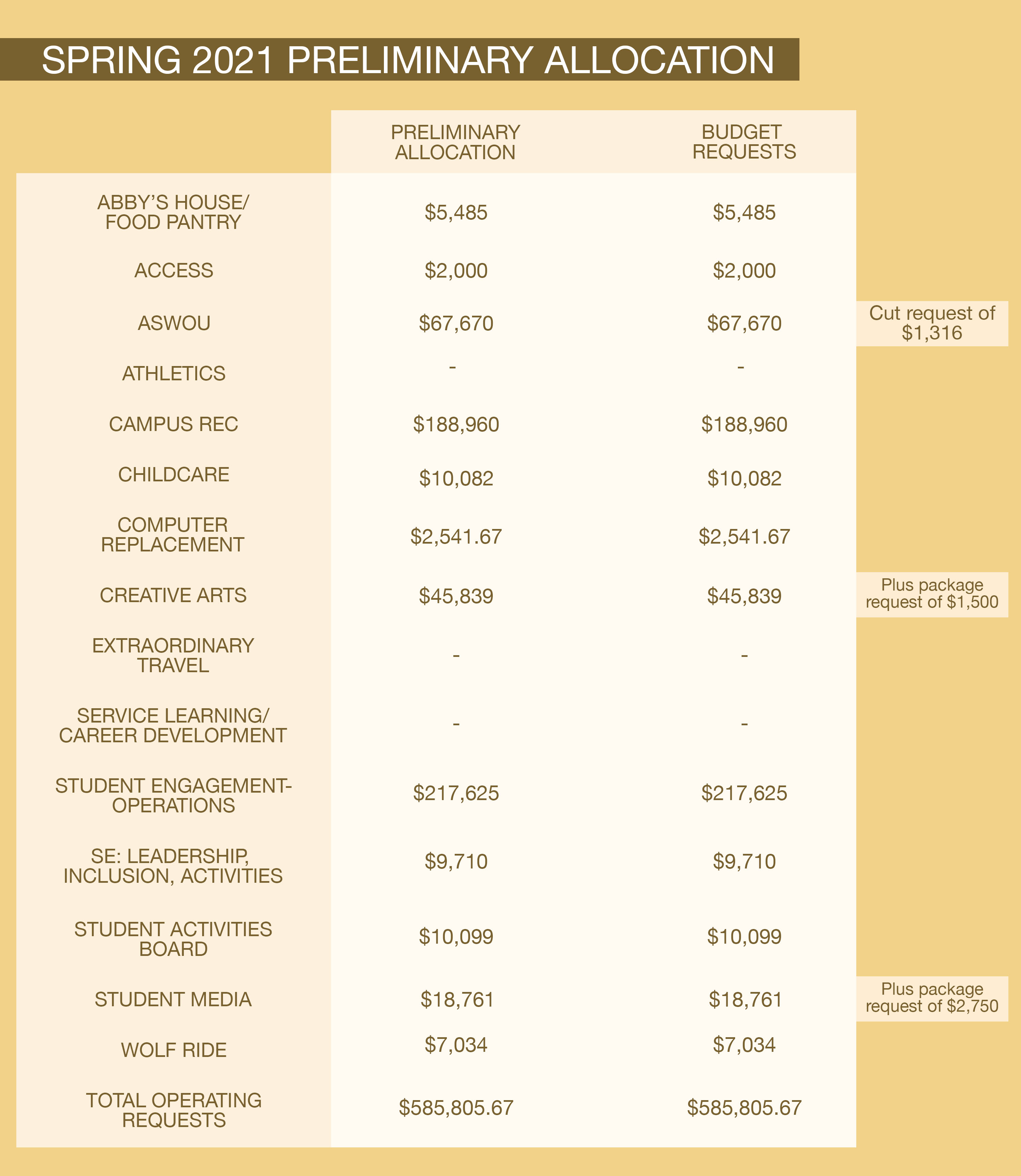
The Incidental Fee Committee has announced preliminary decisions for spring 2021.

In an email announcement sent out on Jan. 21 by IFC Chair Makana Waikiki, the committee provided a spreadsheet of budgetary allocations and two variations of the IFC fee for next term.  During the Jan. 15 meeting, the IFC narrowed down the spring term fee to $115 or $125, to be voted on by students in a survey due Feb. 4. The budget sheet shows that the committee has opted to lower the $150 fee students saw on their bill this term due to lower budgetary requests, explained Waikiki in an open hearing on Jan. 27. 

Under the current proposed fee options, the IFC anticipates collecting either $462,500 or $502,750, depending on the fee option that is chosen. During fall term, the operating expenses from the 15 areas funded by the IFC totaled around $580,000 ⏤ about $400,000 less than last term’s operating budget. For the money allocation, the committee supplied two areas with additional funding: Student Media received $2,750; the Creative Arts department, $1,500.

At this time, the IFC is projected to finalize budgetary evaluations for spring term by Feb. 5. 

For students that are interested in the IFC’s process, the committee holds their meetings via Zoom every Friday starting at 9 a.m. All committee meetings are open to the public and the link to the meeting can be found at their website wou.edu/ifc/. For all other inquiries regarding the IFC, students can email the IFC Chair at ifcchair@mail.wou.edu.

Contact the author at scarpenter18@mail.wou.edu


Press Release: Satisfactory Senate Resolution

ASWOU and WOU Faculty Senate approve the Satisfactory/No Credit grading option

Liz Marquez Gutierrez | ASWOU Senate President

WOU students: 

On behalf of the ASWOU Senate I am excited to share that the E-Satisfactory/NoCredit* grading option will be offered for Winter and Spring of 2021. The S*/NC grading option was offered last spring term to support students adjust to learning in a remote format due to the COVID-19 crisis, however, it was not a grading option for fall 2020 although ~95% of courses were offered online. 

As fall term began, we remained concerned about the mental health and well-being of students, understanding that learning in a remote format during a pandemic continues to be a challenge. In order to address this issue, the ASWOU Senate passed Senate Resolution 6.21 requesting WOU Faculty continue offering students the S*/NC grading option for the remainder of the 2020-2021 academic year. Additionally, Elizabeth Braatz who is a phenomenal student advocate, created a survey to collect student support for the S*/NC grading option to demonstrate how this grading option would greatly benefit students this academic year.

Thankfully, the WOU Faculty Senate voted to approve the S*/NC grading policy for the rest of the 2020-2021 academic year. This effort would not be possible without the support of students who filled out and shared the survey with their peers. I would like to thank Elizabeth Braatz for her incredible work in creating a survey to collect student support for this grading option and for presenting the survey results to the WOU Faculty Senate. I would also like to express my deepest gratitude to the WOU Faculty Senate for listening to students’ concerns and for their support of Senate Resolution 6.21.

On December 29th, 2020, the University Registrar sent an email to students providing more details about the S*/NC grading option. It is highly encouraged that students work with their academic advisor when deciding between S*/NC and A-F grading options for winter term as it may impact financial aid status or admittance to future programs (e.g. nursing school, law school).

We hope this grading option provides students the opportunity to successfully complete their courses as we continue to adjust to a new learning environment.

For more information, contact ASWOU Senate President Liz Marquez Gutierrez at aswousenpres@mail.wou.edu.

Approved IFC fee application makes historic changes for student run committees

ASWOU and WOU administration debate over IFC fee application leads to new Oregon Legislation proposals 

Sydney Carpenter | News Editor

The Associated Students of Western Oregon University and Western administration have concluded their debate over fee application for winter term. 

As a result of the actions of administration, ASWOU is working with Oregon legislators to improve the current Oregon statue that is supposed to protect and guarantee student autonomy over incidental fees.

“Much of the problem is that the law as written now provides the opportunity for an institution to ‘pocket veto’ the student fee through inaction and enough delays,” said Oregon Student Association Executive Director Andrew Rogers in an article written by Oregon Public Broadcasting. 

During the discussions fee revision, ASWOU President NJ Johnson reports delayed action and staling of IFC processes by President Rex Fuller.

“We had sent the fee request on Nov. 25,” said Johnson, “ We needed … for him to respond to the fee request by Dec. 9.”

At the time President Fuller was sent the request, he had no authority to approve the fee in its entirety. However, in an emergency Board of Trustees meeting held on Dec. 8, the committee gave Fuller temporary permission to approve the IFC fee. According to President Johnson, President Fuller was asked to approve the fee by 1 p.m. on Dec. 9, and reports receiving a response around 12:34 p.m that day. Instead of approving the fee Fuller questioned aspects of the proposal.

“He had two weeks to ask questions,” said Johnson, “All of the questions asked were just meant to stall our process so that a potential HECC appeal would have been nullified. We’d be in a position where we have to accept the university’s offer for another stimulus. A stimulus that wouldn’t be able to sufficiently fund the programs that we needed to.”

At that time, ASWOU was in the process of filing a second appeal to the Higher Education Coordinating Commission to have a third party evaluate the administration’s rejection of the IFC fee. 

The first appeal was written in September after the IFC was denied consultation with the Board of Trustees to discuss formatting their fee so that it reflected a campus attending classes 95% online. The appeal was ultimately withdrawn by ASWOU after Fuller stated that the IFC would receive a negotiated million dollar deal on the condition they withdraw their appeal to HECC. ASWOU filed their second appeal later that afternoon on Dec. 9, after their discussion with Fuller.

Following the HECC appeal, Johnson received an email from Fuller saying he would charge the IFC fee.

“For the IFC it seemed that we appealed and there was an attempt to stall us, but we didn’t let it stall us,”  said junior communications major and IFC chair Makana Waikiki. “The president then realized that we were very serious and prepared to move along with the HECC appeal.”

Waikiki explained that it appeared the administration didn’t want ASWOU to make the HECC appeal, so they agreed to charging the IFC fee. Never in Western’s IFC history has a fee established for the year been changed in the middle of that fiscal year. Although a monumental moment for student autonomy, Johnson expressed how disappointed he was that the fee was only accepted after legal action was taken.

“It’s a disappointment that so much effort and time has to go into retaining our rights as students,” said Johnson.

For the upcoming term, regardless of modality and amount of credits being taken, all students will see an flat rate IFC fee of $150 on their bill in comparison to their previous two tier fee system approved back in Apr. 2020. This fee charged students over $200 depending on course load.

In a press release issued on Dec. 16, ASWOU calls for students to participate in the new legislative process taking place within Oregon law. To be involved in the statewide student effort to pass legislation which regulates student fees, contact Oregon Student Association at andrew@orstudents.org to learn how to advocate for student voices.

Contact the author at scarpenter18@mail.wou.edu

ASWOU makes a million dollar deal with WOU administration

Administration denies ASWOU the ability to collect IFC fees, instead offering a one million dollar stimulus

Sydney Carpenter | News Editor

Across Oregon, many universities are converting a majority of in-person classes to online due to COVID-19, Western is one of them. On Aug. 18, a group designated as the “reopening committee” voted in favor of Western holding 95% of its classes online. 

Based on the Tuition & Fees for the 2020 to 2021 academic year, student governed fees — such as Incidental Fees — could not be applied on the fall bill. At the time of approval, fee application was dependent on course delivery. If a student does not attend an in-person class on campus, then the fee would not be applied to their bill.

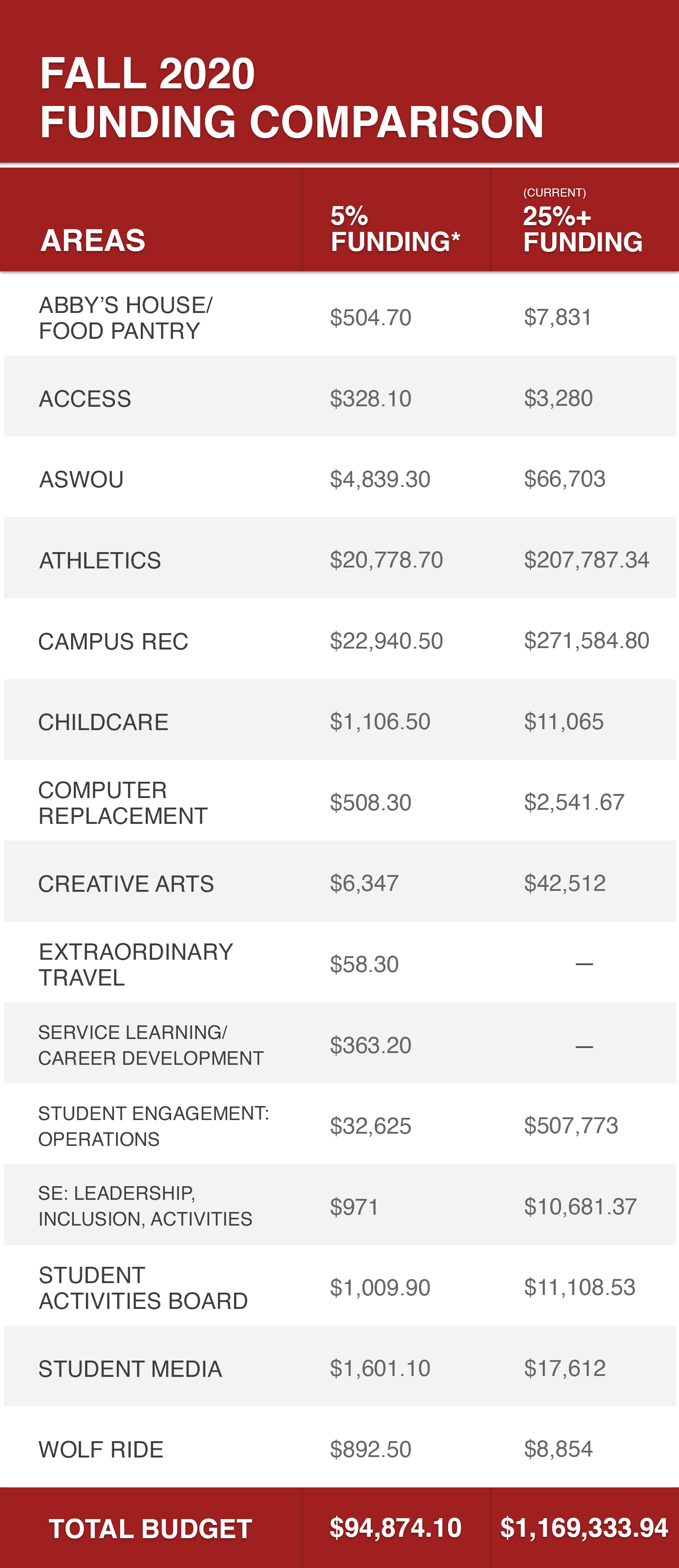
As a result of the online conversion, the Incidental Fee Committee estimated collecting only 5% of their anticipated 1.9 million dollar budget for fall term.

“I was on the committee … designed to reopen campus in a safe way, but I was the only student on that committee,” said senior public policy and administration major and ASWOU President N.J Johnson, “When we were putting together the email announcement…about classes being online I had expressed my concerns.” 

Johnson stated that the email indicated online students wouldn’t be paying a fee. He went on, saying he voiced to the reopening committee that the IFC was not consulted. Johnson said he was outvoted by other members of the reopening committee, resulting in no online students being charged incidental fees.

In the days following the email announcement, the IFC Steering Committee — a group tasked with reviewing and changing IFC bylaws — met on Aug. 31 to take action in response to the reopening committee’s decisions.

“We made two amendments to the bylaws,” said junior communications major and IFC member Makana Waikiki. “One of them was to allow a Special Committee to meet and it also specified who would be a part of the committee.” 

Waikiki voices how the committee felt it important to have more than one student in a room making decisions.

The second amendment gave the IFC control over defining what a fee paying student is. It is considered by the committee to be a historic change.

“We haven’t had the power to define a fee-paying student (until) recently,” said junior philosophy and English double major and IFC Member Nick Denning, “which is absolutely integral in us charging online students.”

After the bylaws were passed by the Steering Committee, the newly formed Special Committee sent out a petition to the student body, asking if they wanted to have a fee applied on the fall bill to fund the 15 programs covered by the IFC. On Sept. 2 the Special Committee convened to discuss applying applying a flat rate fee of $250. During the meeting Denning revealed the petition sent out by the Special Committee received over 300 signatures. Currently Western has 4,164 students registered for classes. 

On the same day of the Special Committee’s first meeting, Johnson reported he was contacted by President  Rex Fuller.

During their discussion , Fuller offered a one million dollar stimulus from the $53 per credit online tech fee approved back in April. According to the Business office the online tech fee is not new. In April when the Board of Trustees were finalizing billing, they took the difference of online tuition  — $228  —  and Oregon residency tuition  — originally $176 before the 4.55% increase in April — increased it by $1 and made it a separate fee for bill transparency.  According to Fuller, the $53 was originally intended for Western’s new Learning Management System called Canvas. However due to COVID-19, Western  entered a contract with Canvas that is funded by the CARES act until the end of 2020.

“Due to the unique situation of Fall 2020 being almost 95% online, I offered to ASWOU a $1M allocation of online course fee revenue to ease the revenue shortfall,” Fuller explained.

After talking with Fuller, Johnson said that he told the Special Committee about the million dollar deal immediately. However, the minutes from the Special Committee’s first gathering discussed applying a temporary flat rate fee of $250, and did not mention the conversation between President Fuller and ASWOU President Johnson. 

Although they were offered a million dollars, Johnson explained the fee application was still requested.

“We had two reasons we wanted to apply a fee,” said Johnson, “The first reason is to have a recognized student government.” 

The second reason Johnson cited for fee application was precedence.

“It’s about having your decision … through (the) proper process as stated in the IFC bylaws. We thought it was important … that those decisions were recognized.” he stated.

On Sept. 23, ASWOU posted a press release claiming the Board of Trustees were asked to meet in September to review the fee being discussed by the Special Committee. However, the Board affirmed they wouldn’t meet till Nov. 18.

“Chair Komp and President Fuller said it wasn’t advisable at the time. Because we have the million dollars from the tech fee that would buy us enough time to solve this problem collaboratively,” recalled Johnson.

In order to work with the Board of Trustees, ASWOU lowered the original $250 fee to $50 because the million dollar offer funded more than 51% of the IFC’s budget. Even so, ASWOU still wanted to establish precedence and the student body government as a legitimate power on campus.

Johnson went on to say that the Board of Trustees still did not want to meet, citing that they felt it would be better to apply a fee in the winter and spring. 

After being denied consultation, on Sept. 14 ASWOU submitted an appeal to the Higher Education Coordinating Commission, requesting a third party to evaluate the administrative rejection process of ASWOU’s request to collect incidental fees. 

Negotiations regarding the million-dollar agreement spanned two days following the Sept. 14 HECC appeal.

On Sept. 16, ASWOU and WOU admin reached an agreement; the three terms of the agreement were not released to the IFC funded area heads until Sept. 17. In the joint email sent by Fuller and Johnson, the three conditions of the agreement were as follows.

First, the University will assess fall term fees based on the course modality of classes offered. For remote/online classes, a technology fee will be assessed while the incidental fee will be assessed on all face-to-face courses. 

Second, the university will provide one million dollars from the tech fee and the remaining funds will be drawn from student reserves. 

Third, ASWOU would drop its appeal to HECC.

ASWOU complied to secure the million-dollar stimulus for the IFC funded areas. After the deal, the IFC received 61% of their projected funds. 

Currently, all areas are being funded 25% or more and the IFC does not intend to apply fees this fall. 

Johnson says that the full IFC will be meeting to discuss what took place this the fall in preparation for winter and spring term. More information will be released when there are developments in the story.

UPDATE (OCT. 28TH, 2020 @ 2:09PM)

For fall term, students did not see an Incidental fee on their billing statements. As a result, IFC was not able to fund the areas it covers until ASWOU President N.J Johnson and Western’s President Rex Fuller made a million dollar deal giving the IFC 52% of their previously anticipated $1.9 million budget. However, the deal was made with the intent to fund the IFC for fall term.

“The online course fee is not designed, as a general proposition, to supplement incidental fees,” said Fuller. “Due to the unique situation of fall 2020 being almost 95% online, I offered to ASWOU a $1M allocation of online course fee revenue to ease the revenue shortfall to support student services funded by incidental fees.”

The IFC met on Oct. 22 to discuss plans going forward. The committee decided to make decisions only for winter term due to the money being unknown so far in the future, feeling it was better to take it term by term, and being able to effectively allocate funds to what best serves students. Currently, all seven IFC area heads are being asked to be prepared to present a 50% budget proposal at their next meeting on Oct. 29.

For the budget proposal, areas are being asked to base 50% funding off of last year’s allocation. In addition to running cost estimation, each department is being asked to present a brief presentation on where the money is going and what has been prioritized in their budgets. The IFC did not give the areas restrictions on what the budget can or can’t be used for.

At this time, President Johnson and President Fuller are revisiting the definition of a fee-paying student — a power the IFC implemented to their amendments in September, but not fully recognized by the Board of Trustees at the time.

All decisions regarding budget proposals and definition of a fee-paying student must be finalized before the first subcommittee meeting for the Board of Trustees, which meets around Nov. 11.

The story will be updated as more information is released.

Contact the author at scarpenter18@mail.wou.edu