

Mount Hood

Western students network at Career and Grad School Fair

Bailey Thompson | News Editor

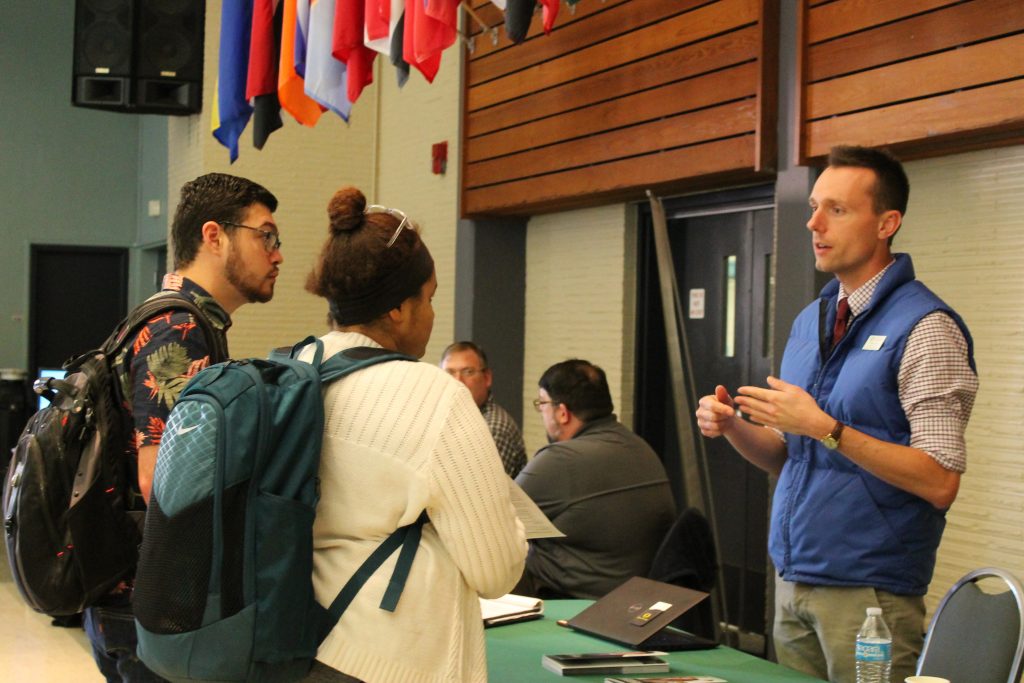
After inviting recruiters to participate in Western’s annual Career and Grad School Fair, the staff at Service Learning and Career Development was eager to welcome students to engage with members of their community on Nov. 7. Inside the Pacific Room, 55 different organizations set up booths with flyers, business cards, and merchandise from their organizations — ultimately hoping students would come to them with inquiries and interest.

The Career and Grad School Fair is organized each year by Jennifer Hansen, the Career Development Coordinator at SLCD. Hansen reaches out to all of the employers who are currently associated with the university, then they are able to sign up to participate.

At the fair, a variety of fields — including law enforcement, education, health services, business and more — had recruiters who were excited to speak with students about their organizations.

Waiting to help students check-in, senior psychology major and SLCD Peer Career Advisor Ashley Johnston shared why this event continues to be hosted each year at Western.

“As we’ve been doing this more and more, we find that it’s super beneficial and that the students have given great feedback,” said Johnston. She added that, In the past, students have “met someone they eventually got a job with or (learned about) grad schools they didn’t know about.”

When asked what was the most beneficial thing that students could take away from this event, Johnston replied without hesitation: networking.

“Networking is huge — I think it’s the biggest thing,” said Johnston. Related to this, she emphasized how important it is to have the skill set “to talk to someone and make a face-to-face contact because a lot of people don’t do that. And it’s hard to do that outside of school, too, which is why it’s really important that it’s here.”

Additionally, Johnston stated that going to the Career and Grad School Fair gives students the chance to build connections in a manner that would be easier than if they were to approach these companies and schools elsewhere.

“People are here to talk to them specifically,” said Johnston. “They’re meant to be networking, so they don’t have to work as hard.”

Finally, Johnston wanted Western students to realize that there are number of reasons why employers are interested in hiring students, so there is no need to be scared to talk with them.

“Employers want (students) to reach out,” said Johnston. “I know we’re younger…but students are really beneficial employees in a lot of ways — fresh minds, being able to learn,” etc.

Although the Career and Grad School Fair has passed, Western students can make appointments to discuss careers or graduate school with SLCD, which is located in Werner University Center 119.


Contact the author at howlnews@wou.edu

Photo courtesy of Bailey Thompson
Greek organizations rally in support of survivors

Bailey Thompson | News Editor

Alpha Chi Omega sisters in black dresses and purple ribbons welcomed guests on Nov. 1 to their event with Kappa Sigma, “My Little Black Dress Doesn’t Mean Yes.” The Greek organizations joined together to raise funds for The Center for Hope and Safety, a domestic violence shelter in Salem.

“We help victims and survivors of domestic violence, sexual assault, human trafficking and stalking,” said Stephen Broncho, the Community Engagement Manager at The Center for Hope and Safety. “Last year, we had over 26,000 contacts to our program.”

Two Alpha Chi Omega members shared their personal experiences with domestic violence, and the President of Kappa Sigma and senior computer science major, Brandon Linton, conveyed a number of statistics about the prevalence of domestic violence in the United States, particularly amongst college-aged women. However, he also stated that there is no one type of person domestic violence targets.

“Domestic violence does not care about your age, your race, your skin color, your religion or your sexual orientation,” said Linton. “Domestic violence affects people of all socioeconomic backgrounds and education levels.”

Linton then stated that the biggest problem survivors of domestic violence face is not being heard. Although survivors have many reasons for not reporting, he shared that some of the most common ones include not believing the police could help, not wanting to get the abuser in trouble, not feeling their experience was important enough to report and being afraid of retaliation.

“I’m here to tell you that there are people in this room and on this campus who care about you,” Linton said. “It is up to us to change the stigma and stereotypes about domestic violence and expose domestic violence for what it is. Too often these terrible crimes go unnoticed — unseen and unspoken — and the cycle of violence continues thriving.”

Although there is still a long way to go, Vice President Philanthropy of Alpha Chi Omega and sophomore ASL/English interpreting major, Serenna Galloway, shared that she has hope that events like this will make a positive change in Western’s community.

“It’s something that’s so prominent right now, and to have a fraternity join with a sorority and break the stigma of that is awesome,” Galloway said. “We hope that other survivors will be able to speak up, or if they need someone to rely on, they know that they can come to us and we’ll find resources for them…we know sometimes it’s harder  to come up yourself, so when you have support it’s a lot easier.”

Through their 50/50 and prize basket raffles, Alpha Chi Omega and Kappa Sigma ultimately raised $779 for Center for Hope and Safety.

If anyone is in need of resources provided by Center for Hope and Safety, their 24-hour hotline is (503) 399-7722.


Contact the author at howlnews@wou.edu

Photo courtesy of Bailey Thompson
Polk County 4-H hosts 56th Annual Holiday Fair

Bailey Thompson | News Editor

Walking into the Polk County Fairgrounds and Event Center, a number of local children called names for door prizes and those involved with Polk County 4-H sat at a greeting booth in the entryway. Roughly 130 vendors gathered on Nov. 2-3 for the 56th Annual Polk County Holiday Fair — a time to share homemade items and help support the local 4-H program.

Paintings, dolls, holiday decorations, wooden items, jewelry and ceramics: all things that could be found at this year’s bazaar. Along a multitude of rows sat vendors of all ages, talking with prospective customers about the products they had made.

Back at the entrance to the fair, however, event organizer Suzi Busler sat and managed several volunteers in order to make sure that the event was a success.

“We’re a holiday fair that started before Christmas bazaars were the in-thing to be,” said Busler. “About nine years ago (an extension study group program) turned it over to the 4-H program. And we’ve expanded and added quite a few things to the program since then.”

In discussing the impact that this annual event has on the local 4-H children, Busler remarked that the holiday fair is one of their biggest fundraising events — drawing close to 3000 people from the community — and it also helps the kids to grow and develop in their leadership skills.

“This is an opportunity for them to be able to market and use those skills that they’re learning in the 4H program,” said Busler.

When asked about whether or not groups of college students are able to rent booths in future years, Busler responded, “Absolutely…maybe a college student doesn’t have enough time to be able to have enough product to staff their own booth, but a collection of students could easily join together to be able to have enough products to sell.”

If any Western students or organizations are interested in being a part of the Holiday Fair next year, Busler advised that they contact the Polk County Extension Office at (971) 612-0028 after information comes out next August. It costs $40 for crafters to participate in the fair, and this money goes to funding the Polk County 4-H program.


Contact the author at howlnews@wou.edu

Photo courtesy of Ashlynn Norton

Update: The results of Oregon’s Midterm Election

Bailey Thompson | News Editor

[fruitful_tabs type=”accordion” width=”100%” fit=”false”]
[fruitful_tab title=”National Offices”]U.S. Representative District 5: Kurt Schrader [/fruitful_tab]
[fruitful_tab title=”State Offices”] Governor: Kate Brown

State Representative District 20: Paul Evans

State Senator District 10: Jackie Winters

[/fruitful_tab]
[fruitful_tab title=”Local Offices”]

Monmouth Mayor: Cecelia Koontz

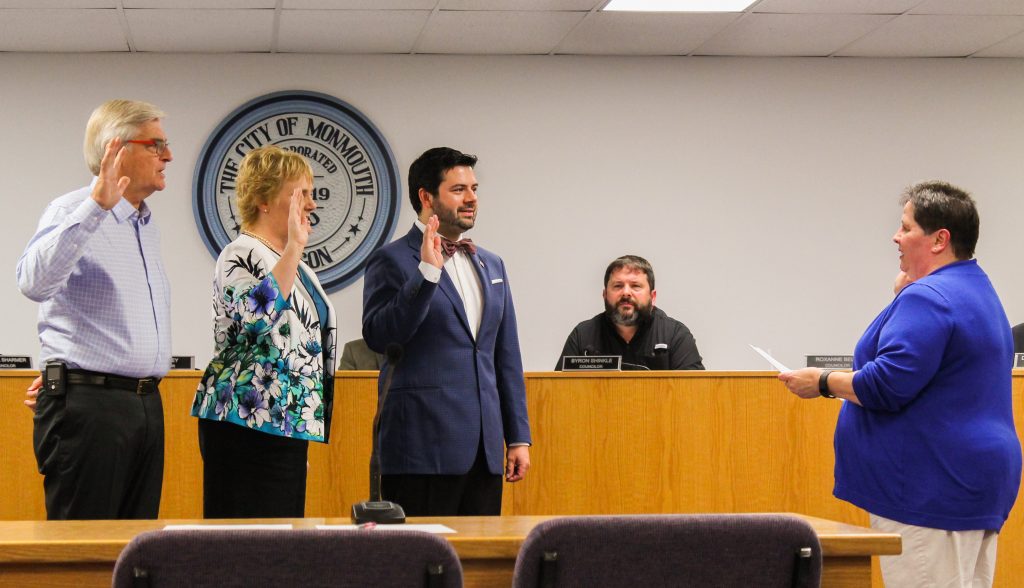
Monmouth City Councilors: Roxanne E. Beltz, Jon Carey and Stephen Howard

[/fruitful_tab]
[fruitful_tab title=”Ballot Measures”]

Measure 102: Yes

Measure 103: No

Measure 104: No

Measure 105: No

Measure 106: No

[/fruitful_tab]
[/fruitful_tabs]

[fruitful_alert type=”alert-success”] Stay tuned for more information on these results. [/fruitful_alert]


Contact the author at howlnews@wou.edu

Photo courtesy of Ashlynn Norton

Western’s LGBTQ+ club holds their fall dance

Bailey Thompson | News Editor

While some people might have expected the middle of the term to involve overwhelmed college students staying in their rooms and eating instant noodles, this wasn’t the reality for all — a fact which Triangle Alliance recently proved. Dancing under a disco ball and playing card games with friends, the Western club hosted Pajama Jammy Jam on Nov. 2 as a time for LGBTQ+ community members and allies to come together and enjoy a night of wholesome fun in the Werner University Center.

With a fairly open structure to the event, attendees were free to socialize, dance, play games and enjoy a variety of refreshments. During the second half of the event, club members held a drawing and gave away five different prize bundles to those in attendance.

When asked what the goal of the event was, Triangle Alliance Club President Sam Shoemaker, a sophomore theater history major, said that their aim was pretty simple:

“It’s to get people from Triangle Alliance, our club, out and having fun on a Friday night where we would not normally be out and about and partying,” said Shoemaker.

Shoemaker shared that the club is always looking to involve new members. If someone goes to Pajama Jammy Jam who doesn’t normally go to Triangle Alliance, Shoemaker hoped that they would meet people and want to get more involved.

“If you like the people you should come to the club,” Shoemaker said. “It broadens the horizons of the club members and it gives more opportunity for people who might be like, ‘I don’t know if I would like this club’” to get involved.

In addition to social events like Pajama Jammy Jam, the Black and Red Ball and Triangle Alliance’s Annual Drag Show, Shoemaker expressed that there are also a number of informative events that Triangle Alliance has been hosting in order to educate its member about important issues in the LGBTQ+ community.

“Last Thursday (Oct. 25) we put on a talk with the LGBTQ+ class about the trans memo that came out that weekend about what President Trump allegedly might do in the trans community,” said Shoemaker. “There’s a really good quote that I heard from somebody: ‘Being gay is being political. Being queer is being political.’ And so, first thing for me this year with the club is that I don’t want to just be a fun social club — I want to talk about the issues.”

For anyone who might be looking for resources to learn more about the LGBTQ+ community, Shoemaker had a couple of suggestions for where to go.

“The Stonewall Center is the resource center for the LGBTQ community. Suse Doepken is the coordinator of Stonewall, and she’s amazing,” said Shoemaker. “If somebody wants to know about things, go to her. Also, Abby’s House is a great resource about advocacy and the feminist mindset.”

If Western students are interested in becoming involved with Triangle Alliance, Shoemaker advises that they start by going to Triangle Alliance’s Midnight Movies event on Nov. 16, which will be showing Fantastic Beasts: The Crimes of Grindelwald, and looking out for auditions to be in the annual drag show, which will occur during Winter Term.

For more information, Sam Shoemaker can be reached at sshoemaker17@wou.edu and the club can also be contacted through trianglealliance@wou.edu. Triangle Alliance meets on Thursdays in Ackerman 141 from 4:30-6 p.m.


Contact the author at howlnews@wou.edu

Photo courtesy of Ashlynn Norton

Abby’s House hosts Take Back the Night during Domestic Violence Awareness Month

Bailey Thompson | News Editor

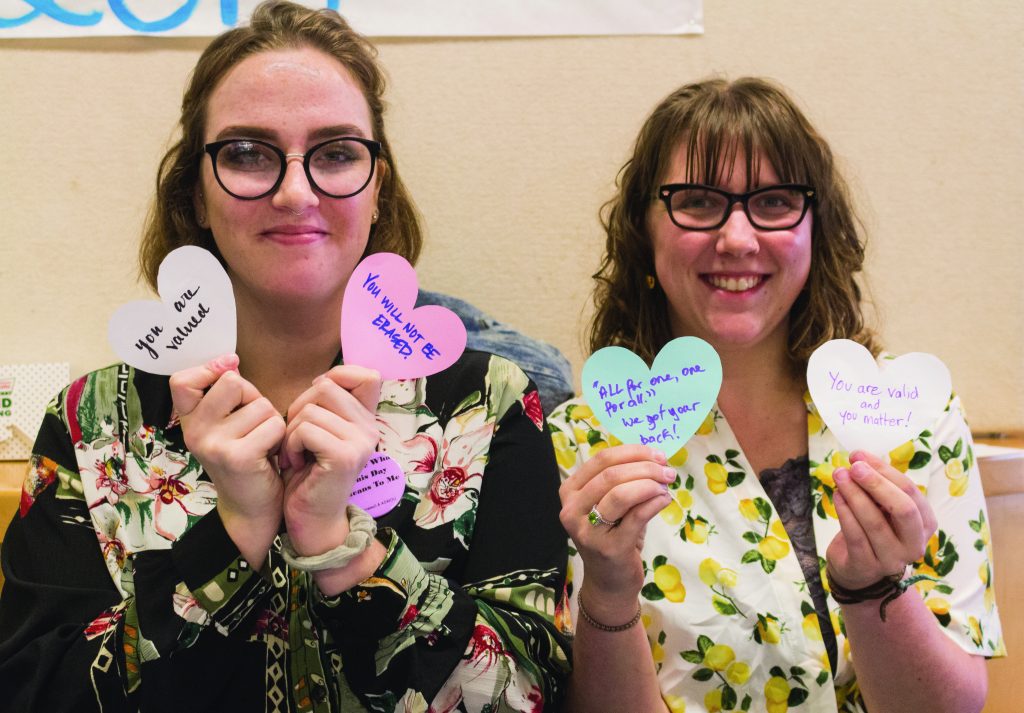
Despite the rain pouring outside, a room full of Western students and staff came together on Oct. 25 —­ in the midst of Domestic Violence Awareness Month — to offer community and support to those affected by domestic and sexual violence. Paper hearts with messages of hope and Abby’s House Advocates dressed in blue vests were spotted throughout the room.

To open the event, Abby’s House Director Aislinn Addington and a number of the student advocates explained that Take Back the Night was first held in the United States in 1975 when a young microbiologist named Susan Alexander Speeth was murdered while walking home from work.

“Today, we know that attacks and assaults do not only happen in the night,” Abby’s House Advocate Gisela Ayala shared. “Data shows that women are at risk at all times of the day because women are most likely to be abused or attacked by people that they know, not just strangers in the dark. We also know that folks of all genders experience interpersonal violence and we are here to support all survivors.”

Then, advocates led the crowd in a silent reflection where attendees listened as a gong sounded every nine seconds — a sound that symbolized the amount of time that passes between each instance where physical violence occurs in the United States.

At this time, Addington introduced Carli Rohner, the Campus Advocate Coordinator from the Oregon Attorney General’s Sexual Assault Task Force.

“Violence is preventable, and we all have a role to play in that,” said Rohner. She shared that their goal is to figure out how to “build communities that…can respond and take care of each other better,” and to “make sure that (domestic and sexual violence) doesn’t have to happen.”

Rohner also encouraged those present to think about a reality in which violence is not rampant, although she acknowledged that this can be hard for many to do.

“Culture is not stuck,” said Rohner. “When we think about it over time, our humanity, collectively, has done some really wildly different things if we look back 40, 50, 60, 100, 200 years ago. We’re doing things differently now…and most of the change that we see, especially with in the United States context, is driven by students.”

If Western students want practical, tangible steps they can take, Rohner emphasized that most things that are interruptive of negative behaviors really don’t take long to do: go to a Green Dot training, share campus resources like Abby’s House or the Student Health and Counseling Center, support people with marginalized identities and don’t be afraid to take time for self-care.

The biggest and most basic things she suggested — to believe survivors who come to you.

“No matter what they tell you,” said Rohner. “I’ll give you two phrases: ‘I totally believe what you’re saying’ and ‘It wasn’t your fault.’ When folks hear that…they are 80 percent more likely to get help and assistance moving forward and much less likely to experience some of the bad things we talk about in terms of like PTSD and other effects of trauma.”

Following the talk, students were given the microphone and a platform to share their stories and experiences with violence. An emotional time for all, a number of students gave accounts that moved them and the audience to tears. For many, these memories were hard to share, but freeing to not carry alone anymore.

To conclude the event, marchers took up signs and glow sticks and chanted in unison as they walked through campus. With empowering statements including “we won’t take it anymore,” “violent acts have got to go” and “survivors unite,” they joined together to take back the night.

After marching, the group gathered in a circle, lit candles and shared why they wanted to end domestic violence — daring to dream of a brighter future.

If students would like to talk with someone about these issues, they can contact Carli Rohner at carli@oregonsatf.org or visit Abby’s House or the Student Health and Counseling Center on Western’s campus.


Contact the author at howlnews@wou.edu

Visiting lecturer Dr. Asoa Inoue discusses white language in education

Natalie Dean | Freelancer

Imagine if the pressure to perform to the highest standard in school was completely removed. An “A” could be earned through the amount of effort put into the material, rather than frantic memorization. A “D” was no longer reflective of things done wrong, but rather of the amount of labor put into an assignment. By exploring these alternative grading methods, Dr. Asoa Inoue, a professor at the University of Washington Tacoma argued, it is directly challenging institutionalized racism within education.

These are themes that Dr. Inoue spoke about on Oct. 29. As a professor and the Director of University Writing, Dr. Inoue is well-versed in the impact of unchanging grading systems. He elaborated that the current grading system is failing students specifically students of color through hidden white supremacist values. This is due to the fact that our grading policies for writing and linguistics prioritize enunciated speaking, formal tones and rigid dialects — and the opposite is seen as “uneducated” or lazy.

He explains this as a direct result of the colonization of the US, which favored white-centric ideals early on. Code-switching, the act of flipping from one language to another midway through during a conversation, such as from English to Spanish, has been looked down upon as a failure to fully assimilate into American culture. American culture is often referenced and made an example of in our education systems; language and culture hit the same vein.

Dr. Inoue reminds students that these values are not set in stone and that institutional change can happen. By analyzing where these expectations of writing and literature come from, it can allow for alternative grading methods, such as labor-based grading contracts.

Labor-based grading is an agreement between the students and professor that states if students meet specific criteria, they will earn a certain grade. It focuses on the content of the course and how it’s evaluated and “graded.” So if a student fails, they are held directly responsible for the effort put into the project.

With this method, students can take an active role in their learning, while fully understanding the work and dedication that goes into an “A.” When asked about students’ reaction to this program, he stated that 8/10 students are willing to at least try this alternative method and many have found it helpful for their writing overall.

“I’m going to go into High School Education for English,” said senior humanities major Madeline Hannah, who was in attendance. “And it definitely opened my eyes to some of the problems that affect a lot of students of color. I’ve been looking into different ways to assess and grade, and this gave me an option that could be more equitable for everyone.”

If students or faculty have any questions regarding the impact of white supremacist language in today’s educational systems, Dr. Inoue can be contacted at asao@uw.edu.


Contact the author at ndean17@wou.edu

Math major profile

Bailey Thompson | News Editor

Of the 52 majors offered at Western, sophomore Josh Salsbury has chosen to be a math major. After finding success and being awarded Outstanding Freshman in Mathematics last year by the Math Department faculty, Salsbury currently works as a tutor in The Math Center and as the Finance Director for Western’s Residence Hall Association — both positions that relate directly to his major.

When asked about his motivation in becoming a math major, Salsbury reflected back on experiences he had before coming to Western.

“I had a really awesome calculus teacher when I was in high school,” said Salsbury. “It was that combined with learning that the way math is taught in schools isn’t a good reflection of what math actually is. Learning that there was a lot more to (math) really inspired me to learn more about it.”

In learning about math, Salsbury shared that there is more to the process than many people initially think.

“With a math major, it’s not just about being able to do math,” Salsbury said. “A lot of what it teaches you…is doing things efficiently or finding the best way to do something.”

According to the Mathematics page on Western’s website, there are a number of career opportunities that are available to a math major. Amongst them, a few options listed include computer scientist, cryptographer, business operations specialist, elementary and secondary math teacher and financial analyst.

Salsbury is still deciding which pathway to pursue within mathematics.

“I was originally going to go for a career in software engineering because I’m also getting a computer science minor…but I’ve been talking to a couple of professors and they think I’d make a really good professor…(and) it’s something I’ve been considering.”

Besides the future possibilities the major holds, Salsbury also values the Math Department for another reason: the people involved.

“The Math Department is one of my favorite communities on campus,” said Salsbury. “And that’s a combination of both the faculty and the students. It’s a small enough department that it’s really easy to make friends and get to know people.”

Salsbury also praised the math faculty who help make the program what it is.

“I don’t think I’ve met a group of professors so dedicated to getting to know their students and helping them succeed in life,” said Salsbury.

Whether students are interested in math or not, however, Salsbury offered a piece of advice:

“If you look hard enough you will find your community. There are always more places to explore, people to get to know. And, in my experience, it’s been really easy to make close friends. And the more you put yourself out there, the more likely you are to find those people that you really care about.”


Contact the author at howlnews@wou.edu

Photo courtesy of Ashlynn Norton

A new governor for Oregon

Bailey Thompson | News Editor

With the 2018 Midterm Elections approaching fast, Oregon voters have a limited amount of time before Nov. 6, the day they must elect Oregon’s next governor. Although Oregon has not had a Republican governor since 1987, Knute Buehler’s moderate social views have recently made this race a toss-up, according to Real Clear Politics and the Cook Political Report. On the other hand, Gov. Kate Brown, after being elected the first openly LGBTQ+ governor of a U.S. state in 2015, is looking to be elected for her first full term.

Kate Brown

Oregon’s current governor, Kate Brown, is the Democratic gubernatorial candidate who is also endorsed by the Working Families party. During her time in office, Brown raised Oregon’s minimum wage, signed a law to phase out coal power and signed the bill for Oregon Promise, among other things. The main issues Brown emphasizes on her official website: economy and jobs, government efficiency, healthcare, education, the environment, public safety and strong communities.

Brown has a background as a family law attorney, but she has also held a number of governmental positions such as representative, senator and secretary of state.

According to an Oregon Public Broadcasting article, however, Brown’s critics have complained about her time in the governor’s office, stating that “the state faces massive problems, yet…the governor hasn’t articulated a clear vision or unveiled a comprehensive plan to solve them.”

Her supporters, on the other hand, assert that Brown simply has a different leadership style that isn’t as assertive as people are used to seeing in a governor.

Knute Buehler

Republican candidate Knute Buehler hails from Bend, Oregon and has, until recently, worked as an orthopedic surgeon. In 2015, Buehler was elected to the Oregon House of Representatives, where he has since served two terms. The four issues that Buehler lists on his campaign site are education, health care, homelessness, and bridging Oregon’s rural/urban divide.

Even though, in many ways, Buehler’s fiscal conservatism aligns with popular expectations for Republican candidates, some of his progressive social beliefs have taken some voters by surprise — in both positive and negative ways. Buehler, unlike some traditional Republicans, is a pro-choice candidate who both believes in climate change and supported the legalization of gay marriage. While these views are may be a deterrent to a number of conservative Republicans, there are others for whom this is a selling point. For instance, according to the Oregonian, Nike co-founder Phil Knight — who has supported both Republicans and Democrats in the past — has contributed $2.5 million to Buehler’s campaign, which breaks the record for a single political donor in Oregon’s history.


Contact the author at howlnews@wou.edu

Photo courtesy of Ashlynn Norton

Western’s trustees compare retention strategies

Bailey Thompson | News Editor

At their Oct. 17 meeting, the Western Board of Trustees wrestled with a number of critical issues to Western’s future success. Regularly featured in these meetings, the Board heard reports from groups such as Faculty Senate, Staff Senate, ASWOU, President Rex Fuller and numerous university committees.

One thing that was unique to this meeting, though, was the October discussion theme: enrollment.

Vice President of Student Affairs, Dr. Gary Dukes, presented on this topic, sharing with the Board that Western enrollment is down by three and a half percent this year, mirroring the trends of other Oregon universities. He also informed the Board about steps currently being taken to improve in this area: the university aims to attract more first-year students by improving affordability, more transfer students by reaching out to those in the Oregon Promise program, more graduate students by developing new programs and more international students by adding new countries to Western’s outreach.

Dukes also discussed a number of other strategies that Western is implementing to increase retention and new enrollment.

After the meeting, Board of Trustees Faculty Representative Dr. Gavin Keulks, English professor and Honors Program Director, shared his theory about the cause of enrollment decline.

“There just aren’t as many people going to college because…some people who can go to the job market are choosing to do that,” said Keulks. “Also, the tuition promise with community colleges means that more people are going to community colleges and then transferring in…and our enrollment has been going down.”

Commenting on the gravity of the situation, Keulks continued by saying, “I don’t think it’s an alarm, but it’s certainly not a little thing because this is where it impacts students. If enrollment keeps going down…there will be pressure to increase tuition.”

In the end, however, Keulks remarked that “everyone (on the board) has a deep love of the university and a genuine to concern that the university is thriving,” meaning that “if we fight about something, it’s because we want the school to make the right choice.”

If students are interested in learning more about this meeting, Keulks suggested looking on the university’s website, as there are a number of documents and statistics that can be reviewed far faster than it would have taken to attend the entire six-hour meeting.


Contact the author at howlnews@wou.edu

Photo courtesy of Ashlynn Norton

Homecoming at Western

Bailey Thompson | News Editor

Beginning on Monday, Oct. 15, and continuing through Saturday, Oct. 20, students gathered together to celebrate another year at Western. Throughout the week, events sponsored by Student Engagement, SAB, ASWOU, Weekend Programs and Western Athletics provided Wolves with numerous opportunities to relax, have fun with friends and show off their school spirit with this year’s “Across the WOUniverse” theme.

The highlighted events on Monday were the 2nd annual Homecoming Carnival, an event with games, face painting, a human gyro machine, food, a palm reader and informational booths for a number of campus organizations. The second Western tradition that was held on Monday was Paint the Wolf, a time for students to help re-paint the school logo that lies on Church Street.

Then, on Tuesday, a number of Western clubs and organizations contributed to Paint the Town Red by decorating the windows of participating business around Monmouth with out-of-this-world “Across the WOUniverse” designs. On Tuesday evening, the intergalactic fun continued with a screening of Space Jam in the Pacific Room of the Werner University Center.

Wednesday brought a special edition of SAB’s WOU Wednesdays, where SAB executive members drove around Western in a “rocket ship” and delivered swag to any students wearing Western apparel. The campus itself even reflected the students’ school spirit through the Office Decorating competition. Although many groups captured the space theme well in their décor, the winners of the competition were the Center for Early Learning & Youth Development, Business Services and the Criminal Justice Department.

When Thursday rolled around, the main event of the day was a Galactic Roller Rink that was held in the WUC. The rink even glowed in the dark, and the first 20 students received a homecoming t-shirt.

On Friday, the 39th annual Powerpuff Game and tailgater saw an On-Campus team take on an Off-Campus team, and although On-Campus scored first, the Off-Campus girls ultimately won 7-6.

“As my second year coaching the On-Campus PowerPuff team, I am grateful to have worked with so many friendly students on our campus,” said Wenyin Metcalf, senior communications major who was also on the 2018 Homecoming Court. “Though it is only a one-game per year experience, the friendship bonds we create each year are irreplaceable.”

Immediately following this match, students walked over to the lawn near Campus Public Safety in order to watch the lighting of the “W” bonfire and pep rally. This event featured performances by the Western cheerleaders and band, and it finished with a pie-eating contest in the dark.

Saturday concluded the festivities with the Homecoming football game against Humboldt State University. Before the game, students gathered in the parking lot for a tailgater with food and activities. And at halftime, the Western Homecoming Court for 2018 was announced and the two Wolf Royalty from the senior class were named. This year, the two who earned this honor were Riley Bardes, an exercise science major, and Carlos Chairez, a business major.

The Wolves beat the Humboldt State Lumberjacks 45-24, providing an exciting end to an eventful homecoming week.


Contact the author at howlnews@wou.edu

Photo Courtesy of Paul F. Davis and Caity Healy

Western develops and introduces a sustainability major

Bailey Thompson | News Editor

With the start of the 2018-19 school year, a new major has come to Western.

Sustainability is an issue that geography professor Dr. Mark Van Steeter has been passionate about for a number of years, and his dream of having it as a major at Western has finally become a reality.

“I knew it was something that would be great for students,” said Van Steeter. “For their ability to understand the interconnections in the world and get employment and have hope about the future instead of dread.”

He shared that he committed to developing the major after meeting with President Rex Fuller three years ago.

“I said ‘Okay. I’ll do it.’ And one of my qualities and weaknesses is when I say I’ll do something, I actually do it. So, I made that commitment to the students, to the president and to myself. And so, I just started working on it,” said Van Steeter.

With the final design, students are able to choose one of two concentration areas within the sustainability major: environment or business.

The reason for this, as Van Steeter explained, is that “it can’t just be the environmentalists complaining; it needs to be corporations and businesses that are working for sustainability.”

In the core of the major, students will take classes in “business, economics, geography, political science, communications, philosophy (and) biology,” said Van Steeter. “We’re trying to put those things together, so they mesh and give people the ability to see reality and therefore do something positive, effectively.”

When asked about the importance of prioritizing sustainability both on Western’s campus and in the United Stated, Van Steeter said “by definition, if something is not sustainable it will cease to exist. And given current pressures on ecosystems and on society, we are starting to reap the dark outcomes of not acting sustainably. If we don’t integrate sustainable thinking into our practices and continue down the path we’re on, the world…is not going to be a place of great opportunity and freedom.”

If students are interested in learning more about the new sustainability major, they can find information on the university’s web page, or they can reach out to Van Steeter at vanstem@.wou.edu. They can also talk to his colleagues in the Geography and Sustainability Department — Dr. Mike McGlade, Dr. Shaun Huston, and Dr. Sriram Khé.


Contact the author at howlnews@wou.edu

Salem Out of the Darkness Walk offers hope for suicide prevention

Bailey Thompson | News Editor

Holding signs and wearing t-shirts with messages about lost loved ones, over 1500 people gathered together at the Oregon State Capitol on Oct. 13 to participate in the Salem Out of the Darkness Walk for suicide awareness and prevention.

After all the participants had checked in, the event’s organizers stood on the steps of the capitol and offered a message of hope and support to everyone in attendance.

“Did you know that the mission of (American Foundation for Suicide Prevention) is a simple one? It’s only (10) words: save lives and bring hope to those affected by suicide. That’s it,” said Angela Perry, president of the Oregon Chapter board for AFSP. “Today is the perfect day to reflect, to remember those we have lost and to honor those who have struggled and are fighting to stay.”

According to AFSP’s 2018 statistics page, suicide is the second-leading cause of death for college-aged students in Oregon. Additionally, one person dies by suicide in Oregon every 11 hours. Because of statistics like these, Perry shared that AFSP is hosting nearly 400 community walks nationwide in order to raise funds for awareness of mental illness and suicide prevention.

“We’re all connected — connected by something none of us ever wanted a connection to,” Perry said. “Suicide is hard. It’s dark. But what we’re doing here today is bringing it out of the darkness: it’s okay to not be okay and you are not alone.”

Another speaker who shared her testimony before the crowd was 11-year-old Kelly Johnston, a middle school student who has become an advocate for suicide prevention, speaking at a number of AFSP events and even sharing her wisdom with graduate students at Lewis and Clark College.

“Two and a half years ago I lost my dad to suicide… every so often I would have dreams about how he had done it and what he may have been thinking. And often I’ve wondered where I would be if it wasn’t for counseling. Through counseling, I’ve been able to make speeches that I feel have made me mentally stronger,” said Johnston. “I love knowing that I might be helping someone out there — especially someone with depression. People who struggle with depression may feel that they will be judged if they ask for help or ask questions. Part of my mission is for people to know that it is okay to ask for help.”

After Johnston’s speech, the crowd was led through a traditional bead ceremony — a moment filled with emotion for many.

For each type of loss that a person had experienced, there was a different color of bead to wear. In turn, audience members raised red beads if they had lost a partner or spouse; gold beads if they had lost a parent; white beads if they had lost a child; orange beads if they had lost a sibling; silver beads if they had lost a military member or first responder; and purple beads if they had lost a friend or relative. Furthermore, there were also teal beads if their friend of relative struggles with or has attempted suicide, green beads if they themselves have struggled, and blue beads that showed their support for the cause.

To conclude, the crowd walked around the capitol building, taking time to remember their loved ones. At the end of the day, the event had raised $65,395.82.

For anyone currently struggling with the effects of suicide in some manner, there are resources that are available to help. Western students can call the Student Health and Counseling Center at (503) 838-8396 in order to set up a counseling appointment. Additionally, students can also call the National Suicide Prevention Lifeline any time at 1 (800) 273-8255.


Contact the author at howlnews@wou.edu

Photo courtesy of Ashlynn Norton

Western hosts speaker about injustice in Latin America

Flora Pugh | Freelancer

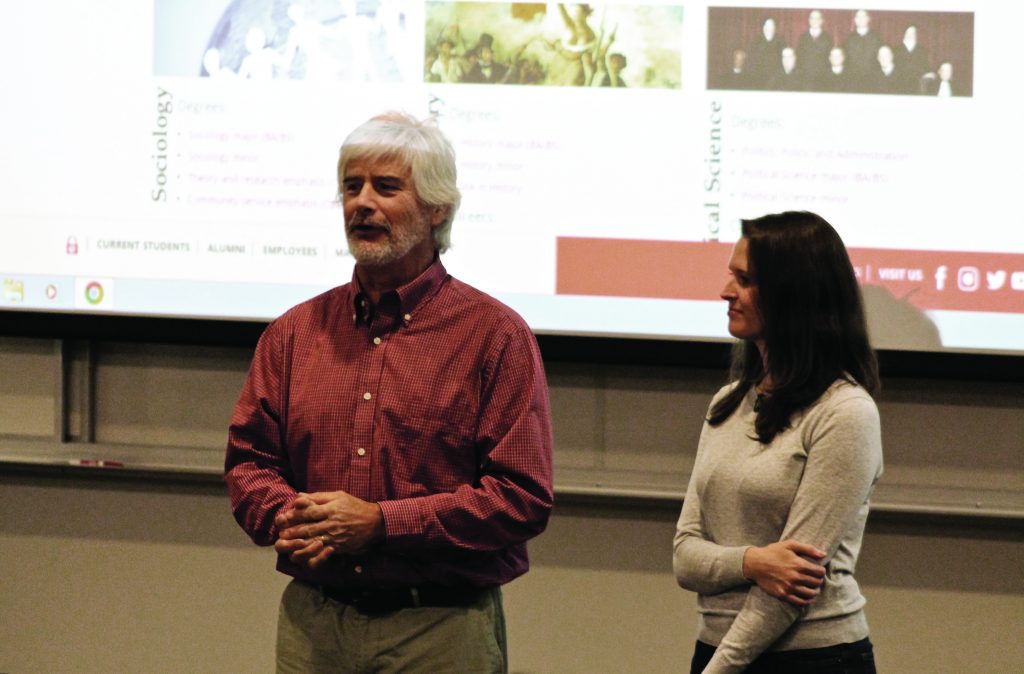
Witness for Peace is a “grassroots non-profit organization and our goal is to change unjust U.S. policies and corporate practices towards Latin America,” said Kris Hannigan-Luther, organizer of the group’s northwest region.

On Thursday, Oct. 11, a Latina speaker and Honduran journalist named Jennifer Ávila came and spoke at Western with Witness for Peace. Sponsored by the College of Liberal Arts and Sciences and hosted by the Communication Studies Department and Social Sciences Division, the speech was held at the Werner University Center in the Columbia Room.

Jennifer Ávila shared about the rampant injustice and violence in Honduras that threatens the safety of its citizens. Since 2009, a time when Honduras was considered one of the top ten most dangerous countries in the world, Honduras has become even more dangerous and full of violence.

Ávila also mentioned that the U.S. has helped illegal states remain in control, and since then, Honduras has become more militarized and unjust, with more fraudulent power being put in place. In its current state, Honduras has corruption, no healthcare and practically no education. Most Hondurans only are educated up to the eighth grade, and less than 13 percent of Hondurans end up attending a university. In addition, most of the universities in Honduras are only open to the elite, according to Ávila.

With that being the case, the majority of Hondurans prefer to work because they can’t afford to live and attend school. In fact, more money in Honduras is used to fund the elite, corporations and the military — which the U.S. helps fund — than to fund education and healthcare.

According to Ávila, 90 percent of drug trades pass through Honduras, which has resulted in many being afraid. And a number of people, such as women and children ages 12 to 18, are used as bait for things such as transporting drugs.

However, the LGBTQ community, and particularly trans women, are the most at risk in Honduras. Many trans women end up stuck working in sexual commerce because there is no identification law and very few job opportunities.

In the timeframe between 2009 and 2018, 292 people were murdered in Honduras. Ninety-two of those people were trans women. Ultimately, only 20 percent of the 292 murders were prosecuted.

On a more positive note, Ávila also spoke about how beautiful Honduras is and how we as U.S citizens can help the people in Latin America through voting, advocating and supporting Witness for Peace.  

As a Western student, one can raise awareness about the injustice in Honduras as well as vote in favor of local businesses and non-damaging corporation in Latin America. Students can also help by voting on issues surrounding the Honduran people’s basic needs: justice, better education, health, peace and a safer environment to live and raise their children.

When asked what she thought of Ávila’s speech, Anna Cortez, a first-year biology major, commented, “It was really good. I liked the facts and picture and that they showed the good and bad, because it is important to show both.”

For more information on Honduras, Western students can look into Ávila and her friend’s media journal Contra Caliente on the website contracorriente.red. They can also learn more about Witness for Peace on their Facebook page, Witness for Peace Northwest.


Contact the author at fpugh18@wou.edu

Photo courtesy of Ashlynn Norton

Oktoberfest put on by Western German Club

Bailey Thompson | News Editor

In the courtyard of the Werner University Center on Oct. 10, popular German music blasted through speakers and the smell of German food wafted through the air: the members of German Club had prepared a feast for the whole Western community.

“What we’ve got here is bratwurst — one of the most German things there is — and we’ve got some… curry sauce, which is like a German version of ketchup. Then we have German-style sauerkraut and potato salad… and we’ve got some German Apple Cakes,” said German Club President and sophomore German major Alyssa Jackson.

The only thing missing from this traditional Oktoberfest meal is beer, but the club doesn’t serve alcohol since their event is hosted on a college campus.

When asked about the significance of Oktoberfest to the club, Jackson said that “it’s fun, there’s lot of good food and it’s nice to just share the German culture.”

Although the event is exciting for the club members and those in the Western community, Jackson shared that the club also has another reason for selling Oktoberfest meals.

“All the proceeds are going to the German Club scholarship, which is $1,000 that gets awarded to one student,” said Jackson. And, when asked about how the scholarship recipient was chosen, she shared that “it goes off of what German means to you and why you’re studying it. Obviously, we want to put it with someone who has a connection to German rather than just someone who wants money.”

One thing that many students may not know is that Oktoberfest is a long-standing tradition on Western’s campus.

“I started here 37 years ago, and we’ve done it ever since,” said German professor Dr. Hoobler.

Reflecting on the way that the festivity occurs in Germany, Hoobler added that “October gets rainy, and so (in Germany) they do Oktoberfest in September.”

Hoobler concluded by saying that “what you see (here) is really what they do. It’s the end of the harvest festival, and they serve us this and it’s a chance for us to get together. Germans are very social — it’s all about the community — and so really all over Germany we’ll have Oktoberfest.”

Contact the author at howlnews@wou.edu

Photo courtesy of Paul F. Davis

Brett Kavanaugh confirmed to the Supreme Court

Bailey Thompson | News Editor

The American people were subjected to months of controversy when President Donald Trump, on July 9, chose Brett Kavanaugh as his nominee for Supreme Court Justice.

Kavanaugh has been involved in the political realm for a number of years. According to Business Insider, his presence at key events in political history effectively earned him the nickname “the Forrest Gump of Republican Politics.”

In his younger years, Kavanaugh held positions as law clerk to Justice Anthony Kennedy and as associate counsel on the team who investigated former President Bill Clinton’s affair with Monica Lewinsky. After that, he worked as assistant, staff secretary and senior associate counsel to former President George W. Bush.

Since 2006, Kavanaugh has served on the DC Circuit Court of Appeals.

Although his political background was the motivating factor for his nomination, alleged elements of Kavanaugh’s past have shocked and horrified much of the American public.

Dr. Christine Blasey Ford, Deborah Ramirez, and Julie Swetnick have each come forward with sexual assault allegations against Kavanaugh since his nomination.

On Sept. 27, Ford testified at a hearing, stating she was “100 percent” certain that Kavanaugh was the man who had attacked her 36 years prior.

Ford’s testimony inspired an FBI investigation, postponing the senate’s confirmation vote until further knowledge had been obtained.

The hearing also incited an outcry of sentiments online — with conflicting hashtags such as #StopKavanaugh, #ConfirmKavanaugh and #Ibelievesurvivors highlighted the passion of those on both sides of the issue.

Concluding the investigation, the FBI reported they did not find any evidence to corroborate the allegations against Kavanaugh. So, on Oct. 6, the Senate voted 50-48 to confirm him to the Supreme Court, establishing what is anticipated to be a conservative majority for many years to come.

The outcome of this vote will prove significant to Western students for a couple of different reasons. First, the addition of Kavanaugh to the Supreme Court suggests that the interpretation of highly-contested laws will have a more conservative influence in the future. On top of that, the way that these hearings addressed individuals who brought forward sexual assault allegations may spur a national conversation about the way that the justice system treats survivors.

Ultimately, the controversy of the decision stemmed from one foundational question: who has the onus of proof in such a situation? Should Kavanaugh have needed to prove his innocence, or was it up to Ford to verify his guilt?

Although legal proceedings have traditionally operated under the presumption of innocence, defined by Oxford English Dictionary as “the fundamental principle and legal requirement that a defendant must be presumed innocent, and treated as such, until proven guilty,” it can be difficult to provide convicting evidence for many sexual assault cases, particularly when time has elapsed since the event.

“There’s inappropriate questions to ask someone about gender/race violence and one of them is ‘why did you wait so long?’” said Director of Abby’s House Aislinn Addington. “It’s so much more complicated than that.”

Speaking on the ways that Kavanaugh’s confirmation will affect Western students, she said that, “there’s a lot of weight surrounding this appointment, and so then that’s on the shoulders of survivors in a way that it shouldn’t be.”

“Start with supporting each other,” Addington said when asked how students can help survivors in their community. “Come to Abby’s House. We have peer advocates who are trained to help and listen… And that’s a great place to start.”

For those who would like to connect with Abby’s House for support, they can be reached at (503) 838-8219 or visit them in lower level of the WUC. Students can also reach the Student Health and Counseling Center at (503) 838-8313 or Sable House in Dallas at (503) 623-6703.


Contact the author at howlnews@wou.edu

Wolves encourage their peers to vote in upcoming election

Bailey Thompson | News Editor

With elections coming up on Nov. 6, Western students have a limited window left where they can register to vote. The voter registration deadline for the state of Oregon is Oct. 16, meaning that students will need to act quickly if they want their voices heard in local government.

A few of the ways that students can register include being automatically registered at the DMV, filling out the registration form online, mailing a voter registration card and going to a local election office to fill the form out in person.

Oregon’s official voter registration website is https://sos.oregon.gov/voting. On this site, students can register to vote, view candidate information, find materials about the current election and, beginning Oct. 12, access the voters’ pamphlet.

If Western students would like on-campus assistance with their registration, the ASWOU executive staff will be tabling in the WUC until the deadline in order to answer questions they might have.

“If 50 percent of young folks (in Oregon) were to register, it would be the largest voting group to date,” said Oregon Students of Color Coalition Organizer Manuel Mejia Gonzalez, who has been helping ASWOU with their tabling.

“In 2016, we registered 49,000 students…They were all people from 15 different campuses here in the state.” said Gonzalez.

ASWOU Director of Equity Natalie Dean then affirmed how significant individual votes can be when it comes to the outcome of an election.

“100 votes can swing an election easily. The numbers don’t lie,” Dean said.

Finally, Dean empathized with students who may be hesitant to vote, but she encouraged them to look out for the support that it available to them.

“I understand why people are less inclined to want to go out and vote because, if you don’t know the process, it’s daunting,” Dean said. But she also hoped students would find it easier if they knew that their student government was willing to stand by them in saying “It’s not that bad. We can help you.”


Important Dates

Oct. 10-12, 2018 Voters Pamphlets delivered

Oct. 16, 2018 Voter registration deadline

Oct. 17-22, 2018 Ballots mailed

Nov. 6, 2018 Election Day


Contact the author at howlnews@wou.edu

Western hosts a candidate forum

Bailey Thompson | News Editor

13 candidates — two for representative, four for mayor, and seven for city council — gathered together on the evening of Oct. 5 to discuss key issues that were concerning to the citizens of Monmouth and Independence, as well as students of Western Oregon University.

A partnership between Western and the Monmouth-Independence Chamber of Commerce and Visitors Center, the forum gave candidates the opportunity to hear from their community about the subjects that matter to them.

Of those in attendance, Representative Paul Evans (D) and Selma Pierce (R) are running for the House District 20 seat; Cec Koontz and Kevin Chambers for mayor of Monmouth; John McArdle and Jack Waddell for mayor of Independence; Stephan Howard, Chris Lopez, Roxanne Beltz, Steve Milligan and Jon Carey for Monmouth city council; and Shannon Cockayne and Marilyn Morton for Independence city council.

Dr. Mark Henkels, professor of political science, mediated this forum, which centered largely around infrastructure, relations between Monmouth and Independence, reducing debt and community growth.

The questions that were asked of the House District 20 candidates mostly focused on their positions on certain house measures, but there was also some dissension about negative campaigning and the relationship between opposing political parties.

“In the last seven weeks, somewhere between $350,000 and $550,000 has been spent by my opponent and her supporters on billboards, TV and mailers calling me everything but a nice person,” said Representative Evans about Pierce.

Pierce, on the other hand, declared that “I am not involved with any of those negative ads. I am busy being the best candidate that I can be… if you look at my Facebook page or my web page, there is nothing other than about myself or about policy.”

For the Monmouth candidates, there was one debated issue that may be surprising to anyone who isn’t familiar with local politics: the maintenance of sidewalks.

Although the current Monmouth ordinance states that homeowners are responsible for maintaining the sidewalk in front of their own homes, a task Beltz said can often cost “upwards of four and five thousand dollars,” there are several of the candidates who would be eager to rescind that ordinance.

“This is more than just about sidewalks — this is about ADA accessibility issues, this is about the safety of our town and this comes down to the place we want to call home,” said Lopez.

One other issue which became important in the forum was the debt associated with MINET, Monmouth and Independence’s public utility provider.

“All things come to an end, as will the MINET debt… we are on the right track, and I would like to see us get all the way there,” said Lopez.

$Current Monmouth mayor, Steve Milligan, stated that “it was one of the smartest things that we did. It may have had its risks…but it’s reaped rewards for all of us…we are MINET and we’re paying for our investment.” Because of MINET, Milligan also said that “the university can thrive, and research and invest in all our futures.”

Other questions regarding the prosperity of Monmouth and Independence caused the mayoral candidates to assert competing visions for the future of both towns.

“There’s been multiple projects that have just put our city in a lot of debt — millions of dollars of debt,” said Jack Waddell about Independence. “I just feel as if what we need to do is stop the bleeding and figure out what we can do to increase our chances of success with the new projects that are already underway.”

Contrasting this reaction, current Independence mayor John McArdle upheld that “We’ve done a bunch to help our economy. We’ve invested in infrastructure…and MINET is also part of what makes Independence a wonderful place.”

Moving to the Monmouth candidates, when asked about involvement with students, Koontz said, “I work in the school district, so students are a huge part of my life. And the students here at Western are also a huge part of my current volunteer time… my whole goal in doing that is to improve the lives of our students and to improve their success.”

Her opponent had a slightly different perspective on the issue.

“I’m involved with a church plant here on campus called Resonate,” said Chambers. “I get to talk with soon-to-be-graduates about how hard it is after you graduate… I’m still young, so I can relate to the issues we face.”

If they have registered to vote, students can make their voices heard by voting for the candidates of their choice on Nov. 6.


Contact the author at howlnews@wou.edu

Photo courtesy of Ashlynn Norton

A legacy of support

Bailey Thompson | News Editor

Throughout his time at Western, Director of the Veterans Resource Center Andrew Holbert has diligently helped student veterans acclimate to the college environment and provided them with a home at the Veterans Resource Center. Under his guidance, the WOU Student Veterans of America won a national award and Western was able to legislatively assist in the betterment of veterans’ programs all across Oregon. He will be sorely missed by veterans and non-veterans alike after his departure on Oct. 5.


Q: How long have you been working at Western?


A: “I’ve been here since September of 2015. So, that’s almost three years.”


Q:What is your current position?


A: “I’m the Director of the Veterans Resource Center, so I oversee all of the programming… I’ve also been the advisor for the Veterans Club since I got here. When I first started I brought that back and I’ve been advising them. And last year… they were the National Club of the Year. Our vet center and vet program are the best in the state right now.”


Q: What’ve been your favorite things about working with the Veterans Resource Center?


A: “I get to work with my own population, my own culture… There are so many negative narratives out there for veterans: the homelessness and the drug abuse…those aren’t the realities… if non-veterans are hearing those narratives, then you better believe veterans are going to hear them as well…I’m challenging them to know that there’s a better narrative — that they don’t need to be a part of these other narratives. This isn’t what defines you. You can pave your own way.”


Q: What do you feel is the biggest thing you’ve learned while working in this position?


A: “I did a lot of legislative work… I ended up going and testifying on senate bills that involved veterans’ education. And, most recently, Senate Bill 143… That grant ended up saying ‘here’s money to make a vet center and hire (a full-time director)’, so for that to be the reality for the entire state now, that was really cool.”


Q: What are your future plans for after you leave Western?


A: “I’m going to be working for a senator’s office out in Las Vegas and I’ll be his veteran aide. I’ll go from working with 200 veterans to working with 32,000 veterans… It’s not necessarily where I want to go…but I wanted to stay in veterans’ advocacy. Getting hired (at Western) to do that full time…was the best job I’ve ever had. I used to say that about the Marine Corps, but no, this

is the best job.”


Q: What’s one thing you’re going to miss about the Western community?


A: “Everything. It is very, very difficult for me to leave… There were days that I’d just walk around the vet center and try to just be really slow and methodical and look at everything –take it all in—because the vet center has changed. It was just a stark room with a few pieces of furniture, and now it’s just incredible. It’s a community center. It’s changing how veterans are participating in college… we do LGBTQ veterans events, we’ve done women veterans events… I’m going to miss how our community is so tight here on campus that you can make a real-world impact.”


Contact the author at howlnews@wou.edu

Photo courtesy of Paul F. Davis

Disc golf pick-up

Bailey Thompson | News Editor

Working contentedly in the afternoon heat on Sept. 28, the members of Kappa Sigma fraternity had set one goal for themselves: to clean up the disc golf course. The seven members in attendance picked up trash and spread bark dust around the course, hoping to create a more inviting atmosphere for Western students to enjoy.

When asked what inspired them to do service projects on campus, Kappa Sigma Grand Master of Ceremonies and junior business major Andrew Wagman said that “one of our big values is service within our fraternity. Our national organization really promotes that and we really like being a part of campus.”

When it came to choose this particular project, Wagman shared that a number of the fraternity members had enjoyed having the course on campus, so they decided to “give back to the school by just making it look a little nicer. It’s always good to go out and have fun, but at the end of the day, service is important too.”

Fraternity president Brandon Linton, a senior computer science major, added that another motivating factor for Kappa Sigma was to help change the perception of Greek Life that has been perpetuated on many college campuses.

“Honestly, we’re really hoping that this can bring a better image for Greek Life on campus, because Greek Life (at Western) is… only five years old. So, we’re really hoping that this can open the community’s eyes that we’re not just the stereotypical fraternity.”

The Kappa Sigma brothers also shared how completing projects like this helps to connect them as an organization.

“It’s all about teamwork. I mean, I don’t think that just one of us could come out here and get the job done in the way that it needs to be done,” shared Linton.

“Obviously we all like to hang out,” Wagman added. “We’re all best friends with each other. But it’s always good to be outside working, just talking… it’s something to bond over.”

If students are interested in rushing Kappa Sigma, Wagman said that the best thing to do would be to contact Linton at blinton16@wou.edu or himself at awagman15@wou.edu. Even though first-year students aren’t able to rush during Fall Term, students of any age are welcome to come and talk with them to see if Kappa Sigma might be a good fit.

Contact the author at howlnews@wou.edu

Photo courtesy of Bailey Thompson