


Mount Hood

The rebirth of bookstores

A photo of the inside of Browsers’ Bookstore. | Photo by Hannah Field

Jan. 21 2026 | Hannah Field | Editor-in-Chief

Recent bookstore statistics prove that popularity for local businesses in the US is climbing rather than subsiding five years after the coronavirus shutdown, with communities rallying and the landscape of bookstores adapting to meet modern demands.
The American Booksellers Association, or ABA, reported a membership increase of 18% and 323 new brick-and-mortar, pop-up and mobile stores opening across the United States in their 2024 annual report. They noted that 2024 had “the most successful Independent Bookstore Day to date.”
According to Harvard Business School, despite local bookstores struggling to remain afloat during pandemic regulations that limited business operations and corporations like Amazon dominating the industry, localism has become a social movement that has been steering indie bookstores back to the forefront. Communities have emerged to shop small and support local businesses in the wake of recent corporate boycotts against companies like Starbucks, Target and Amazon for their various methodologies, including anti-union sentiments alongside a lack of corporate accountability and diversity inclusion.
Abe Richmond, owner of Browsers’ Bookstore located in Albany, Oregon, said, “I was working here during the pandemic. It was obviously bizarre, and we closed for several months, but the customer base rallied behind us. So we would do sidewalk drop-offs, they would pay for it over PayPal or whatever, Instagram, and then we would package their books and put them on the porch.”
Richmond bought Browsers’ from the previous owner after graduating from Oregon State University, having been an employee of his, and has been at the forefront for more than three years. While Browsers’ Bookstore handled the precarious nature of being a small business during the pandemic, the customer base has also adapted to new ownership — and adapted well, with Richmond being recognized across town as the owner of Browsers’ and building a solid rapport with customers who seek out his services specifically.
When it comes to Amazon and Barnes & Noble, resale bookstores like Browsers’ suffer less than one might think. “I like them because people will spend $40 on a new hardcover in Salem and then read it, and then not know what to do with it, so then they bring it here. And I have a fairly new, good-shaped book.”
Customers who drop off books may receive in-store credit at Browsers’ to spend. Beyond that, Richmond also displays local authors and merchandise drawn by nearby artists. “It’s counterintuitive. Because who is this person, you know? But then, if you point it out, like, ‘Hey, they live in Albany or Corvallis,’ people are like, ‘Oh, I’ll read it almost just for that sake.’ Whereas if it was some other book that you’d never heard of, they’d probably pass over it.”
He also noted the enjoyable community aspect when authors host signing events at Browsers’, bringing a sense of life to local stores. Richmond also instrumented a film drop box through Light Rider Studios, meaning customers can drop off their film to get developed on their behalf and delivered.
Bookstores have been changing since the 1970s, with 43% of local bookstores closing between 1995 and 2000, reminiscent of the decline in physical bookstore sales through the Kindle push in the late 2000s and 2019, when Amazon had sold more than half of all books in the United States. Jeff Bezos, owner of Amazon, stated, “Amazon isn’t happening to the book business. The future is happening to the book business.”
Amazon was founded in 1994 as an online bookseller by Bezos. Since then, the ABA has labeled it an unchecked monopoly, claiming that it stifles competition and that it has an enormously negative impact on the bookselling market. Amazon was able to expedite growth, printing an effective blueprint to attract customers and obtain and keep wealth by failing to comply with tax regulations and offering duty-free purchases.
Amazon also regularly offers discounted books, undercutting businesses that have to sell at full price in order to stay afloat. Booksellers have been forced to drop employees in order to stay profitable — which could also be a part of why Richmond and Sydney-Anne Graves are the sole paid workers as owners of their respective businesses, Browsers’ Bookstore and Monarch Books.
Regardless, Richmond and Graves have found success. And, according to the Associated Press, others are too; more than 200 local bookstores were predicted to open across the country between 2023 and 2025.
Monarch Books only just started in April of 2024 out of Lebanon, Oregon, owned and founded by Sydney-Anne Graves, who was a senior in high school when she encountered at a coffee shop the landlord of the building in which Monarch Books resides. That conversation alone spurred Graves to tell her mom later that night: “Mom, I’m buying a bookstore.”
After touring the building — reportedly falling in love with it — and dedicating multiple weeks to deep-cleaning, Monarch Books came to life under Graves’ new ownership and keen eyes.
“We opened, and (that) first day, it was really busy,” said Graves. “And I was like, ‘Okay, this might work out.’ It was really busy. And then, ever since, I’ve been slowly getting more inventory in, decorating, getting it to my vibe. I really love a lot of colors and plants, and there’s still a lot of ideas I have for in here, but it’s come so far from where it originally was.”
Richmond expressed appreciation for the anti-corporate push in 2025, leading to more local shoppers steering clear of Amazon and other corporate sellers. In the current political and social state of the US, local businesses may be inclined to further build queer-safe communities and book selections as opposed to corporate booksellers — potentially building a reliable customer base seeking a supportive book hub and shared community.
Browsers’ Bookstore remains open consistently under Richmond’s new ownership and maintains a loyal clientele across nearby cities. A good chunk of customer interaction relies on online postings and website sales through Browsers’ Bookstore’s virtual pages.
“I sell a lot (from what) I post on Instagram, and then people will be like, ‘Hey, I’ll take it.’ And so they come in and pay for it,” said Richmond. “It’s weird, though, because say you wanted a book we don’t have. It shocks me every time how many people are like, ‘Hey, can you order it for me?” Instead of them hopping on Amazon, because we go through a new book distributor. But I think it’s because people want to support. I think people like having bookstores.”
“It’s just so awesome, and it’s really cool to see that so many people still support the book community,” said Graves. “I was really nervous about that. I know I read and I know some of my friends read, but I don’t know how many people actually still buy books or shop downtown — so I think that was the most nerve-wracking part about it. But it’s been really great.”
Another aspect of the resurgence of bookstores is the online platforms Instagram and TikTok, cultivating an online community of book lovers. Dubbed “bookstagram” and “booktok,” readers and writers participate in hashtags, giveaways and online sharing, creating trends and catapulting books onto bestseller lists through sheer word of mouth via the internet.
“I feel like I get new customers every single week,” said Graves. “There are so many people who still love reading and that’s (been) helped a lot with bookstagram and booktok, different things that have really kind of inspired people to get back into it, which is so cool.”
“Taylor Swift — I’m not sure what — did something with Shakespeare,” said Richmond. “I’ve had so many women, and girls, college and under, be like, ‘I need Shakespeare.’ … It’s the same, if a movie comes out of a book, people flood the place, like when ‘Dune’ came out. Yeah, I couldn’t keep ‘Dune’ to save my life.”
“I was like, ‘Why is my Shakespeare selling all of a sudden?’ Nobody cared about this before,” Graves joked.
Taylor Swift’s most recent album, “The Life of a Showgirl,” features imagery, lyrics and photography modeled after Shakespeare’s character Ophelia in “Hamlet,” no doubt causing the wave of Shakespeare-mania that Richmond and Graves both experienced. “Dune” amassed a box office of more than $400 million in 2021 and “Dune: Part Two” grossed $715 million in 2024, with the “Dune” franchise built off of six core books written in the 1960s through the 80s.
However, there is a catch to the media frenzy. Allison K. Hill, CEO of the American Booksellers Association, blames Amazon: “Amazon is now the water we swim in … There are multiple ways that an independent bookstore is forced to not only interact with Amazon, but support them — books made into shows streaming on Prime Video are printed with Amazon stickers on the cover.”
Regardless, books have long since had movie adaptations, and well before Amazon and other corporations took hold. Much like local bookstores, movie theaters are becoming increasingly popular — for the second time. Upcoming releases like “Wuthering Heights,” “Project Hail Mary” and “Sunrise on the Reaping” are all 2026 book-to-movie adaptations spanning classic literature, sci-fi and the famous Hunger Games franchise. Show adaptations are equally successful, with notable pop-culture stars of book-to-show adaptations being “The Summer I Turned Pretty,” “Heated Rivalry” — currently thriving on HBO Max — and “Bridgerton.”
With books inspiring much of modern media turnout, it’s unlikely that books and bookstores will succumb to the strains of aging. In a way, books are trendy again, as the statistics prove — Barnes & Noble opened almost 70 new locations in 2025 and has more on the way.
Hill said in a statement in the 2024 annual report, “The numbers only tell part of the story. This momentum occurred despite significant challenges: the usual ones like thin margins, rising costs, and Amazon’s chokehold on our industry, and urgent threats that shook the very foundation of our work as the right to read and access books faced sustained, coordinated attacks.”
The current presidential administration has made a dedicated effort to place bans on books that affect educators and librarians, limiting access to certain content, especially that which discusses gender, race and sexuality. While that’s less likely to impact independent booksellers, the pressure remains to conform as book access limits book readers and their interests. Additionally, independent bookstores can rely on author visits and community involvement; divisive political action can split a customer base or turn away potential author-bookstore collaborations. The ABA, when discussing concerns for people interested in opening a bookstore, cited “free expression challenges.”
Portland’s own Powell’s Books — the largest independent and used bookstore in the world, spanning one city block and containing over a million potential reads — participated in the ABA’s Banned Books Week event in 2024, discussing the right to read, spreading awareness about book bans and hosting panels.
ABA also conducts the yearly Independent Bookstore Day. In 2024, when the ABA reported the highest participation numbers to date for the event, ambassador Amanda Gorman stated, “Independent bookstores are vital hubs of creativity and community. They offer curated selections that foster discovery for readers, while providing vital support and a platform for diverse voices for writers and other creators. They are the true modern-day town square, the beating heart of our communities, and a place for meaningful interaction and human connection.”
The day involved 1,216 stores from across all 50 states.
“Our mission — to help independent bookstores survive and thrive — remained at the core of everything ABA did,” said Hill.
While the 2025 annual report from the ABA won’t arrive until mid-2026, the expectation is that the indie bookselling industry will only continue to grow in spite of the last decade’s challenges, with Graves adding, “I don’t think books will ever go out of style.”

Contact the author at howleditorinchief@wou.edu

Why you should try “Grey’s Anatomy”

Written by: Hannah Field | Editor-in-Chief

Content warning: this article contains spoilers and discusses fictitious violence

Season 20 of “Grey’s Anatomy” was released to Netflix June 29, 2024, featuring ten episodes on top of its already prominent 430, spanning from 2005 to the present. Since premiering, “Grey’s Anatomy” has been nominated for 39 Emmys, won a Golden Globe Award for Best Drama Series and a People’s Choice Award for Favorite TV Drama, inspired two spin-off shows and hit an all-time audience record of 37.88 million viewers for episode 16 of season two.
The show has gone on so long that most of the main cast has moved on, their characters being killed or written off, with even protagonist Ellen Pompeo — Meredith Grey — stepping back in the latest seasons.

Most credit the success of “Grey’s Anatomy” to Shonda Rhimes, founder of the production company Shondaland and creator of “Grey’s Anatomy.” Rhimes has become well known for her tendency to kill off characters in the most tragic ways possible, with more than nine notable recurring character deaths overall. In 2015, Rhimes left “Grey’s Anatomy,” but the calamity persists in her absence.

Meredith Grey survived not just a plane crash, a shooting, a physical assault, a bomb, drowning and COVID-19, but also managed to scrape by after a miscarriage, the death of her husband, multiple deaths of her friends, losing her parents and even going to jail in season 16 for — easy guess — insurance fraud.

The show has always incorporated real-world issues, mixing them with fictitious characters and applying a level of relatability for viewers to connect to. Characters struggle with infertility, lack of insurance, love triangles, affairs, religion, relationships, family, cancer and more. “Grey’s Anatomy” takes those issues to an extreme level, allowing for an eventful watch in any episode, and often mixes humor in with how the characters interact and work together.

Most iconic are the original five interns of Seattle Grace Hospital, Meredith Grey, Cristina Yang, Alex Karev, Izzie Stephens and George O’Malley, starting strong in season one until, one by one, the team falls apart through loss, separation and other work opportunities. Most viewers refer to the first few seasons of “Grey’s Anatomy” as the best, having great rewatchability and incredible banter.

Although this might be the case for many viewers, the later seasons add more flexibility and characters and the budget increases over time, allowing for incredible set design, new actors and new plots — meaning more riveting turmoil for “Grey’s Anatomy’s” most loveable characters.

At the end of the day, “Grey’s Anatomy” is an ideal show to watch when coping with something difficult — why? Because Meredith Grey will always be having a worse day.

Contact the author at howleditorinchief@mail.wou.edu

It’s the end of the world as we know it, and I feel fine

Written by: Claire Phillips | Entertainment Editor

“It’s The End Of The World As We Know It” — R.E.M.

“Skyfall” — Adele

“In a Week” — Hozier feat. Karen Cowley

“Seven Devils” — Florence + The Machine

“Apocalypse Please” — Muse

“Everybody Wants To Rule The World” — Tears For Fears

“(Don’t Fear) The Reaper” — Blue Öyster Cult

“As the World Caves In” — Sarah Cothran

“Exit Music (For A Film)” — Radiohead

“Blue Spotted Tail” — Fleet Foxes

“Losing My Religion” — R.E.M.

“Who Wants To Live Forever” — Queen

“Enjoy the Silence” — Depeche Mode

“Time is Running Out” — Muse

“Bottom of the River” — Delta Rae

“Stare at the Sun” — Mutemath

“I Know It’s Over” — The Smiths

“Alone Again Or” — The Damned

“The Sound of Silence” — Simon & Garfunkel

“Everybody Loves You When You’re Dead” — The Stranglers

“Victory Dance” — My Morning Jacket

“Highway to Hell” — AC/DC

Contact the author at howlentertainment@wou.edu

Campus Voices: sharing their feelings on the mask mandate lifting

Western students answer the question: “What is your raw, honest, unfiltered, opinion about the recent lifting of the mask mandate?

Gretchen Sims | Freelancer

Contact the author at gsims20@mail.wou.edu

Name: Ruth Simonsen

Class standing: sophomore

Major: psychology

Pronouns: She/her

“I like seeing people’s faces. I like knowing when I smile at them that they will smile back. I like seeing the faces of people in my clases. Of course there are still fears, but I like being able to put a face to a name and a name to a face. I feel like when you can see people’s faces and can smile at them, it is easier to be friendly. It’s just a better vibe.” 


Name: Makaela Calonder

Class standing: first-year

Major: pre-education

Pronouns: She/her

“Personally, I am very excited about not having to wear masks. I work at a pool, so in general — in my daily life ⏤ it is nice because it gets very hot and sweaty in the mask. Here at WOU it is nice not having to worry about not having one on me at all times. Of course I respect everyone who still chooses to wear a mask, but for me it is really nice.”


Name: Kamryn Bolan

Class standing: first-year

Major: business

Pronouns: She/her

“So far this year, especially as a freshman, I have felt very distant from the community of students here. Over the past two years, it’s like we have forgotten how to socialize. I think there is so much personality revealed in a person’s face, so when you cover half of it up, you have trouble connecting with the person you just met. Going into spring term with masks off has given me a new sort of motivation for going to class. It’s crazy how much seeing the teacher’s face can amplify your engagement.” 


Name: Sienna Painter 

Class standing: junior

Major: American Sign Language studies

Pronouns: She/they

“Throughout the pandemic, I have been very cautious through shutdowns. (I) was not going anywhere other than like the forest during the shutdown. I started wearing a mask in January of 2020 — long before everything. I already had masks because I have been wearing masks since like 2018 whenever I felt sick or whatever, so I was already really comfortable with masks to begin with. For mask mandates being lifted, right now, I am very skeptical–mainly because of Spring Break. We lifted the mask mandate in all of Oregon, California and Washington right before Spring Break — right where all of WOU students would be traveling too. That’s why I am still wearing a mask to all of my classes and will be especially more cautious over the next two weeks. Also, I am like f—–g scared of COVID because of all of the variants and waves and stuff. I have never really minded with masks, but I do think because of our (WOU’s) high vaccination rates, and WOU is a pretty small campus, and people are fairly responsible, I am fairly comfortable with other people not wearing their masks. I also have not felt pressure to take my mask off. I was afraid I would be the only person in my classes not wearing a mask, but people have been pretty chill.”


Name: Max Brayton 

Class standing: first-year

Major: psychology

Pronouns: They/Them

“My parents are more conservative and Republican so they have been against the masks since the beginning and it’s nice to not hear s–t from them anymore. But, you know, with them as my parents, I see different perspectives which is interesting. Although I don’t agree with them, it is nice to have that perspective. I am from southern California and even down there, they are not being as safe as we are (in Oregon). I feel more comfortable not having my mask on here because I know, at least at our school, that more than ninety percent of people are vaccinated. Everyone has been really safe and respectful. Like I feel comfortable wearing, or not wearing, my mask here. I feel like this community has been very welcoming and inclusive and I feel like it’s about time (the mask mandate was lifted). I am a little nervous though. I saw a New York Times article this morning that a new COVID wave is hitting, but I feel like as long as everyone is being safe, I like to have my mask off ⏤ you really connect to people more.”

Vaccine requirements are increased over the U.S.

The Biden-Harris Administration introduces new nationwide vaccination requirements

Mikayla Coleman | News Editor

Since the beginning of his presidency, President Joe Biden has been a huge advocate for the importance of vaccinations among Americans to stop the spread of COVID-19. In September,  President Biden asked the Occupational Safety and Health Administration (OSHA) to develop a set of rules that would require companies with over a hundred employees to get all of their employees vaccinated for COVID. 

Since COVID vaccination opened up freely for all Americans 12 and older on April 19, 2021, the Biden-Harris Administration has taken steps to make COVID vaccines available at 80,000 locations across the United States. They have since moved to vaccine requirements — first in federal employees, then to employees of contractors that work for the federal government, and now extending to all businesses that have more than a hundred employees. 

The official White House report on vaccination requirements released on Oct. 7 stated this requirement will impact over 80 million workers in private sector businesses. If employees decide to remain unvaccinated they will be required to produce a negative test result on a weekly basis before reporting to work. 

The word “requirement” can cause a knee-jerk reaction for many. It is clear that, in general, the American people do not like to be told what to do, especially by the government. But vaccination requirements have been proven to actually work. The Oct. 7 White House report stated, “Vaccination requirements have increased vaccination rates by 20+ percentage points to over 90% in many organizations.” 

OSHA has been faced with the task of writing out the mandate and are working around the clock to make the parameters of the requirements very clear and strong enough to pass legal muster. This is the reasoning behind the slow start to implementation — but it is smartest to iron out all standards as they will most definitely be challenged by those who refuse to comply.

The White House report stated, “Without vaccination requirements, we face endless months of chaos in our hospitals, further detrimental impacts on our economy, and anxiety in our schools. With them, we will accelerate our path out of the pandemic.” 

Contact the author at newseditor@thewesternhowl.com

WOU announces plans to require COVID-19 vaccine

Western leadership creates incentive program for vaccines

Sydney Carpenter | News Editor

As of May 11, a total of three private and four public universities in Oregon have announced requirements for students to be vaccinated for COVID-19 for the next school year.

Western became the third public university to announce its plans to require students, staff and faculty to be vaccinated for the upcoming school year during a virtual town hall meeting on May 10.

“I wanted something that rewarded students for doing the right thing,” said Johnson, “and I also wanted to push us to have a more safe opening in the fall.”

The incentive program was initialized by Associated Students of Western Oregon University President NJ Johnson to further encourage the community to be vaccinated against the virus. Under the program, people who have received their first dose of the vaccine qualify to receive a $25 WolfStore voucher that can be used for textbooks, Western merchandise or other miscellaneous items found at the bookstore. To receive the voucher, a vaccine card and student ID must be presented to the Werner University Center information desk.

According to Johnson, the program is currently being funded by the General Fund and anticipates it costing around $100,000. The intent is to eventually have the program funded by the emergency relief fund, however, due to the ambiguity of what emergency relief is permitted to be used for, the university is still working with the federal government to determine if the program is legally permitted to be funded this way.

Western intends to provide students with the opportunity to take in person classes next term. During the virtual town hall meeting, the modalities were presented as follows: in person classes will make up 53% of Western’s curriculum, 22% hybrid, 19% online asynchronous and 6%  online synchronous; departments were not specified.  For students planning to live on campus next year, Tina Fuchs announced reduced capacity in the residence halls. Ackerman will be filled to 85% capacity while Arbor Park will be filled to 100%. Barnum and Landers will be assessed on a need basis. 

The COVID vaccine is not the only required vaccination by the institution; according to the Student Health and Counseling website, all admitted students are required to have the measles, mumps and rubella vaccine before coming to campus. Exceptions include being born before Jan. 1, 1957, religious beliefs and specific nonmedical related issues that are provided by the state of Oregon. Western is still currently researching exemptions for COVID.

“Many of the details remain unfinished,” said Western Vice President and General Counsel Ryan Hagemann, “and that’s because we have to speak to our community.” 

Hagemann went on to say how the university is making this a priority and is trying to get it right.

“This really relates to the idea that we should be able to have a safe community,” said President Rex Fuller during the May 10 virtual town hall meeting. “We know that being together in face to face encounters with careful safety planning, we have a better educational experience for all of our students, faculty and staff.”

Contact the author at scarpenter18@mail.wou.edu

Pandemic Baby — growing up not seeing faces

Being born when voices are known and faces are unrecognized

Hannah Greene | Guest Contributor

I found out I was pregnant in July of 2020, smack dab in the middle of the pandemic. I was laid off from all three of my jobs and for some reason or another didn’t qualify for unemployment — but that didn’t matter, I was only filled with pure joy and excitement. 

Keeping the pregnancy on the down low was easy, especially while having to quarantine  — it was refreshing, being able to focus on my own health and happiness to let my body do its thing. 

Because of the pandemic, a lot was different — rather than going into the doctors for my first appointment it was over the phone, and once “real” appointments started, I had to check in on the bottom floor, get my temperature checked and get a badge to the correct floor that I was going to. This happened again once I checked in for the actual appointment. At first, it was interesting and totally different, but after four or five appointments it seemed normal and habitual.

Besides the new way of appointments, businesses being closed and everyone wearing masks, life didn’t feel that much different.

Fast forward to the birth of my darling little one — on March 15 I went into labor, but stubborn little girl didn’t want to arrive until the 18 — I was administered a COVID-19 test that I had passed, so I was able to have my mask off during the delivery, and luckily rules weren’t as strict as when the pandemic first started, so my partner was able to be there the entire time and even my mom was given permission to visit us after the birth. 

The realness of growing up in a pandemic hit when I was thinking back to the delivery of her; rather than getting to see smiling faces and hear happy voices about a new baby entering the world, my daughter was welcomed by masks and muffled words. Her first sight of her dad was with a mask, as well my midwife’s mask, nurse assistants’ masks and so on — the only one without a mask was me, and it wasn’t until a couple hours later that she got to meet her dad without a mask. 

Thinking about growing up in a world where people’s faces are covered wherever you go is so new and not something I had to do, but makes me question how children will develop with this gap of interaction, no matter the amount they get at home.

One positive to being a new mom with a new baby in a new world is not having to worry about people crowding her stroller to look at her, bother her, breathe on her, etc. Now, people are distant, respectful and allow me to be in control of who my daughter meets, how she meets them and when. Throughout my whole pregnancy, I was told how annoying it gets when you’re constantly being bombarded by people when you have a new baby, and how their manners go out the door. Luckily, this was not the case. I feel comfortable leaving the house knowing when I go on a walk with her, people will cross the street or step to the side to let us pass and never bother to put their heads close to hers to see her. I don’t have to worry about bringing her to restaurants or grocery stores knowing that rules are set in place and no one will not be wearing a mask around her.

Of course, this is only right now, and she doesn’t have daycare or school and isn’t involved in sports; I can only cross my fingers that things go back to “normal” when she starts to enter these stages of life. Until then, I’ll do my best as her mom to make sure she’s getting regular interaction to develop her social skills, seeing how her mom and dad interact with each other and the outside world.

Contact the author at thehoneyhannahgreene@gmail.com

Press Release: Governor Kate Brown urges Oregonians to get vaccinated

15 counties qualify for extreme risk amid rapid surge in COVID-19 cases and hospitalizations

Charles Boyle |‌ Deputy Communications Director

April 27, 2021

Vaccinations key to staying safe, fully reopening the economy: “There are appointments available right now all across the state.” 

Governor partnering with Oregon Legislature for $20 million emergency relief package to immediately aid businesses in Extreme Risk counties 

County health and safety restrictions to be evaluated weekly, with counties remaining in Extreme Risk for a maximum of three weeks 

(Salem, OR) — Due to the rapid spread of COVID-19 in Oregon, Governor Kate Brown today announced updates to county risk levels under the state’s public health framework. With hospitalizations rising above 300 people statewide, threatening to overwhelm doctors and nurses, 15 counties will move to the Extreme Risk level effective Friday, April 30 through Thursday, May 6. In addition, nine counties will be in the High Risk level, four at Moderate Risk, and eight at Lower Risk. A complete list of counties and their risk levels is available here.

“If we don’t act now, doctors, nurses, hospitals and other health care providers in Oregon will be stretched to their limits treating severe cases of COVID-19,” said Governor Brown. “Today’s announcement will save lives and help stop COVID-19 hospitalizations from spiking even higher. With new COVID-19 variants widespread in so many of our communities, it will take all of us working together to bring this back under control.”

Governor Brown is partnering with lawmakers to approve a $20 million small business emergency relief package to immediately support impacted businesses in Extreme Risk counties through the commercial rent relief program.

In an effort to speed up the return to normal business operations, county COVID-19 data will be evaluated weekly for at least the next three weeks. Any updates to county risk levels next week will be announced on Tuesday, May 4 and take effect on Friday, May 7. Counties that improve their COVID-19 metrics will have the opportunity to move to a lower risk level. Counties will remain in Extreme Risk for a maximum of three weeks.

Continued Governor Brown: “The fastest way to lift health and safety restrictions is for Oregonians to get vaccinated as quickly as possible and follow the safety measures we know stop this virus from spreading. I recognize the burden these restrictions place on Oregon businesses and working families. My goal is to lift these restrictions as soon as it is safely possible, and keep Oregon on the path for lifting most health and safety requirements by the end of June so we can fully reopen our economy. But we will only get there if enough Oregonians get vaccinated. There are appointments available right now all across the state.”

Governor partnering with Legislature for $20 million for immediate aid to businesses in Extreme Risk counties, announces updates to outdoor capacity limits

Governor Brown is also partnering with legislators on a $20 million emergency relief package to provide immediate aid to impacted businesses in Extreme Risk counties through the state’s commercial rent relief program.

Governor Brown continued: “After conversations with legislative leaders, I am confident we can move quickly to bring relief to businesses and their employees in Extreme Risk counties. The vast majority of Oregon businesses have followed our health and safety guidance to protect Oregonians from COVID-19, even though doing so has come with an economic cost. This emergency aid will help businesses in Extreme Risk counties.”

In addition, the Governor announced that outdoor capacity limits for bars, restaurants, and other sectors will be raised from 50 to 100 people in Extreme Risk counties, with health and safety measures, including physical distancing, in place.

Added Governor Brown: “We know that the risk of COVID-19 transmission is lower outdoors. I am urging all Oregonians, if you choose to gather with others, keep it outdoors. Indoor transmission is a key driver in the COVID-19 surge that is making renewed health and safety restrictions necessary.”

The Oregon Health Authority will also be working to align Oregon’s outdoor mask guidance with the CDC guidance announced today.

Three-week limit placed on Extreme Risk level, Portland-area hospitals to closely monitor capacity

Under the Risk Level framework, counties move to (or remain in) Extreme Risk when they meet the county metrics for case rates and percent positivity, and Oregon meets statewide hospitalization metrics: COVID-19 positive patients occupying 300 hospital beds or more, and a 15% increase in the seven-day hospitalization average over the past week.

Counties will stay in Extreme Risk for a maximum of three weeks, and will be able to move to a lower risk level sooner if their COVID-19 case rates are brought down in the intervening weeks, or if Oregon moves below 300 statewide hospitalizations or the seven-day hospitalization average percent increase goes below 15 percent.

The Governor has also worked in partnership with Portland metro-area hospitals to ensure systems are in place to closely monitor and manage hospital capacity. Health systems in the Portland area are using the coordinated system developed at the beginning of the pandemic to manage hospital surge capacity, bed space, essential services and non-urgent procedures as needed over the next three weeks in order to preserve hospital beds and critical care capacity.

Continued Governor Brown: “I want to thank hospital and health care leaders for the work they are doing to manage hospital bed space, so that no Oregonian is turned away from receiving the health care they need. Now, I am asking Oregonians to do their part to help stop the spread of COVID-19 in our communities so we can help support our nurses, doctors, and frontline health care workers.”

The Governor has asked hospital leaders to alert the Governor’s Office and OHA immediately if additional measures are needed to preserve hospital capacity.

If, after three weeks, Oregon still exceeds statewide hospitalization metrics and one or more counties still meet the case rates and percent positivity for Extreme Risk, the Oregon Health Authority will evaluate why and make recommendations to the Governor’s Office.

For more information, call Media Contact, Charles Boyle, at 503-931-7773.

Independence Cinema showings begin April 9

Independence Cinema reopening after COVID closures

Sydney Carpenter | News Editor

In February, movie theaters in Oregon were permitted to reopen under the official Center for Disease Control and Prevention guidelines. However, some movie theaters such as the Independence Cinema delayed their reopening, citing concerns for the new strains of COVID-19 and wanting more viable movies to showcase in the theaters.

The hardest thing on a small business so devastated by these closures would be to reopen only to have to close down again,” said Independence Cinema in a Feb. 23 Facebook post. “We did it this fall, and we could not repeat that scenario and survive.”

However, on March 10 the local theater announced that it would be reopening its doors on April 9. 

“This was a very careful decision,” said a March 10 Facebook post, “with lots of planning, waiting and watching. We feel confident that everyone is ready to safely enjoy family entertainment again.”

The current plans for reopening entail operating daily with limited showtimes and adhering to industry-wide safety standards called CinemaSafe. Under these guidelines, all theaters are expected to require staff and patrons to wear masks, social distance audience members, increase ventilation where possible, provide hand sanitizer with at least 60% alcohol content, disinfect the auditorium between showings, train staff on COVID-19 symptoms, make online tickets available for patrons and minimize cash transactions. In each state, theater capacity size varies depending on state governments mandates; in Oregon, it is contingent on a county’s COVID risk level. 

As of March 26, Polk County Health officials reported the county qualified for the moderate risk level by having a 2% positivity rate and 72.3 cases per 100,000 people over the course of 14 days. As a result, Independence Cinema will have a maximum capacity of 50%.

At this time, the theater does not have an official schedule for their showings, but according to their Instagram page, they plan to open with “Voyagers,” “Godzilla vs. Kong,” “Nobody,” “Chaos Walking,” “Raya and the Last Dragon” and “Tom & Jerry.” 

To ensure patron safety, the theater is implementing an RSVP system that can be done either online at www.independencecinema8.com or in person at the ticket counter located outside the theater.

If patrons are not comfortable with watching movies in person, the theater is still offering to-go concessions.

For further information or questions, visit their Facebook page @independencecinema8 or their Instagram @indycinema.

Contact the author at scarpenter18@mail.wou.edu

Northwest Housing Alternatives finishes College Manor renovations and mural

Northwest Housing Alternatives hosts big reveal of Monmouth project

Sydney Carpenter | News Editor

During Spring Break, Northwest Housing Alternatives ⏤ a not-for-profit developer of affordable housing in Oregon ⏤ completed the renovations on College Manor apartment complex.

Starting back in Aug. of 2020, the organization began revamping the interior design, mainly with the replacement of existing, domestic and wastewater systems and updating the bathrooms. External renovations included siding and window replacements on North and South elevations, exterior stairs and enclosure replacements, adding accessible ramps and walkways, mow strips, sealcoat and restriping the parking lot. 

“Affordable housing that is well cared for is an increasingly rare resource all across Oregon, especially in smaller/rural communities,” said Northwest Housing Alternatives housing developer Clayton Crowhurst. “Ensuring that this property continues to be … affordable for many years to come and isn’t sold to a market rate developer that will raise rents and let housing vouchers expire is critical.”

Over the course of the build, the update encountered setbacks, including a four-week delay due to COVID-19 and the Sept. Oregon wildfires, replacing moldy refrigerators and collecting funding.

“The most challenging part of any project like this is obtaining the funding to do it and then getting the many different funders and attorneys involved to all sign off on the project,” said Crowhurst. “The closing process occurred right at the start of COVID and came in right under the wire as several other projects had major funders pull out at the last minute due to fear about what the economy was going to do.”

However, the project was able to be fully funded by the Low-Income Housing Tax Credit, Housing Partnership Fund and a perm loan with Oregon Affordable Housing Tax Credit. During COVID and the wildfires, Crowhurst stated the cost of materials rose significantly, causing a challenge to remain within budget. According to Crowhurst, the construction team of 80 to 100 people remained within budget, totaling $4,553,747 for labor and cost of materials. 

In addition to the construction, Northwest Housing Alternatives implemented a mural ⏤ painted by Portland artist Heidi Schultz ⏤ to showcase during their small presentation to the public. 

“The two of us just kicked back and forth a few different design ideas,” said Crowhurst, “and we really settled on the oak tree … It encompasses the themes of growing but also being sturdy and providing shelter during changing times. It captured a bunch of those things that embody our organization.”

Crowhurst explained that the organization is not out to make a quick dollar, and genuinely cares for its people. Being able to provide 3,000 Oregonians with a place to call home every single night ⏤ because housing is a human right and no one should have to choose between food, housing or healthcare ⏤ makes him proud to be affiliated with Northwest Housing Alternatives. 

Although there were renovations done to College Manor, current rents will not be increased. For more information about the organization, visit their website at https://nwhousing.org/#.

Contact the author at scarpenter18@mail.wou.edu

Making Spring Break safe

Five precautions to take if traveling for Spring Break

Allison Vanderzanden | Lifestyle Editor

This Spring Break may look similar to the one in 2020, but luckily, we’ve had much more time to prepare for 2021. While the Center for Disease Control and Prevention continues to discourage unnecessary travel, it cannot be denied that many of us are ready to get out and enjoy the break. If leaving home or school for Spring Break, follow these tips for safe travels.

Consider household members: Remember that traveling can also put roommates and family at risk for COVID-19 upon returning. Plan a trip with household members to keep social circles small, and self isolate for one week after arriving home. Or, hold off on traveling entirely if someone is at high risk for contracting COVID.

Plan ahead: COVID regulations change constantly, and every place has different requirements for travelers. Research the destination’s local, statewide and nationwide regulations about travel, lodging, entertainment and eateries beforehand. Get tested for COVID one to three days before leaving, and print out negative test results to present just in case.

Car or plane?: While planes have great air circulation, crowded airports do not, making contracting COVID more likely when traveling by plane. Road trips are easier to maintain social distancing, even with stops for gas and rest areas. Packing food from home can also prevent exposure at restaurants or grocery stores. If still planning to fly, double check requirements for travel ⏤ such as presenting a negative COVID test ⏤ and try to avoid layovers.

Pack the new essentials: Among a toothbrush and a phone charger, some new items have become essential for travel. Don’t forget to pack masks and extra filters, hand sanitizer with at least 60% alcohol content, disinfecting wipes and disposable gloves. Always wear a mask in shared spaces, like rest areas and hotel hallways, and use hand sanitizer regularly if soap and warm water is not available.

Take it outside: The COVID virus is much less likely to spread in well ventilated areas where social distancing can be maintained, so try to spend Spring Break outdoors. Take a day trip to a park or beach, go camping or enjoy outdoor activities such as swimming and hiking. If visiting with others, sit outside to eat and chat if possible.

Contact the author at avanderzanden19@mail.wou.edu

West Valley Hospital moves second vaccine distribution site to WOU

Western’s Pacific Room is being used to allocate COVD-19 vaccine during Phase 1A 

Sydney Carpenter | News Editor

Last week, West Valley Hospital relocated their second distribution site for the COVID-19 vaccine from the Polk County fairgrounds to Western’s campus.

 “We were able to put up our first week there,” said Pathway Program and Community Outreach Administrator Jenny Von Derahe. “We moved here because it’s a central location and the technology is adequate for our needs.”

According to Von Derahe, the clinic was furnished in a day with the help of hospital facility workers, the environmental services team and kitchen staff.

“It feels safer and more comfortable than the fairgrounds,” said Polk County resident Wendy Brockhouse. “It just seemed weird in the big old barns … this just seems more a part of the community and safer.”

At this time Western is not charging West Valley to rent out the Pacific Room. According to Von Derahe, Western is not funding employment for the workers or volunteers of the clinic, however there are discussions of potentially allowing Western students interested in the medical field to volunteer at the clinic. Additionally, the clinic is not administering vaccines to administrators, faculty, staff or students unless they qualify within Phase 1A.

“One positive that’s come out is the collaborations that have taken place,” said Western Alumnus and District 1 Polk County Fire Chief Ben Stange.

Stange explained that Western has worked extensively with the community to facilitate a functional clinic on its campus.

“The Pacific Room would normally be used for this or that … but we (Western) can’t have events so it’s available. So what can we do to help the larger cause,”said Stange.

According to the Oregon Health Authority, Polk County has partially vaccinated 8.5% of its population and fully vaccinated less than 1% of the population. 

“It’s been such a huge deal to our people,” said Stange. “We were transporting positive patients every couple days, and it’s been difficult to see. The opportunity to actually hands on start to fix a problem that we’ve really felt we’ve had zero control over has been nice.”

Stange explained that, just like other health care professionals, their focus is to take care of people during emergency situations.

“There hasn’t been anything really till this moment that we’ve felt like we can do to make a large impact,” said Stange.

At this time, West Valley is charging a $60 administration fee for the vaccine that will be billed to the patient’s insurance. If uninsured, the hospital waives the fee. Due to the unpredictability of vaccine dose delivery, clinics are not open daily. To learn about hours and vaccination qualifications, visit their website at salemhealth.org.

Contact the author at scarpenter18@mail.wou.edu

COVID-19 vaccines arrive in Oregon

Oregon enters Phase 1A of vaccine delivery initiative

Sydney Carpenter | News Editor

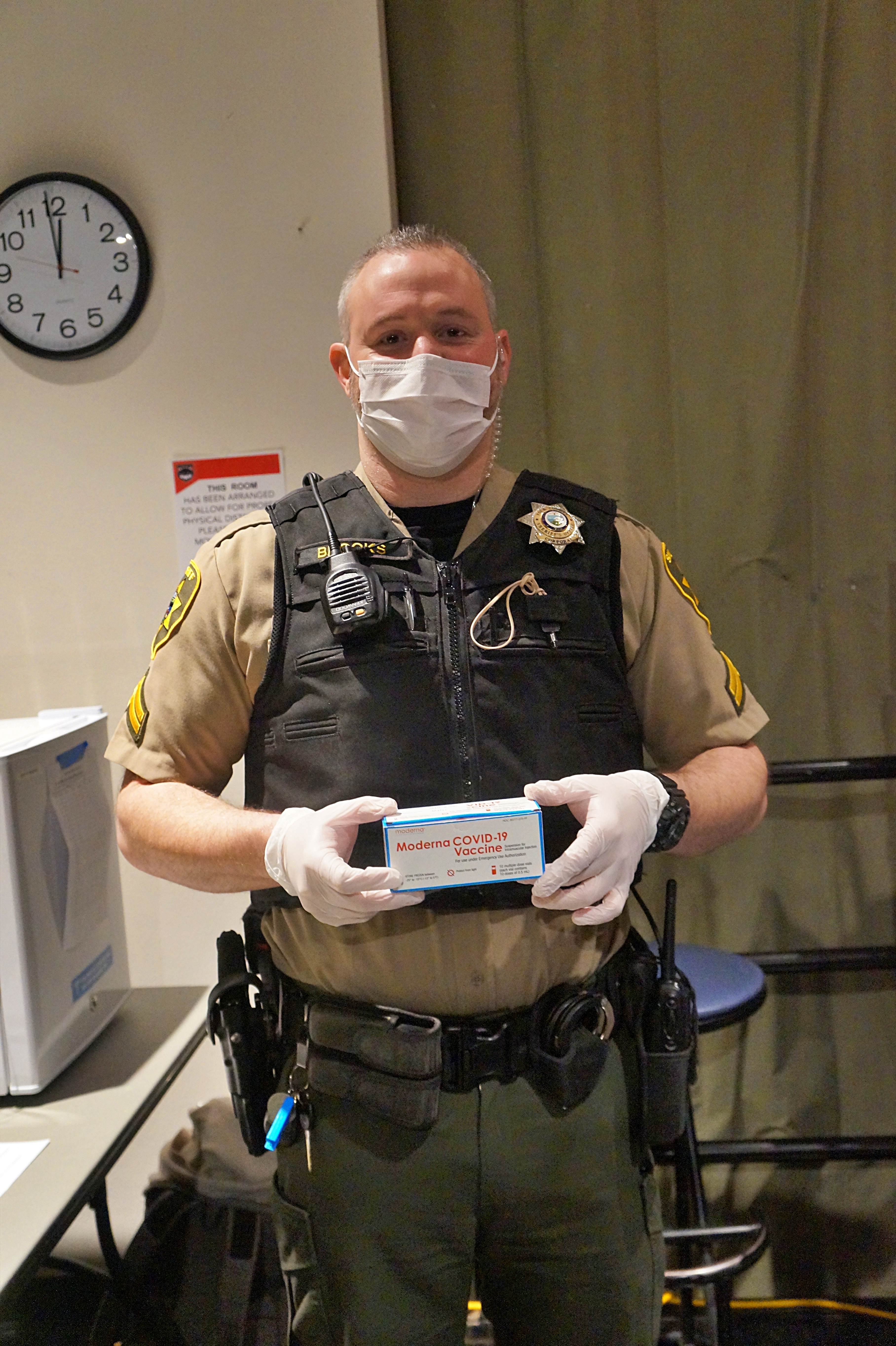
In late December, select Oregon residents received doses of the Pfizer and Moderna COVID-19 vaccines.

To deliver the vaccine to all Oregonians, the state has implemented a three-phase rollout plan. On Jan. 5, Oregon began Phase 1A of its vaccination schedule. In Phase 1A, the Oregon Health Association lists in its plan: hospital workers and first responders, elderly and those involved in their care, prison doctors, clinics serving high-risk groups, visiting nurses/home health care providers, other health care providers and funeral home workers to be vaccinated first. 

Over 51,000 Oregonians have received the first dose of the Coronavirus vaccine since the beginning of 2021, whereas only nine people have completed the two doses required for full vaccination according to covidvaccine.oregon.gov. Currently, the CDC reports Oregon has delivered over 117,000 doses of Pfizer vaccine and over 121,000 doses of the Moderna vaccine.

Currently Pfizer and Moderna are known to have three major differences, including age restrictions, temperature storage requirements and length of time between each dose. In comparison to Pfizer, the Moderna vaccine can be kept at -4 °F, whereas Pfizer’s must be kept at  -94 °F. Additionally, a person must be at least 18 years old or older to receive the Moderna vaccine and the two doses must be administered 28 days apart in comparison to Pfizer’s 21-day separation, which has an age restriction of 16 years.

On Dec. 22, West Valley Hospital in Dallas received its first shipment of Moderna vaccine according to a press release by Salem Health. 

“For decades, West Valley Hospital has been providing a wide range of quality care to residents of Polk County,” said West Valley Hospital Chief administrative officer and licensed registered nurse Brandon Schmidgall in the press release. “Today we begin offering a new and historic service — the COVID-19 vaccine — first to our health care heroes, but eventually to our small-town community.”

As of Jan. 5, Polk County has vaccinated 1% of an estimated 82,000 residents according to the OHA. Local clinics like Western’s Student Health and Counseling Center have not received COVID vaccines yet; although, on Dec. 22, Oregon added educators to the list. 

 “Teachers have recently been added to Phase 1A and who that all includes will need to be more clearly defined by OHA,” said Polk County Public Health Administrator Jacqui Umstead. “We will work with Western Oregon University, and other local educational institutions to ensure that both staff and students have access to the vaccine, when it is their turn.” 

Contact the author at scarpenter18@mail.wou.edu

Editorial: Current information keeps our staff and students safe

Increased communication is crucial to the community 

The Editorial Board

It has been a little over nine months since students from Western and around the world have adapted to a new, virtual lifestyle. All things considered, Western has done as much as they can to provide us with a safe environment. However, there is a need for more transparency with information regarding positive cases, and further precautions to be taken on campus.

Some of the controversies started when Western took a long time to announce that fall term would be taught virtually, leaving students abroad scrambling to prepare for another stressful term. And then, Western failed to be clear with their community about the number of COVID-19 cases. 

Information regarding the number of positive coronavirus cases has been notoriously hard to track down due to privacy concerns. However, the university can disclose these numbers while still respecting the patient’s privacy. Plenty of other universities disclosed their numbers to the community, all while respecting the boundaries of privacy. Oregon State University reported a total of seven confirmed cases as of Nov. 4; and, Southern Oregon University has 19 confirmed cases — they even specified if the individual lived on or off campus. Additional information is posted on both of the university’s websites, under “OSU-Cascades Dashboard” and “SOU COVID-19 Cases.”

Eventually, Western followed suit. Now, as of Nov. 16, there are less than 10 confirmed cases in the community. This information, while originally hard to find, is now updated and available at wou.edu/coronavirus/.

While it is reasonable to respect the privacy of positive patients, Western shouldn’t have left their community in the dark for as long as they did. These numbers inform whether or not safety protocols are working or if they need to change.

With those things out of the way, it’s safe to assume that some students of Western appreciate the improved effort. But now, a new problem has arisen in regards to COVID testing for both staff and students. When further researched, it is inconclusive if free testing is offered for staff. 

If you were to look on the COVID-19 webpage — which is ridiculously difficult to navigate by the way — they detail the steps you can take if you are seeking testing. However, the webpage doesn’t help you understand whether or not you should seek a test in the first place. How are students who may be asymptomatic supposed to know what to do? None of this is specified.

The problem is if you check “yes” on the CDC’s survey that you’ve been in contact with someone who tested positive, they will tell you to wait out the 14-day isolation, and if you develop symptoms at the end of that period, you go take the test. While there’s quite a bit of information regarding symptomatic cases, there’s not a lot of specification for asymptomatic cases, which leaves folks uninformed.

Western is a smaller school with already limited funding and budget cuts left and right, so we may be tight on funding, but that doesn’t mean that people deserve to be uninformed. Transparency with Western students and the greater community is what establishes a trusting and close-knit feeling for everyone, especially for a small town like Monmouth.

Students who are looking for information on testing can find it at wou.edu/coronavirus/students. If an appointment needs to be set up, call the Student Health and Counseling Center at 503-838-8313.

Six ways to celebrate Thanksgiving during COVID

Enjoy Thanksgiving together while social distancing

Allison Vanderzanden | Lifestyle Editor

COVID-19 has impacted nearly every aspect of our lives, including celebrating holidays. It’s important to stay safe and protect loved ones by maintaining social distancing and adhering to state and national guidelines. Here are some new Thanksgiving traditions to try with family and friends this year.

1) Virtual gathering: With numerous communication options available ⏤ such as FaceTime, Skype, Google Meet and Zoom ⏤ scheduling a virtual meeting with family and friends can be a good replacement for in-person celebrations. Each family can prepare a feast at their own tables while enjoying the company of others through a computer screen. Set a laptop at one end of the table and chat away.

2) Exchange Thanksgiving dishes: If loved ones live nearby, consider swapping side dishes. Have each household make one side dish — mashed potatoes, a casserole or a salad to name a few — and leave a dish on one another’s doorstep. If close relatives live some distance away, band together with neighbors to create a contactless potluck.

3) Share recipes: As opposed to cooking for one another, design and send loved ones recipe cards. Go old-fashioned and send a notecard in the mail, or simply text and email the recipes. Send them ahead of time so that everyone can make each other’s favorite dishes on Thanksgiving Day.

4) Movie marathon: Enjoy some holiday classics with the household or watch one of each person’s favorite. Use Teleparty ⏤ a Google Chrome extension ⏤ to watch along with friends and family, no matter how far they are. Leave movies playing all day, or begin the morning by watching the Macy’s Thanksgiving Day Parade before jumping into movies.

5) Outdoor games: If the weather permits, try hosting some games outdoors. According to the Centers for Disease Control and Prevention, gathering outdoors promotes social distancing and is better ventilated than indoors. Cornhole, soccer, bocce ball and Kan Jam are just a few games to be played outside, or simply toss around a football.

6) Give back: There are also many ways to help in the community this Thanksgiving. Collect canned foods and nonperishable goods to donate to a local food bank. The Food Pantry at Western is open on Mondays, Wednesdays and Fridays for two hours each day; check their website — wou.edu/foodpantry — for updates. Alternatively, donate money to local organizations and charities, or cook a meal for a homebound neighbor. 

No matter how Thanksgiving is celebrated this year, remember to maintain social distancing when possible and wash hands often.

Contact the author at avanderzanden19@mail.wou.edu


Valsetz delivers meals to WOU students testing positive for COVID

Western introduces quarantine meals to campus dining

Sydney Carpenter | News Editor

Over the course of back-to-school season, many universities are facing COVID-19 outbreaks and are being forced to shut down. Western’s administration observed these outbreaks and planned for fall term accordingly.

Instead of having one move-in day for all new students, Western reduced its numbers to less than two-thirds and had four days designated for move-in. During that time, all students were subjected to COVID testing, and students that tested positive were relocated to Gentle Hall and Butler Hall for isolation purposes.

The people currently living in those halls are receiving “dining accommodations” known as quarantine meals. 

“The quarantine meals were food for the entire day and (were) delivered to them,” said Albert Worotikan, Director of Campus Dining. 

Originally, the food served in the quarantine meals was similar to foods given to students experiencing flu-like symptoms. Students could expect to order things like soup, gatorade, milk or orange juice once a day. However, Worotikan said that after their first weekend starting on Sept. 26, students sent feedback to dining about the quarantine meals. 

According to Worotikan, many of the residents living in the isolation zones have reported to be asymptomatic and requesting food with sustenance. The residents don’t want meals that are designated for flu-like symptoms because the meals are light and not filling.

“Yes, they have the virus, but they still want to eat normal (food),” Worotikan explained.

After a meeting with the Dean of Students and Director of Dining, Tina Fuchs, they completely flipped the system; starting Oct. 5, students living in Butler Hall and Gentle Hall are able to order three regular meals a day under the ‘quarantine meals’ section of the app, Nutrislice, with no additional cost for delivery.

For labor efficiency, campus dining has designated specific times for delivery service, Worotikan said. From 8 to 9 a.m., students can have breakfast delivered, from 11 a.m. to 12 p.m., students can request lunch to be delivered and from 4 to 5 p.m., dinner can be delivered. The residents are also allowed to order snacks during these times. 

In an effort to reduce physical contact during delivery, dining has also set up a notification system to let the person know when their food has been delivered.

“In our system we would be able to email the individual and let them know that the food has arrived,” Worotikan said. “Also with the way Butler and Gentle is set up, the door is outside. Of course we are also going to wear the face masks as well.”

If students start experiencing symptoms late in the term, they are advised to contact the Student Health and Counseling Center to see if they qualify for testing. If a student does qualify for testing, they will be charged $95 for the lab work. Most insurances cover the testing fee, but if a student doesn’t have insurance they can call 211 for additional resources. 

Contact the author at scarpenter18@mail.wou.edu