

Mount Hood

Todd Hall

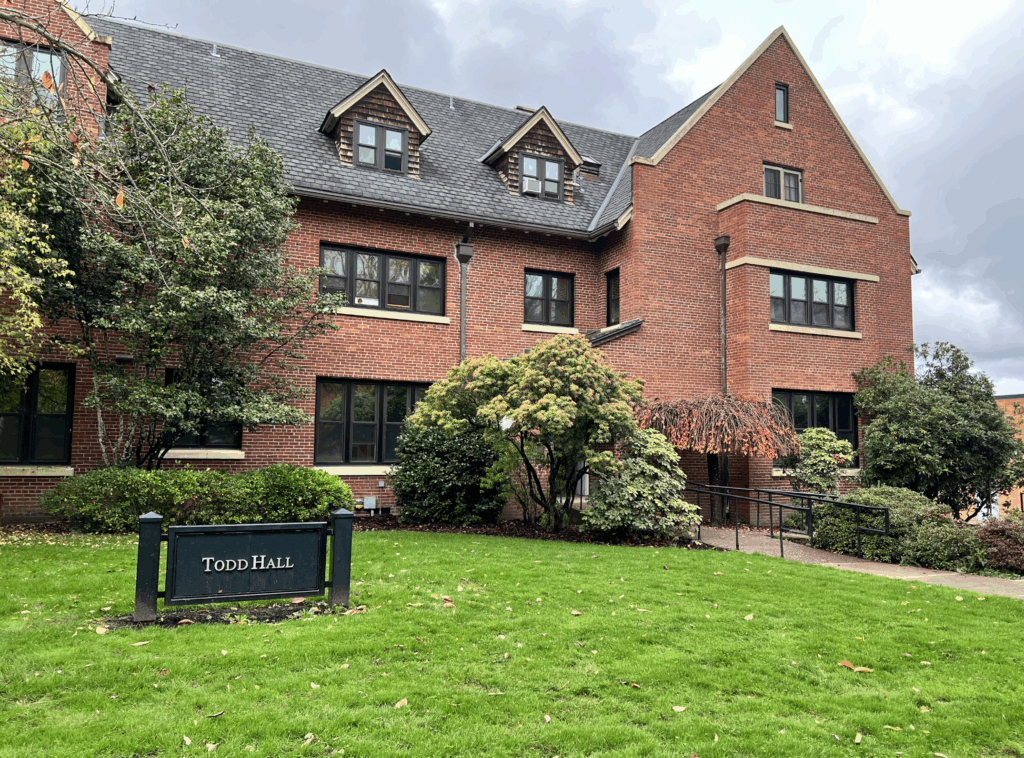
A photo of Todd Hall | Photo by Abbi Duhart

Nov. 19 2025 | Abbi Duhart | News Editor

Todd Hall was built in 1912 and was originally 10,800 square feet, costing about $50,000 — equivalent to $1.65 million today — to build. With its steep roof, small glass windows, red brick detailing and chimney, the building was constructed in a Tudor style, common for the time period. The original purpose of Todd Hall was to house students on campus, with students starting to move in in 1913.
In 1921, additional dorm rooms were added to the building along with a second dining room, and later in the same year renovations took place to add the West Wing, the Music Room and the Arcade. The kitchen and dining room were moved to the new Student Center in 1960 and the space was transformed to only encompass dorm rooms, a living room and two study rooms. This remodel cost about $31,000. The building started housing the Teaching Research Division in the 1970s, until it eventually became the Todd Hall we know with classrooms, offices and PsychPAC.
Todd Hall received its namesake from Jessica Todd, the first dean of women and the first director of dormitories at Western. She was born in 1869 in Beaver Falls, Pennsylvania, and moved to Monmouth in 1912 when she became the supervisor of critic teachers for Monmouth Training School. When Todd moved to Monmouth and started working at Western, she recognized a need for a dormitory on campus and helped petition to the state for funds to build a women’s dorm, ultimately leading to the construction of Todd Hall.
In 1926, she received an honorary baccalaureate in recognition for her exceptional work on campus. When she eventually retired in 1931, the Oregon State Board of Education unanimously agreed to name the dormitory she directed after her, thus creating Todd Hall.
Jessica Todd was a strong advocate for women living on campus, but was known for her very strict nature. Her dormitory was strictly an all-girls dorm, and she was often reported to push her teachings of how to be a “proper woman” onto the girls living in her dormitory. She would promptly lock the dormitory doors right at curfew and make her residents say goodbye to their dates right before she did so. For these reasons, the girls in her residence would often be known to sneak boys in through the basement — which was then the laundry room.
Jessica Todd eventually died in 1944, but it is speculated that her spirit may live on. Rumors have spread around campus that her ghost still lives in Todd Hall to this day, and students often report strange occurrences like hearing footsteps or seeing lights flicker. Most of her ghost sightings originate from the bathroom because it was the room that used to be her living space. It’s also theorized that her ghost targets men specifically because her building was an all-girls dormitory and she doesn’t like men inside.
Whether these speculations are true or not, Jessica Todd was one of the big reasons women were able to have a place to live on campus, and paved the way for the historic and unique Todd Hall known today.

Contact the author at howlnews@mail.wou.edu

Push for in-person

A photo of a student study group in the Hamersly library. Pictured left to right: Kalyn Gambill (junior), Preet Dhaliwal (senior) and Richard Loos (junior). | Photo by Hannah Field

Nov. 19 2025 | Hannah Field | Editor-in-Chief

Starting Jan. 5, 2026, all staff members will be required to work on campus five days a week due to a request by Western president, Jesse Peters. The request excludes faculty, meaning professors, but includes all other full-time employees at Western, such as janitorial staff, advisers, counselors, administrators and others.

Any part-time staff member may review their hours with their supervisor, who will then, on a case-by-case basis, determine the best course of action for the staff member. No further information was disclosed regarding the new rule and the effects of the changes are yet to be seen until Winter term begins.

According to Western spokesperson Maureen Brakke, faculty are encouraged to be on campus and communicate with the community as much as possible. With that in mind, the university is aware of additional responsibilities connected to teaching, scholarship and service, leading to greater flexibility for faculty hours. Many professors on campus are long-distance, either via commute or purely teaching online. While the potential of that changing seems unlikely, Western in the new year will be pushing toward in-person classes more than ever before.

“This decision comes in light of WOU’s strong tradition of in-person classroom instruction, with many faculty and students expressing a preference for enhanced face-to-face learning experiences,” said Brakke.

With in-person classes as one of the main priorities of Western at this time, President Peters also requested that the Academic Affairs Division assess undergraduate courses and determine which should be offered as hybrid or fully online options. Considering previous statements from Western, it’s likely that fewer online courses will be available.

Those changes, however, have no announced timeline. The faculty will complete an audit of online and hybrid classes by the end of Winter term, which will then offer more information to the school about maintaining or altering those as online options.

With that information being gathered at the end of March, it’s unlikely that any major changes will take place in the Spring term of 2026 following the week-long break.

“Nothing will be changing immediately,” said Brakke. 


Contact the author at howleditorinchief@mail.wou.edu



Wolf pups

A photo of the Wolf Pups with visitors from the Veterans Resource Center. | Photo courtesy of Tammy Gardner

Nov. 12 2025 | Abbi Duhart | News Editor

Wolf Pups — formally known as the Child Development Center — is a school and daycare area on campus where parents in the community and enrolled parents at Western can drop off their kids aged 2 1/2 to 5. The center has been up and running for 45 years, and was originally in Todd Hall, but moved to its new residence in the Child Development Center behind Campus Public Safety. They are part of the Student Affairs division at Western. Currently, there are three classrooms and 46 kids enrolled. A helpful resource they also provide is a dual-language classroom for children who speak English and Spanish. Additionally, they provide a young preschool room that supports children who still need to work on potty training, as well as kids with disabilities.
The original purpose of the Child Development Center was to serve Western students who are also parents by providing a space to assist parents in being able to attend things such as their classes. Currently, they serve Western students, faculty and members of the community, but the most prominent customers now are members of the community.
The center is funded by the IFC for student parents with children enrolled, meaning that Western students with children enrolled receive a sizable discount. A large Preschool Promise grant is also offered to around 30 parents who are low-income, covering the full payment to enroll their child.
The staff at the center encompasses around 25 individuals, including three full-time teachers, two full-time assistant teachers, one half-time assistant teacher and 15-20 student staff who attend Western and are most often enrolled in the Education program. Tammy Gardner, the director at the Child Development Center, explained that they wouldn’t be able to run the center without the large number of student teachers they get.
Gardner emphasized and wanted to highlight that the center is so thankful for and “couldn’t believe the love and support and resources that were given to the preschool, it’s absolutely amazing, and not just to the students, to the families and the staff here.”
The Wolf Pups partner with many different departments and faculty around campus, and have expressed feeling so welcomed by them as they bring joy to the kids. Recently, trick-or-treating for the Wolf Pups in the Werner University Center involved over 30 clubs and organizations around campus, setting up tables and going all-out with decorations, costumes and prizes or candy for the kids. The preschoolers came and had so much fun going to all the different tables; Gardner mentioned, “I will tell you, it was so amazing that after the kids left, I just sat in the WUC and cried.” During Halloween, Campus Public Safety also takes out one of the patrol cars to fire up the lights and sirens and take the kids on little tours.
She also mentioned the great partnership they have with the Natural Science department. Beeb Singson from the department has set up various experiments and lab tours for the kids to come in and do, like an exploding volcano and an earthquake demonstration that are both educational and fun.
They’ve worked with Michael Gonzalez from Athletics, who has invited them to play basketball with Western’s basketball teams. Members of the football team have also come in to visit the kids and play with them. Gardner explained that doing this is so enjoyable for the children and a way for them to meet amazing athletes. Rip Horsey, the director at the Health and Wellness Center, has also set up times for the children to come into the gym and have fun with all of the different activities offered.
Tim and Corrie Cowart, professors in the Dance department, have come in to teach the children mini dance classes as well. The kids love this, and it’s a great way for them to have fun interactions while being active. Currently, the center is also working with the graduate occupational therapy program because they wanted a place for their grad students to engage and observe little children as a way to prepare for their future careers. Each graduate student comes in to teach a lesson plan to the kids, and the kids enjoy it because “they’re young and fun,” as phrased by Gardner.
Gardner also had Logan Doerfler from the Veterans Resource Center come in with a crew to have a special story time about Veteran’s Day with the preschool classes. Doerfler and his crew dressed in uniform and discussed how they serve people and keep them safe, as well as deliver food and water.
Campus Dining provides the Child Development Center with all of the food they need, such as lunches and snacks. The center has expressed gratitude over the hot meals and two snacks a day they receive and how Dining is willing to accommodate, even sending treats like cookies occasionally.
All in all, the Wolf Pups at the Child Development Center are thankful and appreciative of all the resources and activities provided by departments and faculty around campus. The center is a great resource for students attending Western who have preschool-aged children. While the faculty at the center are pleased with how welcoming everyone on campus is, the children have the opportunity to be enrolled in such an amazing space where they can participate in many offered activities from organizations on campus. The people who take time out of their day to volunteer for these events know it’s all worth it to see the joy on even one child’s face.

Contact the author at howlnews@mail.wou.edu

ASWOU

February 5, 2025

Written by: Sadie Latimer | News Editor

The Associated Students of Western — ASWOU — is Western’s official student government. It is run by students, for students. 

ASWOU is extremely active on campus, representing students’ interests and needs, overseeing clubs, putting together programs on campus and ensuring that students have their voices heard. 

ASWOU President Brenda Rocio Martinezis a fourth-year student at Western, double majoring in communications and public policy and administration. 

“My role is (mainly) representing students in general and having their best interest in mind,” Rocio Martinez said. As a student herself, Rocio Martinez is always looking for ways to support her peers. “We always like to put our ear to the ground and see (what students want and need.)”

ASWOU not only supports individual students but student clubs as well. Joining a club is how Rocio Martinez first got involved on campus, followed by her becoming a justice in the judicial branch of ASWOU. After that, she was ASWOU’s director of PR, then, finally, the president. 

Rocio Martinez knows the importance of getting involved through clubs on campus, so she strives to make sure the clubs have the resources, training and support they need. One of her goals is to allow the clubs to collaborate and connect with each other. 

“I just want to be able to serve students,” Rocio Martinez said. “We are student-funded, so we’re here for (students).” ASWOU is funded by the IFC — Incidental Fee Committee. Students pay a set amount as part of their tuition and fees, which goes towards several student activities on campus, including but not limited to ASWOU, student media, Abby’s House, WOLF Ride, athletics, campus recreation, childcare and more.

Every person involved in ASWOU is dedicated to making their fellow students’ voices heard. “People in higher positions like faculty and staff are wanting the students’ perspective, and ASWOU can give that perspective,” Rocio Martinez said. 

“Elections should be coming pretty soon for anyone who wants my position in the future. And I will say this: it’s not hard, it’s fun,” Rocio Martinez said. She loves getting to be more involved in her community as ASWOU president. According to Rocio Martinez, the position has helped her become a better leader. It has also been helpful for her field of study and will likely apply to the career path she wishes to follow. ASWOU elections will begin at the start of spring term. For students who wish to run for election, applications open March 8. 

ASWOU has weekly public meetings on Fridays in the Calapooia room of the Werner University Center. The executive branch of ASWOU holds their meeting at 12 p.m. and the senate meets at 2 p.m. 

The judicial branch’s meetings are not weekly, instead they are held “when there’s work to do,” Rocio Martinez said. “That entails rules being broken by any clubs or any students, if there are any concerns or if people just want an interpretation of a law.”

For students who have concerns, comments or questions, an ASWOU senate meeting is the place to be. The senate focuses on things such as bylaws, getting involved with the clubs they oversee and the needs of students. 

If students have large concerns, they can fill out an ASWOU student feedback form, which goes to the senate. The form is located on the student portal under the My Programs tab. 

Rocio Martinez knows how difficult it is to advocate for every student, which is why it is important for students to bring their concerns and feedback to ASWOU’s attention. A community thrives when everyone supports each other and works together to make positive changes. 

“We ensure that students are well represented if they feel anything should change,” Rocio Martinez said. “Change comes with many people. It takes a village to make true change.”

Contact the author at howlnews@mail.wou.edu

Western’s food pantry

Written by: Sadie Latimer | News Editor

Western’s food pantry is located in room 165 of the Welcome Center. It is open Tuesdays 11 a.m. – 3 p.m. for Western students and faculty only. It is open to the public 9 a.m. – 1 p.m. Wednesdays and 2 – 6 p.m. Thursdays. Abby’s House — Western’s center for equity and gender justice — is the parent organization of the food pantry.

Everyone is welcome to utilize the food pantry on the allotted days, even including non-residents of Monmouth. There is also no maximum or minimum amount of income an individual needs to have to be a customer. Everything in the food pantry is free to all customers. 

Also located in room 165 of the Welcome Center is the Stitch Closet. The Stitch Closet provides clothes for individuals, free of charge. It has the same hours as the food pantry for the convenience of users. Like the food pantry, the Stitch Closet is also a part of Abby’s House. The concept for the Stitch Closet was imagined in 2020 and came to fruition fall 2021. 

Tarly Sineo, a first-year at Western majoring in psychology, started volunteering at the food pantry and the Stitch Closet as soon as it opened for the 2024-25 school year. “I took multiple steps to ensure that I got to volunteer the first day it was available to me,” said Sineo. 

Student volunteers are integral in ensuring the organization runs smoothly. “(I make) sure that the floors are clear, everything’s stocked correctly, clothing racks are clear and we’re using the right hangers. Just general maintenance,” said Sineo.

Sineo is passionate about helping students and members of the community and making sure they have the resources they need. “It means a lot to me. Pretty early (in the term) I figured that I’d probably be bored and have a lot of hours just kind of sitting around my room … So I figured I’d kill two birds with one stone; busy myself, and make the community a bit better for the people around me.” 

Food pantries are an important part of many communities, and it is especially beneficial for students. Western’s food pantry is helping to battle food insecurity among students, with college campuses statistically having more people who struggle.

“It’s a really valuable asset,” said Sineo. “Some (meal plans) don’t get to three meals a day on all of the weekdays.” The food pantry also helps anyone who is hosting community events — such as a Thanksgiving gathering or a residence hall event — get the materials and resources they need. 

Western’s food pantry put together turkey baskets for community members. The baskets have uncooked turkey or ham, stuffing, mashed potatoes, gravy, corn, cranberry sauce and the ingredients to make green bean casserole. 

“It’s a program for people who might not have the money to get a full turkey or the circumstances to be able to get a bunch of different Thanksgiving food for their family,” said Sineo.

Much of the food that Western’s food pantry offers is provided by a Salem food bank — Marion Polk Food Share. The rest of the food supply is a collection of donations from people in the community. 

The food pantry follows a client-choice model of shopping. Customers can choose their items instead of receiving a preselected bag of groceries. This ensures that people will use everything they take, instead of wasting the things they either don’t like or can’t eat due to allergies. 

There is no limit to the number of times people can shop at the food pantry. They can take as much food as they need as long as they are courteous of other customers who also need to use the food pantry. Once customers have finished shopping, they weigh their food and anonymously fill out a checkout survey. The personal information of shoppers is never collected. 

Individuals can support the food pantry and the Stitch Closet by volunteering or giving donations. They accept donations of food, clothes, hygiene products, pet food and school supplies. Donations are collected in a box in front of the food pantry. Individuals can also donate money to the food pantry through Abby’s House. 

For food donations, homemade goods and meals from restaurants will not be accepted. Store-bought foods should have a visible expiration date and nutrition label. It should be in the original packaging with any lids and seals still intact. 

For clothing donations, the Stitch Closet will not accept anything that shows offensive words or visuals, or clothes that are damaged or dirty. 

If donors are unsure if an item will be accepted, they can take it to a student volunteer who will inspect it. 

For students who would like to volunteer, there is a volunteer interest form linked in the food pantry’s Instagram — @woufoodpantry.  

Contact the author at howlnews@mail.wou.edu

Discussing the importance of mental health at Western

Western professor Lars Söderlund on acknowledging students’ mental health

Mirella Barrera Betancourt | Staff Writer

Depression, anxiety and other mental illnesses common among university students have emerged at an increasingly large rate in the age of the coronavirus pandemic. In a recent survey conducted on college students by Inside Higher Ed and College Pulse, 50% who participated chose mental health as a potential reason for poor academic performance. 

With some universities experiencing a lack of easy and accessible mental health care, college professors are now more than ever having to act as gatekeepers to students’ mental health. However, faculty are rarely trained for such scenarios. Thus, the question becomes: what can university faculty members and educators possibly do to help tend to students’ mental and emotional health needs? 

At Western, professors approach mental health in different ways. Many, if not most, include a few links to university and campus resource centers in their syllabus, with some falling under disability accommodations. Some professors are also open with their own struggles, teaching students that it is important not to shy away from the topic of mental health.

Western professor and chair of English department Lars Söderlund, Ph.D., takes it one step further and advocates for students to ask for assignment extensions when necessary. He acknowledges that deadlines don’t always reflect instances of real life situations and wants to be sensitive to that. 

“The courage it takes to ask for an extension is, I think, important for professors to reward when it’s possible and when they have enough time,” Söderlund said.

Oftentimes, students have a negative perception that college professors are clueless or ignorant to their students’ mental well-being. Söderlund argues that this is not usually the case. 

“In a lot of cases, students are going through a lot and professors are going to understand that too,” Söderlund said, “so while it’s important not to expect extensions, I think it’s always good to ask.”

Most professors at Western have even tailored their grading to accomodate students struggling with social anxiety disorders, removing participation points as part of the grading criteria. Even those that do require participation are willing to make the time and effort to work with students to come up with something that works for them. “A lot of professors are more lenient than you think,” Söderlund added.

Of course, many professors are often burdened with the task of feeling the need to “fix” students’ problems, and Söderlund is no exception. Upon asking how he would go about helping a student dealing with emotional and mental drawbacks, Söderlund said, “My first reaction would be ‘Okay, this person is in stress, how can I fix it?’” 

Söderlund went on to explain the importance of validation — the act of affirmation that a person or their feelings are valid and understandable. He said that professors seeing themselves as a supportive role for the student and having an “I’m here to help, but you know best” mindset could greatly assist students in distress. 

For those students struggling with managing feelings of depression, anxiety or loneliness, Söderlund recommended reaching out to the many resources the Western campus and the cities of Monmouth and Independence offer. He also mentioned the existence of suicide and mental health helplines, which include the National Suicide Prevention Hotline 1-800-273-8255 and the Polk County Mental Health helpline 503-623-9289. They, too, are resources available for students 24/7. 

Söderlund highly advocates for putting in the time to find the right therapist — a process that may take weeks or even months — and acknowledging when a certain type of therapy is not working. And if those feelings start to negatively impact academic performance, Söderlund advises students to take it up with their professors to see if they can come to a consensus regarding participation and class work. A way to do so, according to Söderlund, is by reaching out during office hours or by appointment to ensure a timely and successful meetup. This way, everyone can make the best of their situations.

If students are in need of psychological or mental help, the Student Health and Counseling Center on the Western campus is available for virtual and in person appointments from 8 a.m. – 5 p.m. Monday – Friday. Students are also encouraged to join support groups and workshops. For more information, go to the SHCC website, wou.edu/health.

Contact the author at staffwriter@thewesternhowl.com

Cuts to Western’s departments and programs

President Fuller’s Article 15 Task Force proposes draft of program curtail and Non-Tenure Track reductions

Sydney Carpenter | News Editor

Beginning in 2011, the administration office began seeing lower enrollment rates at Western, resulting in financial challenges in the years following.

In spring 2020, COVID-19 accounted for 70% of the university’s 25% drop in enrollment. This resulted in the university asking the deans to propose two budgets to reduce salaries by 10% and 17% in June. In addition, all Cabinet members were asked to review budgets for FY21 and develop 10% and 17% cuts, based on salary. 

When the task force began reviewing program curtailments, an extensive list of qualitative and quantitative factors were taken into account. 

Additionally, the task force also utilized feedback from original reports from the deans, the recommendations from Western Oregon University’s Federation of Teachers, the recommendations from the Faculty Senate Executive Committee, PowerPoint for panel discussion, feedback from three faculty panel discussions, the report from the faculty Sustainability Task Force and Article 15 of the Collective Bargaining Agreement outlining faculty contracts and rights.

In totality, the task force has proposed the elimination of five majors, two programs, seven minors, one program freeze and one history concentration removal. For non-tenure track faculty, 15 departments have received deductions in full-time equivalents.

All of us are frustrated and shocked, and more importantly we are not okay with it,” said senior earth science major Nicole Niskanen. “Granted, the times we are in are very challenging and it is understood that the university is not exclusive with the sacrifices it is making, because many other schools are in the same position.”

Niskanen explained that a lot of the cuts are impacting first-generation college students that are interested in pursuing degrees in science, technology, engineering and math.

“Western Oregon University is an affordable option for many first-generation college students, along with that, the campus prides itself on diversity and equality,” said Niskanen. “The Earth Science program at Western has a significant number of women and other individuals from diverse backgrounds and populations enrolled in the program including students with disabilities.”

According to Niskanen, eliminating the program strips away the opportunities for some of those underrepresented first-generation college students and deprives those who cannot afford to attend expensive STEM-focused universities.

Under the current program cuts, students will be permitted to complete their major and professors will still teach until students learning in their areas complete their major or minor; the effects of program cuts will impact all incoming students starting in 2021.

“I am writing on behalf of all of the Earth Science students who have completed the program, who are currently trying to finish the program, and those who will complete the program; we don’t want to see any of our professors leave because they have done so much for us by dedicating their time to support us and by selflessly helping prepare each student for whatever career path they take. We want to fight for the program and fight for our educators,” said Niskanen.

Currently, faculty are working to try and save these programs. To advocate for programs or faculty jobs, students can go to the ASWOU site within Engage. From there, students can fill out the Student Concern Report.

UPDATE (DEC. 15TH, 2020 @ 6:52PM)

Western has announced its final program curtailment enacted by Article 15, as well as non-tenure track layoffs outside of Article 15.

Under the article, the university is permitted to make reductions in cases of demonstrable financial need, discipline curtailment or retrenchment. As of now, Western is claiming financial strain due to COVID-19 and long-term decline in enrollment as the cause of enacting Article 15.

Since fall of 2011, Western’s enrollment has decreased over 25% from 6,217 to 4,552 in fall of 2020, as reported in the Article 15 Task Force’s finalized plans. Currently, under the Article 15 program curtailment plans, 14 full time positions will be lost, and a total of 10 majors and minors will be eliminated along with two masters programs. Outside of Article 15, a total of 16 full-time non-tenure tracks are being laid off.

“Quite frankly, our options for achieving a balanced budget are limited,” said President Rex Fuller in a letter to the campus community. “Given that more than 85% of our expenses are salary and benefits. With limited options for tuition increases, declining enrollment, and likely cuts to state funding, we must act decisively to align our budget with our fiscal reality.”

As of now, the impact of the program cuts will not impact students who are currently majoring or minoring in the program. In the letter, Fuller noted how important it is for students impacted by the program cuts to finish their degrees. According to the campus-wide letter, program curtailment will only impact incoming students starting in the 2021 to 2022 school year. Tenure-track and non-tenured positions will not be cut until deans and division heads submit final layoff decisions. The decisions are expected to be an ongoing discussion through the month of January.

Some members of Western’s faculty union — the WOU Federation of Teachers — are asking for program curtailment to be delayed until the new university president comes into office.

“We know that WOU is in some financial difficulties,” said WOUFT Communications Director Scott Beaver. “We just don’t want to rush, do long term solutions without due diligence.”

In an effort to advocate for faculty and departments WOUFT included some alternatives to department layoffs in the finalized plan, including moving Western out of Division II sports, looking for efficiencies in non-instructional office budget cuts and personnel assignments, reduce the number of campus sponsored events and used additional money from the fund balance.

In the final plan, all layoff notices must be given to designated faculty no later than the end of January. Affected tenure-track faculty will receive a one-year layoff notice before their positions end, at the latest by the end of January 2022.

The union at this time remains hopeful that there are departments that can be saved before layoff notices are issued. Beaver said the union is still fighting. 

Contact the author at scarpenter18@mail.wou.edu