


April 22nd, 2026 | Isaac Garcia | Sports Editor
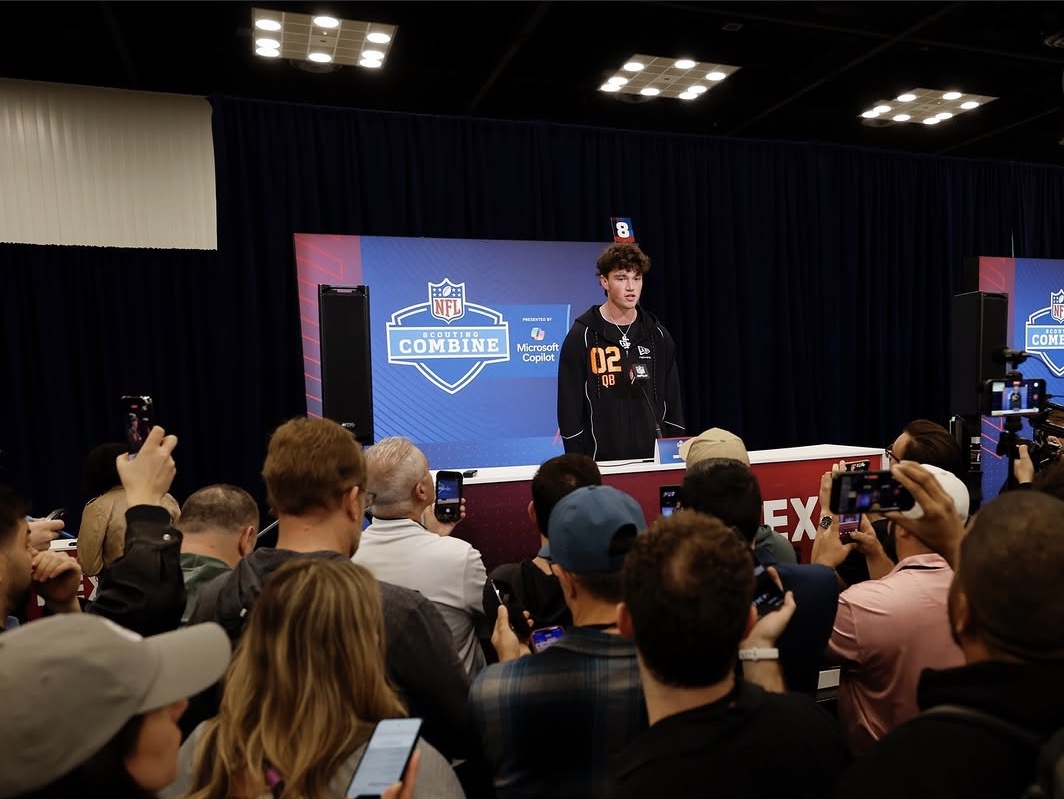
On Thursday, April 30, the first round of the 2026 NFL draft will commence and will then be followed by the second and third rounds on Friday and rounds four through seven on Saturday. Headlining the draft class is Heisman Trophy winner and national champion Fernando Mendoza out of Indiana University at the quarterback position. As of now, it’s all but a done deal that Mendoza will become a Las Vegas Raider on Thursday night, but what about the remainder of the class? Safety Caleb Downs from Ohio State is an NFL franchise’s dream for the modern iteration of the position and running back Jeremiyah Love from Notre Dame could immediately contribute and put himself among the NFL’s best at the position. For all the talk of the top of the draft, what about the rest of it? Below is a quick guide to each position and who some underrated prospects could be.
Drew Allar, quarterback, Penn State. Allar was supposed to have a similar year to what Mendoza had in 2025, but unfortunately, that just wasn’t the case. Penn State struggled mightily and Allar would suffer a season-ending injury, which concluded an incredibly disappointing year that reduced his draft stock heavily. However, the physical tools that had Allar as highly touted as he was heading into the year are all still there. He’s 6-foot-5 and has the arm strength to make multiple high-level throws. While much could — and maybe should — be made about his struggles in big moments, the consensus has possibly overcorrected on him a bit too harshly. If he finds himself in a situation where he isn’t expected to start immediately and he can work on some of the deficiencies in his game, he could turn into a star.
Taylen Green, quarterback, Arkansas. Upon being drafted, Green will have an argument as the most athletically gifted quarterback the league has ever seen. At 6 feet, 6 inches, he ran a 4.36-second 40-yard dash and had a 43.5-inch vertical. The potential with Green is immense, and like Allar, he could turn into a cheat code if put in the right situation. The main problems are his struggles at the more refined parts of the position, where his accuracy has never been very strong and he’s turned the ball over at a high rate. There’s probably a bit of a way to go before he’s ready to start at the professional level, but don’t be surprised if he gets some level of usage in special packages in his rookie season based on his athletic traits alone.
Elijah Sarratt, wide receiver, Indiana. Sarratt being underrated probably has more to do with the hype around some of the other Indiana prospects, such as Mendoza and fellow receiver Omar Cooper Jr., but Sarratt is a very technically sound player who does a great job of adjusting to the ball. Cut the tape on almost any Indiana game this season, and there will be a clip of Mendoza lofting him a back-shoulder fade on the outside of the field whenever the offense needs a play, and it works almost every time. He’s not some insanely athletic player that will just outrun or out-jump everyone, but he’s skilled and reliable and should be a valuable asset to a franchise’s passing game.
Harold Perkins Jr., linebacker, LSU. Perkins is a relatively similar case to Allar, where he was a big-name prospect just a couple of seasons ago before his production started to dip. In addition, Perkins is pretty undersized for the position and might have a tough time making plays against the behemoths he’ll face in the NFL. Still, he’s got incredible speed for a linebacker, running a 4.45-second 40-yard dash and if he’s able to add some more strength to his frame, he could do well enough to avoid being too overmatched.
Cole Payton, quarterback, North Dakota State. Payton is an interesting prospect because the sample size on him is so small, and he’s from a school that most people aren’t watching every Saturday. While North Dakota State has definitely sent its share of players to the NFL and even had Carson Wentz and Trey Lance drafted in the top five in 2016 and 2020, respectively, there will always be a bit of doubt in most people’s minds about the level of competition being faced. Aside from that, the sample size on Payton is also very small, and he really only started in his final season with the Bison. He made a heavy impact as a rusher last season, but experts have noted his passing mechanics need quite a bit of work. He seemed to do decent enough, taking care of the ball at North Dakota State, so it provides some hope that, at the very least, he could be a backup that keeps things steady if he ever needs to come in. While maybe he doesn’t quite have superstar potential, he could become an interesting player within the next couple of years.
Tacario Davis, cornerback, Washington. At 6-4, Davis is in the 99th percentile for height at his position. His height gives him the ability to get to the ball first in mid-air and become especially effective in the red zone. On top of that, he runs a 4.41-second 40-yard dash, which could make it difficult to truly separate from him in coverage. While it’s best to be hesitant when comparing draft prospects to past established superstars, the read on Davis screams Richard Sherman, as they have nearly the exact same height and weight with a very similar physical and aggressive playstyle. In fact, Davis is significantly faster than Sherman. It also helps that Davis went to school in Seattle, where Sherman had the best seasons of his career. One thing to look out for with Davis is that, despite being fast, his ability to cut laterally around the field leaves a bit to be desired and could leave him exposed against shiftier receivers. It has also been noted that Davis has a tendency to be penalized at a high rate in coverage. So will Davis be the next Richard Sherman? Probably not, but on Day 3 of the NFL draft, is there the potential that he could be enticing enough to take a flyer on him? Absolutely.
Contact the author at howlsports@mail.wou.edu