


Mount Hood

Western’s lawsuit

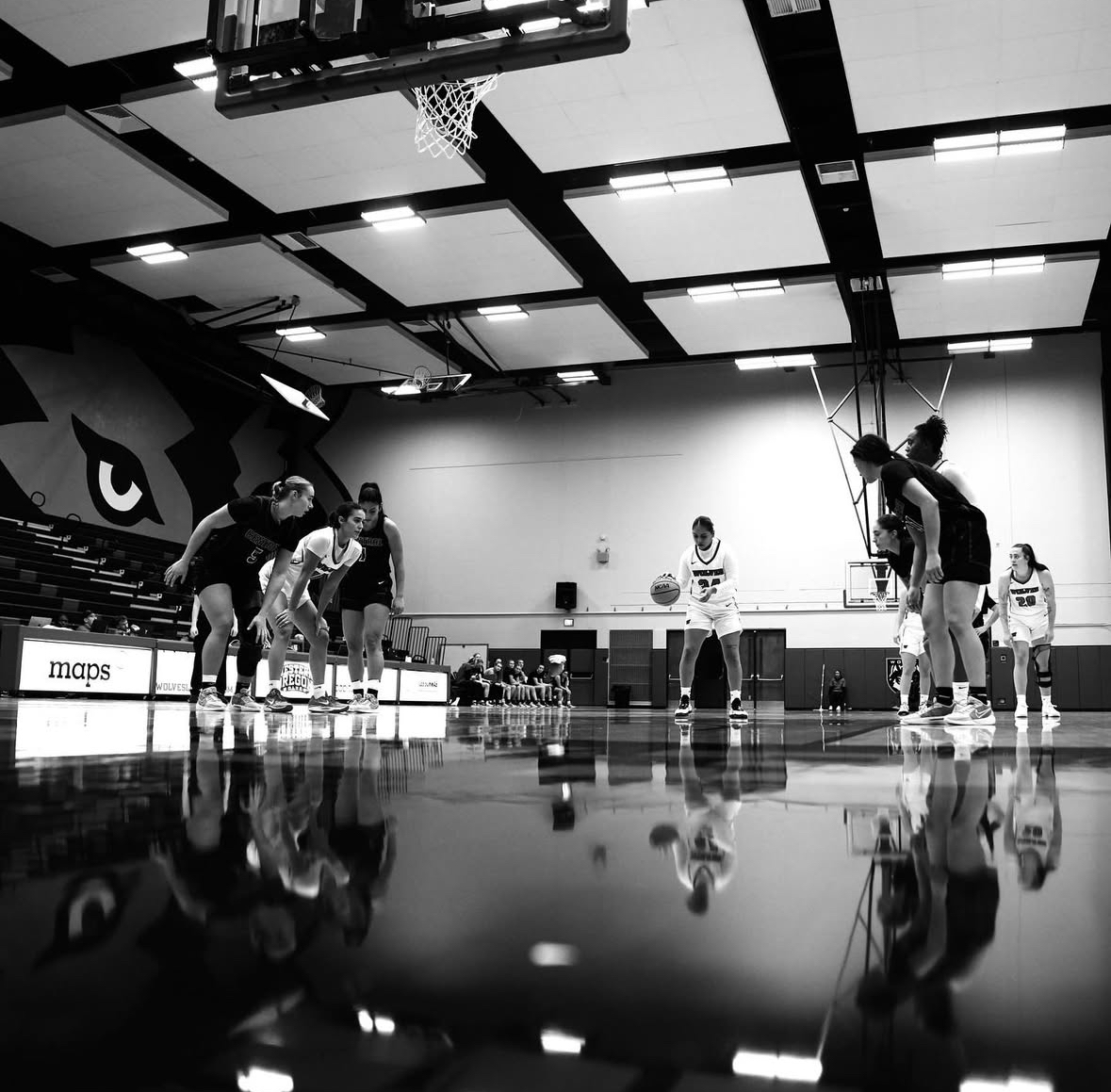
A black-and-white photo of the 2023-2024 women’s basketball team playing a match at Western, posted Dec. 4, 2023. | Photo from @wou_wolves and @wouwbb on Instagram

Nov. 19 2025 | Hannah Field | Editor-in-Chief

In January of 2025, nine former basketball players from the women’s team at Western filed a $28.2 million lawsuit against the college, coaches Jessica Peatross and Demetrius “DJ” Marlow, athletic director Randi Lydum, Dean of Students Malissa Larson and President Jesse Peters, alleging abuse from coaches Peatross and Marlow that, once reported, led to retaliation via rescinded scholarships.

The 2023-24 women’s basketball season was cut short with six games left without detailed explanation from the university following a practice Feb. 12, 2024. Western conducted an internal investigation while Peatross and Marlow were put on paid administrative leave Feb. 19 until being reinstated two months later after no conduct violations were found.

Recent investigations from the Statesman Journal reported the internal investigation, handled by law firm Littler Mendelson P.C., had “misquoted players, misconstrued situations and misstated what happened during a contentious practice on Feb. 12, 2024, and in the days after it.”

The alleged event included one player, Hanne Hopkins, who bumped into Head Coach Peatross during a drill, which turned into Peatross accusing Hopkins of running into her intentionally and telling her to leave practice, and was captured on video saying “I’m your coach. Get out. Get out. Y’all don’t get a choice.”

The day after, Peatross called the Monmouth Police Department and said she was intentionally elbowed in the chest at the practice and she had left practice to go to the hospital, where she experienced pain on a scale of 1-10 at a 10, and that it felt even worse the next day.

The video taken on a team member’s phone shows Peatross “talking calmly” after the alleged incident, said the Statesman Journal.

Two days after that, Peatross filed a report with Campus Public Safety and said she was experiencing chest and head pain, shortness of breath and nausea. The police officer whom Peatross spoke to earlier tried to contact Peatross for a month following the incident, but heard nothing back, and was denied access to the video by the university according to the Statesman Journal. From there, the investigation was requested to be closed due to “lack of cooperation,” per the police officer.

Monmouth police officers were eventually able to review the video and saw no indication of forceful or intentional contact from the player to Peatross. Police also did not see evidence to support Peatross being injured or in pain.

The team soon met in a small conference room where, when asked, 10 players voted to not play the six games remaining in their season. According to the Statesman Journal, some of the players expressed feeling pressured by the coaches to leave the team, with Peatross allegedly giving an ultimatum to player Ana McClave: “You either quit or you come and you kiss my ass.”

Both coaches were placed on paid administrative leave Feb. 19, 2024.

Players also alleged intense physical activity during practices, noting physical illness, dehydration and vomiting. The lawsuit states that if they did not complete the exercises, the punishment was more laps, with McClave stating, “The running we had to do, it wasn’t for speed, quickness or strength, it was for harm and to see how they could break us.”

One player, Kailiana Ramos, reported losing 20 pounds, and McClave was forced to engage in practices without being cleared by a doctor after knee surgery. Player Jodi Noyes said that Peatross and Marlow claimed “nobody’s welcome back” on the team after they learned of private discussions about the coaches.

Additionally, the lawsuit alleges NCAA rule violations, such as forcing players to miss their classes, pray before games and sign sheets that indicate they “weren’t practicing too much,” with team bonding events on the calendar actually being excessive physical exercise practices.

Peatross allegedly suggested that Noyes quit taking her antidepressant medication in November of 2023. Noyes obliged, but told university staff, who said it would be reported to athletic director Randi Lydum. No changes followed, and it’s unclear if Lydum did or did not receive the information. Lydum and Dean of Students Malissa Larson met with four players individually and “promised immediate changes that never happened,” wrote the Statesman Journal.

The lawsuit states that Lydum told a player, “These coaches deceived us, and this is not what we wanted for the school.”

The coaches were reinstated in April of 2024. A small group of players met with WOU Board of Trustees Chair Betty Komp to explain the situation, but no action took place. Letters came in April 23 to players still eligible to play that said their scholarships were terminated.

Littler Mendelson, which is based in the U.S. and is the world’s largest firm specializing in labor and employment law, was paid $33,696 to conduct the investigation by Western. The firm claimed that Feb. 12, during the practice where Peatross alleged she was elbowed intentionally, that Hopkins, the player who made contact with Peatross, was warned to not perform the action by McClave. The investigation also claimed that the lawsuit inaccurately reported Hopkins’ response to Peatross following the event, which was captured on camera, despite citing the video filmed by a player. It also allegedly wrongfully stated which players were told to leave and who was allowed to stay at practice, and contained conflicting information regarding who remained.

The investigation implied that the three students —  Hopkins, McClave and Ramos — involved in the conflict failed to follow university conduct when they did not immediately oblige Peatross’ demand for them to leave. The report also did not clarify the intention in the contact between Peatross and the student.

In another incident, McClave claimed that Assistant Coach Marlow collided with her Jan. 4, 2024, reinjuring her left knee post-surgery. The Littler Mendelson report “casts doubt if McClave was injured in that collision,” according to the Statesman Journal. However, McClave documented being in pain and sought help from athletic trainer Sara Gordon.

The report itself implicated team members Ana McClave and sister Cali McClave of having a negative influence over the culture of the team and implied criticism of team members for addressing concerns with Lydum over Peatross and Marlow. The players were addressed as “problematic” in the investigation and it also stated that Lydum appeared to understand that.

Western denied the request to share the report with the Statesman Journal. Following an appeal that handed the report to the Statesman Journal, Western filed a lawsuit against journalist Bill Poehler, who was providing coverage on the ongoing lawsuit, requesting a court order to clarify what information the university is required to submit. Ultimately, Western was ordered to provide the documentation by a district attorney.

Western is seeking to dismiss the lawsuit from the nine basketball players. The lawsuit was moved to federal court in February of 2025; the Statesman Journal reported, “The sides are in a lengthy discovery process that has a deadline of June 5, 2026.”

For more information, “The Western Howl” has discussed the allegations in more detail in previous articles titled “From court to court,” “Western women’s basketball update” and, before the lawsuit when the Howl reported on a tip, “Women’s basketball faces turmoil.”

The articles are available on the Howl’s website and by online search.


Contact the author at howleditorinchief@mail.wou.edu

Let’s get physical

April 2, 2025

Written by: Isabelle Jones | Lifestyle Editor

Let’s get physical; cardiovascular health refers to the health of the heart and blood vessels. Its system circulates blood, oxygen and nutrients through the body. It’s important to maintain good cardiovascular health in order to prevent disease later in life. It also helps to improve energy levels and overall well-being. With our generation taking health and exercise seriously, it may feel like we have forgotten the importance of cardio while prioritizing strength training. 

There are many benefits of cardiovascular health, with the biggest being that it prevents heart disease and stroke. Unfortunately, heart disease is the leading cause of death worldwide, but it’s completely preventable with a healthy lifestyle. Focusing on cardiovascular health maintains a strong heart and clear arteries, which reduces the risk of heart attacks, strokes and hypertension. With preventing heart disease comes keeping one’s cholesterol and blood pressure in check. Plaque tends to build up in one’s arteries when they live a sedentary lifestyle. Taking a proactive approach to cardiovascular health can add years to one’s life. A second benefit is that it can boost energy and stamina. When a healthy heart is able to pump blood more efficiently, the muscles and organs get more oxygen and nutrients. When someone gets more oxygen and nutrients, they will feel more alert, active and energized throughout the day. 

When one focuses on their cardiovascular health, there are other personal benefits, such as enhanced brain function, increased quality of life and improved sleep. Working on our cardiovascular health reduces inflammation and stress on the heart, which in turn can lower the risk of certain illnesses, such as dementia and Alzheimer’s disease. With the improvement of one’s quality of life, those who tend to their cardiovascular health can reduce their anxiety and possibly alleviate some of the symptoms associated with depression. With regard to improving our sleep quality, poor cardiovascular health can directly lead to sleep disorders, such as sleep apnea and insomnia. Improving one’s cardiovascular health works to regulate sleep cycles and improve feelings of restfulness. 

As some may want to improve their cardiovascular health, it’s crucial to understand the detrimental effects of poor cardiovascular health. Ignoring this portion of our health can lead to serious, life altering consequences. When one is neglectful, it can lead to an increased risk of stroke, chronic fatigue, low energy levels, poor mental health, increased stress, blood clots and the possible risk of permanent disability. All of this can result in a weakened immune system and a shorter life expectancy. 

Understanding the impacts cardiovascular health has on our lives, there are many workouts that help to improve one’s cardiovascular health. Cardio exercises are also known as aerobic exercises, which help to strengthen one’s heart, improve circulation and boost overall endurance. Here’s a list of some of the most flexible and popular exercises one could try. 

Walking — This is typically seen as the first step in cardiovascular disease prevention. This low-impact, beginner friendly exercise helps to reduce stress and improve circulation. 

Jogging or running — This is what comes to mind when someone hears the word “cardio.” It is easily adjustable between participating outdoors or on the treadmill. Along with walking, these exercises improve one’s lung function, heart rate and endurance levels. 

Cycling — Strengthening leg muscles, this low-impact exercise is great for joint health. 

Swimming — This exercise works the whole body while also being easy on one’s joints. It is ideal for all fitness levels and is a great way to beat the heat in the coming months.

Dancing — This exercise is a fun and engaging way to get one’s heart pumping. It improves coordination and flexibility which can be done alone or in a group. 

High intensity interval training — This last workout consists of short bursts of intense exercise followed by rest. This means that one would burn more calories in less time, boosting metabolism.

Cardiovascular health is not just about avoiding disease — it’s about living one’s best life. A strong heart leads to more energy, better brain function, improved mood and a longer, healthier future. Taking small steps today can make a huge difference in one’s heart’s health over time.

Contact the author at howllifestyle@wou.edu

Winter term clubs

Written by: Isabelle Jones | Lifestyle Editor

Looking for ways to get involved outside of classes? Western provides a plethora of clubs that can entice any type of student. Whether it’s furthering knowledge within a degree, getting to know other people in the community or creating change, Western has so much to offer — come out and join a club.

WOU ASL Club (Instagram @wouasl)

An organization for the Deaf, Deaf+, Hard of Hearing and Hearing students at Western.

Aspiring Teachers Association (Instagram @wou.ata)

Supporting future educators from step one.

Associated Students of Western Oregon University (Instagram @aswou)

Advocators for students’ rights to the Western administration as well as the state of Oregon and the nation.

Board Game Club (Instagram @wou.board.game.club)

Bring games and find new friends.

Business And Economics Club (Instagram @woubeclub)

A space for students to have discussions, speakers, workshops and networking opportunities for the business and economics fields. 

Creative Writers’ Guild (Presence https://wou.presence.io/organization/creative-writers-guild)

A place where all creative writers of any writing medium are welcome to write and share their work with the guild. 

Criminal Justice Club (Instagram @wou.cjclub)

This organization discusses the justice system events and issues.

CRU (Instagram @cruatwou)

“We’re real people dealing with the real problems of living out a real faith in the real world.”

Exercise Science Club

Exercise science students get to connect with different community members in order to provide members with unique opportunities, networking, recreational activities and insight into potential future professions. 

Meetings on the third Tuesday of every month in the Richard Woodcock Education Center, room 208.

Fiber Arts Club (Instagram @wou.fiberartsclub)

This is a club open to anyone, be it someone who has been crocheting or knitting for years or a complete beginner interested in learning a new craft. 

Filipino American Association at Western Oregon University (Instagram @faa.wou)

Encouraging and promoting the culture of the Philippines among Filipinos and other students who want to learn about the customs and culture of the country.

Gerontological Society of America Student Chapter (https://www.geron.org/)

This campus chapter focuses on sharing gerontological knowledge, expertise and interest. A welcoming space for all students interested in gerontology to participate in social events, networking and service learning. 

Kappa Delta Chi Sorority Inc. (Instagram @kdchibetadelta)

A sisterhood based on serving the community, upholding the values of unity, honesty, integrity and leadership, while also prioritizing academics, service and sisterhood.

KWOU Radio (Instagram @kwoustudios)

Student-run online radio station who are blasting away tunes, growing a music library and adding to the broadcast equipment supply.

Math Club (Instagram @woumathclub)

Open to anyone; come participate in Estimathon and Pi Day.

MECHA (Instagram @mechadewou)

A group focusing on community, support, activism and advocacy.

Model United Nations (Instagram @wou_mun)

An organization participating in a simulation of the United Nations where students act as delegates and work together to solve global issues.

Monmouth Student Nurses Association (Instagram @monmouthstudentnurses)

Students practicing diversity and inclusion through community outreach projects and volunteerism. 

Native/Indigenous Culture Club (Instagram @wounativeclub)

Advocating for connections and friendships among the students at WOU who identify under the umbrella term of Native/Indigenous and corresponding supporters within a purely respectful space.

Natural Science Club (Instagram @wou_natural_science_club)

Providing hands-on, real-world activities beyond the lecture and lab, offering social and academic networks for students. 

Omega Delta Phi Fraternity Inc. (Instagram @wou_knights)

A brotherhood dedicated to the needs and concerns of the community, which promotes the traditional values of unity, honesty, integrity and leadership. 

Pre-Med Club (Instagram @woupremedclub)

Striving to be a safe space for any interested in pre-health and provide valuable connections and resources.

Pre-Nursing Club

A resource for students interested in the nursing field through virtual and in-person events. 

Public Health Club (Instagram @wou.publichealthclub)

Provides a place for students interested in community health education and public health. Opportunities in networking, leadership, service learning and pre-professional training are available. Meetings are held Mondays bi-weekly from 12 – 1 p.m.

Resonate Church (Instagram @resonatemonmouth)

Come make lasting friendships and discover the purpose that one was made for. 

Spanish Club (Instagram @wou_spanishclub)

A vibrant community where those come together to explore the language and Hispanic culture through a multitude of activities in a diverse, respectful and inclusive environment.

The Northwest Passage (Instagram @wounp)

The Passage has been in publication in one form or another for 80 years, supporting the creative arts every step of the way. 

Unidos Club (Instagram @unidoswou)

Building community and creating a safe and supportive environment to help empower students to bravely fight social justice issues.

Western Oregon Swing Dance Club (Instagram @wouswingdance)

Concentrating on West Coast Swing and Single-Time Swing. No experience required.

Western Oregon University Fellowship (Instagram @wou_fellowship)

Creating diverse communities where students are safe to seek answers to spiritual and faith-based questions or concerns in life.

WOU Digital Games Club

Created for the purpose of maintaining a safe space for Western students to enjoy video games, and to foster such a community at Western. Meetings are 4 – 7 p.m. on Thursdays in the ITC, room 303.

WOU Student Veterans of America (Instagram @wousva)

Dedicated to fostering a sense of belonging, camaraderie and empowerment among student veterans, active-duty service members and their families within our university community.

Thespians Club (Insta @wouthespiansclub)

The Thespians Club here at Western provides, supports and advocates for educational, social and performance opportunities.

If interested in finding out more about Western affiliated clubs, check out their Involve pages at https://wou.presence.io/

Contact the author at howllifestyle@wou.edu

Winter resources

Written by: Hannah Field | Editor-in-Chief

It has been reported that about 10 million American adults suffer from seasonal affective disorder — SAD — from mid to late fall through the spring season. Oregon, especially, is cold and wet during the cold season, with the sun setting early and the temperature staying chilly throughout the day, even at the peak of the sun.

Seasonal affective disorder is a form of depression occurring during the colder months, the timing being the only difference between SAD and typical depression. It often returns annually for those who experience SAD. Explanations for why someone might experience SAD are still relatively unknown. The trigger, however, is a lack of light. The effects can be debilitating for some, and merely exhausting or tiring for others, meaning it varies from person to person.

Doctors make multiple recommendations for those who struggle with SAD. Studies state that proper sleep will elevate energy levels. If sleeping is a problem, doctors also recommend avoiding screens or other blue light before bed and creating a nighttime routine, something that promotes mindfulness and relaxation, ideally for a few hours leading up to sleep.

On the topic of mindfulness, many may benefit from meditation, yoga, pilates or other exercise or mindfulness practices to stabilize the mind and body. The easiest way to do this is to think of the moment — what is being done and how does it feel? Consider it “grounding.”

It is recommended to find everyday movement. To be clear, this does not necessarily mean exercise as in going to the gym or pushing yourself too hard, but finding time every day to walk, jog, step or play. Finding winter activities can assist, such as snowboarding, skiing, ice skating, sledding or even indoor activities, such as baking, cooking, reading, writing, crocheting and more. Creating things is good for the brain and brings feelings of pride and accomplishment.

And, although difficult, it is recommended to leave the house in one way or another, even when it’s freezing outside. Fresh air is good for the body and brain and leaving the house can stimulate, leading to better mental health.

Surrounding yourself with friends and family is a proven way to ward off the negative feelings accompanied by winter and is highly recommended. Being intentional with plans and self-care can help propel oneself into better health. Examples of self-care include forms of mindfulness as mentioned, cleaning, eating more healthily, exploring faith, self-reflection, practicing gratitude and more.

Artificial light is an alternative as well. Individuals may use sun lamps to replicate the light of the sun and using such light first thing in the morning has been proven to have positive effects. Studies also recommend taking media breaks, such as distancing from apps and social media. News, especially, can negatively affect mental health and during such critical months, access should be limited.

Having a clean, clutter-free environment may elevate moods, although the process is technically a chore. Doing the laundry, dishes and vacuuming can create comfort and remove at least a few tasks off the stressful weekly list.

Other resources, such as therapy, are recommended and can be easy to locate. Psychologytoday.com offers therapists from the area, virtually and in-person, and can point interested folks toward the right information to get set up. It often displays insurance information and sign-up material needed.

Antidepressants can also be helpful for those who suffer majorly from SAD. Meeting with your doctor can get this process started.

There are vitamins that individuals can take to promote health and well-being, such as vitamin D supplements — easy to buy from most local stores.

Most of all, individuals should learn what they need to be healthy and prioritize their health. Western’s Student Health and Counseling Center offers resources, professionals to speak to and other help at https://wou.edu/health/. “Wellness is a conscious, self-directed and evolving process of achieving full potential. We view well-being as a multidimensional and holistic process. The seven wellness realms we focus on, include: social, emotional, physical, spiritual, financial, environmental and mental,” says the center.

The website also provides graphics with more advice for handling poor mental health and finding a work-life balance. It recommends volunteering, maintaining relationships and adopting daily rituals. Figuring out what stress responses there are can be incredibly helpful as well, as each method can be remedied in a different way. Those who isolate may benefit from energizing activities, while those who grow angry or emotional may need to find a quiet, relaxing activity to recover instead.

Starting small with stress can make an impact, eventually snowballing into better coping mechanisms and skills. One conversation at a time opens the door for help.

The weather will, eventually, warm; the sun will return. Nobody should suffer alone. Merely having conversations about mental health can help destigmatize the concept of “winter blues” so that others can receive help as well, and feel less isolated in the process.

Contact the author at howleditorinchief@mail.wou.edu

Western’s ascent

Written by: Quincy Bentley | Sports Editor

Western’s men’s soccer team has experienced a remarkable ascent in collegiate soccer, particularly during the 2024 season. Established just three years ago, the program has quickly become a powerful force in the Great Northwest Athletic Conference — GNAC — under the guidance of head coach Michael Behonick, a seasoned coach with NCAA Division I experience at Penn State, the University of Pittsburgh and the University of Virginia.
This season has been groundbreaking for the Wolves. In October, they reached their first national ranking, debuting at No. 25 in the United Soccer Coaches NCAA Division II Poll, then climbing to No. 14. With a 12-2-1 overall record and an 8-1 mark in GNAC play as of early November, Western has positioned itself at the top of the conference standings.
Beyond individual talent, the Wolves’ success is rooted in a strong team culture and disciplined leadership. Senior forward Alexis Luna, a key player from Salem, Oregon, has contributed significantly since transferring from Corban University. Luna, inspired by his dad’s passion for soccer, has found motivation in role models like German star Mesut Özil and his mother, who instilled in him the value of hard work. “Soccer-wise, Özil stood out to me. His game was so different from others, and the way he played really caught my attention,” Luna shared.
The Wolves’ team culture, built on unity and discipline, has played a crucial role in their success. “It’s all about unity,” said Luna. “Everyone is comfortable with each other; we don’t exclude anyone.” Coach Behonick reinforces this through discipline, including strict policies on punctuality and attention to detail. “Coach’s regulations make us think about everything we do, allowing us to weigh our options before making decisions. He truly gives us a purpose to work harder for the team,” Luna added.
With aspirations for a GNAC title and potential NCAA tournament participation, the Wolves’ focus remains on disciplined play and strategic execution. With two games left in the conference, Western seeks to take its momentum into the soon-to-come playoffs.  

Contact the author at howlsports@mail.wou.edu

Dodgers win!

Written by: Quincy Bentley | Sports Editor

The Los Angeles Dodgers’ 2024 season was a testament to resilience, investments and exceptional performances, resulting in their second World Series title in five years. The Dodgers concluded the regular season with a 98–64 record, securing the top spot in the National League West division. Given the team’s challenges with injuries to key pitchers, this achievement was particularly impressive. Despite these setbacks, the Dodgers were able to adapt and maintain consistent performances.
A pivotal factor in the Dodgers’ success was their massive player signing before the season. The organization invested over $1 billion to enhance the roster, with the main addition being Shohei Ohtani. The Dodgers signed Ohtani to a record-breaking $700 million contract, which didn’t just add a dual-threat player to the team, but also energized the fan base and changed the team’s dynamics.
In the postseason, the Dodgers came out victorious against the San Diego Padres in the National League Division Series. Advancing to the National League Championship Series, the Dodgers overcame the New York Mets in six games, highlighted by a decisive 10–5 win in Game 6.
In the World Series, the Dodgers faced the New York Yankees, revisiting a historic rivalry. The Dodgers secured the championship in five games, with standout performances from key players. Freddie Freeman, named World Series Most Valuable Player, delivered crucial hits, while Ohtani’s contributions were impactful throughout the series.
Freeman’s clutch hitting was vital to the Dodgers’ success. Ohtani’s historic season, featuring a remarkable 50 home run and 50 stolen base milestone, showed his versatility and impact.
With the 2024 championship secured, the Dodgers are determined to build on their success. Reports indicate the organization is considering pursuing MLB star Juan Soto, who is a free agent this off-season.
The Dodgers’ 2024 season was nothing short of excellent, and fans all around the world are waiting to see if they can maintain their level of play going into the 2025 season.

Contact the author at howlsports@mail.wou.edu

Meet Cori Metzgar

Written by: Quincy Bentley | Sports Editor

Cori Metzgar, the Wolves’ respected strength and conditioning coach, began her journey in sports at an early age. Growing up, the Alaska native excelled in sports, which initially introduced her to strength training. She continued her athletic career at Fort Lewis College, an NCAA Division II school in Colorado, where she further developed her passion for fitness and competition.

Metzgar’s early exposure to training started with her love for sports. At Fort Lewis College, Metzgar was a downhill ski racer as well as a soccer player. She competed in both sports from freshman to junior year, until a significant turning point redefined her path. 

Going into her senior year, Metzgar suffered two broken vertebrae in her back, hindering her from continuing to participate in sports. During the recovery period, she began working under her coach at Fort Lewis College, assisting him for two years which eventually solidified her path toward a career in strength and conditioning. She also drew inspiration from her father, a cross-country and track coach, who instilled a deep appreciation for sports and training. 

Metzgar began her career as a graduate assistant at Western Michigan University. After completing her master’s degree, she joined Ohio State University as a professional intern. Following a year at OSU, she spent the next five years at Colorado State University, serving as the head assistant for football while also overseeing training for volleyball, swimming & diving, softball, tennis and track. Metzgar then moved to Washington State University, where she worked for five years — first as an assistant and later as the associate head strength and conditioning coach — leading programs for baseball, volleyball, swimming, soccer and rowing. In 2011, she embraced the role of head strength coach at Western, where she has remained since.

A typical day in Metzgar’s role starts as early as 6 – 6:30 a.m. She runs training sessions for various teams every 45 minutes until about 11 a.m., followed by a lunch break. Her afternoons aren’t any slower though, packed with even more sessions from 1 to 3 p.m. Despite the demanding schedule, Metzgar still manages to carve out time for her own workouts, while also prioritizing her responsibilities as a mother. Her role requires a ridiculous amount of organizing, as she also has to fit everyone’s training schedules in cohesively. She develops and programs workouts for all the athletes she trains, which include Western’s football, men’s basketball, men’s soccer, baseball and softball programs. 

When not immersed in her professional responsibilities, Metzgar lives an active and fulfilling life. When asked about what she likes to do with her free time, Metzgar shared, “I love to train, run and spend time with my daughter.” She also mentioned that she enjoys traveling, cooking and exploring local wineries such as Brynmawr, Ankeny and West Hills.

What truly sets Metzgar aside from other people in her field is her approach to coaching. “I think what leads to my success is that I’m very passionate about what I do and the people I work with,” she explained. Understanding the unique needs of each athlete, she tailors her training styles accordingly, recognizing that motivating a basketball player might differ from motivating a football player. Her priority is to establish trust: “I want everyone to know that I care. Once they know that you care, they’re going to trust you more.” She embraces the challenge of reaching every athlete, acknowledging that while it may not always be possible, it remains her goal.

Supporting Metzgar here at Western is Josie Boucher, a dedicated strength coach from Austin, Texas. Boucher’s career began with training high school athletes, eventually leading to a role at the University of Texas at Austin for seven months and then a year at Texas A&M. Now in her second year at Western, Boucher is motivated by her collegiate powerlifting days and a significant injury that sparked her interest in the science of training. “I wanted to be everything I didn’t have,” she says, inspired by a lack of guidance during her own athletic journey. 

Boucher’s day often starts around 7 a.m., where she finalizes programming before going into training sessions with women’s soccer, freshman football, volleyball and track. Beyond the gym, Boucher enjoys spending time outdoors with her German shepherd, Roy, reading — currently the third Lord of the Rings book — and staying connected with her family in Texas. 

When asked what advice they would give to someone aspiring to follow a similar path, both Metzgar and Boucher emphasized the importance of building connections. Metzgar advises upcoming strength coaches to volunteer and spend time in weight rooms to gain experience firsthand, while Boucher highlights the value of building relationships with mentors and continuous self-education in sports science. “Building connections with people who are willing to help and know what they are talking about is key,” Boucher adds. 

Together, Metzgar and Boucher bring a great combination of experience, passion and mentorship to the Wolves’ strength and conditioning program. Their commitment to both the athletes and their craft makes them an exceptional team in collegiate sports training.

Contact the author at howlsports@mail.wou.edu

Western falls short

Written by: Quincy Bentley | Sports Editor

Following an eventful homecoming week, Western students and fans were eager for the highlight of the weekend, the homecoming football game. The Western Wolves took on Texas A&M Kingsville in a high-stakes, much-anticipated match. With both teams entering with strong records — Wolves at 5-0 in conference play and Kingsmen at 3-2 — this game was set to be an exciting showdown that would test each team’s grit and endurance.
Jordan McCarty started the game off with a 6-yard run into the end zone, while freshman kicker Keaton Emmett finished it off with an extra point, adding a total of seven points to the scoreboard for the Wolves. It wasn’t long until the opposing offense responded though, as the Kingsmen followed up with a touchdown and extra point of their own.
Going into the second quarter, the score was tied at 7-7. Both teams were getting stops on the defensive end, but Andrew Simpson’s impressive interception midway through the quarter shifted momentum in the Wolves’ favor. Things were looking great for Western, as they continued to gain yards and attention from fans, but unfortunately, they weren’t able to capitalize off of Simpson’s play. The possessions continued to go back and forth, but the Kingsmen were able to score seven points right before halftime, making the score 7-14 in Texas A&M’s favor going into the half.
In an intense third quarter, the Wolves faced an uphill battle as their opponents widened the gap with a touchdown and extra point. This set the score to 7-21. However, a strong run from redshirt sophomore Jermaine Land revived the Wolves’ offense, putting them in position for a much-needed touchdown. Soon after, the Wolves struck, with a crucial touchdown pass and a successful kick to narrow the Kingsmen’s lead to just seven points. Their defense held strong, stopping the opposing offense and leaving the Wolves trailing 14-21 as they headed into the final quarter.
The fourth quarter started with a bang as the Wolves pulled off an impressive series of plays. A well-placed throw found senior wide receiver Damon Hickok, who made an acrobatic catch for a massive gain. Another pass to Hickok set the Wolves within 20 yards of the end zone. The next play, redshirt sophomore Kainoa Sayre had a strategic run, placing them only three yards from tying the game. Despite their efforts, a costly fumble on third down turned the possession over. Yet shortly after, the Wolves’ defense kept the dream alive, capped off by an outstanding interception from redshirt junior Daron Ulrich Jr. However, they couldn’t convert on their final chances, even after blocking a critical punt. Ultimately, Texas A&M ran out the clock, leaving the Wolves just shy of a comeback.
The Wolves — 5-3 overall, 5-1 Lone Star Conference — have a chance to redeem themselves next week as they travel to take on Midwestern State in Wichita Falls, Texas.

Contact the author at howlsports@mail.wou.edu

Mental strength transforms you

Written by: Liberty Miller | Lifestyle Editor

To preface this article, I am a terrible role model to follow. I do way too many activities, have way too little time and rely far too heavily on the luck I’ve had making it this far. I am in the volleyball program at Western, which is incredible to be a part of. A large portion of that is because our weights performance coaches, Coach Jo and Coach Metzgar, do their job so well that the only thing we have to do is sleep, eat and show up. The hard part is being able to mentally show up day after day. 

Everybody has heard the famous saying, “The mind gives up long before the body does.” Nobody knows that saying better than me and my team during our twice-a-week cardio sessions. I’ve had struggles with a busy schedule, as well as having attention-deficit hyperactivity disorder which makes it difficult for me to focus and perform actions correctly. It manifests during weights, when I have to remember our barbell complex or during practice, when I forget — once again — to open up my angle during serve receive. Last quarter, I was putting in 32 hours of work in addition to working another job, schoolwork, volleyball and weights sessions. 

It’s frustrating and mentally taxing. If you’re in a similar situation, you know exactly what I’m talking about. When life steps on you every day, refusing to stop and humbling you in ways you didn’t even know were possible, the mind has two choices: it can either collapse or it can grow some muscle to hold up all that weight. 

I remember thinking to myself in mid-March, “Maybe I just wasn’t made for all this. Is this where my athleticism stops? Is this my limit?” Looking back on it, my brain and body needed a break, and I went home for spring break, to vent and reflect on what I’ve been feeling so far. What flashed through my mind was all of those times I thought I wouldn’t make it through cardio. 

I decided that my new belief is — when something is wrong and my mind is tired, I’m going to fight for myself and believe in my potential. I made a few decisions to push myself forward. I took some weights off of the barbell in my brain. I started ADHD medication, I put my foot down at work — weekends only, so volleyball and school take precedence. I even reorganized my room and started opening my blinds so the sun could attempt to fix my circadian rhythm in the morning. Now, who knows whether the changes will be sustainable. However, I’ve already felt like I’ve successfully spotted my brain after it failed a lift. I took some weight off, and I worked my way back up again. Now, the weight moves easier, because I believe in my potential. 

Contact the author at howllifestyle@wou.edu

Off the deep end

Written by: Claire Phillips | Entertainment Editor

Wanting to find an opportunity to get back in the water? Look no further than the Health and Wellness Center for an enthusiastic, tight-knit community that spends two days a week in the pool together. The Western Swim Club offers new experiences to swimmers of all levels. It doesn’t matter if one has been on a competitive swim team or has never dipped their toes in a pool before — the members of the Swim Club are here to help along the way.

Swimming stands out from many other sports and offers unique opportunities for members. Because the exercise takes place in water, there are so many therapeutic benefits to swimming. Just submerging oneself in the water increases blood flow to the brain, improving memory, concentration and mood. Swimming may be a healthy outlet for college students during stressful weeks. 

Learning how to swim may be an intimidating experience. Not everyone is going to be able to swim a 100-meter freestyle with flip turns in a minute the first time they enter the pool. Swim Club is a fantastic place to practice the basics, with new friends to cheer you on along the way.

If swimming laps aren’t preferable, there are many other fun aspects to Western’s Swim Club. There are days in the schedule dedicated to team building with activities such as relay races, water polo and playing fun water games, such as sharks and minnows. The annual Swim-A-Thon is also an opportunity to engage in exciting games and get to know team members.

Maximus Sing, the president of Western’s Swim Club, spoke about his philosophy in regard to creating a great team and environment. “I have three things that go with any sport — learn to play the game the right way, make yourself better every day and have fun,” Sing said. The Swim Club officers are all eager to start competing with other schools, such as University of Oregon and Oregon State University. Before the club is competition ready, the swimmers have to focus on bettering themselves and each other.

No matter one’s level of swimming, there are many people eager to help. “Winter term is a clean slate… it’s not too late to start to learn how to swim because we can teach you,” Sing said. 

The Health and Wellness Center pool is waiting for new members to dive in.

Contact the author at howlentertainment@wou.edu