

Mount Hood

The rebirth of bookstores

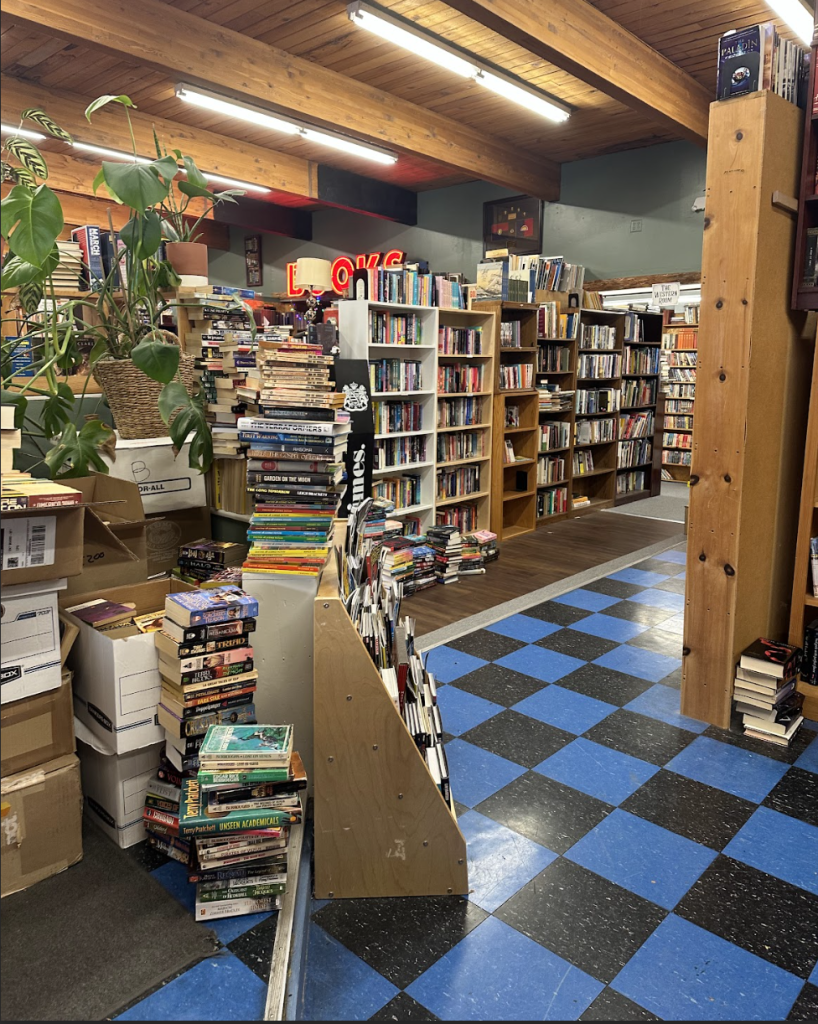
A photo of the inside of Browsers’ Bookstore. | Photo by Hannah Field

Jan. 21 2026 | Hannah Field | Editor-in-Chief

Recent bookstore statistics prove that popularity for local businesses in the US is climbing rather than subsiding five years after the coronavirus shutdown, with communities rallying and the landscape of bookstores adapting to meet modern demands.
The American Booksellers Association, or ABA, reported a membership increase of 18% and 323 new brick-and-mortar, pop-up and mobile stores opening across the United States in their 2024 annual report. They noted that 2024 had “the most successful Independent Bookstore Day to date.”
According to Harvard Business School, despite local bookstores struggling to remain afloat during pandemic regulations that limited business operations and corporations like Amazon dominating the industry, localism has become a social movement that has been steering indie bookstores back to the forefront. Communities have emerged to shop small and support local businesses in the wake of recent corporate boycotts against companies like Starbucks, Target and Amazon for their various methodologies, including anti-union sentiments alongside a lack of corporate accountability and diversity inclusion.
Abe Richmond, owner of Browsers’ Bookstore located in Albany, Oregon, said, “I was working here during the pandemic. It was obviously bizarre, and we closed for several months, but the customer base rallied behind us. So we would do sidewalk drop-offs, they would pay for it over PayPal or whatever, Instagram, and then we would package their books and put them on the porch.”
Richmond bought Browsers’ from the previous owner after graduating from Oregon State University, having been an employee of his, and has been at the forefront for more than three years. While Browsers’ Bookstore handled the precarious nature of being a small business during the pandemic, the customer base has also adapted to new ownership — and adapted well, with Richmond being recognized across town as the owner of Browsers’ and building a solid rapport with customers who seek out his services specifically.
When it comes to Amazon and Barnes & Noble, resale bookstores like Browsers’ suffer less than one might think. “I like them because people will spend $40 on a new hardcover in Salem and then read it, and then not know what to do with it, so then they bring it here. And I have a fairly new, good-shaped book.”
Customers who drop off books may receive in-store credit at Browsers’ to spend. Beyond that, Richmond also displays local authors and merchandise drawn by nearby artists. “It’s counterintuitive. Because who is this person, you know? But then, if you point it out, like, ‘Hey, they live in Albany or Corvallis,’ people are like, ‘Oh, I’ll read it almost just for that sake.’ Whereas if it was some other book that you’d never heard of, they’d probably pass over it.”
He also noted the enjoyable community aspect when authors host signing events at Browsers’, bringing a sense of life to local stores. Richmond also instrumented a film drop box through Light Rider Studios, meaning customers can drop off their film to get developed on their behalf and delivered.
Bookstores have been changing since the 1970s, with 43% of local bookstores closing between 1995 and 2000, reminiscent of the decline in physical bookstore sales through the Kindle push in the late 2000s and 2019, when Amazon had sold more than half of all books in the United States. Jeff Bezos, owner of Amazon, stated, “Amazon isn’t happening to the book business. The future is happening to the book business.”
Amazon was founded in 1994 as an online bookseller by Bezos. Since then, the ABA has labeled it an unchecked monopoly, claiming that it stifles competition and that it has an enormously negative impact on the bookselling market. Amazon was able to expedite growth, printing an effective blueprint to attract customers and obtain and keep wealth by failing to comply with tax regulations and offering duty-free purchases.
Amazon also regularly offers discounted books, undercutting businesses that have to sell at full price in order to stay afloat. Booksellers have been forced to drop employees in order to stay profitable — which could also be a part of why Richmond and Sydney-Anne Graves are the sole paid workers as owners of their respective businesses, Browsers’ Bookstore and Monarch Books.
Regardless, Richmond and Graves have found success. And, according to the Associated Press, others are too; more than 200 local bookstores were predicted to open across the country between 2023 and 2025.
Monarch Books only just started in April of 2024 out of Lebanon, Oregon, owned and founded by Sydney-Anne Graves, who was a senior in high school when she encountered at a coffee shop the landlord of the building in which Monarch Books resides. That conversation alone spurred Graves to tell her mom later that night: “Mom, I’m buying a bookstore.”
After touring the building — reportedly falling in love with it — and dedicating multiple weeks to deep-cleaning, Monarch Books came to life under Graves’ new ownership and keen eyes.
“We opened, and (that) first day, it was really busy,” said Graves. “And I was like, ‘Okay, this might work out.’ It was really busy. And then, ever since, I’ve been slowly getting more inventory in, decorating, getting it to my vibe. I really love a lot of colors and plants, and there’s still a lot of ideas I have for in here, but it’s come so far from where it originally was.”
Richmond expressed appreciation for the anti-corporate push in 2025, leading to more local shoppers steering clear of Amazon and other corporate sellers. In the current political and social state of the US, local businesses may be inclined to further build queer-safe communities and book selections as opposed to corporate booksellers — potentially building a reliable customer base seeking a supportive book hub and shared community.
Browsers’ Bookstore remains open consistently under Richmond’s new ownership and maintains a loyal clientele across nearby cities. A good chunk of customer interaction relies on online postings and website sales through Browsers’ Bookstore’s virtual pages.
“I sell a lot (from what) I post on Instagram, and then people will be like, ‘Hey, I’ll take it.’ And so they come in and pay for it,” said Richmond. “It’s weird, though, because say you wanted a book we don’t have. It shocks me every time how many people are like, ‘Hey, can you order it for me?” Instead of them hopping on Amazon, because we go through a new book distributor. But I think it’s because people want to support. I think people like having bookstores.”
“It’s just so awesome, and it’s really cool to see that so many people still support the book community,” said Graves. “I was really nervous about that. I know I read and I know some of my friends read, but I don’t know how many people actually still buy books or shop downtown — so I think that was the most nerve-wracking part about it. But it’s been really great.”
Another aspect of the resurgence of bookstores is the online platforms Instagram and TikTok, cultivating an online community of book lovers. Dubbed “bookstagram” and “booktok,” readers and writers participate in hashtags, giveaways and online sharing, creating trends and catapulting books onto bestseller lists through sheer word of mouth via the internet.
“I feel like I get new customers every single week,” said Graves. “There are so many people who still love reading and that’s (been) helped a lot with bookstagram and booktok, different things that have really kind of inspired people to get back into it, which is so cool.”
“Taylor Swift — I’m not sure what — did something with Shakespeare,” said Richmond. “I’ve had so many women, and girls, college and under, be like, ‘I need Shakespeare.’ … It’s the same, if a movie comes out of a book, people flood the place, like when ‘Dune’ came out. Yeah, I couldn’t keep ‘Dune’ to save my life.”
“I was like, ‘Why is my Shakespeare selling all of a sudden?’ Nobody cared about this before,” Graves joked.
Taylor Swift’s most recent album, “The Life of a Showgirl,” features imagery, lyrics and photography modeled after Shakespeare’s character Ophelia in “Hamlet,” no doubt causing the wave of Shakespeare-mania that Richmond and Graves both experienced. “Dune” amassed a box office of more than $400 million in 2021 and “Dune: Part Two” grossed $715 million in 2024, with the “Dune” franchise built off of six core books written in the 1960s through the 80s.
However, there is a catch to the media frenzy. Allison K. Hill, CEO of the American Booksellers Association, blames Amazon: “Amazon is now the water we swim in … There are multiple ways that an independent bookstore is forced to not only interact with Amazon, but support them — books made into shows streaming on Prime Video are printed with Amazon stickers on the cover.”
Regardless, books have long since had movie adaptations, and well before Amazon and other corporations took hold. Much like local bookstores, movie theaters are becoming increasingly popular — for the second time. Upcoming releases like “Wuthering Heights,” “Project Hail Mary” and “Sunrise on the Reaping” are all 2026 book-to-movie adaptations spanning classic literature, sci-fi and the famous Hunger Games franchise. Show adaptations are equally successful, with notable pop-culture stars of book-to-show adaptations being “The Summer I Turned Pretty,” “Heated Rivalry” — currently thriving on HBO Max — and “Bridgerton.”
With books inspiring much of modern media turnout, it’s unlikely that books and bookstores will succumb to the strains of aging. In a way, books are trendy again, as the statistics prove — Barnes & Noble opened almost 70 new locations in 2025 and has more on the way.
Hill said in a statement in the 2024 annual report, “The numbers only tell part of the story. This momentum occurred despite significant challenges: the usual ones like thin margins, rising costs, and Amazon’s chokehold on our industry, and urgent threats that shook the very foundation of our work as the right to read and access books faced sustained, coordinated attacks.”
The current presidential administration has made a dedicated effort to place bans on books that affect educators and librarians, limiting access to certain content, especially that which discusses gender, race and sexuality. While that’s less likely to impact independent booksellers, the pressure remains to conform as book access limits book readers and their interests. Additionally, independent bookstores can rely on author visits and community involvement; divisive political action can split a customer base or turn away potential author-bookstore collaborations. The ABA, when discussing concerns for people interested in opening a bookstore, cited “free expression challenges.”
Portland’s own Powell’s Books — the largest independent and used bookstore in the world, spanning one city block and containing over a million potential reads — participated in the ABA’s Banned Books Week event in 2024, discussing the right to read, spreading awareness about book bans and hosting panels.
ABA also conducts the yearly Independent Bookstore Day. In 2024, when the ABA reported the highest participation numbers to date for the event, ambassador Amanda Gorman stated, “Independent bookstores are vital hubs of creativity and community. They offer curated selections that foster discovery for readers, while providing vital support and a platform for diverse voices for writers and other creators. They are the true modern-day town square, the beating heart of our communities, and a place for meaningful interaction and human connection.”
The day involved 1,216 stores from across all 50 states.
“Our mission — to help independent bookstores survive and thrive — remained at the core of everything ABA did,” said Hill.
While the 2025 annual report from the ABA won’t arrive until mid-2026, the expectation is that the indie bookselling industry will only continue to grow in spite of the last decade’s challenges, with Graves adding, “I don’t think books will ever go out of style.”

Contact the author at howleditorinchief@wou.edu
The great divide

Jan. 14 2026 | Belen Ponce Leal | Lifestyle Editor

I am not a very tech-savvy person. Granted, I know my way around most types of phones and computers. Yet that is mostly due to growing up with this kind of technology around. However, as someone who also works for a cell phone service provider, I have had to interact with, set up and attempt to fix a lot of issues with various devices. If there is anything that I have learned during this time, it is that there are stark differences between iPhone and Android phones. 

Growing up, Android phones were what was given to me by my predominantly Apple device-loving family. So here’s what I noticed. 

Strengths Android phones have a much simpler operating system that is easy to use and convenient. It typically has three buttons on the home screen: one to go to the home screen, another to see all apps that are open and the last to go back to the previous screen. Android smartphones also come in many different versions. Samsung alone has three different series of phones, each very starkly different from each other. One is fast, one is foldable and the last is cost-effective while still being a decent phone. Another popular Android phone is Google Pixel, which is well known for its camera quality and sturdy design. Motorola phones are known for being budget-friendly, but are reliable and simple. 

Weaknesses A lot of people with Android phones come into the store to tell me that their phone is full of pop-ups. The most common cause of those is “bad apps” being downloaded. Essentially, any kind of “phone cleaner” app is not actually cleaning the phone. Instead, it is slowing down its performance, and some can cause ads to pop up at random times. The battery life is also a major issue I’ve seen, with many getting new phones due to faulty batteries. There are also the constant updates that are done to the system that some may find annoying.

I recently became an iPhone user. After having the phone for a while now, here’s what I’ve observed. 

Strengths Apple’s phones are incredibly fast, with their chip processors able to have many apps open at once without slowing down the smartphone. For newer models, the iPhone battery life is often incredibly good, being able to last an entire day. They also switched their charger from the Lightning cable to a USB-C to become more compatible for Android users who want to switch to iPhone. Furthermore, iPhone’s have their own Apple ecosystem of apps that allows for a much stronger privacy shield compared to Android. iMessage, FaceTime, Apple Cash, etc., are all iPhone-exclusive applications for these types of phones. The Apple App Store is also much more strict with what apps are allowed to be downloaded from it, making it much less likely for any bad apps to affect iPhone users. 

Weaknesses I believe that iPhone’s main weakness is the lack of variety in their phones. While over time the screen size has gotten bigger and the camera positioning has changed, there isn’t a difference between the models. Obviously, if someone compares the first iPhone to the newest one, they look very different. However, there isn’t a huge change between the iPhone 16 and the iPhone 17. Another issue with Apple is that, due to the strictness of the App Store, many apps are not available to download. There isn’t a variety of different types of apps to get, while Android app stores allow for more options. There is also the fact that iPhones are not as customizable as Android phones. While their display options are sleek and clean looking, I’ve seen much more be able to be done with Androids, whether it be their shortcuts or widget flexibility. 

In my opinion, the other differences are minuscule. The keyboards between the two phones look and feel different from each other. Android phones still have “buttons” to control the screen, while iPhone users need to swipe up to navigate the phone. 

However, these smaller things are like comparing different fonts. If one is a person who likes consistency, I recommend an iPhone. If variety is preferred, there is an array of different Android phones from many companies that may be the better choice. 


Contact the author at howllifestyle@mail.wou.edu

Work for fun

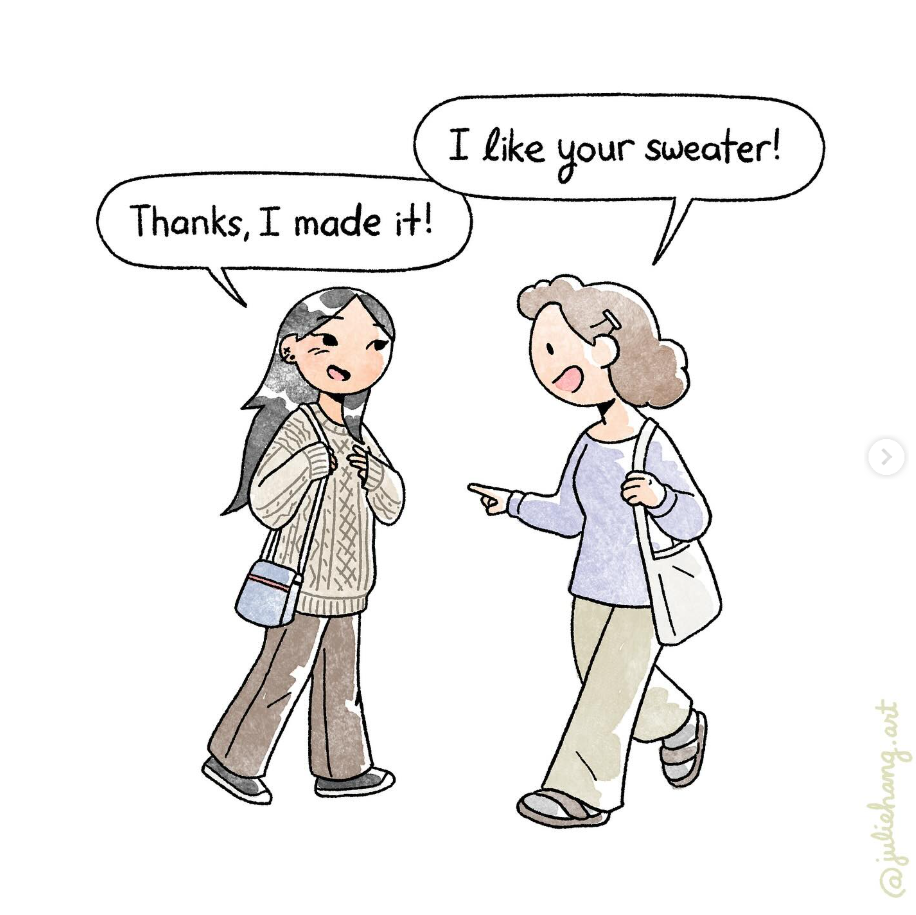
A sketched comic of a woman complimenting a girl’s sweater. | Photo from @juliehang.art on Instagram

Jan. 14 2026 | Belen Ponce Leal | Lifestyle Editor

According to the Oxford dictionary, a hobby is an activity that is done by a person for the sole purpose of enjoyment or relaxation. Hobbies can range from hiking in the mountains to playing video games at home. I personally don’t have a lot of hobbies. The main hobby I have, writing, has become something I do for school and work. While I still love it with a passion, I have been wanting to take up a new one that doesn’t involve me trying to spell things correctly. 

I haven’t had the opportunity to really explore activities to do in my free time. Yet during 

break, when I had all the time in the world, I came to the realization that I had no idea how to get a new hobby.  I’ve usually just stuck to the ones I had growing up. I can only imagine that a lot of other students feel the same way. Therefore, I have created some tips on how to discover a hobby. 

Something simple that anyone can do is create a list of things they like. The list doesn’t have to be concrete. It could range from things done as a child that were fun, like playing tag or building things with LEGOs. Some things to consider would be topics that are engaging and that aren’t tiresome for oneself. 

There’s also scheduling that should be considered when taking up a new hobby. As someone with a busy schedule, I would want a hobby that is easy to do anywhere and can be done wherever I go. For someone who would prefer to do something with their hands, crafting and sculpting would be good ideas. 

Something that discourages a lot of people from starting new hobbies is the lack of perfection at first. Obviously, no one is going to be good at something from the start, and if they are, they are not human. 

Stuart Brown once said, “Life without play is a grinding, mechanical existence organized around doing the things necessary for survival. Play is the vital essence of life. It is what makes life lively.” I’ve thought about trying to start crocheting because the thought of creating my own things sounds awesome. However, I’ve been hesitant to do so because I know for a fact that the first thing I make will look horrifying. Still, that shouldn’t dissuade me or anyone else searching for something new to do in their spare time. 


Contact the author at howllifestyle@mail.wou.edu

Maas(bestos)ke Hall

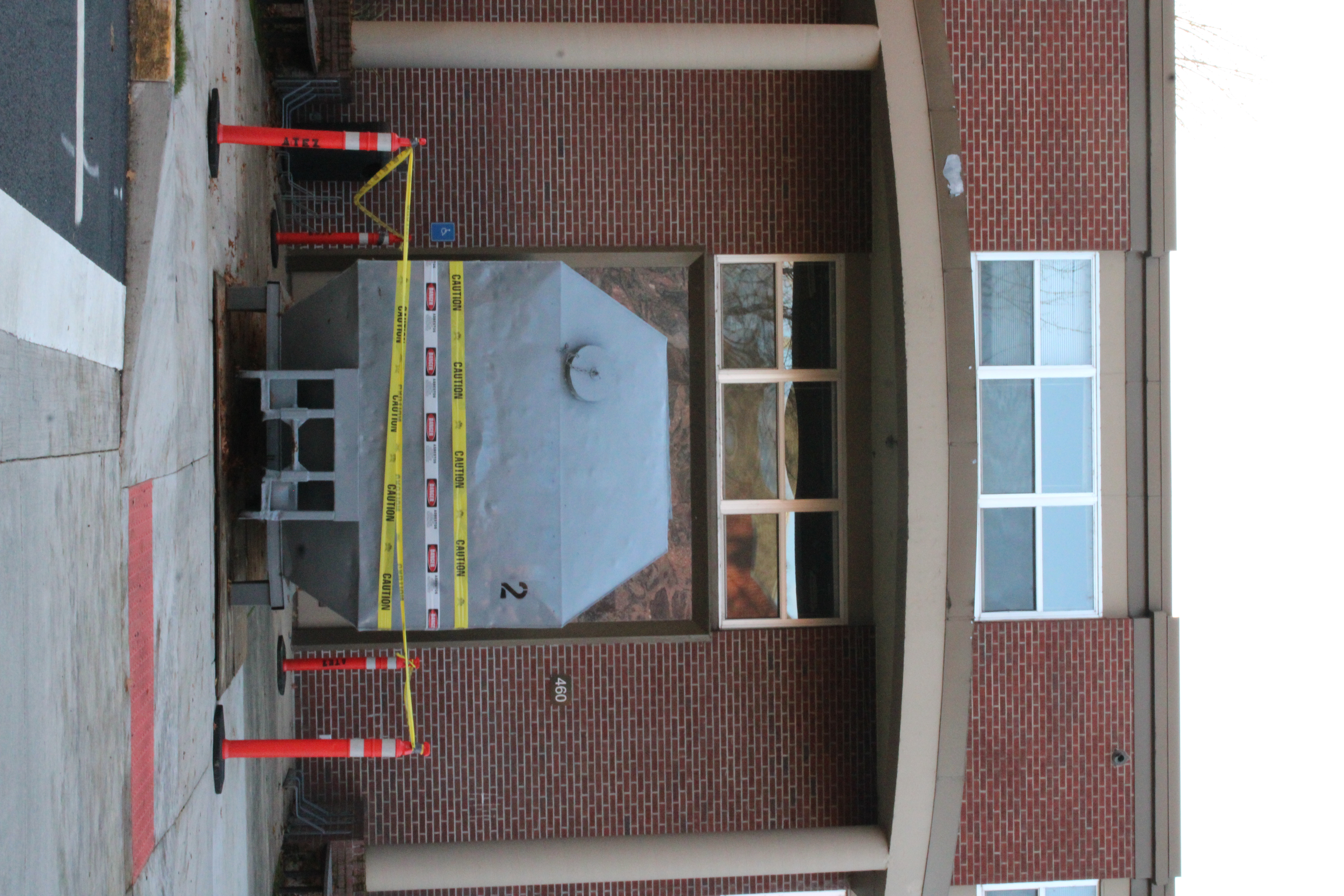
Maaske Hall while under construction for asbestos abatement. | Photo by Hannah Field

Nov. 19 2025 | Hannah Field | Editor-in-Chief

Maaske Hall is facing renovations through the end of Fall term on the first floor. Construction began Monday, Nov. 17, and is expected to take roughly three weeks.
In an email sent out to campus, the school reported that a contractor would perform asbestos abatement, which is the process of identifying asbestos and removing, repairing or encapsulating it. Asbestos is a cancer-causing substance, affects the lungs through irritation and causes scarring to the lung tissue. Most often found in buildings or cars, asbestos is present in many buildings built before the 1980s, found in various places such as piping, insulation and roofing. It was a common building material before it was found to be harmful, because of its anti-corrosion and heat-resistant properties.
Due to the risks, the first floor was sealed off to the rest of the building as well as the outside. Students, staff and faculty are asked to not attempt entry into the first floor of Maaske Hall. An exterior elevator is present for use on the north side of the building to enter upstairs, with many offices in the building for faculty on the second and third floors.
Further renovations are reportedly coming in the following Winter and Spring terms, including new flooring, lighting and fresh paint, but no further information was released hinting at what kind of changes or upgrades are coming to the building other than the overall goal: to build a Forensic Education Center.
The center will be an interdisciplinary collaboration in the College of Liberal Arts and Sciences, led by the Division of Criminal Justice and the Department of Chemistry. “The space will provide hands-on learning in the field of forensics and provide opportunities for wider community and regional engagement,” said Rebecca Chiles, assistant vice president, in an informative email sent to campus.
Maaske Hall is tucked between the Werner University Center and the Math and Nursing Building. It harbors no classes, so students often pass right by it, and many were previously unaware of any inside damage or potential harm, up until the asbestos abatement began and a large danger-sealed gray hallway was sealed to the front doors. Ideally, it’ll attract students for more than their professors’ office hours with the planned Forensic Education Center, which is a first for Western and could spark a lot of positive change in the college community.

Contact the author at howleditorinchief@mail.wou.edu

Wolf pups

A photo of the Wolf Pups with visitors from the Veterans Resource Center. | Photo courtesy of Tammy Gardner

Nov. 12 2025 | Abbi Duhart | News Editor

Wolf Pups — formally known as the Child Development Center — is a school and daycare area on campus where parents in the community and enrolled parents at Western can drop off their kids aged 2 1/2 to 5. The center has been up and running for 45 years, and was originally in Todd Hall, but moved to its new residence in the Child Development Center behind Campus Public Safety. They are part of the Student Affairs division at Western. Currently, there are three classrooms and 46 kids enrolled. A helpful resource they also provide is a dual-language classroom for children who speak English and Spanish. Additionally, they provide a young preschool room that supports children who still need to work on potty training, as well as kids with disabilities.
The original purpose of the Child Development Center was to serve Western students who are also parents by providing a space to assist parents in being able to attend things such as their classes. Currently, they serve Western students, faculty and members of the community, but the most prominent customers now are members of the community.
The center is funded by the IFC for student parents with children enrolled, meaning that Western students with children enrolled receive a sizable discount. A large Preschool Promise grant is also offered to around 30 parents who are low-income, covering the full payment to enroll their child.
The staff at the center encompasses around 25 individuals, including three full-time teachers, two full-time assistant teachers, one half-time assistant teacher and 15-20 student staff who attend Western and are most often enrolled in the Education program. Tammy Gardner, the director at the Child Development Center, explained that they wouldn’t be able to run the center without the large number of student teachers they get.
Gardner emphasized and wanted to highlight that the center is so thankful for and “couldn’t believe the love and support and resources that were given to the preschool, it’s absolutely amazing, and not just to the students, to the families and the staff here.”
The Wolf Pups partner with many different departments and faculty around campus, and have expressed feeling so welcomed by them as they bring joy to the kids. Recently, trick-or-treating for the Wolf Pups in the Werner University Center involved over 30 clubs and organizations around campus, setting up tables and going all-out with decorations, costumes and prizes or candy for the kids. The preschoolers came and had so much fun going to all the different tables; Gardner mentioned, “I will tell you, it was so amazing that after the kids left, I just sat in the WUC and cried.” During Halloween, Campus Public Safety also takes out one of the patrol cars to fire up the lights and sirens and take the kids on little tours.
She also mentioned the great partnership they have with the Natural Science department. Beeb Singson from the department has set up various experiments and lab tours for the kids to come in and do, like an exploding volcano and an earthquake demonstration that are both educational and fun.
They’ve worked with Michael Gonzalez from Athletics, who has invited them to play basketball with Western’s basketball teams. Members of the football team have also come in to visit the kids and play with them. Gardner explained that doing this is so enjoyable for the children and a way for them to meet amazing athletes. Rip Horsey, the director at the Health and Wellness Center, has also set up times for the children to come into the gym and have fun with all of the different activities offered.
Tim and Corrie Cowart, professors in the Dance department, have come in to teach the children mini dance classes as well. The kids love this, and it’s a great way for them to have fun interactions while being active. Currently, the center is also working with the graduate occupational therapy program because they wanted a place for their grad students to engage and observe little children as a way to prepare for their future careers. Each graduate student comes in to teach a lesson plan to the kids, and the kids enjoy it because “they’re young and fun,” as phrased by Gardner.
Gardner also had Logan Doerfler from the Veterans Resource Center come in with a crew to have a special story time about Veteran’s Day with the preschool classes. Doerfler and his crew dressed in uniform and discussed how they serve people and keep them safe, as well as deliver food and water.
Campus Dining provides the Child Development Center with all of the food they need, such as lunches and snacks. The center has expressed gratitude over the hot meals and two snacks a day they receive and how Dining is willing to accommodate, even sending treats like cookies occasionally.
All in all, the Wolf Pups at the Child Development Center are thankful and appreciative of all the resources and activities provided by departments and faculty around campus. The center is a great resource for students attending Western who have preschool-aged children. While the faculty at the center are pleased with how welcoming everyone on campus is, the children have the opportunity to be enrolled in such an amazing space where they can participate in many offered activities from organizations on campus. The people who take time out of their day to volunteer for these events know it’s all worth it to see the joy on even one child’s face.

Contact the author at howlnews@mail.wou.edu

Deep dive into the American Sign Language at Western

February 26, 2025

Written by: Hannah Field | Editor-in-Chief

American Sign Language has a rich and profound history across the country — but is a rare program to encounter in higher education. Few colleges along the West Coast offer American Sign Language courses beyond the beginning levels — Western, however, offers two degree paths, a minor and a master’s program.

The American Sign Language studies program at Western, on average, carries 15 students per class through 60 required credits of classes, beginning with the basic models of ASL and leading into a variety of additional classes, such as Deaf history, mental health in the Deaf community and deafblind studies.

For roughly half a century, Western has been serving the Deaf community in Monmouth, Oregon. Some current staff of Western in the ASL department, with examples such as Brent Redpath, LeShonDre Brown and Elisa Maroney, attended Western in prior years. 

Historically, Western showcases success in instructing the future interpreters of America. Western was the first base for a national ASL assessment service in the West as of 2020 — a testament to Western’s dedication to American Sign Language proficiency testing for anyone interested in their fluency level.

The two Bachelor of Arts programs — American Sign Language studies and interpreting studies: theory — differ, despite common misconceptions about the programs. American Sign Language studies, according to Western’s website, helps foster knowledge of ASL in a way that promotes respect for Deaf culture, history and community. “You will not only continue to hone your ASL skills, but you will also study areas such as linguistics, language acquisition, cultural competency and mental health and learn how this information can serve the (Deaf) population.”

Other higher education institutions may refer to their version of ASL studies as Deaf studies or, potentially, be known as simply American Sign Language.

Elisa Maroney, current program co-coordinator of the ASL branch of the interpreting program and certified interpreter, helped construct the ASL studies program curriculum at Western in its prime, alongside Debi Duren. The program originated from the interpreting program, which found its footing first at Western.

“Our program is a study of the language, the culture, the history. For ASL studies, we’re often a more foundational program — students have that skill in ASL that they can use for the next step in their lives, which might be a graduate program, or it could be related to their career that requires an ASL background,” said Brent Redpath, American Sign Language studies program coordinator. Redpath has been working diligently at Western since 2012 and has become a well-respected professor — often harboring full classes with a waitlist each term.

Redpath, as program coordinator, schedules classes, makesing sure each class is properly staffed with instructors, balancesing course loads for faculty, addressesing student concerns and assistsing in conflict management amongst students. Redpath wholeheartedly represents the ASL program — his face and name are well-known in the Richard Woodcock Education Center — RWEC — where the majority of ASL classes take place.

Predominantly, classes in ASL are taught by deaf professors. ASL language classes — 101 through 303 — follow this model earnestly.

“It’s very nice to have native users of a language who are instructing in their native language,” said Redpath. “And to receive language and culture directly from a deaf person. Nothing against hearing people, don’t get me wrong — but their experiences will be different than a person who grew up as a Deaf individual. They’re going to have a different background, and they won’t be able to speak to that perspective in the same way a Deaf person can.”

With this in mind, ASL classes are regarded as “Deaf classrooms.”

“You might notice as you come into class that we have our tables set up in a U-shape, which is different from other classes. That’s how we always teach so that every student in the class can see each other. It’s a visual language,” said Redpath. “It’s important that we can all see each other, that I can see the students and they can see me.”

The RWEC boasts glass panels in the wall, allowing professors to see what’s happening in the hallways and beyond — a common Deaf-friendly window style. Redpath personally acted in the committee that assisted with designing the RWEC. “I was able to offer some tips and ideas for how to make this building a more Deaf-friendly space,” said Redpath. Additionally, the topic of what makes a Deaf-friendly space is discussed in class to teach on Deaf culture and respect.

Deaf classrooms are also deadly quiet to the average hearing person.

“It is dead silent … The way you can just hear a pin drop — the way people can hear you swallow wrong,” laughed junior Abby Money. “And then the two people on your left hear it and you have to say, ‘sorry, I’m hungry today.’”

Unfortunately, the COVID-19 pandemic has impacted the ASL studies program; staff has been reduced, as have extra class options. As of 2025, Western has two full-time ASL studies staff members, alongside five part-time employees. Ideally, the program will be able to restore more staff members, in-person classes and more classes and class times.

Functionally, ASL classes utilize Canvas and GoReact for exams, homework and lessons. GoReact is a video-based system, allowing students to upload videos of their exams and receive direct feedback. 

ASL students, if struggling, may resort to the tutoring center for additional assistance with their signing fluency. Ideally, students will continue to participate in the Deaf community. “I always encourage students to be involved,” said Redpath. “It’s not enough to just go to ASL classes and be done. You can’t thrive that way … There is actually an ASL hall in the dorms, where you can have extra opportunities to socialize outside of class time.”

The ASL club on campus is a good resource for students to gain signing experience and practice with their peers.

Redpath’s classes involve three exams per term and weekly assignments. Students meet in small groups to practice for a grade on a weekly or bi-weekly basis, depending on the instructor’s choice.

“The ASL studies program is one of the biggest language programs that we offer on campus, and administration at Western has recognized us for that. We appreciate their support for our program,” said Redpath. “We felt their involvement in making our program successful … We hope (the program) will continue to grow even larger in the future. Of course, things are different now in post-COVID days, but we really hope to be back to what we were before. It’s a really important program — to me and to the university.”

As for Redpath — “My favorite part of this job is definitely working with the students. I teach a variety of classes, I work with diverse students from diverse backgrounds. And they’re not just learning from me — I’m learning from them.”

For junior Dylan Meader, Redpath stands out as a professor. “His teaching style is really effective for me,” explained Meader. “I’ve had good experiences with all the professors here, but I feel I respond best to his methods of teaching — he’s just a really nice guy.”

Meader gravitated to American Sign Language in high school, needing to fulfill a language requirement and finding it fulfilling beyond his initial expectations. 

“There’s not a single school in Washington that has the interpreting program, and that was something I really wanted to pursue,” said Meader. “I decided to look out of state, and the closest to my home in Bellingham, Washington, was Western. So I applied and I toured. It was something that I liked — so I decided to go for it … it’s been really great so far.”

Maroney attests that somewhere between one-third to one-half of ASL interpreting students in any given year are from out of state — such as juniors Abby Money and Meader.

Money, like Meader, hails from another state. Money grew up in Templeton, California, and Monmouth has been her first taste of life somewhere else.

“It was really scary for me moving here because I had, genuinely, never lived anywhere else on my own,” said Money. “Being fully immersed in the classes, I was so scared starting college. It was a nice surprise — it was worth it.”

Often, Redpath or LeShonDre Brown are the first faces students see when entering the program at 101.

“I went in, freaking out,” said Money, describing her first term with Redpath in ASL 201. “I was so scared. I was like, ‘he’s deaf. What if he doesn’t understand a word I’m saying?’ Spoiler alert — he did. He understood me.”

Western’s interpreting program hopes to help fulfill the country’s growing need for ASL interpreters. At Western, the program is available entirely online to support that goal, so more students from other states can pursue interpreting.

Interpreting, as a class subject, requires focus and drive. Students learn that professional interpreting requires no distracting clothing or accessories, and that hair must be out of the face. Recorded videos must be in good quality and against a blank backdrop.

Videos and exams follow any number of subjects. Often, they rely on translating English into ASL and then signing that statement.

Maroney has been working at Western since 1993 but previously received a certificate in interpreting from the college in prior years. Maroney even found herself at Gallaudet for her master’s — an iconic, and vastly important, college, leading the charge in Deaf education.

Eventually, Western’s undergraduate program will re-incorporate a crucial internship — “Our hope was that by having a graduate program, we could sort of guide students and provide them with supervision opportunities to, then, be more ready to work. The problem is that not everyone chooses to go on to (get their master’s) and they aren’t ready to work if they don’t have that internship piece,” said Maroney. “It is a lifelong learning process. You can’t get your bachelor’s degree and be one-and-done. You have to keep working on your language, on your interpreting, on your cultural experiences and knowledge.”

Chances are the ASL program, in any branch, will continue to evolve. “Everything is in flux,” said Maroney. “We try things, and if it doesn’t work, we try something else. I think it’s an exciting time right now — a little bit unnerving at the moment — but we have searches going on. We’re looking for two ASL studies faculty and one interpreting studies faculty.”

Additionally, Maroney recommends students look into scholarships. The interpreting program is, typically, six years long — meaning the cost can be heavy alongside already taxing work.

As for student-to-student advice, Meader has his own: “(Don’t be) intimidated, especially if you’re brand new to learning ASL and interacting with the Deaf community. Trust yourself. And have fun, it’s a lot of fun.”

“It gets easier,” said Money. “Your receptive skills get better. And when someone’s signing to you and you catch on, you’re like, ‘oh, wait, I’m actually getting this now.’ It’s not something that you’re panicking over, cause I remember panicking.”

Some staff in the program teach truly because they just enjoy the program, often working other jobs — Alethea Boyer-Mularski teaches full-time at Oregon School for the Deaf, showing up for her 5 p.m. 300-level ASL instruction classes after a full day of work.

“I teach at WOU because it’s where my teaching journey began nearly 18 years ago. Deb Duren, who was then the ASL Studies Program Coordinator, hired me despite my lack of teaching experience at the time, recognizing potential in me. Over time, my love for teaching grew, and I developed a desire to share my knowledge of ASL, Deaf culture and the Deaf community,” said Boyer-Mularski. “During the day, I work at Oregon School for the Deaf, and in the evenings, I teach hearing students at WOU. It’s a rewarding contrast — teaching Deaf students their true language while introducing ASL to hearing students.”

Western’s launch of the Deaf and Hard of Hearing Education Program — 2015-2021 — had Boyer-Mularski in one of the first cohorts. After a six-year hiatus starting in 2017, Boyer-Mularski has since returned to the college.

“It was amazing. I love Alethea. She definitely helped my receptive skills a lot (because) she’s a much quicker signer. That was a lot of fun, being thrown into that,” said Money.

Additionally, Money regards the language with a lot of love. “It’s important to me because it kind of reminds me of where I come from a little bit. I took it originally for my friend, for her and her brother, because she was going to teach it to him. And then I just fell in love with it — it’s a beautiful language.”

“ASL is more than just a language — it’s the heart of Deaf identity and culture. I encourage students (and) faculty to appreciate its true beauty and respect its vital role in the Deaf community,” said Boyer-Mularski.

Meader has appreciated Western’s program so much that he’s opting to pursue his master’s at Western in interpreting. “The staff and the professors in the ASL and interpreting programs have been so supportive and encouraging … and I think that’s what’s made me want to continue, as opposed to (an) experience I had in high school where I almost quit learning ASL because my first teacher said something very harsh and awful to me about my signing, but I’ve just had really good experiences with the professors here,” he said. “Regarding the interpreting program, I think the professors do a really great job at preparing you and setting you up for success. It feels like they really care about you and think about you as more than just a student. Like they really want to set you up for future success as an interpreter or whatever you decide to do with ASL.”

Contact the author at howleditorinchief@wou.edu
Hoaxes

February 5, 2025

Written by: Hannah Field | Editor-in-Chief

Content warning: this article discusses violence

America, in the last few weeks, has been swept by bomb threats — hoaxes that close schools down, reroute police attention and cause panic for thousands.

Late into the evening Jan. 29, Albany Options School received an email informing them of a bomb. On Jan. 30, the school’s staff discovered the email and informed the local police department, leading to a thorough sweep of the school premises, as well as its neighboring elementary school, Sunrise Elementary. Officials from Greater Albany Public Schools deemed nothing suspicious, and allowed for a typical school day.

Albany Police Department, as well as the school district, assured the public that an investigation is underway aiming to identify where the threat came from. They posted online Jan. 30, “We saw a lot of incorrect information on social media about the emailed bomb threat to Greater Albany Public Schools this morning. The situation was fluid, found to be a spoof email attack (per the FBI) and GAPS notified families from the two schools as soon as they had correct and pertinent information … We take all threats seriously and work together with our partners to ensure the safety of all students and staff.”

Reflected in news across the country, bomb threats are making headlines. Notably, a Utah elementary school — Timpanogos Elementary School — was recently investigated due to an unclear threat made right after school was dismissed for the day Monday, Feb. 3. The Provo Police Department swept the school using K9 units, finding nothing suspicious, but have continued to investigate.

Allen County Schools, out of Scottsville, Kentucky, declared Saturday, Feb. 1, that a threat was made against Allen County-Scottsville High School, eventually stated to be non-credible after a thorough sweep of the premises and surrounding area utilizing K9 units.

At approximately 5 p.m. Monday, Feb. 3, a CVS Pharmacy in Sylva, North Carolina, was cleared after a bomb threat was alleged. The neighboring Burger King was evacuated as well as the CVS. Traffic was rerouted to avoid the area as investigators cleared the scene — another hoax.

Authorities in Myrtle Beach, South Carolina, arrested 35-year-old Christopher Newman in connection to a bomb threat that was called into Myrtle Beach International Airport. The bomb threat caused panic across the airport, deplaning multiple aircrafts after pilots were contacted. Newman is being held without bond.

According to America’s Cyber Defense Agency, “The primary reason for employing bomb threats when no explosive device is present is to disrupt, distract and harass.”

Facilities receiving bomb threats are encouraged to stay on the phone for as long as possible, write down exact wording and fill out a bomb threat checklist offered by the cyber defense agency. If not called in but received digitally, it is recommended to leave the message open on the device, take a screenshot, copy the message and title and note the date and time. If written, handle the note as little as possible. Note the date, time and location of the threat and keep the written threat in a secure spot so police may investigate it as naturally as possible.

Most bomb threats — nearly 90% — are expected to be hoaxes. Despite the fact, all threats are to be treated as if real, so as to prevent injury.

All bomb threats should be reported to law enforcement agencies.

A 17-year-old student of Beekman Charter School in Bastrop, Louisiana, was arrested in late January after multiple bomb threats were made over email against the educational facility. All Morehouse Parish schools closed Monday, Feb. 3, and Tuesday, Feb. 4 regarding the incidents.

Mayor of Bastrop, Betty Alford-Olive, stated, “As Mayor, I am asking all citizens to be vigilant of your surroundings and if you see something suspicious, please call 911. Please stay safe.”

Investigations are still underway.

The United States Naval Academy in Annapolis, Maryland, closed after multiple bomb threats were made toward the North Severn Complex. All affected areas were cleared and no threat was located, with the lockdown lifted Jan. 31. 

Nov. 2024, during the election, faced multiple Russian-sourced bomb threats to polling places in multiple states, such as Georgia, Michigan, Arizona, Wisconsin and Pennsylvania. The FBI claimed that none of the threats seemed legitimate and declared the investigation to be at the top of their priority list. At least two polling spots in the state of Georgia were evacuated but opened again after 30 minutes. The Russian embassy in Washington protested allegations of Russian interference — labeling them “malicious slander.”

Overall, more than two dozen threats against polling stations were made.

Contact the author at howleditorinchief@mail.wou.edu

TRIO

Written by: Hannah Field | Editor-in-Chief

The new Student Success Center, upon entry, showcases a large, well-lit lobby, with new floors to boot and even a fireplace accompanied by comfortable seating. Looking ahead, a soft purple doorway boasts a front desk with a friendly face. Around the corner, the room opens up into an illuminated lobby for TRIO — a program that only grows the longer it exists at Western.

TRIO, sometimes referred to as SEP — Student Enrichment Program — is a nationwide program. According to oregontrio.com, the Oregon TRIO Association, otherwise known as OTA, was founded in the year 2000. Three primary initiatives would sprout: an annual professional development conference for TRIO professionals, an annual student leadership conference and a framework for Oregon to send advocates per year to Washington D.C. to pledge for funding for TRIO and spread its programs across the country.

In July of 2021, OTA received a $1 million grant from the state of Oregon to support marginalized students receiving higher education, also assisting with a full-time executive director position within OTA. Their mission: “Growing and supporting Oregon TRIO programs, staff and students … ​TRIO programs assist students with career exploration, college admissions, college preparation, financial aid, scholarships and college retention and graduation.”

Historically, the term TRIO was coined to honor the three main programs: Upward Bound, Talent Search Program and Student Support Services. “By 1998, the TRIO programs had become a vital pipeline to opportunity, serving traditional students, displaced workers and veterans,” said the TRIO history place. Eventually, the three programs would triple — becoming nine different educational assistance programs. Today, OTA serves more than 11,000 students.

At Western, TRIO boasts a well-equipped and established team to support students in many ways: director, Christopher Solario; assistant director, Adrian Trujillo; educational advisor, Alicia Monrroy; educational advisor, Andres Hernandez-Galvan; first generation coordinator and educational advisor, Dana Nunez-Silva; educational advisor, Hayden Campos; educational advisor, Logan Bransfield; educational advisor, Brianna Jones; and Sharon Price, TRIO student enrichment program office coordinator.

Director Christopher Solario has been involved with TRIO since 2000, but has been a leader in the program since 2012. The program itself has been at Western for more than 35 years. “I loved it as a student and I really enjoy it as the director,” said Solario.

Solario oversees TRIO and SEP. Occasionally, he works with students, regarding them as his favorite part of the job. “Seeing (first-year students) as kind of wide-eyed, kind of nervous, not knowing where they’re at — and then four to five years later, seeing them walk across the stage, graduating. It’s exciting to see their growth … just seeing how much they’ve grown as a person, as a human and as a citizen. It’s wonderful.”

Educational advisors assist students in the TRIO and SEP program by helping them with virtually whatever they might need — class registration, reaching out to professors, finding resources or even just needing someone to talk to. These sessions act as one-on-one advising.

According to the SEP page on Western’s website, services include academic advising, partnering with Destination Western, communicating with other departments on campus, support advising, individualized instruction, student-focused seminars, admission to cultural-enrichment activities, access to textbooks, MacBooks and other resources and organized social programs to invoke a sense of community and unite students.

“Even if we don’t know the right answer right away, we will work to get you the answer. We will connect you to the right resources,” said Dana Nunez-Silva, who began with SEP three years ago. “If you don’t even know where to start, your TRIO advisor is a great place to start.”

The main feature that students are aware of is the educational advisors. Each student admitted into the TRIO program at Western receives an educational advisor, with full-time advisors having a caseload of approximately 70 students.

“It’s really great that you (can) have this rapport with a staff on campus that you hopefully feel comfortable to talk to or ask questions,” said Nunez-Silva. “A social support that hopefully empowers you to take initiative of your academic journey, because I think coming in, especially as a first-gen student, it’s scary.”

“Our advisors care about our students,” said assistant director, Adrian Trujillo. “We try to do our best to make sure that when they leave the office, they’re in a better space than they originally came into, or at least have a better understanding of their path towards their graduation. That’s the end game for a lot of students, making sure they reach graduation.”

Most of TRIO is comprised of first-generation students, with the bundle of offices, workspaces and seating generally titled the “First-Gen Center.” Here, members of TRIO are invited to study, collaborate and enjoy a space catered to their needs, although anyone is welcome and does not need to be a part of the program in order to occupy the area.

Outside the wall of windows in the main area, a small body of water, titled the “retention pond” sits; nearby, the lending library offers donated textbooks to be borrowed. Even a care cupboard, courtesy of Abby’s House, is available to provide snacks and other possible necessities.

“We really wanted to have a space for our students who identify as first generation to come in and hang out,” said Trujillo. 

With all new amenities, the Student Success Center is an adequate community resource for the growing program — lending itself to nearly 400 students across campus.

“I think that we’re all just very thankful to be in this new space. And we’re all very excited to see how this community is going to flourish in this new space, because it’s a beautiful, beautiful building,” said Nunez-Silva. “We’re very lucky to be here.”

TRIO was founded on the concept of accessibility, community and advocating for students who may need it. In light of that, educational advisors pledge to consider their advisees and support them with their needs.

With that goal in mind, the program at Western has established free first-year seminars for students in SEP.

“The overall theme for (the classes) is helping students who are within our program have a better understanding of how to navigate higher education, give them the tools and skills that they need,” said Trujillo, occasional teacher of said classes. The lessons are meant to shine a light on things students may not be aware of, such as credit scores or navigating their identity as being first generation, low-income or having a disability.

In Solario’s words, first-year seminars are to prepare students for college as a whole — “What does it take to be a college student? What’s the difference? What’s the expectations from a professor? How do you approach classes? How do you study? How do you balance your time?”

Time management is something TRIO places a lot of emphasis on, not only covering it in class but also through “TRIO talks” — workshops — that take place throughout the term. Occasionally, prizes or gifts are offered with workshop attendance, but the goal is to walk away more informed than before. The schedule for events is found on SEP’s social media, SEP student weekly emails and can easily be found in the First-Generation Center.

Some of these workshops focus on financial literacy or FAFSA completion, with financial aid being a large problem for many TRIO students.

TRIO Teacher Prep Student Support Services is also an opportunity for education majors at Western to receive support and resources. Eligibility depends on being first generation and meeting financial requirements. Through this, students may receive academic advising, mentoring and tutoring, teacher licensure exam workshops, financial literacy development, FAFSA and scholarship help, student success seminars and workshops and career development services. The program is overseen by Director Sheree Solario and encompasses a small staff, including a bilingual Spanish-English educational advisor, to better provide for student teachers.

Nearly half of Western’s student population is first generation, plenty of whom are not involved with TRIO despite their eligibility.

Misconceptions about TRIO include the concept of being first generation. “Neither parent graduated with a bachelor’s degree. They can have parents that attended school, but as long as they didn’t graduate with a bachelor’s degree, you’re still considered first gen,” said Trujillo. “I like to say, you can have an aunt, an uncle or a dog that gets a bachelor’s degree — that still makes you a first-generation student.”

Secondly, TRIO is not a remedial program. “I would say that the biggest thing I would want people to know is that this is a program that actually works when it’s utilized the way it’s meant to. As a student, you have got to also put in the work,” said Nunez-Silva. TRIO paves a pathway to success, and, according to Solario, has high expectations for involved students.

Nunez-Silva’s office sits closest to the front desk as the first generation coordinator. Her position goes beyond TRIO, tying in with Student Support Services and the Tri-Alpha Honor Society, a new organization looped into Western’s ever-growing community. Nunez-Silva will coordinate with the Tri-Alpha Honor Society to further elevate hardworking first-generation students.

Formal requirements for Tri-Alpha include having at least a 3.2 GPA, 45 credits completed and being a first-generation student. Eventually, positions at Western for Tri-Alpha will be established, such as a president position, which will include more coordination with Nunez-Silva and the community. Members of Tri-Alpha, however, have a minimal time commitment.

Eligible students who do not receive invitations to Tri-Alpha may reach out to Nunez-Silva if interested.

One important feat of TRIO is First-Generation Week, a celebration of students’ achievements over the course of multiple presentations, events and activities.

“There’s (about) three advisors here that were TRIO students at Western, so I think that just goes to show there’s definitely that ‘TRIO magic’ that people talk about — that they feel supported, not just supported enough to go through college, but supported enough to come back and give back to campus,” said Nunez-Silva. “I think that also extends to Western culture … There’s a lot of alumni that are here working now to give back, and so I think that, in general, the fact that this program has been here for 30 plus years says a lot about how dedicated the program is to continue serving.”

Trujillo has his own goal in mind: to help students flourish beyond expectations. “To help people get to a spot where they surpass me in a way — I think that’s how I view leadership … it’s really cheesy, but TRIO works.”

The Student Success Center is open until 7 p.m. each day, with TRIO hoping to eventually keep an advisor there till closing so students may be able to have drop-in appointments or receive help.

Students may apply for TRIO even after their first year at Western, but may be waitlisted. Solario hopes to expand the number of students which TRIO can assist, which is very likely considering TRIO’s expansion — not just a new building, but new positions, opportunities and events.

To get involved or apply, research TRIO at wou.edu/sep/.

Contact the author at howleditorinchief@mail.wou.edu.

Happy birthday, Western

Written by: Hannah Field | Editor-in-Chief

Jan. 18, 1856 — 169 long years ago — Western was founded by 11 Disciples of Christ, originally titled Monmouth University. They were hoping to create a united community in their religion, which did, in its own way over time, become a tight-knit intermingling of students, professors and others, although without the faith originally in mind. Instead, the Western community honors their devotion to academic excellence and the Western way — a tailored educational experience, boasting small class sizes, caring professional staff, educational resources and a safe, walkable campus. Or, in Western’s words, “(commitment) to changing lives, strengthening communities and transforming our world.”

Western is the oldest public university in the state of Oregon, as well as an NCAA Division II institution, harboring a diverse population of students from underrepresented groups, veterans and especially first generation college students, notably recognized by the college.

Thanks to settlers who donated land and money, as well as financial support from local government members, Western came to fruition amongst a trying time in the 1850s, when customs and traditions were clashing with new age movements. Western, despite its religious founding, became an established center for training teachers for public and private schools, becoming Oregon State Normal School in 1882. It closed for a year after lack of funds and reopened as Oregon Normal School — hence the former “Lamron” title of “The Western Howl” paper. If unsure, read it backwards — not a very “normal” concept.

To add on to the normal trend: Western’s athletic teams, prior to 1928, were known as “The Normals.” Yeah, really regular.

Western adopted multiple other names over time: Christian College (1865-82); Oregon State Normal School (1882-1909); Oregon Normal School (1911-39); Oregon College of Education (1931-81); Western Oregon State College (1981-1997); and lastly, the current title, from 1997 to the present.

Throughout the last 169 years, Western hosted some significant and unforgettable events — as well as stories. In 1962, American Communist Party Secretary Gus Hall delivered a controversial speech at the Oregon College of Education, inciting an uproar. The event was later dubbed the “Gus Hall Affair.”

Previously, Hall had spent years running away from the IRS, after having been convicted of fraud and forgery in an election and had even been imprisoned after attempts to overthrow the American government, posted bail, fled to Mexico City and then was re-imprisoned. And, then, 11 years later, someone invited Gus Hall to speak at Western — nice move.

In less exciting, but still important, history, the 123-foot Sequoia tree in the middle of campus used for the annual holiday tree lighting was planted by the class of 1887. 

Columbus Day, Oct. 12, 1962, Campbell Hall lost its iconic tower structure in a massive storm overtaking Oregon, the crash photographed by student Wes Luchau. The storm, titled the Columbus Day Storm, has been tied directly to Luchau’s photo, even after more than 50 years.

Many of the buildings on campus are named after graduates of Western that went on to make notable accomplishments or titles, such as John H. Ackerman, former president of Oregon Normal School. He helped to secure adequate and stable funding for the school. In 2010, Ackerman Hall was named in his honor, incorporating housing and classrooms in an energy-efficient building.

Todd Hall was named after former Dean of Students Jessica Todd. The building was erected in 1912, closely followed by The Cottage in 1917. Todd, having retired in 1931 and passing away in 1944, was fondly remembered by the college community, but also regarded as being a stern, protective and respected woman.

Here comes the interesting part — it’s been told that Todd’s ghost still roams Western’s campus, looking over the students and the dormitories, as she once had so diligently. Possibly a myth, but in order to discover the truth, one might have to ask around or take a visit to one of Western’s oldest buildings.

In more recent news, Western was picked as the focus for the Amazon Prime Video television show, “The College Tour,” in 2024. And — not to bring myself into one of Western’s most accomplished moments — I was featured in B-roll for the episode, partaking in maybe the most awkward conversation I’ve ever had in American Sign Language. They had me sign a waiver and gave me a sticker, which might be worth the embarrassment. I only have myself to blame, after all.

Speaking of American Sign Language, the ASL program, as well as the Education program, continue to be vital to Western. After all, it was the Oregon College of Education, finding its footing by training teachers all those years ago — 169 is nothing to scoff at.

Despite its many name changes, “normalcy,” previous scandals — looking at you, Gus Hall — and potential ghosts, Western has become a beloved part of many students, professors and others’ lives, showcasing a gorgeous campus, with compassionate staff, enticing classes and endless opportunities. If there’s any time to be grateful, it makes sense to celebrate on Western’s birthday Jan. 18, potentially by toasting to Campbell’s lost tower or mourning the loss of the former publishing name “The Lamron” — I admit, it’s a lot funnier than “The Western Howl.”

Contact the author at howleditorinchief@wou.edu

My Western experience

Written by: Taylor Duff | Lifestyle Editor

Western was founded in 1856 as Monmouth University, making it one of Oregon’s oldest public institutions. The school has a long history and a strong dedication to education dating back over 160 years, with Western Oregon State College being renamed in 1939, leading to Western’s formal establishment as a university in 1989. This rich tradition instills pride in the community, and I’ve always felt that as a student here. My experience at Western is probably similar to many others — the campus is smaller and only a few blocks long, yet it’s easy to become lost in the halls and classes, especially in the first few weeks. I’ve had my share of disorientation trying to identify buildings on campus or figuring out which direction to walk when I’m in a new area of the school. But, in other ways, the size has been a great thing as everything is nearby, leaving a comforting feeling from being in a location that’s easy to explore once you get the hang of it. 

What stands out the most from my experience at Western is the sense of community. The classrooms are small enough to build relationships with your teachers and fellow students, but large enough to provide a variety of ideas, viewpoints and interests. Compared to the big lecture halls I had seen in movies or heard about at other universities, Western’s classes felt much more personal and approachable. They were small enough that I felt at ease stepping in, knowing that I could have discussions with my professors and peers. It was simple to pick up a conversation with students, and I truly felt like I was a part of something more than simply a classroom, but part of a community.

Western’s dedication to diversity and inclusion contributed significantly to my sense of belonging. Western is extremely diverse, reflecting a broad variety of cultural, ethnic and socioeconomic origins. Western actively promotes diversity through a range of services, including community centers, multicultural student clubs and activities that encourage inclusiveness on campus. I felt Western was the right school for me, not simply because of its history or location, but because of its real commitment to accepting and giving respect to everyone.

I had a special connection to the university long before I became a student. I grew up witnessing my mom graduate from Western when I was 12 or 13, and the campus and buildings have always seemed like home. The familiarity of Western’s streets, the charm of Monmouth and the inviting attitude all helped me feel connected as a student. Coming back to Western as a college student meant more than simply continuing my education, it felt like coming full circle. When I reflect on my time at Western, I am extremely proud of the route I’ve chosen. From the first day on campus, I felt encouraged and advised, whether through academic advice or just knowing I could bring up concerns to my instructors. There was always a helping hand when I needed it, and I felt it throughout my journey. I’m happy that I got to experience Western for all it is and meet many other students on the way. 

My involvement with “The Western Howl,” the university’s student-run newspaper, was one experience that truly impacted my time at Western. I met other students who worked with me at the paper and it changed my college experience for the better. Initially, I came to Western to pursue a bachelor’s degree in English, but after being involved with the Howl and continuing my love of writing and collaboration, I changed my major to communications. The transition seemed natural, and looking back, it was one of the greatest changes I’ve ever made. Being part of the Howl allowed me to express myself in ways I had not before considered. Writing for the newspaper allowed me to not only show my talents but also to express myself on issues that were important to me and the campus community. It wasn’t just about producing articles, it was about the process, creativity and working with other students. The work I made with the Howl formed my interest in communications and helped me determine my professional goals in ways that no textbook or lecture could.

What distinguishes Western from other schools is its dedication to assisting students in discovering their interests and directing them to programs and opportunities that match their passions. Western provides a diverse range of academic programs and resources to fulfill the requirements of all students. Every department, whether you study education, arts, sciences or communications, fosters a culture of inclusion. The instructors are friendly and truly concerned about their student’s progress. The tools offered from student clubs to internships form an unforgettable network of support. 

I’m very grateful for the time I spent at Western. The experiences, friendships and mentorships have shaped me both as a student and as a person. Without the help of my classmates, teachers and most importantly the people I met at the Howl, I’m not sure where I’d be in my educational journey or my career ambitions now. The university, its tight-knit community and its range of viewpoints all combined make my experience at Western extremely memorable. As graduation approaches, it’s bittersweet to know that I’ll be leaving a place that has seemed like home for so many years. I will take the lessons, friends and sense of belonging wherever I go.

Contact the author at howllifestyle@mail.wou.edu

Empathy in education

Written by: Sierra Porter | Staff Writer

As individuals, there are many elements that affect our daily lives and further influence us as human beings. One element that every human has succumbed to in life is consistent trials and tribulations. As a society, we believe that education and schooling should help us learn and move away from these challenges, including those we face outside of these institutions. For some, this creates a disconnect between school life and home life — believing that a solution in one will fix the other. What our education system is currently missing, that will help this disconnect, is empathy. 

Empathy is the ability to understand and share the feelings of another. This is not just having pity or sorrow for others as sympathy does, but rather, one truly puts oneself in the other’s shoes, viewing things from their perspective. For one to have a truly valuable education with others, it must also involve some form of empathetic learning. 

Those with particularly consistent negative aspects in their home life, especially young students, face things like changing family dynamics. These include financial issues, sibling bullying, history of neglect or maltreatment and more, and are more likely to have struggles in school — leading to a greater chance of dropping out. 

For many, it’s nearly impossible to disassociate the troubles they face at home away from their school life. It’s up to us, as individuals, to learn and encourage empathy — making everyone’s school environment as positive a place as can be. 

Educators who use an empathetic approach to teaching and addressing classroom issues create an inclusive and open environment for students — encouraging them to build safe relationships with their teachers and peers. Empathetic learning and teaching also promote a positive learning environment where students feel valued and proud of their abilities. 

Creating a safe and comfortable environment for students will allow them to enjoy school more, thus motivating them to stick with their education and make overall better decisions in life. Teachers lead by example, so if one is leading with an empathetic mindset, then that will create a community of compassion and a generation of caring students. 

As a student, one can also promote empathy by showing compassion and kindness to their peers and teachers. You never truly know what is going on in others’ lives, so try to put yourself in their shoes. Showing care for your teacher and their life in or outside the classroom can show them how much their work is appreciated, encouraging them to continue teaching. Being empathetic with your peers will help you understand each other better, creating stronger bonds and deeper relationships, again, further creating a community of positive and caring people. 

Empathy in education is not just the responsibility of teachers and students, but institutions as a whole can also promote an empathetic environment and learning. Many schools explicitly promote empathetic learning through social-emotional learning, or SEL, programs or character education. 

Specific classes aren’t the only thing institutions can do to promote empathetic education. As an institution are they empathetic about their tuition? Empathetic about the types of classes they offer? Empathetic about deadlines and requirements for applying students? Empathic about those that need extra assistance, like disability accommodations? There are so many different ways to promote empathic learning and create an empathic environment as an institution — thus universities and schools all over should be looking at what their students need. 

Empathy in education will encourage a new generation of compassionate, caring and bonded individuals who will take their empathetic learning and apply it to the world. Empathy in education tells us that life is difficult, but you are not alone. 

Contact the author at howlstaffwriter@wou.edu

Saving Salem Public Library

Written by: Sierra Porter | Staff Writer

Social media in Salem exploded amid rumors that the city would be shutting down the Salem Public Library to preserve its police budget, including an expanded team to sweep homeless camps. An outcry from Salem residents, including hundreds of emails to Mayor Chris Hoy, and support from surrounding communities has brought unity and hope that the library will be saved. Here’s what to know about the Salem Public Library budget cuts:

The city of Salem is facing a multi-million dollar shortfall and plans for no new revenue in the next year. Due to this, many plans to cut down costs have been introduced, including the possibility of closing the Salem Public Library. This plan was discussed at a budget meeting on March 21 when Chief Financial Officer, Josh Eggleston, was asked how one could keep all police and fire jobs. Eggleston presented hypothetical options that would balance the budget without additional revenue. Amongst these cuts were positions at the library that would completely reduce hours and many other parks and recreation positions. Salem is taking $1.2 million from the SPL alone. The city claims they have no plans on shutting down SPL completely, but by July, there will be tremendous cuts and changes. 

Public libraries offer affordable or even free access to a world of knowledge and life-long learning opportunities that are affordable or even free. Registered Behavior Technician and Salem resident, Jessie Shull, works directly with children in the community who often utilize the library. Shull says, “It’s going to impact low-income families in the area that use the library for more than just books. These resources are so valuable to children’s education and lives- without this access and sense of community they lose so much.” Shull believes these budget cuts will dwindle the benefits that the public library has to offer and ultimately eliminate many opportunities for those in the community. 

For the moment, Salem claims it will not shut down the library in its entirety, but librarians and residents have still testified at recent budget meetings in hopes of preventing further budget cuts.

The budget committee, which includes the mayor, city council and ten appointed community volunteers, will continue to discuss the cuts in meetings on April 17, April 24, May 1 and May 8, when they will make their recommendation to the city council. In June, the city council will hold a public hearing before adopting the annual budget. 

Show up, support and save the Salem Public Library. 

Contact the author at howlstaffwriter@wou.edu

Thoughts and Gifts Project invites community to grand opening

The Thoughts and Gifts Project welcomes Polk County residents to celebrate the move to their new permanent location 

Sydney Carpenter | News Editor

On Feb. 20, the Thoughts and Gifts Project nonprofit organization will be commemorating their permanent move to 427 Main St. E from 1 to 3 p.m..

Established in 2018 by founder Jean Love, TAGP celebrates the birthdays of underserved youths and qualifying senior citizens by providing $30 worth of gifts, three books and two birthday cards. 

Prior to COVID-19, TAGP would host one large birthday party each month for all participants within their program. Adapting to COVID regulations, the nonprofit does not have large birthday parties, but now does monthly prize drawings with donations from the Dollar Tree in addition to their other gifts.

Love had the idea after listening to a Toys for Tots commercial on the radio during Christmas time.

“It’s great that there’s such an outpour of support for one day, but what about the other 365 days of the year?” explained Love.

When the organization first began providing services to the public, their original location was temporary. 

“We had a partnership with the Polk County Service Club … They allowed us to use their club house free of charge and we were there for three days a week,” said Love, “but we did not have on site storage.”

According to Love, they spent the next few years fundraising until they were able to purchase a storefront in Monmouth during the fall of 2020. 

“We thought about doing a grand opening in October, but at that point you’re getting into November and December where the main focus is Christmas,” Love explained. “We don’t want to compete with anything Christmas because there is too much good that happens then.”

For the event, TAGP is doing a ribbon cutting ceremony in front of the store at 1:30 p.m. in addition to three different game stations.

“They will be quick fast games and after they can win prizes,” said Love.

Participants will also be able to receive some TAGP swag bags that contain various branded items. At this time, food will not be provided due to COVID regulations. People interested in attending the event are required to wear a mask, but no RSVP is required.

“We’re really doing something positive for our community,” said TAGP volunteer Kathy Grudle. “It’s such a wonderful feeling to be able to say this something we’re giving you and because we care about you having a birthday.”

To learn more about qualifications or to donate to The Thoughts and Gifts Project, students can visit their website at thoughtsandgifts.org.

Contact the author at scarpenter18@mail.wou.edu