

Mount Hood

The rebirth of bookstores

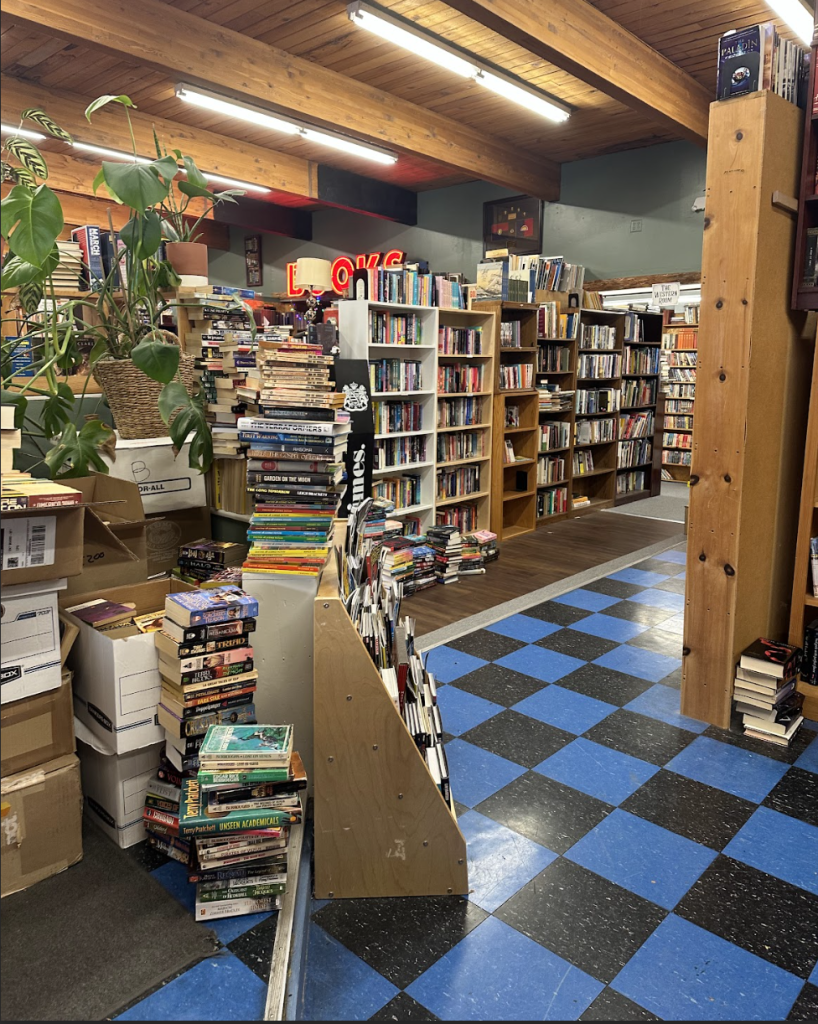
A photo of the inside of Browsers’ Bookstore. | Photo by Hannah Field

Jan. 21 2026 | Hannah Field | Editor-in-Chief

Recent bookstore statistics prove that popularity for local businesses in the US is climbing rather than subsiding five years after the coronavirus shutdown, with communities rallying and the landscape of bookstores adapting to meet modern demands.
The American Booksellers Association, or ABA, reported a membership increase of 18% and 323 new brick-and-mortar, pop-up and mobile stores opening across the United States in their 2024 annual report. They noted that 2024 had “the most successful Independent Bookstore Day to date.”
According to Harvard Business School, despite local bookstores struggling to remain afloat during pandemic regulations that limited business operations and corporations like Amazon dominating the industry, localism has become a social movement that has been steering indie bookstores back to the forefront. Communities have emerged to shop small and support local businesses in the wake of recent corporate boycotts against companies like Starbucks, Target and Amazon for their various methodologies, including anti-union sentiments alongside a lack of corporate accountability and diversity inclusion.
Abe Richmond, owner of Browsers’ Bookstore located in Albany, Oregon, said, “I was working here during the pandemic. It was obviously bizarre, and we closed for several months, but the customer base rallied behind us. So we would do sidewalk drop-offs, they would pay for it over PayPal or whatever, Instagram, and then we would package their books and put them on the porch.”
Richmond bought Browsers’ from the previous owner after graduating from Oregon State University, having been an employee of his, and has been at the forefront for more than three years. While Browsers’ Bookstore handled the precarious nature of being a small business during the pandemic, the customer base has also adapted to new ownership — and adapted well, with Richmond being recognized across town as the owner of Browsers’ and building a solid rapport with customers who seek out his services specifically.
When it comes to Amazon and Barnes & Noble, resale bookstores like Browsers’ suffer less than one might think. “I like them because people will spend $40 on a new hardcover in Salem and then read it, and then not know what to do with it, so then they bring it here. And I have a fairly new, good-shaped book.”
Customers who drop off books may receive in-store credit at Browsers’ to spend. Beyond that, Richmond also displays local authors and merchandise drawn by nearby artists. “It’s counterintuitive. Because who is this person, you know? But then, if you point it out, like, ‘Hey, they live in Albany or Corvallis,’ people are like, ‘Oh, I’ll read it almost just for that sake.’ Whereas if it was some other book that you’d never heard of, they’d probably pass over it.”
He also noted the enjoyable community aspect when authors host signing events at Browsers’, bringing a sense of life to local stores. Richmond also instrumented a film drop box through Light Rider Studios, meaning customers can drop off their film to get developed on their behalf and delivered.
Bookstores have been changing since the 1970s, with 43% of local bookstores closing between 1995 and 2000, reminiscent of the decline in physical bookstore sales through the Kindle push in the late 2000s and 2019, when Amazon had sold more than half of all books in the United States. Jeff Bezos, owner of Amazon, stated, “Amazon isn’t happening to the book business. The future is happening to the book business.”
Amazon was founded in 1994 as an online bookseller by Bezos. Since then, the ABA has labeled it an unchecked monopoly, claiming that it stifles competition and that it has an enormously negative impact on the bookselling market. Amazon was able to expedite growth, printing an effective blueprint to attract customers and obtain and keep wealth by failing to comply with tax regulations and offering duty-free purchases.
Amazon also regularly offers discounted books, undercutting businesses that have to sell at full price in order to stay afloat. Booksellers have been forced to drop employees in order to stay profitable — which could also be a part of why Richmond and Sydney-Anne Graves are the sole paid workers as owners of their respective businesses, Browsers’ Bookstore and Monarch Books.
Regardless, Richmond and Graves have found success. And, according to the Associated Press, others are too; more than 200 local bookstores were predicted to open across the country between 2023 and 2025.
Monarch Books only just started in April of 2024 out of Lebanon, Oregon, owned and founded by Sydney-Anne Graves, who was a senior in high school when she encountered at a coffee shop the landlord of the building in which Monarch Books resides. That conversation alone spurred Graves to tell her mom later that night: “Mom, I’m buying a bookstore.”
After touring the building — reportedly falling in love with it — and dedicating multiple weeks to deep-cleaning, Monarch Books came to life under Graves’ new ownership and keen eyes.
“We opened, and (that) first day, it was really busy,” said Graves. “And I was like, ‘Okay, this might work out.’ It was really busy. And then, ever since, I’ve been slowly getting more inventory in, decorating, getting it to my vibe. I really love a lot of colors and plants, and there’s still a lot of ideas I have for in here, but it’s come so far from where it originally was.”
Richmond expressed appreciation for the anti-corporate push in 2025, leading to more local shoppers steering clear of Amazon and other corporate sellers. In the current political and social state of the US, local businesses may be inclined to further build queer-safe communities and book selections as opposed to corporate booksellers — potentially building a reliable customer base seeking a supportive book hub and shared community.
Browsers’ Bookstore remains open consistently under Richmond’s new ownership and maintains a loyal clientele across nearby cities. A good chunk of customer interaction relies on online postings and website sales through Browsers’ Bookstore’s virtual pages.
“I sell a lot (from what) I post on Instagram, and then people will be like, ‘Hey, I’ll take it.’ And so they come in and pay for it,” said Richmond. “It’s weird, though, because say you wanted a book we don’t have. It shocks me every time how many people are like, ‘Hey, can you order it for me?” Instead of them hopping on Amazon, because we go through a new book distributor. But I think it’s because people want to support. I think people like having bookstores.”
“It’s just so awesome, and it’s really cool to see that so many people still support the book community,” said Graves. “I was really nervous about that. I know I read and I know some of my friends read, but I don’t know how many people actually still buy books or shop downtown — so I think that was the most nerve-wracking part about it. But it’s been really great.”
Another aspect of the resurgence of bookstores is the online platforms Instagram and TikTok, cultivating an online community of book lovers. Dubbed “bookstagram” and “booktok,” readers and writers participate in hashtags, giveaways and online sharing, creating trends and catapulting books onto bestseller lists through sheer word of mouth via the internet.
“I feel like I get new customers every single week,” said Graves. “There are so many people who still love reading and that’s (been) helped a lot with bookstagram and booktok, different things that have really kind of inspired people to get back into it, which is so cool.”
“Taylor Swift — I’m not sure what — did something with Shakespeare,” said Richmond. “I’ve had so many women, and girls, college and under, be like, ‘I need Shakespeare.’ … It’s the same, if a movie comes out of a book, people flood the place, like when ‘Dune’ came out. Yeah, I couldn’t keep ‘Dune’ to save my life.”
“I was like, ‘Why is my Shakespeare selling all of a sudden?’ Nobody cared about this before,” Graves joked.
Taylor Swift’s most recent album, “The Life of a Showgirl,” features imagery, lyrics and photography modeled after Shakespeare’s character Ophelia in “Hamlet,” no doubt causing the wave of Shakespeare-mania that Richmond and Graves both experienced. “Dune” amassed a box office of more than $400 million in 2021 and “Dune: Part Two” grossed $715 million in 2024, with the “Dune” franchise built off of six core books written in the 1960s through the 80s.
However, there is a catch to the media frenzy. Allison K. Hill, CEO of the American Booksellers Association, blames Amazon: “Amazon is now the water we swim in … There are multiple ways that an independent bookstore is forced to not only interact with Amazon, but support them — books made into shows streaming on Prime Video are printed with Amazon stickers on the cover.”
Regardless, books have long since had movie adaptations, and well before Amazon and other corporations took hold. Much like local bookstores, movie theaters are becoming increasingly popular — for the second time. Upcoming releases like “Wuthering Heights,” “Project Hail Mary” and “Sunrise on the Reaping” are all 2026 book-to-movie adaptations spanning classic literature, sci-fi and the famous Hunger Games franchise. Show adaptations are equally successful, with notable pop-culture stars of book-to-show adaptations being “The Summer I Turned Pretty,” “Heated Rivalry” — currently thriving on HBO Max — and “Bridgerton.”
With books inspiring much of modern media turnout, it’s unlikely that books and bookstores will succumb to the strains of aging. In a way, books are trendy again, as the statistics prove — Barnes & Noble opened almost 70 new locations in 2025 and has more on the way.
Hill said in a statement in the 2024 annual report, “The numbers only tell part of the story. This momentum occurred despite significant challenges: the usual ones like thin margins, rising costs, and Amazon’s chokehold on our industry, and urgent threats that shook the very foundation of our work as the right to read and access books faced sustained, coordinated attacks.”
The current presidential administration has made a dedicated effort to place bans on books that affect educators and librarians, limiting access to certain content, especially that which discusses gender, race and sexuality. While that’s less likely to impact independent booksellers, the pressure remains to conform as book access limits book readers and their interests. Additionally, independent bookstores can rely on author visits and community involvement; divisive political action can split a customer base or turn away potential author-bookstore collaborations. The ABA, when discussing concerns for people interested in opening a bookstore, cited “free expression challenges.”
Portland’s own Powell’s Books — the largest independent and used bookstore in the world, spanning one city block and containing over a million potential reads — participated in the ABA’s Banned Books Week event in 2024, discussing the right to read, spreading awareness about book bans and hosting panels.
ABA also conducts the yearly Independent Bookstore Day. In 2024, when the ABA reported the highest participation numbers to date for the event, ambassador Amanda Gorman stated, “Independent bookstores are vital hubs of creativity and community. They offer curated selections that foster discovery for readers, while providing vital support and a platform for diverse voices for writers and other creators. They are the true modern-day town square, the beating heart of our communities, and a place for meaningful interaction and human connection.”
The day involved 1,216 stores from across all 50 states.
“Our mission — to help independent bookstores survive and thrive — remained at the core of everything ABA did,” said Hill.
While the 2025 annual report from the ABA won’t arrive until mid-2026, the expectation is that the indie bookselling industry will only continue to grow in spite of the last decade’s challenges, with Graves adding, “I don’t think books will ever go out of style.”

Contact the author at howleditorinchief@wou.edu

Life-Changing Lessons from the World of Harry Potter

Written by: Liberty Miller | Lifestyle Editor

I, alongside many others, spent my childhood looking through the lenses of the main characters in the novels I read. Having pored over the “Harry Potter” series since third grade, I got to experience a large portion of my developmental years from the perspective of the Chosen One, Harry Potter. 

“Harry Potter” is a distinct pop culture personality, who openly defies the government, fights prejudice and is fiercely loyal to his friends. J.K. Rowling also creates a wonderfully dimensional character profile for everyone in the book — rather than making the characters one-dimensionally morally sound or evil, she creates multifaceted characters that make mistakes, have moral gray areas, apologize and evolve as people. 

“Harry Potter” makes a relatable variety of mistakes throughout the series, and while being an astute and stubborn personality, also admits when he’s wrong and works to make things right. 

Coming from an unsavory background as the humble punching bag of the Dursley family, Harry Potter had the beginnings befitting of a supervillain. Facing daily roadblocks and abuse with no connections or friends, Harry became self-reliant and resentful of his life. 

He eventually gained status as a wizard and escaped his life with the Dursleys to attend Hogwarts, a similar path to Voldemort’s. However, Harry chose to defend those less fortunate and befriend characters like Ron Weasley and Hermione Granger, who were not the most popular or influential characters but were genuine friends. 

He rejected the Sorting Hat’s offer to place him in Slytherin despite being offered power and influence. Throughout the series, he makes conscious decisions to defend and protect people against prejudice and hatred and recognizes his faults concerning his impulsiveness and how his actions affect others. 

Harry is a prime example of having a choice to be a good person or to pursue power and influence without regarding others, and he is a great role model for young readers in terms of being authentic to oneself and fighting for what one believes in. 

J.K. Rowling also tackles some tough subjects for young readers such as bullying, grief, unfair circumstances, jealousy between friends, family dynamics and the uncomfortable feeling of growing up. While most readers cannot relate to having to face a faceless, bald and red-eyed supervillain with murderous tendencies, there are many other subjects that coming-of-age readers can relate to or struggle with. What “Harry Potter” teaches readers is, in essence, to create strong dependable friendships, use power and influence to do good things and reject social prejudice and administrative or governmental systems that work against the people. Most importantly, the series reminds readers to stay true to themselves and what they believe in. 

Contact the author at howllifestyle@wou.edu

Into the Maasverse

February 26, 2025

Written by: Jaylin Emond-Hardin | Entertainment Editor

Content warning: This article contains spoilers for “A Court of Thorns and Roses,” “Crescent City” and “Throne of Glass”

Spanning 16 books across three different series, Sarah J. Maas’ works have been translated into 38 languages and have sold over 12 million copies across the globe. All three of the series fit into different niches of their genre — romantasy, urban fantasy and high fantasy — but when diving into Maas’ works for the first time, most readers don’t realize that they are connected in one universe. After all, I didn’t and I’m 12 books deep. 

Unless one has read all three series, this isn’t as obvious. Most of the connections between the three only become clear in “House of Sky and Breath” and “House of Flame and Shadow,” the second and third books of the series “Crescent City.”

The most glaring is when Bryce Quinlan, the series’ main heroine, discovers that the Asteri — the godlike beings that rule their world — have been feeding off the people to fuel their immortality. Across centuries and millennia, the Asteri have traveled across worlds inter-dimensionally to feed off the people that live there. 

When Rigelus, the Asteri’s leader, begins to pursue her, Bryce uses her abilities to open a portal and cross into Prythian, the continent where “A Court of Thorns and Roses” takes place. There, under the watchful eye of Nesta and Azriel, Bryce discovers that her ancestor, Theia, was originally from Prythian. This information suggests that Theia is the ancestor of Rhysand, as one of her daughters returned to Prythian from Lunation, and it is currently the most popular fan theory. 

The connection between these two series and “Throne of Glass,” however, is not as obvious. It isn’t until “Kingdom of Ash” that we even see glimpses of Prythian or Lunathion. 

When Aelin burns out and uses an immense amount of her powers, she begins to fall between worlds. During this fall, she observes what fans believe to be Lunathion and she is eventually slowed by none other than Rhysand, the High Lord of the Night Court. 

These examples alone show how interconnected Maas’ series are. Whether she began writing her series to connect them or not, having them exist in the same multiverse opens up an entirely new door of possibilities. 

For example, in the bonus chapter of “House of Flame and Shadow,” Bryce returns to Prythian and brings her mother, Ember, with her. There, Ember and Bryce interact with all of the Inner Circle, Rhysand’s group of friends and advisors in “A Court of Thorns and Roses,” and suggests that Bryce’s ability to cross over the worlds can be used for a much larger purpose — perhaps even bringing an army to Lunation or Prythian to help defeat the next world-ending threat. 

However, fans have noticed other commonalities between the three series long before Maas connected them explicitly. Most connect “Crescent City” to “Throne of Glass” and “A Court of Thorns and Roses” rather than vice versa. What this means isn’t certain, though it likely sets up a “past, present and future” scenario between the three: “A Court of Thorns and Roses” as the past, “Throne of Glass” as the present and “Crescent City” as the future. 

This “past, present and future” theory arises from the fact that out of the three series, only one has gods that have remained in their world: “Crescent City.” In “A Court of Thorns and Roses,” the gods have been long gone, now nameless and forgotten, while in “Throne of Glass,” both the gods and magic have been gone for eight years. This also supports the theory that the Asteri also once were in Prythian and Erilea — where “Throne of Glass” takes place — but were forced to leave at some point. 

Out of all of the connections across the books, my favorite is the connection between Aelin Galathynius, the protagonist of “Throne of Glass,” and Lidia Cervos, a minor, antihero-type character in “Crescent City.”

The similarities between these women are glaring and go much deeper than just their appearances. Of course, both are described to look very similar — golden blonde hair, pale skin and eyes that are somehow both gold and blue — but even Lidia and Aelin’s ability to wield fire is nearly identical. Stags are the symbol of Aelin’s kingdom, Terrasen, and Lidia is one of the most powerful Stag shifters of her long lineage. Even one of Lidia’s sons is named Brannon, who was the first fire-wielding king of Terrasen and Aelin’s ancestor. 

The Autumn Kings of “Crescent City” and “A Court of Thorns and Roses” are also theorized to be related to the line of Terrasen or even just plain connected to one another.

Yes, that’s right. Two separate kings who rule over two separate courts in two separate series with the same name? It might just seem like a coincidence, but it’s in more than just their names. 

While Einar rules over the Valbaran Fae in Lunathion and Beron rules over the Autumn Court, they both have wine-red hair and tanned skin and are described as power-hungry, cold Fae men. 

Not convinced yet? Well, their strange gold and blue eyes and fire powers are what wrap this package up with a neat little bow. It’s also these attributes that lead fans to theorize the connection between the Autumn Kings and the line of Terrasen. 

Another important minor detail is the style of tattoos throughout the three series, especially between those of Feyre Archeron and Rowan Whitethorn, and Bryce Quinlan and Nesta Archeron. 

Between Feyre and Rowan, there is no shortage of swirling black lines, most notably on their arms — Rowan’s tattoo travels up from his arm onto his neck and face — while Bryce and Nesta both have an eight-pointed star, Bryce’s in the middle of her chest and Nesta’s in the middle of her back. 

Though it’s not exactly clear why these characters have such similar tattoos — the only tattoo we have explanations for is Bryce’s — it shows a deeper connection between the three fae cultures across three different continents and even series. 

Of course, I might just be reading into all of these similarities too much. After all, it is common for authors to use recurring themes in their series, but with Maas connecting her stories in very explicit ways, it appears to be more than just coincidence.

Maas has yet to announce when the next books in “Crescent City” and “A Court of Thorns and Roses” will be released, but with 16 books worth of information, there is plenty to devour and theorize on what exactly the author will be up to next.

Contact the author at howlentertainment@wou.edu

Romance + fantasy = romantasy

Written by: Jaylin Emond-Hardin | Entertainment Editor

Content warning: this article contains spoilers for “Crescent City” by Sarah J. Maas

Though it is unclear how long the term “romantasy” — a blend of the words romance and fantasy — has been around, the genre has now become rather common in most book social circles.

The idea behind the genre is that the plot has two defining features: romance and fantasy. If a book has too much romance and not enough fantasy, especially if the love interest is a high fae or another fantasy race, the plot cannot survive. 

The books typically contain smut —  sexually explicit content, also sometimes called “spice” online — though it is not a requirement of the genre. Many romantasy books fade-to-black or have behind-closed-doors moments — scenes where the explicit content is implied but never stated — and the romance is kept clean for readers. 

The fade-to-black scenes are typically best for the young adult genre, as it means that underage readers are not consuming sexually explicit content not intended for their age demographic. For example, the book “From Blood and Ash” by Jennifer L. Armentrout is considered one of the spiciest books currently on the market. As this book is one of my current reads, I can safely say that this is true; the book is roughly 20% actual plot and 80% smut and is not suitable for young adult readers, which is why fade-to-black scenes are so important. 

Within the last few years, the genre has seen an uptick in readers and number of books sold. Sarah J. Maas, the author of “A Court of Thorns and Roses,” “Throne of Glass” and the “Crescent City” series, has sold over 40 million copies of her books. Maas is currently the biggest name in romantasy, and some would say she created the current blueprint for the genre, as well as for the love interests. It seems that Maas has cracked the code behind the romantasy genre. 

One theory to explain the popularity of romantasy is that readers can see themselves in the female main character, also known as FMC in bookish communities. Generally, FMCs are ordinary women, usually in their early to mid-twenties, who are thrust into a world that they are not used to and are not meant for.

These women are also outspoken and don’t always take “no” for an answer, as well as possess some sort of supernatural power, either when they are first introduced or as their stories progress. They are angry, typically traumatized women, but begin to soften and let people in again as their stories progress. 

For example, Bryce Quinlan of Maas’ “Crescent City” trilogy is a half-human, half-fae woman who doesn’t want to get caught up in the mess of the Vanir — the immortal, non-human members of her world — but ultimately accepts being thrust into the role of her world’s savior. As the trilogy progresses, readers come to realize that Bryce possesses the Starborne abilities of her fae heritage, abilities that include manipulating starlight and absorbing energy from others. Bryce’s character is best known for her general disdain for Vanir hierarchy and hot pink tennis shoes, which draws readers in because of her relatable nature. 

Another theory is that the male main characters, or MMCs, are incredibly hot. They tend to be opposite of their FMC counterparts in the sense that they have experience in their worlds — often hundreds of years older than the women — and eventually become the steady guiding hand in teaching the world’s magic system to her, after they hate each other first, of course. Unlike their counterpart, the MMCs are typically level-headed and calm, only releasing their true rage when someone close to them is in danger. They also start in a position of power over the FMC, although they end up becoming equals as they fall in love. 

Bryce’s counterpart and love interest in the “Crescent City” trilogy is Hunt Athalar, a 233-year-old fallen angel, who just so happens to be called the Umbra Mortis, or the Angel of Death. Hunt is part of the triarii, the archangel legion that guards Lunathion, and butts heads often with Bryce as he works on protecting her from forces in the city that are coming after her. They eventually fall in love and learn to work together to save their city. 

Fans often give these MMC love interests nicknames like “Shadow Daddy,” alluding to the fact that most of these love interests are tall, dark and handsome, possess the ability to manipulate shadows and yes, are insanely good in bed. 

That leads into the third — and least favorite in the bookish community — theory of romantasy’s popularity: the smut. A theory common on the internet, it accuses the women-dominated fanbase of being, essentially, porn addicts. While a lot of romantasy books do contain smut and many fans do enjoy it, a lot of times the actual smut content is only around 30% of the actual novel. And while some readers will not read a book unless it has smut, the amount of content in these books is usually the same as an R-rated movie. 

Whatever the reason, these books have united communities across the globe on social media and discussion forums. Profiles dedicated to fanart and other content relating to these works have taken TikTok and Instagram by storm, while also connecting fans. 

Events themed to romantasy books have also gained popularity, with the traveling Starfall Ball being the most well-known. Themed as the Night Court from Maas’ “A Court of Thorns and Roses” series, attendees have the opportunity to cosplay as characters from their favorite series and meet people with similar interests.

In the next few months, the romantasy genre has titles soon to hit shelves with fans foaming at the mouth to get their hands on, with the third book in the Empyrean series by Rebecca Yarros releasing Jan. 21, 2025 being the most anticipated. 

Contact the author at howlentertainment@wou.edu

The lives of book readers

Written by: Jaylin Hardin | Sports Editor

Avid readers have many nicknames: bookworm, book rat and ink drinker being commonplace titles. Whether one is a casual or consistent reader, there is a consensus that books are a lifestyle for many. 

Countless online book communities have risen in popularity on social media platforms like TikTok, Instagram and the anonymous message board app, YikYak. These apps have become places where readers of all ages and genres can come together and discuss what they have read. 

The most famous of these, coined “BookTok,” is a hashtag on TikTok where readers can post book reviews and content, show off their bookshelves and promote merchandise they have purchased or made. It is also common for BookTok to be used as a platform where authors can promote their works. 

A reader’s favorite part about the lifestyle is, well, reading the books. In an anonymous online poll with 95 participants, 81 percent said their favorite part was reading books. Very few participants’ favorite was discussing or collecting books — only a combined 16 percent of respondents chose either of these options. 

“I love opening a book and being immersed into a story,” said sophomore Hailey Cook. “I tend to feel strongly about each book I love and I think it makes me enjoy books even more.”

However, there can be issues within these communities.

One of the most prominent is the discourse surrounding the author Colleen Hoover, smut in books and what exactly qualifies as a “good book”; often, all three topics are discussed hand in hand.

Other authors who have come under fire in these discussions include Sarah J. Mass, author of the “A Court of Thorns and Roses,” “Crescent City” and “Throne of Glass” series, and Rebbeca Yarros, author of the “Fourth Wing” series. 

Maas, Yarros and Hoover have all been accused of “mediocre writing” that glamorizes harmful stereotypes, tropes and relationships.

However, fans often come to their defenses, stating these books are more like beach reads in the fantasy genre. They believe that the truly harmful books are those that are labeled “Dark Romance,” which often have explicit scenes of violence, assault and abuse, such as “Haunting Adeline” by H.D. Carlton. 

But, regardless of this discourse, many sections of book communities remain positive. 

“(I’ve had) positive experiences,” Cook said. “I love when I can have a genuine conversation about a book with other readers and understand why they may think a different way than me.”

Despite the discourse, book readers connect, creating and turning a hobby into a lifestyle that all can enjoy. 

Contact the author at howlsports@wou.edu

Celebrating Black authors for Black History Month

Written by: Claire Phillips | Entertainment Editor

As Black History Month comes to an end, here is a list of books written by Black authors to expand one’s reading portfolio. With a mix of thrillers, memoirs and historical fiction, everyone is sure to find something to enjoy. 

“The Color Purple” by Alice Walker This Pulitzer prize winning novel depicts the lives of African American women living in twentieth-century rural Georgia. Though separated while they were young, sisters Celie and Nettie stay loyal to each other across time through a series of letters.

“The Vanishing Half” by Brit Bennett From the Deep South to California, from the 1950s to the 1990s, racial identities and communities are explored. One twin sister remains in the southern town she once tried to escape, while the other hides her past from her white husband.

“Ace of Spades” by Faridah Àbíké-Íyímídé — At Niveus Private Academy, the wealthy students strive for nothing less than perfection. When the anonymous texter, “Aces,” brings two students’ secrets to light, everything turns upside down.

“The Hate U Give” by Angie Thomas — Starr Carter exists in two worlds — the poor neighborhood where she lives and the suburban prep school she attends. The shaky balance between her two worlds is shattered when Starr witnesses the shooting of her best friend.

“Becoming” by Michelle Obama — The first African-American First Lady shares her experiences advocating for young women, creating inclusivity in the White House and changing the ways families pursue the topic of health in her memoir. 

“Right Where I Left You” by Julian Winters — Isaac Martin is ready to start summer, but not ready to start college without his best friend, Diego. Knowing the summer is limited, Isaac enacts a plan to snatch up a pair of badges for a comic convention — until past friends come into the picture and things become complicated.

“The Taking of Jake Livingston” by Ryan Douglass — Jake Livingston is one of the only Black students at St. Clair Prep School, and to make matters worse, he can see dead people. Most ghosts are harmless, but once Jake meets the vengeful spirit, Sawyer, high school becomes a game of survival that Jake isn’t sure he can win.

“Red at the Bone” by Jacqueline Woodson — On the evening of 16 year-old Melody’s coming of age party, she wears a beautiful dress to celebrate with relatives — a dress made for her mother 16 years prior for a ceremony that never happened. Her family history is unfurled as this book moves both forward and backward in time.

Contact the author at howlentertainment@wou.edu

Most anticipated reads of 2024

Written by: Claire Phillips | Entertainment Editor

If you’re a reader who’s looking for new books to add to an already-long reading list, here’s a few more to add that are being released throughout the year.

“Dungeons and Drama” by Kristy Boyce — Musical lover Riley has aspirations to become a director on Broadway, and Nathan is a nerdy employee at Riley’s dad’s game store. When Riley is grounded and has to work at her dad’s store, she doesn’t realize it meant joining Nathan’s D&D game… or flirting with him. Look for this new release on Jan. 9.

“The Color of a Lie” by Kim Johnson — In the 1950s, a Black family passes as white and moves to a “Whites Only” town. Caught between two worlds, teenager Calvin puts his family at risk as he uncovers the racist secrets of the suburbs. Look for this new release on June 11.

“These Deadly Prophecies” by Andrea Tang — Tabatha Zeng, a sorcerer’s apprentice, finds herself caught up in the sorcerer’s death — that he predicted. In order to prove her innocence, she must solve her boss’s murder. Look for this new release on Jan. 30.

“Tehrangeles” by Porochista Khakpour — The four daughters of wealthy reality-TV stars are on the verge of landing their own TV show — until they realize their deepest secrets are about to be revealed to the public before the cameras even roll. Look for this new release on June 11.

“Just Another Epic Love Poem” by Parisa Akhbari — Mitra’s two best friends are Bea and the journal they share, containing an epic, never-ending poem. Nothing is too messy or complicated for “The Book” — except for the fact that Mitra is hopelessly in love with Bea. Look for this new release on March 12.

“James” by Percival Everett — In an action packed reimagining of “The Adventures of Huckleberry Finn” told from the perspective of Jim, Jim is hiding on Jackson Island while Huck Finn is faking his own death to escape his father. Look for this new release on March 19.

“Not in Love” by Ali Hazelwood — Rue has a successful career as a biotech engineer at Kline, and Eli and his business partners want to take over Kline — no questions asked. The one thing that is getting in Eli’s way is Rue — the woman he’s not supposed to want. Look for this new release on June 11.

Contact the author at howlentertainment@wou.edu