
Mount Hood

Spokesperson for Out and Proud, Mick Rose, recalls their journey of reclaiming their cultural and historical queer heritage

Sage Kiernan-Sherrow  | News Editor

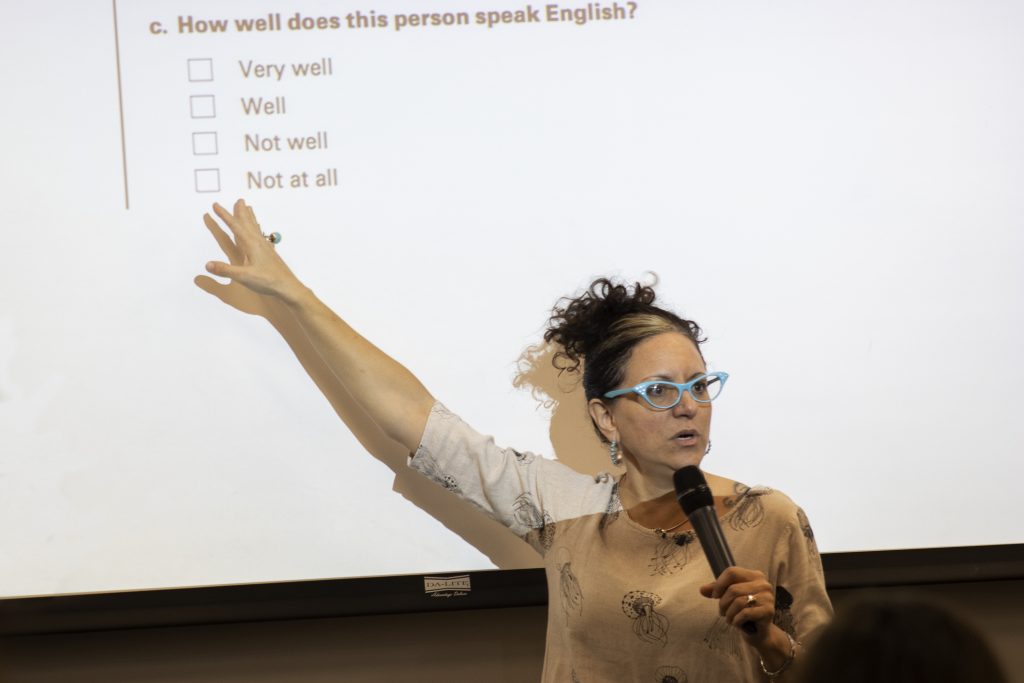
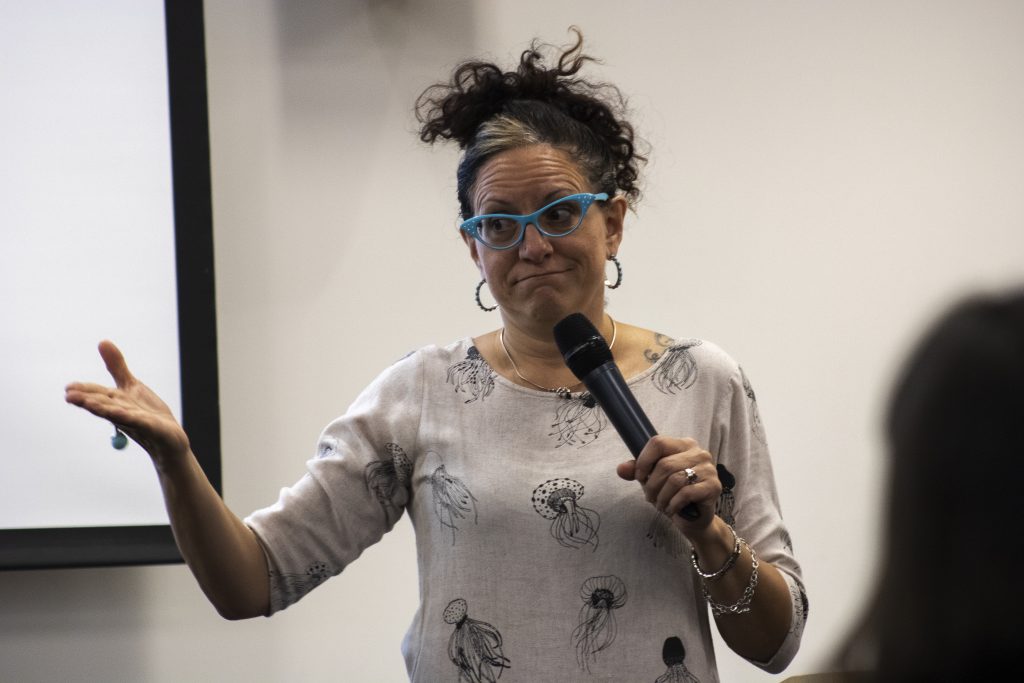
Out and Proud is an event hosted by Western’s Multicultural Student Union, which, “recognizes the challenges that people of color face within the (LGBTQ+) community as well as celebrate their achievements and successes,” according to their executive board. This year, Western invited Mick Rose, an Indigiqueer, non-binary human from the Diné, Omaha, and Pawnee nations to speak about their many intersecting identities.

“Let us never forget our privilege on the land that we occupy and in the institutions in which we study,” Rose began, reminding the audience that the forced relocation of Native people is what allowed Western to grow. 

Initially, Rose stated that they had felt conflicted about speaking because of their complex relationship with their own identity; they hadn’t always identified as a member of the queer community and “at many times felt marginalized by the community.”

For them, their pride was fostered through self-discovery, and reclaiming aspects of their indiginous culture and history that had been severed.

A major turning point in that reclamation came from their grandmother’s affirmations towards their “coming-out,” as it was then that Rose was introduced to their tribe’s five-gender system and realized that they identified as Dilba, a person who identifies with the female spirit, and people their grandmother described as caretakers, peace-makers, counselors and warriors. 

Previously, Rose spent years attending college at BYU, where they assimilated and faked straightness to avoid being kicked out, excommunicated or facing electric-shock therapy. 

“I knew then, it was a dangerous place to be, and I needed to fit in … so I could get out,” Rose said.

During one particular incident, Rose recalled being nearly arrested because they had taken a bite of their pizza as they stood in line to pay for it, and the unjustified consequences that resulted thereafter. 

“This incident left a permanent on my public record. It comes up now when I apply for jobs, it came up when I applied to be a foster parent. Every time I have to justify my conviction … and relive the embarrassment of being a target as a person of color at my university campus,” said Rose.

Rose was inspired to write their senior thesis on Indian Boarding Schools, institutions known for kidnapping native children and forcefully indoctrinating them into Christianity, who operated under the former Bureau of Indian Education whose mantra was “kill the indian, save the man.” Rose’s own family was heavily affected by Indian Boarding Schools.

“This background and my family’s relationship with education is important because there’s layers in that where colonization has severed my ability to connect to my gender and sexuality,” Rose said.

Colonization has removed examples of queer, two-spirit indiginous people from history, and Christianity was responsible for many of their murders and much of their supression. 

Rose acknowledged that the loss of indiginous queer knowledge and heritage is a loss for all queerfolk. 

Now, however, “the consistent work done to discover and of identity in the indiginous community is one that is mirrored by Western society as well. How wonderful that communities and societies are shedding the confines that colonization has held. How beautiful that various tribal nations are able to reclaim and then share our traditional knowledge in these contexts,” Rose said. 

Rose’s embodiment of pride comes at a variety of intersections; it combines the pride of being indiginous, the pride of reclaiming their non-binary, queer identity and the pride of rediscovering the language of identity under the reclamation of their indiginous tradition and culture.

Rose reminded the audience, “you can identify however you feel inside .. and it will change over your lifetime.”

[fruitful_recent_posts_slider posts=”4″ cat=””]

Contact the author howlnews@wou.edu

SONA is a program utilized by the psychology department as they search for research participants.

Sage Kiernan-Sherrow  | News Editor

SONA is a program that allows Western’s psychology students and faculty to both post information about studies, and sign up to participate in them. According to Western professor, Jaime Cloud, prior to SONA, the psychology department used pink slips to give students extra credit or track the credits required for specific classes.

“It’s a much more progressive, elegant solution,” said Cloud. 

Unfortunately, because the program is expensive, only psychology students are given SONA accounts.

“Students and faculty would love to recruit participants from outside the psychology department, but logistically it’s just not easy to set that up,” Cloud stated. 

However, that means that the pool for collecting data is significantly reduced; students conducting research become desperate for participants and those who sign up but don’t show up face certain consequences — like being kicked out of the SONA system for the remainder of the term if they exceed three no-shows. 

Cloud stressed the importance of having students support one another on campus, especially regarding research.

“Basically, the scientific method is the engine of research in psychology … and you have to put (an idea) to the empirical test and collect data …  that very essential component cannot happen if we don’t have students volunteer their time to participate in studies,” she said. 

There are dozens of research projects to choose from — some even offering incentives like pizza or candy. 

One such project is Dr. Foster’s current study which is in collaboration with several undergraduate research students and focuses on creativity, specifically “factors that affect creative behavior … and how to elicit creative behavior in a laboratory situation,” according to the SONA site. 

“A lot of the studies on SONA end up being kind of predictable and survey-based, but some of them are really interactive,” said Cloud. 

The information gained from SONA research is shared both within Western’s community and in scientific communities around the world. 

As Cloud stated, “the time and effort that participants spend contributing to the scientific process is contributing to the amount of information that is shared worldwide.”


Contact the author howlnews@wou.edu

Courtesy of Dr. Cloud

Coffee Talks connects students to local businesses, helps develop career-readiness skills and opens pathways to success

Sage Kiernan-Sherrow  | News Editor 

Coffee Talks are an ongoing program hosted by the Service Learning and Career Development Center located in the Werner University Center. They are small, comfortable events that connect students with local businesses in the hopes that students will be able to gain more information about a potential career path. Brooke Kline, a Peer Career Advisor under SLCD, said they were created, “with the idea in mind that we wanted students to have a more casual meeting with potential employers,” as opposed to formal recruitment events such as career fairs. 

According to Kline, for students with a genuine interest in the organizations, it’s best to go in with some questions prepared — such as if they are looking to employ people with specific majors — but anyone is welcome and the recruiters are always very passionate talking about what they do.

“We get feedback from quite a few employers saying ‘I’ve met with a lot of great students today who were very interested in our program’ and later on we hear that they actually have a job there,” Kline said of the program’s success rate.

Typically, Coffee Talks occur approximately eight times per term, always falling on Tuesdays between 2-4 p.m. in the WUC near the Wolf Grill and they invite a wide range of organizations to participate. Last Tuesday, Jan. 28, Mustardseed Preschool was invited and the next upcoming organization is the Chintimini Wildlife Center, which will be engaging with students next Tuesday, Feb. 11. If an organization is hiring, their job postings will appear on Handshake, and Coffee Talks sometimes offer resume or application-building workshops as well. Students interested in finding future Coffee Talks can find the full schedule on Handshake, located in the Portal, or refer to Western’s event calendar. 


Contact the author howlnews@wou.edu

Photo by Kay Bruley

While cases of the Coronavirus dot the map, Oregon is not yet affected and does not anticipate it crossing the borders.

Sage Kiernan-Sherrow  | News Editor

Coronavirus is a multi-strand respiratory illness that, while newer, has been well-documented. A new strand, 2019-nCoV, caused an outbreak in Wuhan, China and has spread across borders, with 11 confirmed cases appearing in the U.S. — the case closest to Western being in Everett, Washington. An article published by The New York Times on Feb. 3 states that the current amount of deaths from the virus within China equate to 361, exceeding that of the SARS outbreak in 2002 and 2003. 

Jennifer King, the Medical Services Director and a Family Practitioner at Western, shared that the virus is highly contagious and spreads through close contact, but also said “the risk is very low for Oregon. We don’t have any cases or contacts from Wuhan, so it’s a very low risk for the university.”

Coronavirus’ symptoms are identical to the flu when they first begin — high fever, cough, difficulty breathing — which become more severe later on. In that regard, the Student Health and Counseling Center wants students to come in or call their health provider if any flu-like symptoms occur. 

“A lot of it is preventable,” said King, who suggested washing hands, covering coughs, staying hydrated, managing stress and not travelling to China currently as basic prevention techniques. 

At the SHCC, Western’s medical professionals will treat flu-like symptoms as they usually would, with the caveat that if they did suspect someone of having the Coronavirus, they would use standard personal protection equipment before contacting the Polk County Health Department.

“We would take direction from them as far as testing goes because we don’t have the test. We would pretty much hand that over immediately to public health and follow CDC recommendations,” said King.

On Coronavirus, King said, “every single day it’s changing as we learn more about it,” but advises against any fear on campus. King said that such an occurrence is extremely unlikely and reminded everyone that comparative to the Coronavirus, 8,000 deaths occured in the U.S last year from the basic flu alone. 


Contact the author howlnews@wou.edu

Photo by Kay Bruley

Salem issues a city-wide camping ban resulting in homeless from surrounding areas congregating on the streets of downtown.

Sage Kiernan-Sherrow  | News Editor

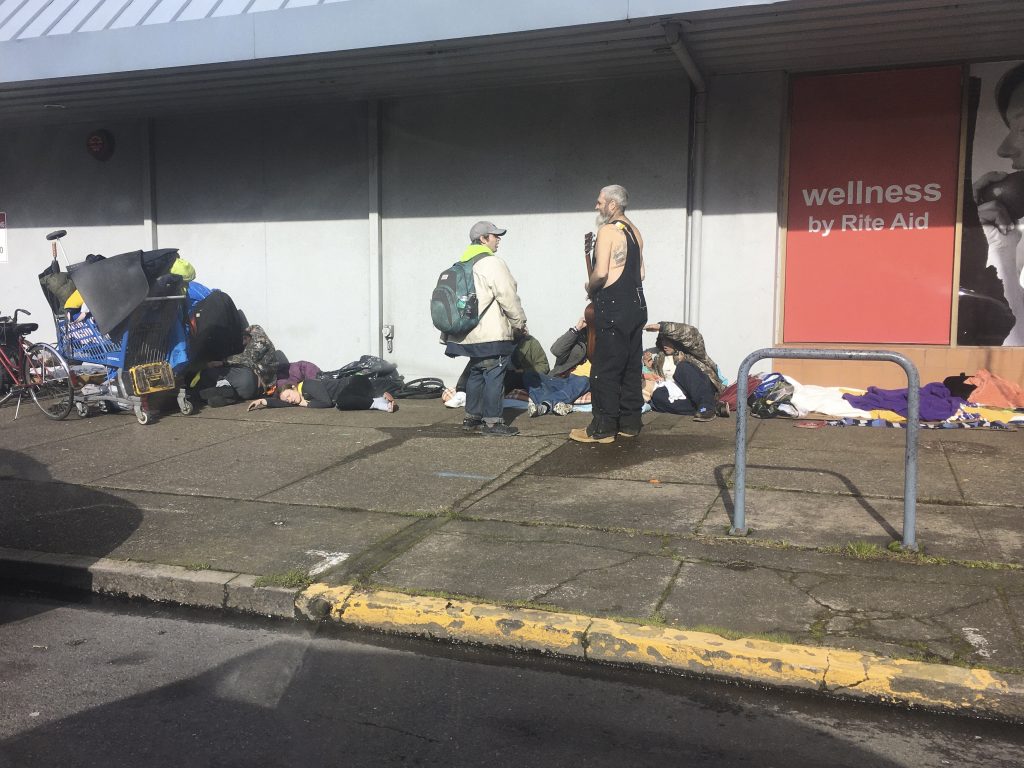
As students drive into Salem as part of their daily route or for a day perusing the shops of downtown, they’re met by sidewalks lined with sleeping bags and valuables belonging to the Salem homeless community. 

The homelessness situation in Salem is a complicated one and the dates for each individual instance that escalated the current issue are difficult to place. In early May of 2019, the homeless community members residing in Wallace Marine Park were given an ultimatum to vacate the premises following dangerous floods that caused rescue efforts to become necessary for several homeless folks. Prior to that decision, the homeless were also told to vacate Salem’s Marion Square Park underneath the bridge that leads into historic downtown Salem where nearby, the city’s new $61.8 million police station — with a $3.3 million boost from the Salem City Council, according to the Statesman Journal — is currently being built.

Recently, Salem issued a complete citywide camping ban, and groups were forced to stop setting up camp outside places like ARCHES, a service provider whose goal is to “promote housing and self-sufficiency by navigating clients from homelessness to stable housing and then to self-sufficiency,” according to their website. 

Homeless folks from those areas had little choice but to congregate inwards towards the city center, first lining the walls of Rite Aid and later expanding into the mall vicinities where, now, every morning, the homeless of downtown Salem are asked to move in order for ServiceMaster Clean crews to purge the streets of human waste. Anthony Stevens, a member of the Salem homeless community, said that they were being treated better on the sidewalks compared to the sweeps through the parks which resulted in volunteers cutting up tents and tossing out people’s keepsakes.

“I’ve had friends lose their mother’s ashes and important documents,” Stevens stated. 

Stevens has a mental disability which prevents him from finding work and he said that he suspects that is the case for many of the other homeless in Salem.

A regular of City Council meetings and a spokesperson for the homeless community, Stevens said that the city is currently considering declaring a state of emergency and bringing in FEMA to address the current situation. Stevens relayed that the homeless community felt torn about this possibility, with some members feeling victimized and others hoping that it would bring them much-needed support. Regardless, Stevens said “if the camping ban lifted, these streets would be empty … normally, we’re out of the public eye,” and concluded by stating, “we’re regular citizens, we just don’t have homes.”


Contact the author at howlnews@wou.edu 

Photo by Sage Kiernan-Sherrow

Family Weekend invites students’ families to campus for a three-day weekend packed full of memory-making activities.

Sage Kiernan-Sherrow  | News Editor

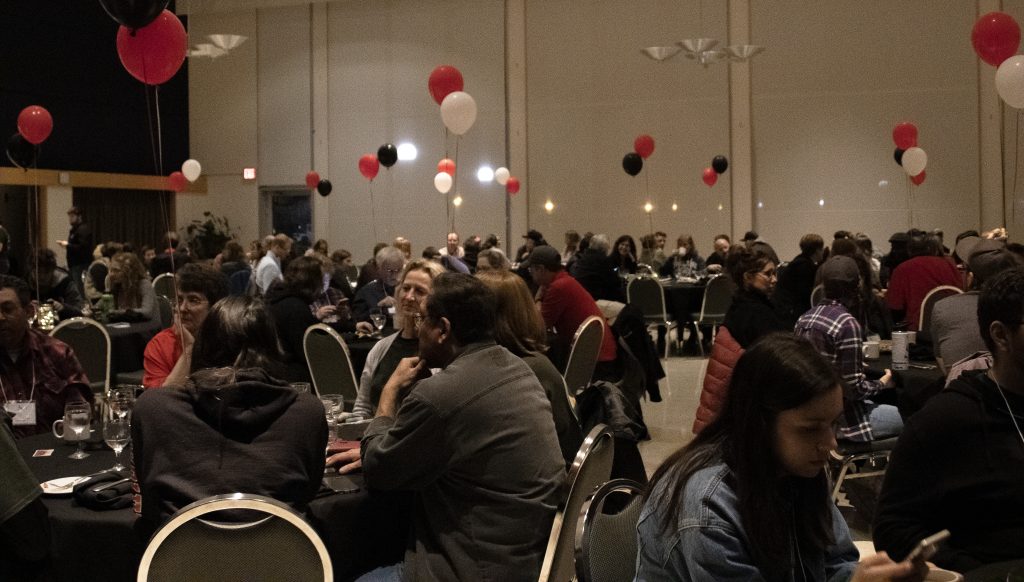
Becoming an annual tradition, Family Weekend brings relatives and chosen family of Western students to campus for a three-day bonding experience and the chance to learn what Western has to offer. This year’s Family Weekend took place Jan. 24-26 and was packed full of activities and entertainment. 


Day 1

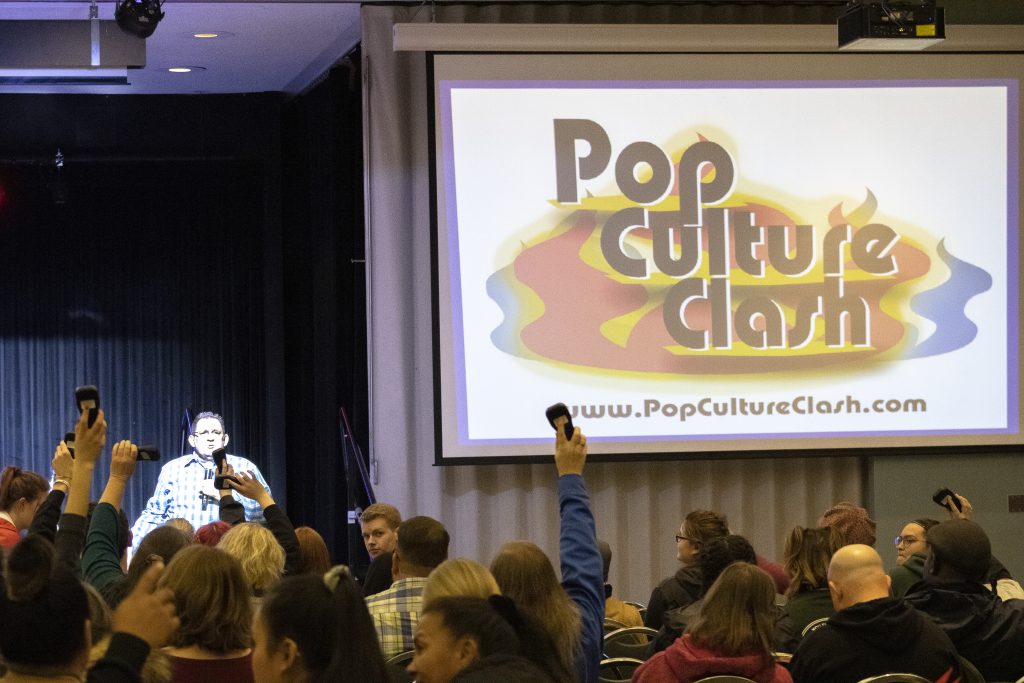
Following a warm welcome issued by President Rex Fuller, students and their families headed over to the Werner University Center to engage in some pop-culture trivia spanning generations. Those uninterested in that escapade had the chance to play a giant game of Hide ‘N Seek in the Hamersly Library.


Day 2

The WUC had a myriad of activities set up on Jan. 25, including a photo booth, crafting DIY Wolfie ears, the opportunity to get caricatured, bracelet-making and origami. While waiting in line for the caricature artist, the Mahoney family said they had enjoyed going to The Donut Bar near campus and that they were “looking forward to the show tonight,” regarding Western hosting comedian Jonathan Burns. 

Over in the Willamette Room making bracelets, LeAnne, the mother of Western student Hailey Struble, said that she was reassured “seeing the way that (her) daughter is thriving and that she’s made a home.”

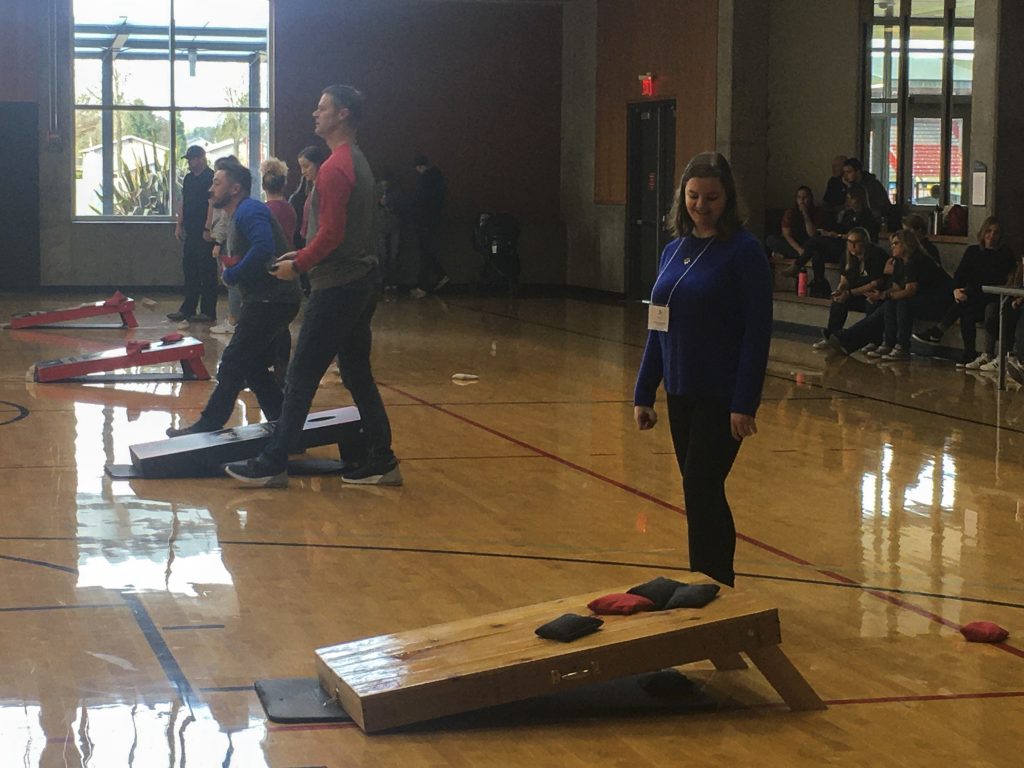
The WUC wasn’t the only place holding events on campus; over at the Student Health and Wellness Center, first-year Nate Henninger’s mother, Tracie Henninger, and the rest of their family waited for their turn during the Cornhole Tournament. Tracie said that the transition of Nate going to college wasn’t too hard, as they live only an hour away. 


Day 3

Sunday was all sunshine and goodbyes following the Brunch Send-off catered by Valsetz and the conclusion of on-campus activities like the scavenger hunt and the look-alike contest. Even though students prepared for the upcoming school day and parents went back to their jobs, the possibility of future bonding events like Family Weekend was a reassurance as they departed.


Contact the author at howlnews@wou.edu

Photos by Kay Bruley

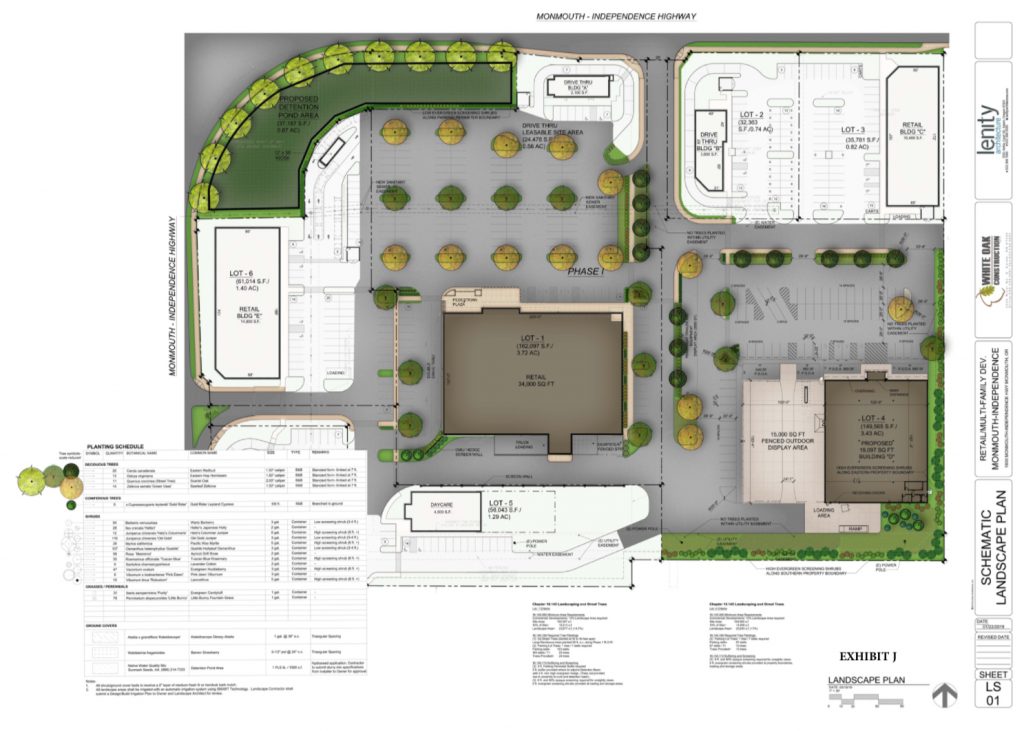
A plan long in the works, development has recently begun on Monmouth’s “S-curves.”

Sage Kiernan-Sherrow  | News Editor

As one drives down Main Street towards Independence, there is a large chunk of land currently being developed to the right of the road. Many locals know this area as the “S-curves,” but Monmouth City Council building official, Larry Thornton, says the area will be known as the Ash Creek Station when it is fully developed.  

Salem resident, Jack Fox, purchased the land in 1999, which will be transformed into a small shopping center complete with nine buildings plus a medical facility. Thus far, three businesses have been confirmed as tenants: a larger and improved Roth’s grocery store, a Papa Murphy’s and a Tractor Supply Co. 

“This has been an ongoing process for quite some time,” Thornton stated, “Mr. Fox has been trying to develop the land for a lot of years. There was a Wetlands issue on the property and until those issues were mitigated, everything was basically put on hold.”

Fox originally applied for permits back in 2018, according to Thornton, and since they’ve received approval from the Corps of Army Engineers, they are now in the second stage of building — a technical process of “framing,” a process where concrete blocks are arranged to act as the buildings frame.

“Roth’s is further along. They’ve got all their walls up and they’re putting on the roof system … once the building is watertight, they can start working on a lot of the other issues like putting the concrete floor down and the wiring and plumbing,” said Thornton.

The prospect of a new grocery store is something Thornton thinks the community will be excited about as Monmouth hasn’t had their own grocery store for the past 15 years.

“There’s a need for these kinds of businesses in Monmouth … I think the general public is totally behind it and probably thinking it’s been a long time coming and we’re glad it’s here,” he said.

The project is expected to be finished sometime in April, according to Thornton, who also warns there might be delays due to the winter weather. 


Contact the author at howlnews@wou.edu

Photo courtesy of Monmouth Community Development Director, Suzanne Dufner

Students and faculty collaborate to create a mural commemorating the anniversary of the 19th amendment to be displayed in Hamersly Library.

Sage Kiernan-Sherrow  | News Editor

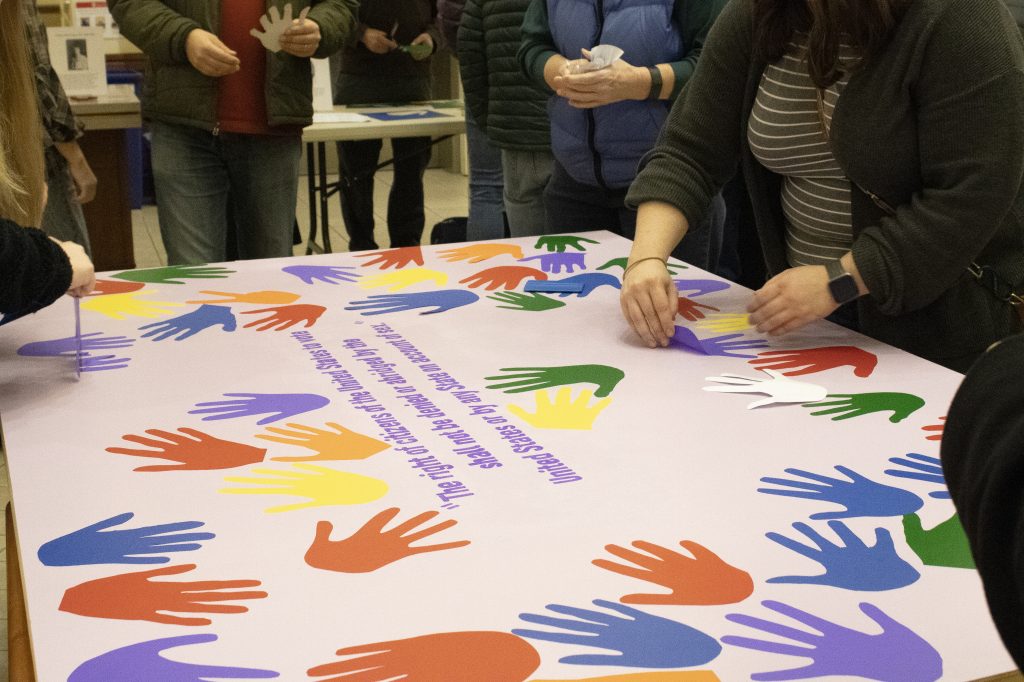
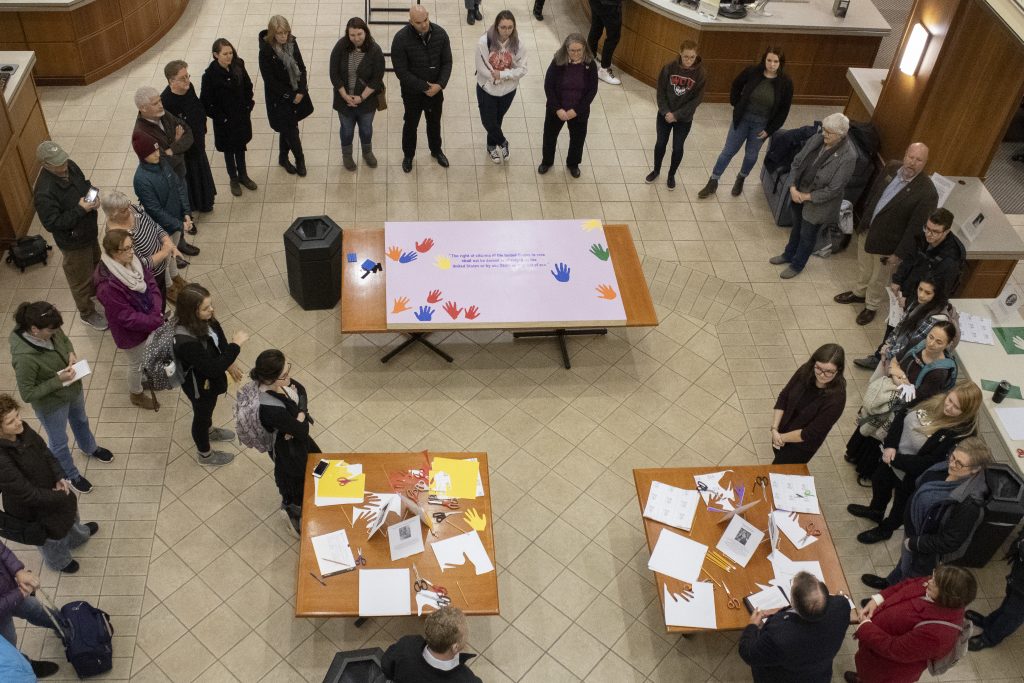
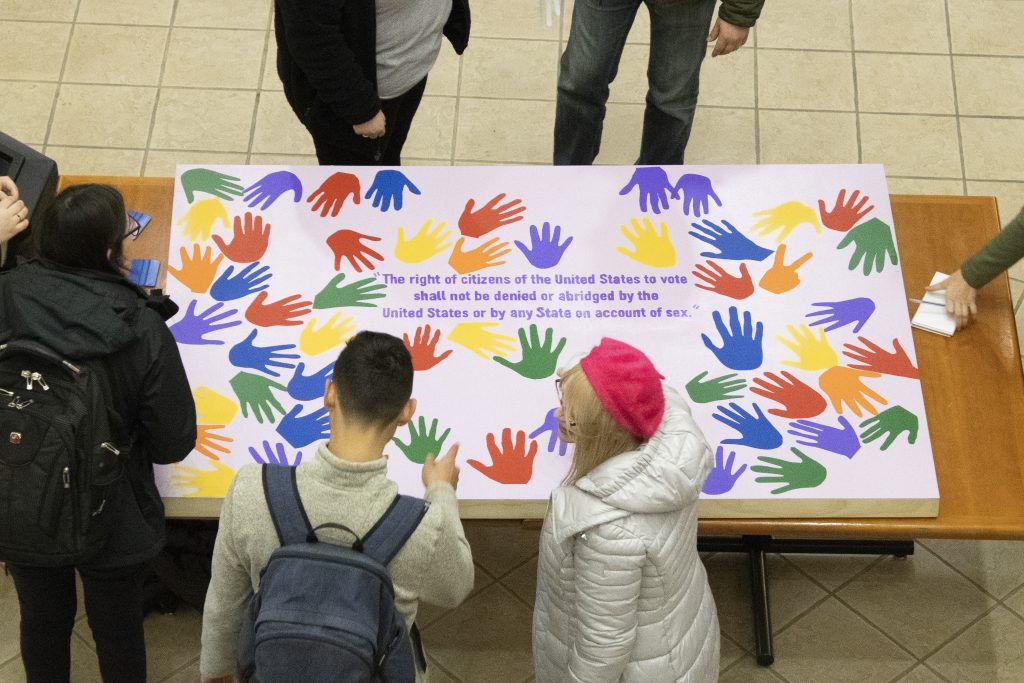
In the foyer of Hamersly Library, students and faculty met on Jan. 14 to celebrate the 100th anniversary of the ratification of the 19th Amendment. To commemorate the occasion, attendees were invited to add a rainbow cutout of their hand to a mural upon which the amendment was printed, symbolizing the diversity of individuals who fought for women’s suffrage and are still supporting women’s rights today. 

Throughout the room, the biographies of a multitude of important activists and allies were displayed, providing various historical perspectives. Among them were Western alumna Teresa Alonso Leon, the first immigrant Latina to represent Woodburn in Congress, and Kathryn Harrison, the first female chair of the Grande Ronde tribal council.

Professor Kimberly Jenson, who teaches a gender issues class at Western, helped organize the event and was one of three speakers including Mayor Cecelia Koontz — the first elected female mayor in Monmouth — and President Rex Fuller. The three of them spoke of Oregon’s historical ties to both current and historical feminist movements. 

Mayor Koontz shared her pride in being an Oregonian, stating that the state motto “she flies with her own wings” has been an inspiration for her. Additionally, she praised Western’s history saying that “it’s fitting to be here … because oral history has it that the pioneer women of the Monmouth migration of the 1850s only agreed to make the dangerous trek West if a school were founded when they got here … a place of learning for both men and women.” 

President Fuller added the historical knowledge that Oregon was among only one of 15 states to grant women the right to vote in 1912 before the ratification of the 19th amendment. 

Jenson continued by reminding everyone that “from the very beginning of our state’s suffragette activism, women of color have been there.” She concluded by stating that “we are strong because we have a state that has this history but it would be a mistake for us to overlook the many struggles that have continued, the very vital work that women leaders and men leaders and people leaders have done.”


Contact the author at howlnews@wou.edu

Photos by Kay Bruley

Western makes history as the first base for a national ASL assessment service in the West.

Sage Kiernan-Sherrow  | News Editor

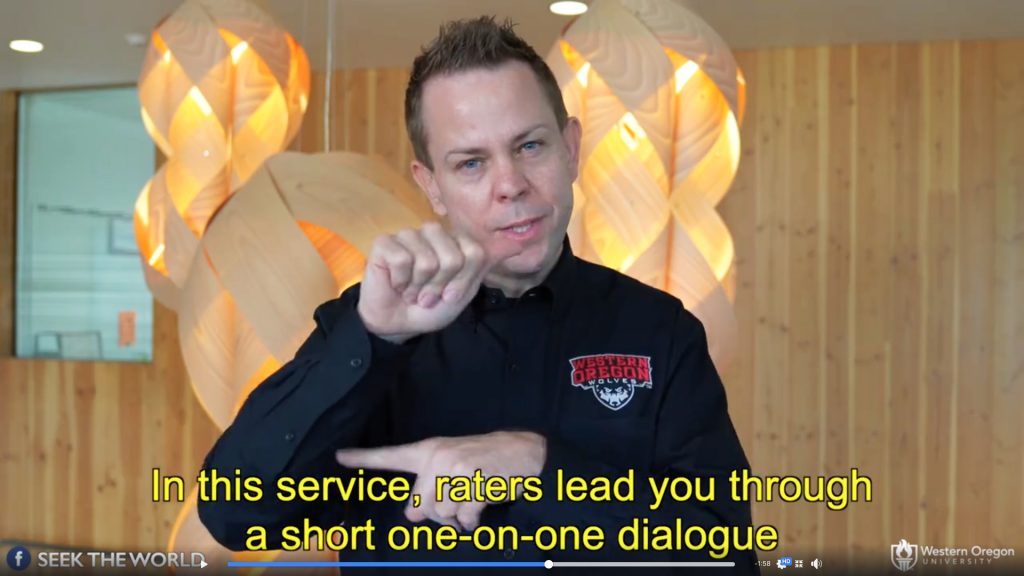
Western has become the first establishment to offer a nationwide American Sign Language assessment service in the western United States after the Regional Resource Center on Deafness Director, Chad Ludwig, decided to restore an updated model of an old program. Officially titled the Signed Language Proficiency Interview, it “assesses a person’s skills in using a natural sign language for communication (function) and provides an analysis of a person’s sign language vocabulary, production, fluency, grammar, and comprehension skills (form),” according to the RRCD website.

A national organization in North Carolina that runs a similar assessment has become overwhelmed with the increasing demand for services. 

“That’s where we come into the picture,” said Ludwig. 

Discounted for Western students, the $160 basic assessment is essentially a 20-minute interview formatted as a casual conversation addressing three main topic areas: work or school, family and leisure activities or hobbies.

“It’s how you express yourself in ASL that helps our raters determine the level of fluency … our interviewer’s goal is to illicit the most fluency that they can from you,” stated Ludwig. 

After the interview concludes, the data is sent to two separate evaluators who then score the results before sending it back to the ASL coordinator. If there is a match, then the score becomes official; if not, then the evaluators either deliberate or it goes to a third evaluator. 

The assessment might appeal to a variety of individuals from state employees — who can gain differentials for proven competency in another language — to high school and college students interested in taking the assessment to test into a higher class.

Following the implementation of the program on Jan. 7, there have already been a myriad of questions, inquiries and requests, according to Ludwig, who also encourages students to visit the website or email rsla@wou.edu for more details. 


Contact the author at howlnews@wou.edu

Photos courtesy of the Division of Deaf Studies and Professional Studies at Western

PURE Insights, Western’s academic journal, connects students to faculty for collaborative research and publication opportunities.

Sage Kiernan-Sherrow  | News Editor

Originally founded by Camila Gabladon, the collection development librarian at Western, PURE Insights is an annual publication of student work, both creative and research-based, which has been sponsored by at least one faculty member at Western. Currently on its ninth issue, the journal — which stands for Program for Undergraduate Research Experiences — serves to connect students to mentoring faculty members with the hopes of bolstering the student’s academic record.

“One of the really nice things about attending a small college is that you are in contact with actual professors doing actual research … the PURE organization was born of the idea that we weren’t seeing students take advantage of that,” said Maren Anderson, an adjunct professor at Western and Managing Editor of the publication.

Having a published research paper is an excellent thing to put on resumes and grad school applications because, according to Anderson, it’s proof that students know how to do research and work collaboratively with people. 

“Student-led research is particularly attractive to us,” Anderson stated, but as long as that research or body of work is submitted by the deadline, follows correct formatting and is sponsored by a faculty member, the work is eligible. 

“I really enjoy the cross-pollination of student work on campus,” said Anderson, mentioning The Northwest Passage and the Academic Excellence Showcase as similar outlets who have published work also featured in the PURE Insights journal. 

The current issue included the winners of the Peter Sears poetry contest, as well as a couple of fiction pieces in addition to the traditional research papers, and the cover is always designed by a Western student.

Students interested in submitting can visit the PURE Insights webpage and click on the “submit article” link located on the left hand bar. If they’re not sure where to start, they can peruse the list of mentors and their past research topics in order to find someone who fits their objective. They also have the opportunity to explore the map at the bottom of the page, which shows the downloads of past submitter’s work in real-time. If students are still having trouble navigating the page or want more information, they can email the director at pure@wou.edu or the managing editor at insight@wou.edu

The next issue is set to publish in week 10 of the upcoming fall term and the deadline for submissions is June 22.


Contact the author at howlnews@wou.edu

Photo courtesy of Western’s Digital Commons

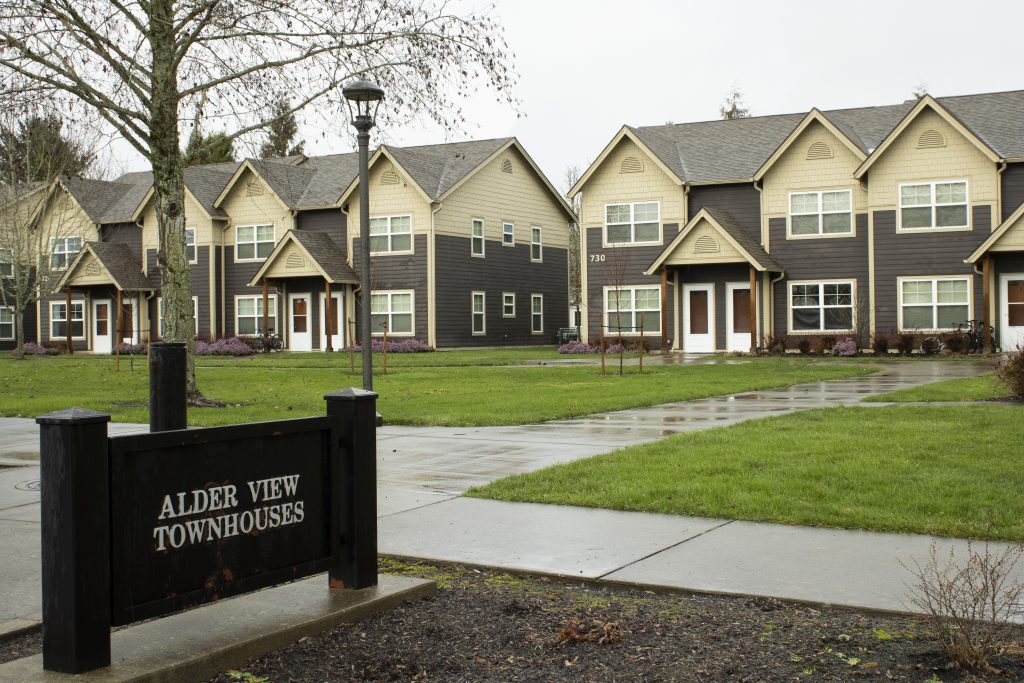
Grease fire in the Alderview Apartments on campus draws a crowd but is quickly dealt with.

Sage Kiernan-Sherrow  | News Editor

Dean of Students and Director of Housing, Tina Fuchs, sent out an email relaying her gratitude towards our campus community last Thursday, Jan. 7, after a fire occurred in one of Western’s Alderview apartments.

Public Safety Officer Anthony Fitch was just getting back from handling a vehicle accident that had occured in Lot H when he was called to respond to a fire alarm in the Alderview apartments. “We get a lot of fire alarms,” Fitch said, “so my thought was ‘is this a fire or not’?” 

But after being waved down by a neighbor, he realized the situation was more serious. Running through the house to confirm that no one was still inside, he noticed that there was a pot of grease on the stove and that the stove had been charred.

“Before entering, I radioed our dispatcher so that she could call the Polk County Fire Department,” Fitch stated, adding that dispatch was a crucial part in aiding the investigation.

When the fire department came, onlookers began gathering, but as Fitch said, “we didn’t have to scoot anyone back … I think the rain deterred a lot of students from straying outside.”

The fire department turned off the sprinklers which were instrumental in the outcome of the incident. 

“We’re lucky we had the sprinkler system, because if not, there’s not telling how big (the fire) would have gotten and I don’t know how much I would have been able to do with my small fire extinguisher,” admitted Fitch. 

And, although he initially had a difficult time finding out who lived there, a lady and her son later came forward, who “have a place to stay and will be relocated to another unit soon,” said Fuchs in her email.


Contact the author at howlnews@wou.edu

Photo courtesy of Kay Bruley

Speaker Kim Potowski came to Western to celebrate bilingualism and educate about ways to increase it

Sage Kiernan-Sherrow  | News Editor

Professor Kim Potowski of the University of Illinois began by stating the facts: that out of roughly 7.7 billion people in the world, an estimated 60% of them are bilingual as opposed to the United States’ 20%. Potowski’s research aims to promote positivity towards bilingualism with the hopes of dispelling language myths and increasing bilingual education. 

“It’s normal to be bilingual,” Potowski asserted during her presentation “No Child Left Monolingual” — also featured as a TedxTalk — given at Western on Jan. 9 in the Werner University Center. 

So why is the U.S. falling behind? 

“Our nation has policies whether implicit or explicit that aim to erase (children’s) Spanish, Chinese, Korean … whatever it is that they speak at home,” Potowski stated. A child who is a heritage speaker enters kindergarten and is typically placed into one of two programs: they are either given ESL support, which removes the child from the rest of the class and, as explained by Potowski, ostracizes and belittles their language, or they are put into a “bilingual program,” which is essentially a transition program designed on having the student speaking solely English by the third grade.

Potowski is in support of a third option — dual-language schools — in which 50-90% of instruction is in a language other than English. Citing various research studies that support the induction of these programs, Potowski noted that the dual-language programs ensure that students who speak a language other than English don’t fall behind their English monolingual peers, that the cognitive benefits of the programs are numerous and that, most importantly, dual-language programs are respectful of language and identity. 

The evidence shows that students enrolled in a dual-language school did better in all content areas — including English — as compared to students enrolled in a normal public school. 

“So what I conclude is that if you don’t want to do this, you’ve got some kind of political agenda going on,” said Potowski. However, she also acknowledged the fears created by linguistic bullying and systematic racism which prevents parents from supporting their children’s bilingualism.

“These parents have suffered for their lack of English, the last thing they want is for their children to suffer for a lack of English,” said Potowski.

However well-intended, Potwoski wants parents to know that their fears, while understandable, are somewhat misplaced. Myths that one language will hinder the development of another or create confusion for the child have since been debunked.

 “Codeswitching,” as the phenomenon is called, “is normal, follows linguistic patterns, indicates strength in both languages, and is a marker of a bilingual identity,” stated Potowski. 

The real issue, then, is the previously mentioned systematic racism and linguistic bullying, which “happens way more often than just the stories that make it to the news … and contributes to this culture of linguistic repression and fear,” Potowski asserted. While the U.S. has no official national language, states have the power to pass English-only laws, and, while Oregon has not, 31 other states have. All of these factors combined “contribute to intergenerational language shifts,” said Potowski. “What you’re getting is parents who can’t talk to their own children … and it doesn’t have to be this way.” 


Contact the author at howlnews@wou.edu

Photos by Kay Bruley

The Pacific Island experience

Caitlyn Nakatsukasa | Staff Writer

Western’s Hawaii Pacific Island Harmony Club’s 12th annual lu’au took place on Saturday, April 12.

The lu’au was hosted by the WOU Hawaii Pacific Island Harmony Club and Pasefika, a group from Salem, Oregon that introduces the spirit of island dances to others. It was held on campus in the New PE building where both dinner and performances were provided.
The evening began with brief music from singers and traditional Hawaiian food: rice, kalua pig with cabbage, macaroni salad, pineapple and coconut cake.
Dancers then came together and performed the Oli Aloha chant, which welcomed the guests to the lu’au. Hawaii Pacific Island Harmony Club President and sophomore Hannah Perreira explained that the song is dedicated to the Polynesian people and brings them together as one. The chant was followed by the Hula Kahiko performance, which embodies the true Hawaiian culture using traditional percussion instruments, such as the ipu keke.

Throughout the show, many dances were performed that express and highlight various cultures.

“Not many people in Oregon know much about the Polynesian culture,” said junior Kameron Acebo, hula dancer and Hawaii Pacific Island Harmony Club member. Acebo is a third-year dancer and performs outside of school. “I think the best way to share (the culture) is to celebrate it and throw this huge lu’au.”
The dances at the lu’au ranged from gentle and flowing hula moves to fast and lively dances.
Perreira explained what each song meant and how it’s relative to the Pacific Islands.
Dancers performed the song Aloha Oe, which was written by Queen Liliuokalani to express her love and farewells to the islands. The song, Perreira described, is related to the illegal overthrow of the Hawaiian kingdom in 1883, and its statehood shortly after.
Pasefika performed the ‘haka’ to the audience, a traditional war cry and dance in the Maori culture that consists of violent chanting and foot stomping. The group also demonstrated the ‘Fa’ataupati,’ a Samoan dance that represented the invasion of mosquitoes in the kingdom. The dance mimics people slapping mosquitoes off of each other’s bodies. Many of these dances represent the storytelling traditions and passion of the islands.

Aside from the performances, there was entertainment involved with the guests and dancers. Hula dancers invited children to the stage and taught them how to dance the ‘ote’a,’ a Tahitian dance with rhythmic hip shaking. The hosts had a ‘chee hoo’ contest, a celebratory exclamation used by many Pacific Islanders. The performers invited volunteers to come up on stage and express their loudest and powerful ‘chee hoo.’

“I enjoyed all of the energy and good vibes at the lu’au,” said junior Kui Silva, hula dancer and Hawaii Pacific Island Harmony Club member. This is Silva’s second year participating in the lu’au and had fun spreading the Aloha spirit through her performances, explaining, “I enjoyed dancing with all of my friends beside me and for my family who came up to visit me.”

Acebo enjoyed performing with individuals that became close friends.

“This was important to me because the club has introduced me to so many new people over the years and it’s great being able to meet new people every year through this club,” Acebo explained.

The event concluded with the announcement of the next Hawaii Pacific Island Harmony Club’s new officers for 2018-2019 and the Aloha Hawaii song, an anthem for Native Hawaiian people and residents.

“Mahalo nui loa!” the hosts exclaimed. “Thank you for coming out tonight.”


Contact the author at cnakatsukasa15@wou.edu

Photos by: Paul F. Davis

What happened on campus during break?

Sage Kiernan-Sherrow  | News Editor

Date: 12/14/2019

Time: 9 p.m.

Location: Lot J near the Stadium

Incident: Public Safety discovered a marjuana violation


Date: 12/20/2019

Time: 11:15 p.m.

Location: Lot J near the Stadium

Incident: Public Safety responded to a report of two subjects arguing in the parking lot.


Date: 12/21/2019

Time: 8:40 a.m.

Location: 1777 Taylor Street, Eugene, Oregon

Incident: Public Safety responded to a report of a theft of WOU property off campus in Eugene.


Date: 12/30/2019

Time: 9:19 a.m.

Location: The Administration Building

Incident: Public Safety responded to a medical assist 


Contact the author at howlnews@wou.edu

Four out of five Oregon representatives approved President Trump’s impeachment

Sage Kiernan-Sherrow  | News Editor

Although most of Western’s students probably know by now that the House of Representatives voted to impeach President Trump on Dec. 18 for abuse of power and obstruction of congress, some may be wondering how Oregon’s representatives contributed to that decision, as well as how students may be affected going forward. 

Oregon currently has five representatives in the House: Representatives Suzanne Bonamici, Greg Walden, Earl Blumenauer, Peter DeFazio and Kurt Schrader, respectively. Of those five, four are alligned with the Democratic Party and one is alligned with the Republican Party. During voting, all four Democratic representatives voted for both articles of impeachment, while Republican Representative Walden, voted against. Their votes combined with the remainder of the House, resulted in 230 votes for impeachment regarding the article for abuse of power, 197 against, and four abstaining from voting; for the article referrng to obstruction of congress, 229 members voted for impeachment, 198 voted against, and four abstained. 

While the majority voted for President Trump’s impeachment, the margin was narrow, and now the Senate must hold a trial to convict the president in order to remove him from office. Oregon Senators Ron Wyden and Jeff Merkley are both registered Democrats, but the Senate’s 100 members are still overwhelmingly Republican, and according to The New York Times, at least 20 Republican votes would have to sway in order to gain the two-thirds majority required to officially remove President Trump from office. And while President Trump may have made history as only the third president to be impeached by the House of Representatives, no president has ever been impeached by the Senate — although Nixon stepped down beforehand. 

While President Trump awaits trial, he has continued to be active on Twitter and also authorized an airstrike, killing Iranian Maj. Gen. Qassem Soleimani and igniting fears of war. Students might be particularly worried because of misinformation revolving around the draft and its link to FAFSA. However, FAFSA only provides a way to register for the draft if one hasn’t already done so after they turned 18; the draft is not currently active.

Despite the misunderstanding, it is an indicator that while the country is waiting for the Senate to begin the trial, questions about the impeachment process have sparked people to become more politically aware — particularly young people. Students at Western and across the nation will have a major role to play in the upcoming 2020 election; whether President Trump is removed from office or not, the country is watching.


Updated on Jan. 16, 2020


Contact the author at howlnews@wou.edu

War and Peace

Sage Kiernan-Sherrow  | News Editor

To commemmorate the 75 anniversary of the end of World War II, twenty-six Oregon communities — including Independence — have plans to plant seeds salvaged from the trees that survived the Hiroshima bombing on August 6, 1945. Called “peace trees,” the Ginkgo seeds are a poignant symbol contrasting growing national fears — and the subsequent memes  — of a potential “WWIII,” triggered by President Trump’s authorization of a military strike in Iran on January 3. 

In Independence, the seeds are to be planted in the Inspiration Garden at Mount Fir Park. Run by the Master Gardeners, the Inspiration Gardens boast medinal plants, fruits and vegetables, a rose garden, and a book box for admirers to peruse — all nearby Ash Creek and the creatures therin. Portions of the garden also serve as a research facility for Oregon State University; wanderers can observe the fruits and vegetables grown but are asked not to pick them, as they are used for educational purposes.

The idea to plant a peace tree in the Inspiration Gardens came from the collaborative efforts of the Oregon Department of Forestry, Oregon Community Trees, and the Founder of One Sunny Day Initiative — Hideko Tamura-Snider. A Japanese native, Snider founded OSDI to “educate the public about the consequences of the use of nuclear weapons and plants seeds of peace, hope and reconciliation among people of the world, through educational presentations and cultural exchange programs,” according to their website. 

The hopes presented in OSDI’s statement and the purpose of the trees is a study in irony, as tensions rise following Iran pulling out of the 2015 nuclear trade deal on January 5 — previously abandoned by President Trump in 2018 — stating that they will no longer abide by the restrictions reflected by the deal. 

The Ginkgo tree that the seeds are collected from rests in the Shukkien Garden in Hiroshima, “where many people came asking for water and shade after the Atomic bombing,” according to a youtube video titled “Introduction video Green Legacy Hiroshima.” And, despite recent political occurances, the goals of the volunteers of that project remain the same, as Green Legacy Hiroshima Initiativie Co-founder and Coordinator states, “we want to pass (the tree’s) message to future generations. We hope to deliver this love from all of us to you.”


Contact the author at howlnews@wou.edu

Introducing the new Aquarium Science program

Sage Kiernan-Sherrow  | News Editor

The first of its kind in the state, Western has collaborated with Oregon Coast Community College to design an Aquarium Science program focused on combining foundations in biology and business and applying them in the field. A career-directed degree, Western’s Head of the Biology Department, Michael Baltzley, recognized the need for a program that would offer students real-world experience before entering the field. 

“When I went into biology … I didn’t know where that career was going to take me … you need specific training and volunteer hours for many positions, which provides little income and is impractical. As such, this degree would have been very attractive to me,” Baltzley commented. 

Baltzley partnered with OCCC’s Aquarium Science Coordinator, Larry Bowles, to create the joint program, the foundations of which were already operative at OCCC as both two-year and four-year degrees with certification, both “well-respected programs with advisors all over the country that helped design the programs,” according to Baltzley. 

At Western, the Aquarium Science degree requires students to take their first three years of biology and business courses at Western, before applying to transfer to OCCC for their final year of in-class training in preparation for the workforce. 

“The problem with an Associates degree is that you run into a ceiling when you are trying to get promoted,” Baltzley said; through Western’s Aquarium Science program, “there are more opportunities for advancement.” 

While the program was officially approved by Western’s Board of Trustees on Nov. 20, it has yet to be approved by the Provost Council which is set discuss approval during their meeting on Jan. 6. Upon approval, the final decision will be made by the Higher Education Coordinating Committee sometime in February. The program itself, however, will not appear in the catalog until next fall. Baltzley suggested that students interested in the program should contact biology professors and their advisors to begin modifying their schedules for the Aquarium Science degree in order to get a head-start. He also says that he welcomes student input on the program in the meantime. 


Contact the author at howlnews@wou.edu

City Manager hesitant to call homelessness an issue in Monmouth

Sage Kiernan-Sherrow  | News Editor

An ongoing issue in Monmouth’s neighboring city of Salem, aspects of homelessness are beginning to become apparent here, as well, with several instances of homeless and transient camping observed in the Monmouth-Independence area. 

According to an article published by the Polk County Itemizer-Observer on Dec. 2, language has been changed to the exclusion ordinance in order to discourage both vandalism to city property, as well as homeless camps from setting up. Despite this, the ordinance changes are not explicitly anti-camping, and according to Monmouth’s interim City Manager, Chad Olsen, the city has no plans to design anti-homeless protocols. 

“I’ve seen instances, but I wouldn’t categorize homelessness as an issue in Monmouth,” said Olsen, citing a few occasions where people camped on city property and one where a transient person was travelling through town. 

“Typically, you would see more of an issue in terms of homeless or transient populations in the county seat, because we just don’t have the services here to provide for those groups,” Olsen stated.

Despite Olsen not anticipating homelessness becoming an issue, a warming center has opened in Monmouth, and the council is currently looking at creating a group with a set of bylaws eligible to become part of the Mid-Willamette Valley Homeless Alliance. The group would make a request to Housing and Urban Development — which allocates funds across the state for eligible groups — and is looking to become an independent organization, according to Olsen.

Olsen also assures that homelessness is on the City Council’s radar as a potential issue and that there are currently discussions being had about what strategies to utilize in the future.


Contact the author at howlnews@wou.edu

Western’s 52nd annual Holiday Tree Lighting lit up the night

Sage Kiernan-Sherrow  | News Editor

Despite the rainy atmosphere present on December 6, students gathered together for Western’s 52nd annual holiday tree lighting, lining both sides of Monmouth Avenue with anticipation. Some stood with hands wrapped around the free drinks offered by Student Engagement, huddling with fellow students to escape the cold while waiting for the parade to start. 

Beginning at 6 p.m., the parade was led by Western’s American Sign Language Club, later followed by the sirens of the Monmouth Police Department not to be outdone by Western’s own marching band. During the procession, both the Director and Associate Director of Student Engagement, Patrick Moser and Megan Habermann, respectively, opted to tell holiday-themed jokes before the crowning moment of the parade — Santa’s arrival. 

Afterwards, Western’s president, Rex Fuller, addressed the crowd, calling for students to “treat each other and ourselves with care and compassion” during this season of giving. Then, he invited everyone to participate in the countdown whereupon, finally, the famous giant sequoia that sits next to Todd Hall — which, prior to the event, had been strung up with lights — was lit, indicating that the parade celebrations were over, but the holiday season was only beginning. 

Students looking for further celebrations congregated at the Gentle House for snacks and wine, while others headed into the Werner University Center to meet with Santa and get into the holiday spirit. 


Contact the author at howlnews@wou.edu

Through student demand, new support groups have developed

Sage Kiernan-Sherrow  | News Editor

Though many are still in the process of being formulated, students seeking community on campus now have the ability to participate in one of Western’s various new support groups. The support groups were created based on student initiative and are run by fellow students with a faculty supervisor — usually a professional from the Student Health and Counseling Center. The following are just a few examples of what is currently being offered.


The Building Resilience in College Workshop Series:


This 10-week workshop series beginning in winter term is open to all students and does not require consistent attendance. It focuses on building life skills while balancing all of the responsibilities required as a college student. Each week focuses around a specific topic ranging from how to be a critical thinker to maintaining healthy friendships and relationships. In addition to this workshop, there will be a separate four-week course on healthy relationships during winter term, run by Megan Miller, a mental health counselor at Western who hopes to “increase student’s communication in relationships and allow a deeper understanding of what they wish to gain in a relationship … through personal reflection, discussion and group activities.” Dates and times for both events are to be determined.


The Men of Color Support Group:


Run by Miguel Gonzales, a mental health counselor at the SHCC, the Men of Color Support Group was created with the intention to “discuss cultural barriers, successes, discrimation, empowerment, acculturation, and … other topics that group members are interested in discussing,” said Gonzales. It is designed for men of color to receive peer support while being able to discuss both personal experiences and overarching issues. The winter term meeting time is to be determined, so students interested in joining can look for a future email from Gonzales.


The Autism Spectrum Disorder (ASD) Support Group:


Focusing on “psychoeducation surrounding autism, shared and common experiences people with autism face as well as skill building and coping skills to manage thoughts, emotions, and behaviors,” as reported by mental health counselor, Katie Endersby, the ASD Support Group is open to all — no diagnosis required. Any student interested in learning about the autism spectrum can join, but meeting times are currently to be determined. 


It is particularly important to note that groups may not run all year. To find groups operating during the current term, visit the Student Health and Counseling webpage. Additionally, some groups require an intake appointment with a counselor through the Student Health and Counseling Center before approval. However, there are many groups that do not have this prerequisite and any student with an idea for creating a group can reach out to the Student Health and Counseling center by calling 503-838-8313.


Contact the author at howlnews@wou.edu