


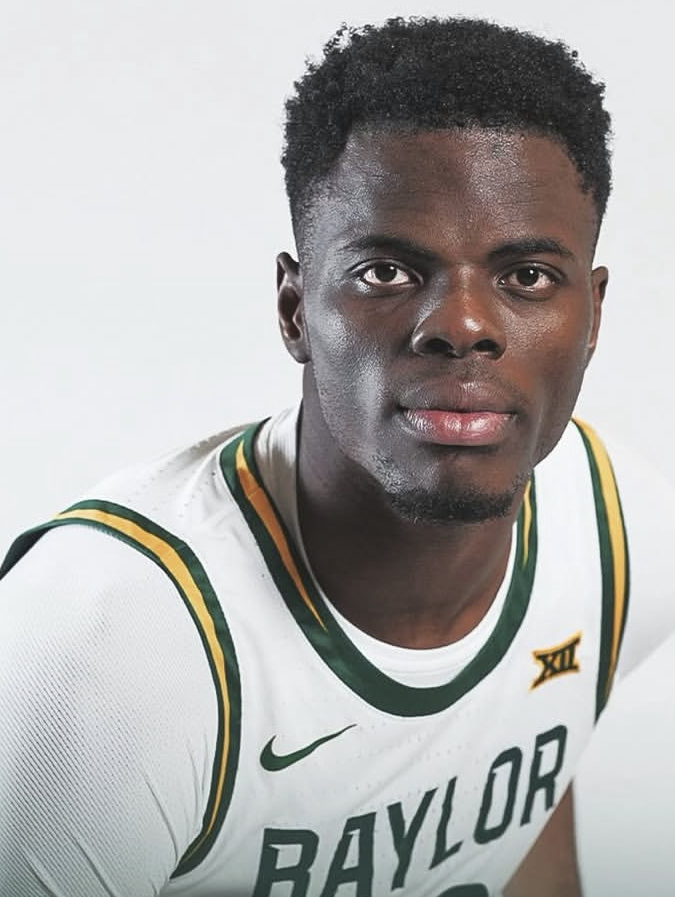
Jan. 21 2026 | Isaac Garcia | Sports Editor
The intense shift in college sports over the past few years has been well documented and discussed ad nauseam. College athletes can now earn money through contracts and brand deals after being strictly prohibited from doing so for essentially the entire history of college sports. In addition, transfer restrictions have been loosened, allowing athletes, for the most part, to become immediately eligible after transferring schools, while the old rule had required them to sit out for a season unless they were a graduate transfer or received some sort of waiver from the NCAA.
For some, the changes are ruining college sports. For others, the changes are welcome and make the system more fair for athletes. Every few months, it seems a new controversy pertaining to these name, image and likeness rules becomes a topic of debate in the sports industry. The newest of these controversies is the eligibility of Baylor center James Nnaji.
Nnaji, age 21, was drafted 31st overall to the Detroit Pistons in 2023 after playing professionally for FC Barcelona’s basketball team and then promptly traded to the Charlotte Hornets. A year later, he was traded to the Knicks as part of a larger deal that included All-Star center Karl Anthony-Towns. Nnaji never played official NBA minutes, playing only in the Summer League in 2023 and 2025. Nnaji was also a “draft and stash” player, meaning that while he was drafted to the NBA, he would hold off on signing a contract and continue playing overseas until he and the team that held his draft rights — essentially the right to be the only NBA team negotiating with him — worked out a deal. The practice has been common with international players over the years, with players like Manu Ginobili, Arvydas Sabonis and current Denver Nuggets star Nikola Jokic all taking extra seasons with their pre-draft teams for various reasons before joining their teams in the NBA. Some players are drafted and stashed due to outstanding contractual obligations with their pre-draft teams and/or because their team in the NBA thinks their development as a player is better off with a team in which they’ll be getting more playing time. Some never sign contracts and end up continuing the remainder of their career in another league.
Nnaji continued playing for Barcelona before being placed on loan to Girona and remaining there until March of 2025, when Nnaji and the club mutually agreed to part ways. Shortly thereafter, he would be loaned again, this time to Merkezefendi Belediyesi Denizli, a basketball club based in Turkey. In July, he announced that he and Barcelona had parted ways, making him a free agent. Nnaji, however, was not ready to give up on his dream of playing basketball at a high level and the Baylor Bears needed the help. After Nnaji’s agent learned that Baylor’s center depth was running thin due to injuries, he proposed the option of Nnaji joining the program to both Nnaji and the Baylor coaching staff. On Christmas Eve, his signing with the team and immediate eligibility were announced, drawing the ire of both coaches and fans. Arkansas coach John Calipari called the situation out in a press conference, saying, “Why did they let that kid play? Tell us all, ‘Here’s the reason.’ Then we’ll all go get pros.” Baylor coach Bryce Drew defended the decision to add Nnaji, saying, “When it came out that you could recruit G-League players, I was against it at first. I didn’t want to do it, but we don’t make the rules. If they say you can drive 80, you’re going to drive 80. If you drive 70, you’re going to get passed.”
UCLA women’s basketball coach Cori Close came to the defense of Drew, saying, “The reality is that I don’t blame him for doing that if it’s within the rules and it’s the landscape we’ve been given. We didn’t ask for those.” Close continued, “The reality is it’s such a chaotic mess and the rules change every couple weeks, and there’s no accountability, and what they said was going to be true about revenue share and caps and what third parties were going to be allowed to do and not allowed to do … hasn’t transpired.”
Close’s comments speak to a larger conversation around the NCAA and its ability to enforce rules. It’s important to note that the changes in name, image and likeness rules didn’t come from the NCAA itself but rather from the NCAA essentially having its hand forced by a unanimous Supreme Court ruling that determined rules against student athletes monetizing their name, image and likeness violated antitrust laws. Still undetermined is whether college athletes legally have the same rights as employees of an organization do. There’s also been legal challenges on the NCAA’s rules about their eligibility timeline, and although for the most part those have stood, challenges are still currently going through court cases and could bring significant change. Michigan State head coach Tom Izzo voiced his displeasure with the NCAA as an authority figure, stating, “I’m not real excited about the NCAA or whoever is making these decisions, without talking to us, just letting it go. They’re afraid they’re going to get sued.” Calipari simply said, “Let them sue us.”
Since joining the Bears, Nnaji has appeared in five games, playing an average of 14.2 minutes with 2.0 points, 4.4 rebounds, .4 assists and .4 blocks per game. The Bears have gone 1-4 in those five games and currently sit at 13th in the Big 12, although it is still pretty early in conference play. In his first game on the road against TCU, the crowd booed him. Nnaji believes the frustration is unwarranted, saying, “I didn’t do anything illegal. I didn’t try to break any rule.” Technically, Nnaji is right. He’s still within five years of what his high school graduation would be, which is the window of eligibility the NCAA provides for student athletes, save for a few special cases. He’s never been enrolled in college before and he never signed a real NBA contract.
It’s not that people are upset at James Nnaji; he’s just an athlete doing whatever he can to chase a dream. In general, they’re upset at the NCAA for what they perceive is a now lawless landscape in college athletics that is slowly turning it into a semi-pro development league, whether that be in football, basketball or any other sport.
Contact the author at howlsports@mail.wou.edu