


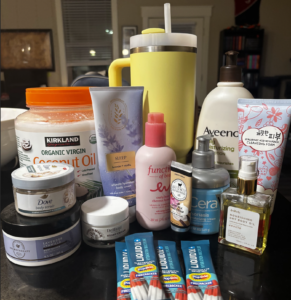
products to manage dry skin. | Photo by Jaylin Emond-Hardin
March 4, 2026 | Jaylin Emond-Hardin | Entertainment Editor
In the winter, dry skin affects approximately 70% of the population. This is due to a plethora of reasons — skin conditions or the low humidity that comes with the season being two of the main ones — and can be cracked, red, flaky and just plain irritating.
As someone with chronically dry skin — having both eczema and psoriasis — it always gets worse in the winter months. When temperatures drop, the air simply cannot hold as much water vapor, which lowers humidity levels and pulls moisture from the skin. For example, air at 77 F can hold nearly three times more moisture than air at 32 F. That sharp decrease in the air’s moisture-holding capacity is one of the main reasons skin feels tighter, drier and more irritated in colder weather.
Of course, when skin dries out like this, solutions become essential — and after 22 years of managing it myself, I’ve learned what truly works. Below are the most effective, winter-tested strategies I rely on to keep dryness under control.
Skin — The epidermis layer of the skin is the most obvious when it comes to dryness. We feel its dryness in the form of cracked, flaky layers. To help repair this layer, it needs moisture put back into it — more than just a shower can give.
Lotion is usually the best when it comes to returning this component, although body oil is another great way to moisturize. I swear by Aveeno lotion for the whole body, although any of Bath and Body Works’ lotions with shea or cocoa butter keep skin both moisturized and smelling absolutely divine. For the face, anything with hyaluronic acid, sunscreen or goat’s milk is ideal, especially when there’s a combination of any of the three. Having protection from ultraviolet rays and the additional moisture helps prevent scaling and flaking.
While in the shower, gentler soaps and body scrubs can remove the dry scales without damaging the layer underneath. Rice-based formulas are the gentlest and are one of the best options, and don’t clog the pores when adding that moisture back into the skin.
The lips are another part that usually becomes especially dry and chapped due to their constant exposure to the cold air. Most traditional chapsticks continuously dry the lips out because of the menthol in them — part of their design to keep consumers using them — and have artificial fragrances and dyes. Because of these factors, I typically prefer to use lip oil or Vaseline. They trap moisture in and guard against the winter elements.
Applying lotion or oil immediately after a shower is one of the best ways to lock moisture into the skin, as well, especially when it comes to replacing oils lost in the shower.
Hair — Just like skin in the winter, hair dries out as well, typically losing shine, volume and strength. When moisture is stripped, hair follicles lose important oils that not only protect it, but also keep it looking healthy. The scalp also dries out, which leads to dry, flaky buildup.
To combat this, I use coconut oil on my scalp and rosemary oil on my actual hair follicles. I’ve found I’ve preferred the brand Venrock’s rosemary oil the best, due to its subtle mint undertones and the fact that it doesn’t drip down my face when I put it in my hair. It’s also specifically formulated for curly hair, which means it helps reduce frizz.
When it comes to coconut oil, organic and food-grade is the best. Typically, cosmetic-grade oil isn’t as refined as food-grade oil and contains other chemicals and scents, which means it isn’t as pure or natural, and can strip the hair further of those much-needed oils. I tend to leave coconut oil in all day when I’m home with nothing to do, and keep my hair tied up in a t-shirt so I don’t get the oil all over my clothes and furniture.
Leave-in conditioner immediately after rinsing regular conditioner is also a great strategy, as it offers long-term hydration and damage protection. I know my hair is always softest when I use leave-in conditioner, and it reduces breakage and split ends that are synonymous with winter-dry hair.
Diet — Diet is one of the biggest factors when it comes to dry skin. Proper hydration can mean the difference between dry and healthy skin and hair and lips; meanwhile, eating water-rich foods can assist the skin’s ability to retain moisture. Cucumbers, watermelon and strawberries are some of the best sources of water that come with essential nutrients like vitamin K, vitamin C and vitamin A.
Drinking plenty of water keeps the skin’s barrier firm and hydrated, which works to prevent scaling and flaking. Electrolytes are important for moving fluids through the body’s cells, so making sure plenty are consumed daily will help with the skin’s ability to retain moisture. Salt helps add electrolytes back into the body, though plain salt water may not be the first choice for many people. In those cases, electrolyte drink mixes such as Liquid I.V. Hydration Multiplier offer a more palatable alternative, combining sodium, glucose and essential vitamins to support hydration in a more flavorful form. The rocket pop flavor is top-tier; with the right amount of ice, it tastes like drinking a melted rocket pop.
Sufferers of dry skin, have heart. Winter will soon be over and humidity will improve, which means dry, scaly and flaky skin will soon be swapped for peeling sunburns. Making sure the moisturizer has sunscreen will help reduce the chances of sunburns, as will keeping the skin hydrated and happy.
Contact the author at howlentertainment@wou.edu