

Mount Hood

An interview with Crystal Ross

Written by: Gretchen Sims | Editor-in-Chief

The first face students see when walking into the Student Health and Counseling Center is often Medical Receptionist, Crystal Ross, always donning an earnest, welcoming smile. Her friendly demeanor fits right in with the center — as if she’s always been there — but what many students don’t realize is that it took a lot to get there.

While Ross is best known for her work at the front desk of Western’s Student Health and Counseling Center, she spent many years working in the field before settling down at Western.

“Well, I met my husband in 1997, and we were both working in the same company in Dallas. The economy was a little unstable and the person who owned the company was selling it and so I told my husband, ‘If we’re both here when this place goes down, or goes under, because I’m pretty sure it’s going to, we’re gonna be in trouble,’” Ross said. 

Ross then made the ultimate decision to go to school for Medical Billing and Coding. She went to a trade school for a year — working graveyard shifts at the company with her husband and going to school during the day. 

After receiving her certification in Medical Billing and Coding, Ross took her internship, or practicum, at West Salem Family Practice. When a receptionist position opened up, she decided to apply.

“It was like a step, a foot in the door, and within three months, they had an opening in their business office so I ended up getting to go into the business office and use that Medical Billing and Coding knowledge that I had. And, so I was there for nine years, and a friend of mine, who was also a coworker, she had come to Western and was working in the Student Health and Counseling Center and she’s like ‘I think you’d really like it here, they have a receptionist position open; you should apply,’” said Ross.

Ross felt that there was nowhere to go in her job at West Salem; she felt like she couldn’t move up and had no room to grow anymore, so she decided to take the opening at Western.

“I guess the rest is history. They told me when I interviewed there would be potential for me to do some Medical Billing — that they were trying to get that started — and I have done some Medical Billing and Coding here. I used to have an office in the back, here, and then when COVID happened, and we lost some of our employees, I went back up front, and I feel like I really just thrive there,” Ross said.

Ross has come to love her home here at Western. 

“My favorite part about (Western) is definitely the students… definitely the students. I love working with the students, I love getting to know them. I try really hard to remember things about students and what they tell me.”

Unlike some larger schools, Western has the unique privilege, in part, due to its size, of fostering strong and consistent communication between departments. 

“…I also really like that I can reach out to someone in other departments and know that they’re going to do their best to help me. Whether it’s helping me personally, or helping me help a student, I just think that Western being as small as it is, we really do well at helping each other help the students,” said Ross. 

Ross loves animals. At home, she has two rabbits, four cats, three dogs, a lizard, a snake, two horses, six ducks and 12 chickens, so, naturally, she feels passionate about the SHCC’s local squirrel. 

“Oh my gosh,” said Ross “I love the squirrel. I love all of the squirrels on campus, I just think they’re such a fun, neat animal and so I’ll see this little guy hop around on the sidewalk in front of our building, you know, of course, in and out of the trash can. I call him Benny… I just thought it was a cute name and… I gave him food one day… ooh I know… I gave him a little peanut. I know, I don’t make a habit of that, because I don’t think they really want you feeding them, but… so yeah, Benny hangs out, I see him every day, running around, in front of the Student Health and Counseling Center — he’s our little mascot,” Ross said. 

Working with students is a passion of Ross’s: she loves every one of them here at Western, but oftentimes, at the front desk of the SHCC, Ross sees them at their lowest. Ross is widely regarded for her optimism and friendly and welcoming personality, and while it’s not always easy, Ross always manages to keep a beaming smile on her face. 

“I had a pretty traumatic childhood myself, and once I got away from the trauma, and I realized the things this person had said about me were not true — it was my ex-stepdad — I just thought, I need to be a cycle breaker, I need to be someone who cares about other people and shows that I care about other people,” Ross said.

Ross attests to the importance of putting her best foot forward when she walks through the doors of the SHCC each morning.

“My goal when someone walks through our doors is for them to have a positive experience because oftentimes they aren’t feeling well. So, if just smiling and being kind can help them feel better, that is my goal. A friendly face can make all the difference,” said Ross. 

“I always tell my kids that, even if I’m having the worst day, none of my students are ever going to know — that I’m having a bad day — because I need to be the person that students can come to and know that they’re going to be taken care of, regardless of how my day is going. I want to be that positive light, I want to show people that I care about them, so I just think that I come to work every day knowing that I am impacting so many people’s lives. That just helps me keep that positive attitude, because I know that everybody has things that they’re going through and sometimes, all you need is one person to be kind to you and that can change your whole entire day — it could change your whole entire mood — and so if I can be the person who is the bright light for that person’s day, then that’s what I want to do,” Ross continued. 

Besides simply being a bright light to the students here at Western, “I also have the privilege of helping these young adults learn how to navigate the healthcare system, which can be overwhelming for anyone. A lot of students are far from home and need guidance. I feel honored to be part of helping them grow and learn. I am a mom, so I think about how I would want my children to be treated,” said Ross.

Ross has several tattoos ranging from her first, which is of her favorite Disney character, Eeyore, to a Gemini astrological sign as a memorial to her father. 

“Then I have one more, it’s on my chest here, so I was a teenager in the 90s, so 90s grunge and alternative music, that is my jam — that’s my favorite thing. My most favorite band in the world is Soundgarden, which was actually my very first concert when I was 18, and Chris Cornell, who is the lead singer of Soundgarden, completed suicide about almost seven years ago. That was really hard for me because my childhood was… traumatic, and music was my outlet. If I was having a bad day, or just needed to be calmed down, music was always my outlet.”

Ross has had the tattoo since Cornell passed away.

“This, here, is Chris Cornell’s autograph, and then this is the lyric from the song ‘Black Hole Sun’ and it says ‘No one sings like you anymore,’ and I thought that was appropriate because no one will sing like him, and that was a song that he wrote,” Ross said. 

Ross loves all of her students — “Yes, I refer to all of you as my students,” — and wants them to feel seen, heard and validated. She aims to make the SHCC as welcoming to students as possible. 

“My goal when someone walks through our doors is for them to have a positive experience because oftentimes they aren’t feeling well. So, if just smiling and being kind can help them feel better, that is my goal. A friendly face can make all the difference,” Ross said. 

With all of that love for students, Ross wanted to leave them with a piece of advice.

“Always believe in yourself because even if you feel like the weight of the world is on your shoulders, it will get better. It will get better. There are people out there that care about you and want you to succeed. Sometimes you don’t always know who those people are and they’ll come into your life when it’s the right time,” said Ross. 

The SHCC is a fantastic resource for Western students. Whether it is to just stop by for a piece of candy, to get some studying done or to, of course, make a counseling or doctor’s appointment, Ross wants students to feel welcome and encourages them to swing by at any time. 

“I know that it’s my job, but it’s also my honor and my privilege to serve the students. I know it’s a job, you get paid for it, but it’s definitely something that I enjoy doing and I love coming to work every day and knowing I am making a difference.” 


Contact the author at howleditorinchief@mail.wou.edu

ASL Club’s 30th birthday

Written by: Hannah Field | News Editor

In celebration of Western’s American Sign Language Club’s 30th birthday, an anniversary party will be held in the Richard Woodcock Education Center May 17. Running from 6 p.m. to 8 p.m in room 101, the founder, co-founder and former presidents will be present, with the founders even delivering a speech.

“It’s a huge legacy of 30 years,” said Hearing President of the ASL Club and fourth-year student, Aiden Hare. “It’s pretty amazing that it’s been consecutively running for that entire time and it’s also one of the biggest clubs on campus.”

The club itself functions with both a Hearing President and a Deaf President. Operationally, events are hosted throughout each term such as game nights, intercultural panels, community nights and arts and crafts, all while communicating with the community. This spring term, the ASL club is hosting an LGBTQ+ panel.

“A lot of people know this program exists, and they know that it’s big,” said Hare. “But they haven’t stepped into it, or they live on campus and they’re just not aware, (but this is a way to get involved).”

Although open to the public, the event, like many others, is voice-off, sign-only and no interpreters will be provided.

According to Hare, the event is a good way to get connected with not only Western but the Deaf community as well.

“We have a lot of people coming from all over, which I’m excited about,” said Hare. “We have Washington State School for the Deaf students coming, Oregon State Students coming, teachers from other universities and random community members (that think) this is awesome.”

Visitors can expect a rather competitive match of musical chairs, amongst other games. Free food will be available as well, but RSVPing is highly recommended so a proper head count may be gathered to estimate how much food to order. Anyone with dietary restrictions or other preferences is encouraged to reach out.

“I think it’ll just be really cool to get that many community members there at the same time,” said Hare. “It’s a very impactful event… to be a part of this is pretty amazing.”

The event will also be handing out goodie bags as an incentive for attendance.

Contact the authors at howlnews@mail.wou.edu

Finding time in a busy college schedule

Written by: Gretchen Sims | Editor-in-Chief

One of the most difficult aspects of being a new college student is learning to work within a set schedule. From elementary school to high school, classes have always been set in stone — 8 a.m. to 3 p.m. for most students. However, come college, doors are opened up for one to set their desired class times — classes at Western are offered from 8 a.m. to 8 p.m. 

Often, students will have one to three classes a day and sometimes won’t have a class at all. This opens up endless opportunities throughout the week, but it is a challenging adaptation for some. 

While it is handy to have the ability to organize one’s schedule around work, one’s social life and individual interests, it also brings forth its own set of unique challenges. Not having a structured schedule leaves it up to the individual to find time to do assignments, study for exams or do important classwork — not to mention carving out time for practicing hobbies or engaging in self-care. 

Thankfully, there are some tips and tricks that I, a graduating senior, have learned along the way that have helped me navigate a jam-packed schedule.

Look at your week/month ahead of time — Something that has helped me is taking a broader look at my schedule. Tackling assignments and work daily can be daunting, but stepping back and seeing everything one has to do that week is crucial. In doing so, one can plan to ensure that assignments are not procrastinated right up to the due date.

Invest in a whiteboard calendar and some sticky notes — I love using my whiteboard calendar because it’s right where I have to see it. I have placed it strategically so that when I walk into my room, I have to address my responsibilities for the day. Additionally, I have my whole week’s assignments planned out on sticky notes so I know exactly when I have carved out time to do them — this helps avoid procrastination. 

Make sure you are leaving time for self-care — Between work, school and one’s social life, it can seem impossible to step back and take a few moments for oneself. However, burnout is rampant among college students, so it is crucial to foster a great relationship with oneself. This can even just come in the form of waking up 30 minutes earlier to do a skincare routine. 

Start a planner — If one still finds themselves procrastinating or surprised by deadlines, writing due dates in Google Calendar might be helpful. This planning method is useful because Google Calendar sends out text alerts which I have found useful for pulling myself out of doom scrolling.

Contact the author at howleditorinchief@wou.edu

TTPD

Written by: Hannah Field | News Editor

Taylor Swift’s newest album, “The Tortured Poets Department,” was finally released April 19. During the announcement speech at the Grammy Awards show Feb. 4, Swift held up two fingers in a peace sign — alluding to her double album drop — when announcing her eleventh studio album. Fast forward to meeting Swift at midnight, fans listening to the 16 tracks of “The Tortured Poets Department” were surprised at 2 a.m. when Swift dropped an extra 15 songs.

The production of the album rested in the hands of Aaron Dessner and Jack Antonoff of the band Bleachers, longtime friends and collaborators of Swift who heavily utilized synths, keyboard tunes and distortion techniques. Track one, “Fortnight,” is sung alongside Austin Post, also known as Post Malone, while Florence Welch of Florence and the Machine is featured on track eight, “Florida!!!”

The album itself appears to be the lovechild of Swift’s last original album release “Midnights” and the pandemic-created sister albums “Folklore” and “Evermore.” While officially being a pop genre album, much of the album is backed by a soft piano and utilizes strong lyricism as Swift sings about various tragic topics, such as heartbreak, abandonment and the nuance of fame.

The 31 songs have topped the charts, being the first album on Spotify to reach one billion streams within a week as well as being the platform’s most-streamed album within one day at 300 million. Despite breaking records, the album has been surveyed heavily in the media — with many fans turned anti-Swiftie and strangers criticizing what they consider to be odd lines, off-beat tunes and a lack of true poeticism, rather antithetical to the tortured poet of “The Tortured Poets Department.”

However, most critically condemned is Swift’s apparent past relationship with The 1975 frontman Matty Healy, with multiple songs dedicated to their previous interloping. Although nobody knows definitively which songs are about Healy, many fans presume at least “Fresh Out The Slammer,” “But Daddy I Love Him” and “The Smallest Man Who Ever Lived” to be in regards to Healy — with the latter being a direct descriptor of Healy’s behavior during and after their time together.

“The Tortured Poets Department: The Anthology,” the second installment of the album, contains the song “thanK you aIMee,” which, in all capital letters, spells out KIM — which fans presume to be about Kim Kardashian and their nearly decade-long feud.

Overall, the album explores the themes of unrest, misunderstanding, dying romance and Swift’s complex relationship with fame. Very few songs, if any, are considered joyful pop hits, and the most upbeat song of all, “I Can Do It With A Broken Heart,” is likely one of the most “miserable.” It’s an album for the tortured poets of the world reeling from personal loss in one way or another — and, according to the Swifties, more is coming May 3. Although, in typical Swift fashion, she’s likely got more tricks up her sleeve to keep the guesses coming and the songs streaming.

8/10.

Contact the author at howlnews@wou.mail.edu

Aloha from Maui

Written by: Hannah Field | News Editor

In August of 2023, wildfires raked the island of Maui, causing unprecedented damage to Maui County and its inhabitants. Homes, businesses, studios, buildings and more were lost to the fires — devastating not only many lives but also countless lifelines for artists, creators, business owners and creative minds. 

Western has since installed an “Aloha from Maui” exhibit in celebration of the artists in Maui, Hawaii, which will be featured through May 3. The exhibit, which can be found in the Cannon Gallery in Campbell Hall, states that, “Through the loss of galleries, studios and art businesses, Maui County artists have persevered. They continue to create and share ways in which art can be healing and bring community together.”

Paula Booth, Western’s Gallery Director and Assistant Professor of Art, led the charge in jurying “Aloha from Maui.” Booth, herself, harbors fond memories of Maui and believes art has the power to heal, leading to the production of “Aloha from Maui.”

The artworks are completely giclee printed reproductions on canvas stretched on a two-inch frame, as, unfortunately, obtaining the artwork of thirty-six different creators crafted, gathered and shipped to Oregon from Maui proved to be difficult. 

The historic town of Lahaina, Maui, was particularly ravaged by the disaster. Featured artist, Laurie Robbins Miller, honored two significant Lahaina landmarks: Front Street and the Banyan Tree — an impactful moment for fourth-year student Tati Ala, having been born and raised in O’ahu, Hawaii.

“When we were first going through and picking out (artwork), I cried at like four of them,” said Ala. “Specific ones that are very meaningful.”

During the fires, Ala was in Hawaii that summer and had been in Maui earlier that year. “I was crying the entire time — we had family and friends there, and I’m very grateful nobody passed away and everyone we know was safe. But there were a lot of people who didn’t have that.”

“This is an important celebration of their work and their livelihoods and it connects what they do to a wider audience,” explained Booth. “This is a very colorful, engaging and fun show — there really is something in it for everyone.”

“It has been really great to have the opportunity,” said Ala. “It’s close to home.”

Contact the author at howlnews@mail.wou.edu

Meet Hunter Hall

Written by: Hannah Field | News Editor

A few things to note about Hunter Hall, the Associated Students of Western Oregon University President: his love for Western is reflected in a Naruto headband engraved with the Western logo, he works with graphic design and used to be deathly afraid of clowns.

Only two of those topics are relevant to his time at Western. 

Hall began his college career at Portland Community College and transferred to Western in 2020, with three years of experience in student government under his belt. During the pandemic, learning was online, and Hall was merely a virtual student. He had little resources and company on campus, but he knew one thing: he wanted to be involved with student government at Western.

His first and second years consisted of student work at the entry level: Destination Western and tutoring at the Math Center. Eventually, he found ASWOU, climbing the ranks to his current position as the President.

“I just slowly integrated myself and started working toward the things I wanted to do here,” said Hall. “I needed to be in a position of power so I could better help support the students like me, who might not have friends or family here, or like many people, to support them … I really tried to throw myself into the sandcastle elbows-deep and get super, duper involved — just (having) many jobs from my first and second years here that helped me get to where I am now.”

Technically, Hall graduated with his Bachelor’s in June of 2023: one in Mathematics, and then another in Interdisciplinary Studies with a double minor in Communications and Writing. Currently, Hall is a graduate student for a Masters degree in the Art of Teaching.

“I’m going to use my math undergrad and then my MAT to teach at the middle school level for about ten years. And then I hope to become a principal of a school, and then eventually a superintendent of a school district. It’s like I said: if you really want to make a change, you have to integrate yourself well.”

Another fact about Hunter Hall: he plans extensively for his future.

Although Hall won’t be ASWOU President next year, he’ll be on campus as a building manager and volunteering at Western’s garden — seeds he planted, a mark to be left behind as he continues to embark on his ten-year plan.

Contact the author at howlnews@mail.wou.edu

Let’s support our athletes

Written by: Jaylin Hardin | Sports Editor

A recent study done by Harvard found that collegiate student-athletes spend up to 25 hours or more a week on their sport — this includes practices, workouts, travel, film sessions and games or competitions. Add in the hours they put in for classes, homework and jobs, and it’s easy to see how much harder a student-athlete would have to work to maintain this.

Sophie Franklin, a senior in Western’s softball program, starts her day at six in the morning and has a combination of weight training, work, class and practice, all of which vary in time and intensity day by day.

Franklin described her mixed experiences with non-athletes on campus. One moment that stuck out to her was the time a group project was done and submitted without her and her group had emailed the professor saying she wasn’t available when she had sent them her schedule and times she was free. “It was very disheartening that the individuals in my group excluded me and I never really got a clear answer on why,” Franklin said. 

Out of 16 answers provided by Franklin’s teammates, 14 of them said they had more positive interactions with staff and students on campus.

Daniel Meade, a freshman thrower for track and field, reported similar positive experiences, but added a feeling of lack of support from the student body.

“I feel like track and field has very little support behind it. It was like that in high school, it’s not a very popular sport,” Meade said. “But it’s really sad when other teams that are not as successful get more popularity when we are extremely good at our sport.” 

Franklin lamented a similar lack of support from the student body.

A common complaint among the student body is that the “vibes” are not the same as the environment of Division One schools; however, it is the students that create that environment. Commonly, students dress to a theme, cheer and sing along with the cheerleaders and interact with the other fans in the stands. A large portion of the fun in the environment comes from the student and fan engagement. Western, however, does not create this environment at games; something that should be pushed for. 

 Western’s athletes work incredibly hard, often with only a month or two off before they return to practices and competition. They play through all kinds of weather and travel hundreds of miles in short periods while maintaining the academic standards that are required of them. As a student body, we should be supporting them much more than they currently receive.

“With softball, we try to do t-shirt giveaways at home games for home runs, strikeouts and general giveaways,” Franklin said. “Plus, we have fun music, great cheers and grand enthusiasm and love for our sport. I would love to see more students come and support us. Trust me, it’ll be worth attending!”

Contact the author at howlsports@wou.edu

Connor Price

Written by: Hannah Field | News Editor

Sworn in earlier this year, Conner Price, a former Western student, has become one of Oregon’s first licensed paralegals.

Before 2023, licensed paralegals did not exist in Oregon. The licensure was created to establish more resources in-house and family law, which, according to the Oregon State Bar, were “the two areas of greatest unmet need by Oregonians.” Previously, clients had to seek far more expensive lawyers for this kind of aid, but now licensed paralegals may offer less costly assistance for similar work.

The work of a licensed paralegal may follow a wide scope of tasks: represent or assist clients in many legal instances, file documents with the court, review documents with clients and prepare clients for court appearances or other conferences — more tasks are listed by the Oregon State Bar.

Price, however, has not yet passed the Bar exam. To be a licensed paralegal, different exams are required.

“I was going to go to law school directly out of college,” said Price. “But after two and a half years of pandemic learning, I was like, I need a break.”

Price graduated from Western in 2022. Since then, he’s moved to work at a law firm located in Astoria, which, according to him, is “a beautiful little town (with lots of) rich history.”

The law firm, Stahancyk, Kent & Hook, embraced the new Oregon Licensed Paralegal program which Price completed — making him the only licensed paralegal at his location.

The program was tedious, requiring proof of 1500 hours of work, a portfolio thoroughly documenting different categories of work and multiple rigorous tests.

His time at Western prepared him well for hard work — pre-pandemic, Price had a full schedule, usually unavailable until past 8 p.m. every weekday. At times, he was taking up to 22 credits, working 20 hours at Valsetz Dining Hall, participating year-round in choir and performing with Western’s cheer team.

Price graduated with two majors — one in Political Science and the other in Communications — with a minor in History. 

“(Western) is a great little school. What I appreciated most was the small class sizes, being able to get one-on-one time with the professors,” said Price. Today, his favorite professor — his former choir professor, James Reddan — has retired, but Price still, occasionally, plays the piano as a musical outlet.

Regarding his career, Price stated that he hopes to eventually attend law school.

“I don’t know if I’m underselling it — it is a pretty big accomplishment. But it’s not, you know, passing the bar and becoming a full-fledged attorney … I never imagined that I would be licensed to practice law without first going to law school.”

Price looks forward to serving his community — especially with the knowledge that legal aid is expensive but necessary for many. “That’s where people like me come in, where I can charge significantly less and still get them the help they need within the scope of my license,” said Price.

For all interested in licensure, seek out the Oregon State Bar for information.


Contact the author at howlnews@mail.wou.edu

Since 1962

Written by: Hannah Field | News Editor

Western’s average first-year student would never pass by Campbell Hall and consider that something is missing.

The building blends in with the rest of the old architecture — a staple to Western’s image. Before 1962, however, it had a whole section of rooms and even a bell tower that was lost to the Columbus Day Storm that wrecked the West coast — blowing in dangerous winds and torrents of rain statewide.

Student Wes Luchau photographed the devastation in action, a photo blasted to national media that even ended up earning Luchau 400 dollars which would be equivalent to four thousand dollars in today’s currency.

There is more of this hidden history that exists in the Western archives —  residing in the library archives and passed on in stories.

According to “Since 1856… Historical Views of the College at Monmouth,” a book kept shelved in Western’s Wayne & Lynn Hamersly Library, the enrollment in 1962 was at 1200 students. 

The book states, “The College attracted a student body most of whom were first generation college-bound,” which corresponds today with Western program SEP., specific to first-generation students, a trait Western has incorporated for over 60 years.

At this time, Western was not yet Western Oregon University, but the Oregon College of Education, and would go by this name until the year 1981.

The sixties arranged a period of rapid growth for the college, tripling their numbers by the end of the decade. More educational programs were established, as well as programs related to the arts, humanities, natural sciences and social sciences. 

The college underwent degree establishment requiring prerequisites for classes in elementary education, whereas previously, students could take the required classes in any order they desired, much unlike today’s system. 

More staff were hired and more funding was given to Western so it would eventually become the school as we know it today. It was a long journey from 1962’s disaster-struck college to today’s successful university.

More of Western’s complicated history can be easily found on the Wayne & Lynn Hamersly Library’s website and archival materials. Books, such as “Since 1869…,” are easily accessible and available to be checked out. 

Contact the author at howlnews@mail.wou.edu

Cross country on a steady pace for the season

Written by: Jaylin Hardin | Sports Editor

Western’s cross country team is holding steady on course for this season. The team secured a pair of sixth-place finishes in San Francisco on Oct. 6 — following a pair of first-place wins at their home meet on Sept. 22.

Senior, Caitlin Heldt, came in seventh place to bring the women’s team to 144 points and secure the sixth-place win — Heldt completed the 6k race in 22 minutes, 0.4 seconds. For the men’s team, Freshman, Konoa Blake, finished 28, completing the 8k race in 26 minutes, 3 seconds and bringing the team to 167 points. 

Heldt and Junior, Olivia Flack, had positive attitudes about their team’s success and training environment.“Our team is very competitive and I think we work very well together in practices,” Flack said. This is Flack’s second year at Western. “This is the first year overall that we actually have been able to have a big group during workouts,” she also said. She feels it helps the team environment and fuels competitiveness.

“This year we’re a lot more positive in what we say to each other and ourselves,” Heldt added. She talked about how the team uses mantras and affirmations to remain positive. “We’re more competitive this year, so we’re always in packs and competing better than last year.” 

Both Heldt and Flack have goals to race in Nationals and to place high in the GNAC championship race in Anchorage, Alaska and the NCAA West Regionals, hosted at home at Western. 

“Zach is a great coach, he’s really good at knowing where we’re at and communicating with us,” Flack said about their head coach Zach Holloway — this is his first year as head coach, after four seasons as Western’s assistant coach.

“He’s very young, so I feel like it’s very easy to talk to him and I feel like he understands us,” Heldt said.

Flack was also among the 21 cross country runners named for the GNAC All-Academic Honors. To receive this honor, athletes must have a grade point average of at least 3.2 and have competed on an official course during the 2023 season. Three students on the list had a 4.0 GPA: Juniors Josie Ackerman, Kaitlyn Kruse and Rami Dear — Ackerman and Kruse had both been on the honoree list the previous year. 

Contact the author at howlsports@wou.edu

What’s up next for athletics?

Written by: Jaylin Hardin | Sports Editor

Thursday, Oct. 19

12 p.m. — Men’s Soccer, HOME v. Northwest Nazarene University

3 p.m. — Women’s Soccer, HOME v. Seattle Pacific University

Saturday, Oct. 21

All Day — Cross Country @ GNAC Championships,Anchorage, Alaska

All Day — Women’s+ Rugby, HOME JAMBOREE

11 a.m. — Women’s Soccer, HOME v. Montana State University Billings

1 p.m. — Men’s Rugby, HOME v. Oregon Institution of Technology

1:05 p.m. — Football, HOME v. Midwestern State University Texas, HOMECOMING

Halftime — Western Oregon Dance Team Performance

4 p.m. — Men’s Club Soccer @ Willamette University

5 p.m. — Volleyball @ State Martin’s University

Thursday, Oct. 26

4 p.m. — Men’s Soccer @ Western Washington University

7 p.m. — Volleyball, HOME v. Northwest Nazarene University

7 p.m. — Women’s Soccer @ Western Washington University

Saturday, Oct. 28

All Day — Women’s+ Rugby @ Oregon State University

1 p.m. — Women’s Soccer @ Simon Fraser University, British Columbia

1 p.m. — Volleyball, HOME v. Central Washington University

1 p.m. — Men’s Soccer @ Saint Martin’s University

1 p.m. — Men’s Rugby @ University of Oregon

4 p.m. — Football @ The University of Texas Permian Basin

Sunday, Oct. 29

All Day — Cross Country v. Stumptown Youth Cross Country Championships

2 p.m. — Men’s Club Soccer, HOME v. University of Portland

Contact the author at howlsports@wou.edu

Abby’s House recognizes Sexual Assault Awareness Month through the Bandana Project

The Bandana Project at Western works to raise awareness about workplace sexual violence against farmworker women

Mirella Barrera-Betancourt | Staff Writer


Contact the author at howlstaffwriter@wou.edu

Content warning: This article contains mentions of sexual assault.

April is designated as Sexual Assault Awareness Month, a month dedicated to raising awareness about sexual violence and how to prevent it. Sexual Assault Awareness Month gave rise to the Bandana Project, a public awareness campaign aimed to address the issue of workplace sexual assault in the United States, particularly among farmworker women.

Recently, Western joined universities across the country in raising awareness to protect farmworker women. Throughout the week of April 11 – 15, Abby’s House set out white bandanas for students and faculty to decorate freely with powerful messages and words of love and encouragement.

Maria Marquez, Peer Educator at Abby’s House, was in charge of bringing the Bandana Project to Western. 

“As a current member of the Dreamers community on our WOU campus, I was thrilled to organize and welcome the Bandana Project,” said Marquez. “My purpose was to bring awareness to our marginalized communities and allow their voices to be heard.”

The Bandana Project was created back in 2007 by Mónica Ramírez when she was directing Esperanza: The Immigrant Women’s Legal Initiative of the Southern Poverty Law Center. Ramírez later founded Justice for Migrant Women, a stand-alone non profit organization now leading the Bandana Project.

Workplace sexual harrassment has long been an issue for farmworker women in the agricultural community. The white bandana first became a figure against sexual harrassment when farmworker women began wearing them to protect themselves against violence and harrassment in the fields. Today, they serve as a symbol of protest.

On why the Bandana Project is such an important project to commemorate, Marquez said, “WOU is in the early stages of becoming a Hispanic Serving Institution. I believe that it is important to consider our large population of undocumented and (Deferred Action for Childhood Arrivals) students on campus to discuss prominent and on going issues that they have to (endure). … Abby’s House is here to celebrate, voice, and support women who have overcome such challenges.”

Abby’s House is a constant advocate for Sexual Assault Awareness Month. They will also be hosting Denim Day on April 27, an event created to show support to the victims of sexual assault who were told they were at fault for wearing what they did. Demin Day sends the message that anyone can experience sexual harrassment or assault regardless of what they were wearing.

To learn more about the Bandana Project, visit justiceforwomen.org.

Campus Voices: sharing their feelings on the mask mandate lifting

Western students answer the question: “What is your raw, honest, unfiltered, opinion about the recent lifting of the mask mandate?

Gretchen Sims | Freelancer

Contact the author at gsims20@mail.wou.edu

Name: Ruth Simonsen

Class standing: sophomore

Major: psychology

Pronouns: She/her

“I like seeing people’s faces. I like knowing when I smile at them that they will smile back. I like seeing the faces of people in my clases. Of course there are still fears, but I like being able to put a face to a name and a name to a face. I feel like when you can see people’s faces and can smile at them, it is easier to be friendly. It’s just a better vibe.” 


Name: Makaela Calonder

Class standing: first-year

Major: pre-education

Pronouns: She/her

“Personally, I am very excited about not having to wear masks. I work at a pool, so in general — in my daily life ⏤ it is nice because it gets very hot and sweaty in the mask. Here at WOU it is nice not having to worry about not having one on me at all times. Of course I respect everyone who still chooses to wear a mask, but for me it is really nice.”


Name: Kamryn Bolan

Class standing: first-year

Major: business

Pronouns: She/her

“So far this year, especially as a freshman, I have felt very distant from the community of students here. Over the past two years, it’s like we have forgotten how to socialize. I think there is so much personality revealed in a person’s face, so when you cover half of it up, you have trouble connecting with the person you just met. Going into spring term with masks off has given me a new sort of motivation for going to class. It’s crazy how much seeing the teacher’s face can amplify your engagement.” 


Name: Sienna Painter 

Class standing: junior

Major: American Sign Language studies

Pronouns: She/they

“Throughout the pandemic, I have been very cautious through shutdowns. (I) was not going anywhere other than like the forest during the shutdown. I started wearing a mask in January of 2020 — long before everything. I already had masks because I have been wearing masks since like 2018 whenever I felt sick or whatever, so I was already really comfortable with masks to begin with. For mask mandates being lifted, right now, I am very skeptical–mainly because of Spring Break. We lifted the mask mandate in all of Oregon, California and Washington right before Spring Break — right where all of WOU students would be traveling too. That’s why I am still wearing a mask to all of my classes and will be especially more cautious over the next two weeks. Also, I am like f—–g scared of COVID because of all of the variants and waves and stuff. I have never really minded with masks, but I do think because of our (WOU’s) high vaccination rates, and WOU is a pretty small campus, and people are fairly responsible, I am fairly comfortable with other people not wearing their masks. I also have not felt pressure to take my mask off. I was afraid I would be the only person in my classes not wearing a mask, but people have been pretty chill.”


Name: Max Brayton 

Class standing: first-year

Major: psychology

Pronouns: They/Them

“My parents are more conservative and Republican so they have been against the masks since the beginning and it’s nice to not hear s–t from them anymore. But, you know, with them as my parents, I see different perspectives which is interesting. Although I don’t agree with them, it is nice to have that perspective. I am from southern California and even down there, they are not being as safe as we are (in Oregon). I feel more comfortable not having my mask on here because I know, at least at our school, that more than ninety percent of people are vaccinated. Everyone has been really safe and respectful. Like I feel comfortable wearing, or not wearing, my mask here. I feel like this community has been very welcoming and inclusive and I feel like it’s about time (the mask mandate was lifted). I am a little nervous though. I saw a New York Times article this morning that a new COVID wave is hitting, but I feel like as long as everyone is being safe, I like to have my mask off ⏤ you really connect to people more.”

Stitch Closet reopens

Western’s Stitch Closet makes a grand re-opening for spring term

Mirella Barrera-Betancourt | Staff Writer

Contact the author at howlstaffwriter@wou.edu

The Stitch Closet on campus continues to provide students with the basic human resources needed for graduation since its opening in 2021. Despite the challenges the organization has faced in recent times, they will continue to persevere and thrive. 

In February of winter term, the Stitch Closet found itself having to close temporarily due to the lack of equipment needed to care for and clean their stock. However, with the help of tenacious volunteers and the Western community, the Stitch Closet was able to make a valiant re-opening — and it’s bigger and better than ever.

Contributing by volunteering for the Stitch Closet worked in an orderly, collaborative fashion. Students wishing to help could do so by signing up for a designated appointment slot, where they were able to come in and retrieve bags of clothing to take home to wash in their own space.

“It really took a village,” said Sofie Fashana, second-year student at Western and creator of the Stitch Closet. “At some point we ran out of clothes to distribute and people were still coming in because they signed up to pick up clothes.” 

Fashana also gave thanks to Katherine Schmidt, professor of writing and Writing Center director at Western. Schmidt helped immensely with the process by sending out emails to the Western community and collecting volunteers to not only wash and dry clothes, but also to help fold, sort and organize them so they were ready to be on display.

“We had 48 people sign up within 48 hours,” said Fashana on the number of volunteers to help sort and display clothes. “That is amazing.”

In the end, the community effort that it took to reopen the Stitch Closet turned out to mean much more for students as it also served the purpose of forming bonds.

“There was a lot of friendship that was built among that interaction … We saw something a lot bigger than ourselves,” said Fashana.

The Stitch Closet is co-located with the Food Pantry in the Welcome Center on the Western campus, room 165. Although the Stitch Closet is open, it is not currently accepting donations. Students can visit the Stitch Closet’s instagram at @stitchcloset.wou to remain updated on future operating hours for spring term and on when donations open up to the community, as well as volunteering opportunities.

Spring term athletics event

Check out the spring schedule for Western athletics

Mollie Herron | News Editor

Contact the author at howlsports@wou.edu

Come support our athletes by attending some of our home games this term and keep an eye out for our away matches further below!

Home games:

  • April 8 – Track and Field vs John Knight Twilight (mens and womens)
  • April 22 – 1 p.m. baseball vs Northwest Nazarene University
  • April 23 – 12 p.m. baseball vs Northwest Nazarene University
  • April 23 – 12 p.m. softball vs Western Washington University
  • April 24 – 12 p.m. softball vs Western Washington University

Away games:

  • April 8 – 12 p.m. baseball at Montana State University Billings
  • April 9 – 11 a.m. baseball at Montana State University Billings
  • April 13–16 – Track and field at Mt Sac Relays
  • April 14–16 – Track and field at Bryan Clay Invitational
  • April 14–16 – Track and field at Long Beach Invitationals
  • April 15 – 12 p.m. baseball at Central Washington University
  • April 15 – 2 p.m. softball at Northwest Nazarene University
  • April 16 – 12 p.m. baseball at Central Washington University
  • April 16 – 12 p.m. softball at Northwest Nazarene University
  • April 19 – 4 p.m. baseball at Bushnell University
  • April 21–23 – Track and field at Oregon Relays
  • April 29–30 – Track and field at Oregon State High Performance
  • April 30 – 1 p.m. softball at Central Washington University
  • May 1 – 1 p.m. softball at Central Washington University
  • May 5 – 1 p.m. baseball at Saint Martin’s University
  • May 6 – 1 p.m. baseball at Saint Martin’s University


Discussing the importance of mental health at Western

Western professor Lars Söderlund on acknowledging students’ mental health

Mirella Barrera Betancourt | Staff Writer

Depression, anxiety and other mental illnesses common among university students have emerged at an increasingly large rate in the age of the coronavirus pandemic. In a recent survey conducted on college students by Inside Higher Ed and College Pulse, 50% who participated chose mental health as a potential reason for poor academic performance. 

With some universities experiencing a lack of easy and accessible mental health care, college professors are now more than ever having to act as gatekeepers to students’ mental health. However, faculty are rarely trained for such scenarios. Thus, the question becomes: what can university faculty members and educators possibly do to help tend to students’ mental and emotional health needs? 

At Western, professors approach mental health in different ways. Many, if not most, include a few links to university and campus resource centers in their syllabus, with some falling under disability accommodations. Some professors are also open with their own struggles, teaching students that it is important not to shy away from the topic of mental health.

Western professor and chair of English department Lars Söderlund, Ph.D., takes it one step further and advocates for students to ask for assignment extensions when necessary. He acknowledges that deadlines don’t always reflect instances of real life situations and wants to be sensitive to that. 

“The courage it takes to ask for an extension is, I think, important for professors to reward when it’s possible and when they have enough time,” Söderlund said.

Oftentimes, students have a negative perception that college professors are clueless or ignorant to their students’ mental well-being. Söderlund argues that this is not usually the case. 

“In a lot of cases, students are going through a lot and professors are going to understand that too,” Söderlund said, “so while it’s important not to expect extensions, I think it’s always good to ask.”

Most professors at Western have even tailored their grading to accomodate students struggling with social anxiety disorders, removing participation points as part of the grading criteria. Even those that do require participation are willing to make the time and effort to work with students to come up with something that works for them. “A lot of professors are more lenient than you think,” Söderlund added.

Of course, many professors are often burdened with the task of feeling the need to “fix” students’ problems, and Söderlund is no exception. Upon asking how he would go about helping a student dealing with emotional and mental drawbacks, Söderlund said, “My first reaction would be ‘Okay, this person is in stress, how can I fix it?’” 

Söderlund went on to explain the importance of validation — the act of affirmation that a person or their feelings are valid and understandable. He said that professors seeing themselves as a supportive role for the student and having an “I’m here to help, but you know best” mindset could greatly assist students in distress. 

For those students struggling with managing feelings of depression, anxiety or loneliness, Söderlund recommended reaching out to the many resources the Western campus and the cities of Monmouth and Independence offer. He also mentioned the existence of suicide and mental health helplines, which include the National Suicide Prevention Hotline 1-800-273-8255 and the Polk County Mental Health helpline 503-623-9289. They, too, are resources available for students 24/7. 

Söderlund highly advocates for putting in the time to find the right therapist — a process that may take weeks or even months — and acknowledging when a certain type of therapy is not working. And if those feelings start to negatively impact academic performance, Söderlund advises students to take it up with their professors to see if they can come to a consensus regarding participation and class work. A way to do so, according to Söderlund, is by reaching out during office hours or by appointment to ensure a timely and successful meetup. This way, everyone can make the best of their situations.

If students are in need of psychological or mental help, the Student Health and Counseling Center on the Western campus is available for virtual and in person appointments from 8 a.m. – 5 p.m. Monday – Friday. Students are also encouraged to join support groups and workshops. For more information, go to the SHCC website, wou.edu/health.

Contact the author at staffwriter@thewesternhowl.com

New Student Week come to a close with the student-run Variety Show

Students come together to share their talent in this traditional New Student Week event 

Camille Lenning | Entertainment Editor

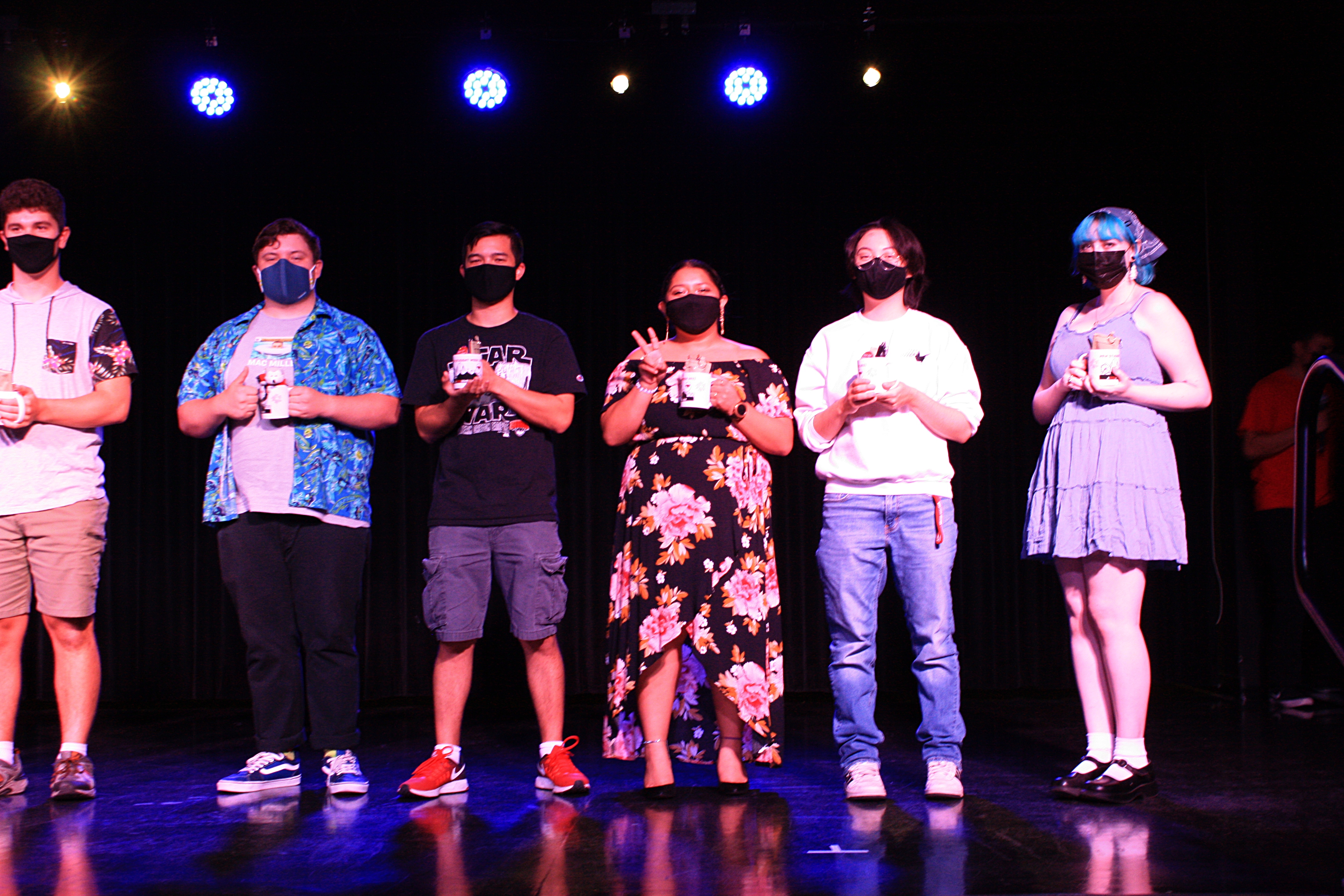
From left to right: Jasper Beck, Jared Foos, Andrew Freeman, Daizy Hernandez Soriano, Jessica Bailey, Aubrey Mollock.

The end of New Student Week was marked by the return of a Western tradition — the Variety Show. Organized by the PLUS team’s Variety Show committee, the event consisted of 10 student acts, three prize giveaways and a New Student Week video shot and edited by Western alumnus and freelance videographer Andy McDonald. 

Moshe Martinez, junior computer science major, PLUS team member and overseer of the Variety Show committee, acted as MC of the event. Spaced throughout the show, the PLUS team held short raffles for prizes, and a select few students won items ranging from a Hydro Flask to a smart TV.  

The performances began with junior ASL Studies major Jared Foos, who sang and played guitar to his own arrangement of “Gone, Gone/Thank You” by Tyler, the Creator and “Relax/Divide” by Hail The Sun. 

First-years Ashlee Ellis, Sorin Santos and Breanna Carrasco Vivar performed an energetic light dance routine to the song “LALISA” by Lisa. 

Senior criminal justice and psychology double major Andrew Freeman, who is vice president and vocal percussionist of Western’s Acapella Club, performed an original beatbox story, taking the audience through a day in the life of a beatboxer. Freeman was joined by the rest of the Acapella Club for a musical finale. 

On the piano, first-year music education major Kourtney Branchfield performed an original song titled “Perfectionist,” something she identifies with.

“I want to kind of help people understand what (perfectionist) means,” Branchfield said of her song’s message, “or people who are also dealing with it can also relate to it.” 

First-year business major Daizy Hernandez Soriano sang “Que Me Vas a Dar” by Jenni Rivera, the only act performed in another language. 

Graduate student Liam Vance performed “Take Out Some Insurance” by Jimmy Reed. As Vance left the stage, he declared, “My Name is Liam Vance and I am just getting started.” 

Channeling a Bo Burnham-style musical comedy, senior art and design major Jessica Bailey performed an original song on guitar titled “WIP” about wanting to find their place and figure out life. 

“One of the things that I was working on was trying to be more honest with myself…” Bailey said, “even if things are kind of embarrassing and weird to say out loud, trying to say it anyways because it’s actually quite helpful.” 

First-year Jasper Beck performed his slam poetry piece titled “2nd Law” accompanied by an original backtrack and slideshow. 

“I essentially used the second law of thermodynamics as a metaphor for the fact that societies and relationships tend to fall apart, just like matter does…” Beck said of the inspiration behind the poem, “and sort of my thoughts on how that affects people and how our reaction to that brokenness is not healthy, in my opinion.” 

First-year psychology major Aubrey Mollock sang an emotional rendition of “Burn” from the musical “Hamilton,” a song performed by wife Eliza after Hamilton released documents to the public revealing his affair. 

First-year Manda Oliver played an original piece titled “Stepping into a Mirror.” According to Oliver, the song was initially about escaping reality, but over time came to be synonymous with creating her perfect reality instead. 

At the end of the live performances, Martinez was joined onstage by the rest of the PLUS team for a choreographed dance to Bruno Mars and Mark Ronson’s hit song “Uptown Funk.”

Contact the author at entertainmenteditor@thewesternhowl.com

WOU announces plans to require COVID-19 vaccine

Western leadership creates incentive program for vaccines

Sydney Carpenter | News Editor

As of May 11, a total of three private and four public universities in Oregon have announced requirements for students to be vaccinated for COVID-19 for the next school year.

Western became the third public university to announce its plans to require students, staff and faculty to be vaccinated for the upcoming school year during a virtual town hall meeting on May 10.

“I wanted something that rewarded students for doing the right thing,” said Johnson, “and I also wanted to push us to have a more safe opening in the fall.”

The incentive program was initialized by Associated Students of Western Oregon University President NJ Johnson to further encourage the community to be vaccinated against the virus. Under the program, people who have received their first dose of the vaccine qualify to receive a $25 WolfStore voucher that can be used for textbooks, Western merchandise or other miscellaneous items found at the bookstore. To receive the voucher, a vaccine card and student ID must be presented to the Werner University Center information desk.

According to Johnson, the program is currently being funded by the General Fund and anticipates it costing around $100,000. The intent is to eventually have the program funded by the emergency relief fund, however, due to the ambiguity of what emergency relief is permitted to be used for, the university is still working with the federal government to determine if the program is legally permitted to be funded this way.

Western intends to provide students with the opportunity to take in person classes next term. During the virtual town hall meeting, the modalities were presented as follows: in person classes will make up 53% of Western’s curriculum, 22% hybrid, 19% online asynchronous and 6%  online synchronous; departments were not specified.  For students planning to live on campus next year, Tina Fuchs announced reduced capacity in the residence halls. Ackerman will be filled to 85% capacity while Arbor Park will be filled to 100%. Barnum and Landers will be assessed on a need basis. 

The COVID vaccine is not the only required vaccination by the institution; according to the Student Health and Counseling website, all admitted students are required to have the measles, mumps and rubella vaccine before coming to campus. Exceptions include being born before Jan. 1, 1957, religious beliefs and specific nonmedical related issues that are provided by the state of Oregon. Western is still currently researching exemptions for COVID.

“Many of the details remain unfinished,” said Western Vice President and General Counsel Ryan Hagemann, “and that’s because we have to speak to our community.” 

Hagemann went on to say how the university is making this a priority and is trying to get it right.

“This really relates to the idea that we should be able to have a safe community,” said President Rex Fuller during the May 10 virtual town hall meeting. “We know that being together in face to face encounters with careful safety planning, we have a better educational experience for all of our students, faculty and staff.”

Contact the author at scarpenter18@mail.wou.edu

Anti-protest bill in Oregon to be conscious of

Important protest bill to keep on the lookout for heading into summer

Sydney Carpenter | News Editor

A national debate over peaceful and violent gatherings has sparked U.S. lawmakers to engage in writing “anti-protest laws.” 46 states have currently proposed or passed bills.

In Oregon, there have been three bills presented; two of them have been defeated or expired, while one known as House Bill 3329 — introduced on March 2 — is currently under review by the House Committee On Judiciary.

The proposed bill, sponsored by Representative David Brock Smith of  District 1, introduced a new felony charge to peaceful protesters who block traffic.

Under the bill, vehicles or people blocking roadways would be classified as a Class C felony. Convicted of the felony, people could expect to serve up to five years in prison and pay around $125,000, done during a ‘violent or disorderly assembly,’” according to icnl.org. 

Additionally, the legislative proposal introduced a Class C felony for “engaging in threatening or intimidating conduct” in public, which disqualifies people from receiving financial aid from the state if convicted of these charges. In addition, it prohibits immediate release if arrested for rioting or for “violent” behavior, and gives protection to police if a person filing a civil claim was “grossly negligent.” More information about the specificities of the bill can be found at incl.org.

Associated Students of Western Oregon University President NJ Johnson said he believes the bill is in direct response to People of Color in Oregon after a full year of using their voice to protest.

“Whether we want to admit it or not, the state of Oregon has a history of trying to silence the voices of People of Color,” said Johnson. “This is obviously a bill (that) if passed is going to be implemented largely to punish and silence People of Color for speaking out against racial injustice. I want to make it clear (that) a lot of this violence that we see and blame on protesters is incited by law enforcement.”

To follow the bill’s movement, community members can visit olis.oregonlegislature.gov or email Rep.DavidBrockSmith@oregonlegislature.gov to learn more.

Contact the author at scarpenter18@mail.wou.edu

WOU softball enters GNAC championship as alternates

Wolves softball team place third overall in GNAC championship

Sydney Carpenter | News Editor

A rise in COVID-19 cases in the state of Washington caused the Great Northwest Athletic Conference’s original fourth seed — Central Washington — to drop out of the softball championship being hosted at Western.  

As a result of the Conference’s bylaws, the Western Oregon Wolves softball team — fifth seed — was promoted to the fourth seed position and entered into the championship game for the eighth consecutive year.

Similar to years prior, GNAC formatted the championship game as a double elimination tournament. The first round winners went head to head in a second round, and the losing teams from the first round played in a second round match to determine the competitors for the third and final championship match. 

In the first round of the tournament on May 6, Western lost to first seed Northwest Nazarene Nighthawks 2-1. The following day, Western competed against third seed Saint Martin Saints; the team gave the Wolves several walking opportunities to fill the bases, leading to a 7-6 victory for the Wolves. Western advanced to face off again against the Nighthawks, only to lose 9-0 in five innings, bringing an end to the softball season. With this, the Wolves placed third in the GNAC conference. 

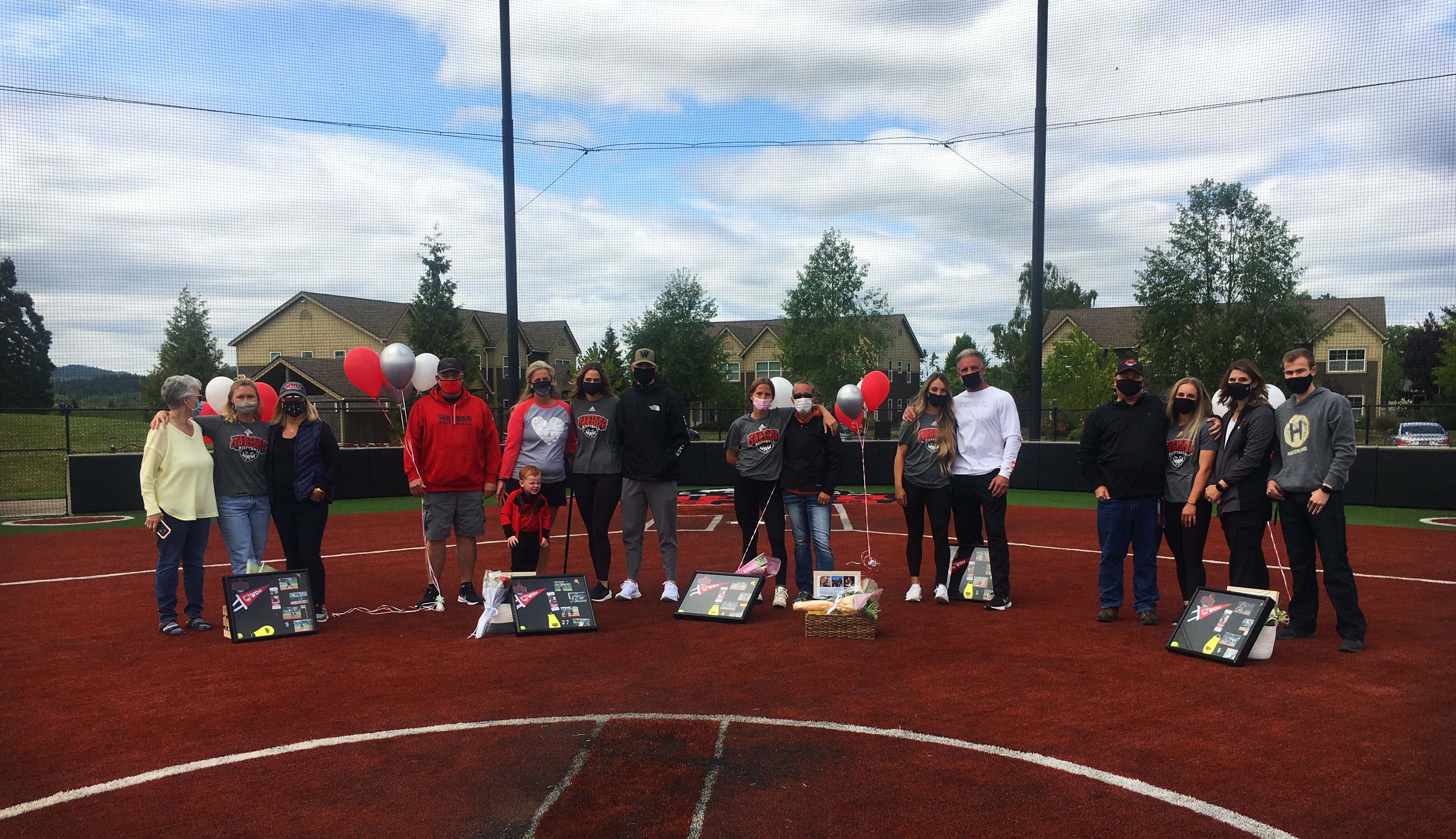
After the game, the Wolves commemorated the senior members of their team that will be graduating in June. Head Coach Lonny Sargent commented on how proud of the team he is after having such a hectic year. 

“It’s such a great group of kids,” said Sargent. “We have a lot of young kids … they just (want to) go play.”

Going forward, Sargent is excited about the upcoming season and what the next year will bring.

“The players we have and the players we have coming in, we’re building another great program for next year,” he said.

Contact the author at scarpenter18@mail.wou.edu