
Mount Hood

The rebirth of bookstores

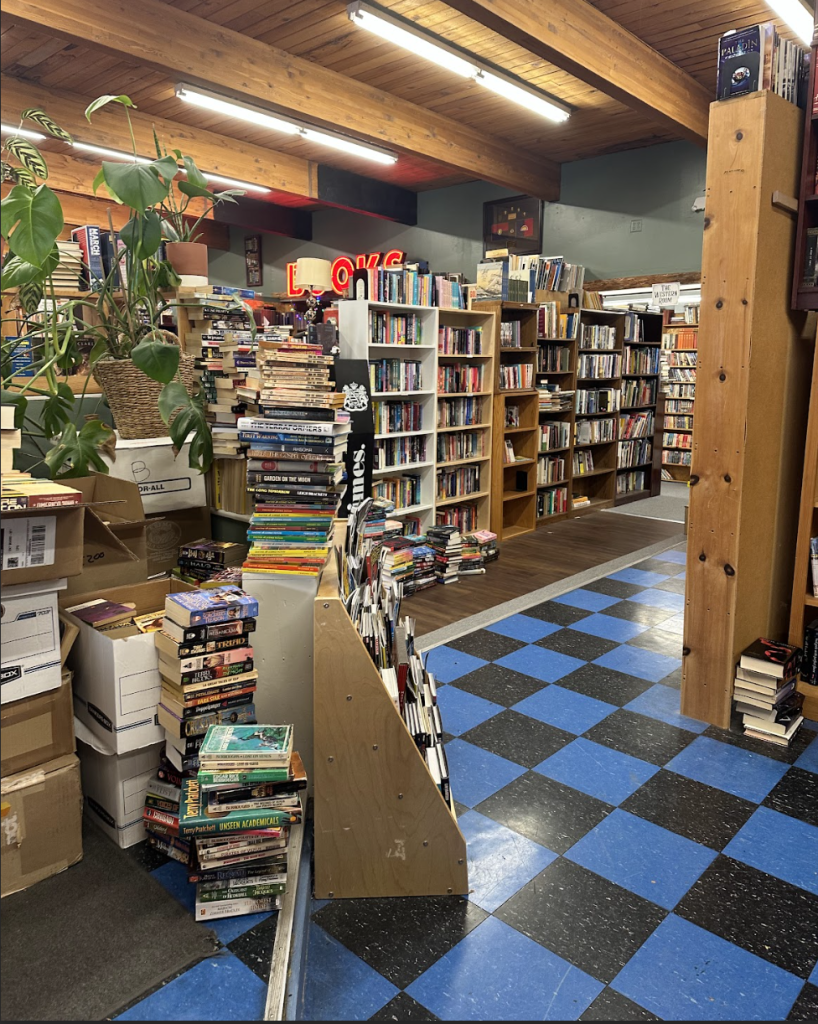
A photo of the inside of Browsers’ Bookstore. | Photo by Hannah Field

Jan. 21 2026 | Hannah Field | Editor-in-Chief

Recent bookstore statistics prove that popularity for local businesses in the US is climbing rather than subsiding five years after the coronavirus shutdown, with communities rallying and the landscape of bookstores adapting to meet modern demands.
The American Booksellers Association, or ABA, reported a membership increase of 18% and 323 new brick-and-mortar, pop-up and mobile stores opening across the United States in their 2024 annual report. They noted that 2024 had “the most successful Independent Bookstore Day to date.”
According to Harvard Business School, despite local bookstores struggling to remain afloat during pandemic regulations that limited business operations and corporations like Amazon dominating the industry, localism has become a social movement that has been steering indie bookstores back to the forefront. Communities have emerged to shop small and support local businesses in the wake of recent corporate boycotts against companies like Starbucks, Target and Amazon for their various methodologies, including anti-union sentiments alongside a lack of corporate accountability and diversity inclusion.
Abe Richmond, owner of Browsers’ Bookstore located in Albany, Oregon, said, “I was working here during the pandemic. It was obviously bizarre, and we closed for several months, but the customer base rallied behind us. So we would do sidewalk drop-offs, they would pay for it over PayPal or whatever, Instagram, and then we would package their books and put them on the porch.”
Richmond bought Browsers’ from the previous owner after graduating from Oregon State University, having been an employee of his, and has been at the forefront for more than three years. While Browsers’ Bookstore handled the precarious nature of being a small business during the pandemic, the customer base has also adapted to new ownership — and adapted well, with Richmond being recognized across town as the owner of Browsers’ and building a solid rapport with customers who seek out his services specifically.
When it comes to Amazon and Barnes & Noble, resale bookstores like Browsers’ suffer less than one might think. “I like them because people will spend $40 on a new hardcover in Salem and then read it, and then not know what to do with it, so then they bring it here. And I have a fairly new, good-shaped book.”
Customers who drop off books may receive in-store credit at Browsers’ to spend. Beyond that, Richmond also displays local authors and merchandise drawn by nearby artists. “It’s counterintuitive. Because who is this person, you know? But then, if you point it out, like, ‘Hey, they live in Albany or Corvallis,’ people are like, ‘Oh, I’ll read it almost just for that sake.’ Whereas if it was some other book that you’d never heard of, they’d probably pass over it.”
He also noted the enjoyable community aspect when authors host signing events at Browsers’, bringing a sense of life to local stores. Richmond also instrumented a film drop box through Light Rider Studios, meaning customers can drop off their film to get developed on their behalf and delivered.
Bookstores have been changing since the 1970s, with 43% of local bookstores closing between 1995 and 2000, reminiscent of the decline in physical bookstore sales through the Kindle push in the late 2000s and 2019, when Amazon had sold more than half of all books in the United States. Jeff Bezos, owner of Amazon, stated, “Amazon isn’t happening to the book business. The future is happening to the book business.”
Amazon was founded in 1994 as an online bookseller by Bezos. Since then, the ABA has labeled it an unchecked monopoly, claiming that it stifles competition and that it has an enormously negative impact on the bookselling market. Amazon was able to expedite growth, printing an effective blueprint to attract customers and obtain and keep wealth by failing to comply with tax regulations and offering duty-free purchases.
Amazon also regularly offers discounted books, undercutting businesses that have to sell at full price in order to stay afloat. Booksellers have been forced to drop employees in order to stay profitable — which could also be a part of why Richmond and Sydney-Anne Graves are the sole paid workers as owners of their respective businesses, Browsers’ Bookstore and Monarch Books.
Regardless, Richmond and Graves have found success. And, according to the Associated Press, others are too; more than 200 local bookstores were predicted to open across the country between 2023 and 2025.
Monarch Books only just started in April of 2024 out of Lebanon, Oregon, owned and founded by Sydney-Anne Graves, who was a senior in high school when she encountered at a coffee shop the landlord of the building in which Monarch Books resides. That conversation alone spurred Graves to tell her mom later that night: “Mom, I’m buying a bookstore.”
After touring the building — reportedly falling in love with it — and dedicating multiple weeks to deep-cleaning, Monarch Books came to life under Graves’ new ownership and keen eyes.
“We opened, and (that) first day, it was really busy,” said Graves. “And I was like, ‘Okay, this might work out.’ It was really busy. And then, ever since, I’ve been slowly getting more inventory in, decorating, getting it to my vibe. I really love a lot of colors and plants, and there’s still a lot of ideas I have for in here, but it’s come so far from where it originally was.”
Richmond expressed appreciation for the anti-corporate push in 2025, leading to more local shoppers steering clear of Amazon and other corporate sellers. In the current political and social state of the US, local businesses may be inclined to further build queer-safe communities and book selections as opposed to corporate booksellers — potentially building a reliable customer base seeking a supportive book hub and shared community.
Browsers’ Bookstore remains open consistently under Richmond’s new ownership and maintains a loyal clientele across nearby cities. A good chunk of customer interaction relies on online postings and website sales through Browsers’ Bookstore’s virtual pages.
“I sell a lot (from what) I post on Instagram, and then people will be like, ‘Hey, I’ll take it.’ And so they come in and pay for it,” said Richmond. “It’s weird, though, because say you wanted a book we don’t have. It shocks me every time how many people are like, ‘Hey, can you order it for me?” Instead of them hopping on Amazon, because we go through a new book distributor. But I think it’s because people want to support. I think people like having bookstores.”
“It’s just so awesome, and it’s really cool to see that so many people still support the book community,” said Graves. “I was really nervous about that. I know I read and I know some of my friends read, but I don’t know how many people actually still buy books or shop downtown — so I think that was the most nerve-wracking part about it. But it’s been really great.”
Another aspect of the resurgence of bookstores is the online platforms Instagram and TikTok, cultivating an online community of book lovers. Dubbed “bookstagram” and “booktok,” readers and writers participate in hashtags, giveaways and online sharing, creating trends and catapulting books onto bestseller lists through sheer word of mouth via the internet.
“I feel like I get new customers every single week,” said Graves. “There are so many people who still love reading and that’s (been) helped a lot with bookstagram and booktok, different things that have really kind of inspired people to get back into it, which is so cool.”
“Taylor Swift — I’m not sure what — did something with Shakespeare,” said Richmond. “I’ve had so many women, and girls, college and under, be like, ‘I need Shakespeare.’ … It’s the same, if a movie comes out of a book, people flood the place, like when ‘Dune’ came out. Yeah, I couldn’t keep ‘Dune’ to save my life.”
“I was like, ‘Why is my Shakespeare selling all of a sudden?’ Nobody cared about this before,” Graves joked.
Taylor Swift’s most recent album, “The Life of a Showgirl,” features imagery, lyrics and photography modeled after Shakespeare’s character Ophelia in “Hamlet,” no doubt causing the wave of Shakespeare-mania that Richmond and Graves both experienced. “Dune” amassed a box office of more than $400 million in 2021 and “Dune: Part Two” grossed $715 million in 2024, with the “Dune” franchise built off of six core books written in the 1960s through the 80s.
However, there is a catch to the media frenzy. Allison K. Hill, CEO of the American Booksellers Association, blames Amazon: “Amazon is now the water we swim in … There are multiple ways that an independent bookstore is forced to not only interact with Amazon, but support them — books made into shows streaming on Prime Video are printed with Amazon stickers on the cover.”
Regardless, books have long since had movie adaptations, and well before Amazon and other corporations took hold. Much like local bookstores, movie theaters are becoming increasingly popular — for the second time. Upcoming releases like “Wuthering Heights,” “Project Hail Mary” and “Sunrise on the Reaping” are all 2026 book-to-movie adaptations spanning classic literature, sci-fi and the famous Hunger Games franchise. Show adaptations are equally successful, with notable pop-culture stars of book-to-show adaptations being “The Summer I Turned Pretty,” “Heated Rivalry” — currently thriving on HBO Max — and “Bridgerton.”
With books inspiring much of modern media turnout, it’s unlikely that books and bookstores will succumb to the strains of aging. In a way, books are trendy again, as the statistics prove — Barnes & Noble opened almost 70 new locations in 2025 and has more on the way.
Hill said in a statement in the 2024 annual report, “The numbers only tell part of the story. This momentum occurred despite significant challenges: the usual ones like thin margins, rising costs, and Amazon’s chokehold on our industry, and urgent threats that shook the very foundation of our work as the right to read and access books faced sustained, coordinated attacks.”
The current presidential administration has made a dedicated effort to place bans on books that affect educators and librarians, limiting access to certain content, especially that which discusses gender, race and sexuality. While that’s less likely to impact independent booksellers, the pressure remains to conform as book access limits book readers and their interests. Additionally, independent bookstores can rely on author visits and community involvement; divisive political action can split a customer base or turn away potential author-bookstore collaborations. The ABA, when discussing concerns for people interested in opening a bookstore, cited “free expression challenges.”
Portland’s own Powell’s Books — the largest independent and used bookstore in the world, spanning one city block and containing over a million potential reads — participated in the ABA’s Banned Books Week event in 2024, discussing the right to read, spreading awareness about book bans and hosting panels.
ABA also conducts the yearly Independent Bookstore Day. In 2024, when the ABA reported the highest participation numbers to date for the event, ambassador Amanda Gorman stated, “Independent bookstores are vital hubs of creativity and community. They offer curated selections that foster discovery for readers, while providing vital support and a platform for diverse voices for writers and other creators. They are the true modern-day town square, the beating heart of our communities, and a place for meaningful interaction and human connection.”
The day involved 1,216 stores from across all 50 states.
“Our mission — to help independent bookstores survive and thrive — remained at the core of everything ABA did,” said Hill.
While the 2025 annual report from the ABA won’t arrive until mid-2026, the expectation is that the indie bookselling industry will only continue to grow in spite of the last decade’s challenges, with Graves adding, “I don’t think books will ever go out of style.”

Contact the author at howleditorinchief@wou.edu

Online courses: yea or nay?

February 26, 2025

Written by: Sadie Latimer | News Editor

Western prides itself on its campus community, where students are supported and uplifted. Part of that support comes from in-person classes, with small class sizes and personalized experiences for students. 

Western’s provost and Vice President for Academic Affairs Dr. Jose Coll is leading the charge in reducing the amount of online classes offered at Western in favor of in-person instruction. He created a working committee — the Undergraduate Course Modality Task Force — to conduct research and ultimately recommend what percentage of courses should be taught online. 

The task force is being led by Chelle Batchelor, dean of library and academic innovation. 

According to Batchelor, “The task force is currently in the process of gathering information to inform the recommendation we have been asked to present to the provost and Faculty Senate in spring term.” 

Fall and Winter terms were dedicated to determining what would be best for students when it comes to online classes. The task force will share their findings in the Spring term, which will help the university move forward with the change.

The task force is concentrating on all aspects of online learning. “The recommendation of the committee will consider all modalities with an online component: online asynchronous, online synchronous (Zoom classes) and hybrid,” Batchelor stated. 

As of now, the task force isn’t focusing on the fully online majors, such as the ASL interpreting program. The provost’s goal is to limit first-year students to only in-person classes starting Fall 2025 unless their declared major is fully online. 

This potential decision will only affect the mode of the coursework, and won’t result in faculty cuts. “Teaching a course in person requires the same amount of FTE as teaching a course online,” according to Batchelor. FTE — full-time equivalence — indicates and measures the workload of faculty.

The potential reduction in online courses has been one focal point of the Faculty Senate, which is made up of representatives from the different departments at Western.

“In the December meeting of the Faculty Senate, faculty discussed concerns about program needs, student needs, student engagement and success, and faculty representation on the task force,” Batchelor stated. “After that meeting, Faculty Senate identified a faculty member to serve on the task force.”

Not only has the task force started working more closely with the faculty, but they have also begun to work with ASWOU in order to engage with Western’s students. Specifically, they are working with Senate President Maggie Bartosovsky and Senator Briana McNeel to bridge the gap between the committee and Western’s students. 

Batchelor and the committee are also reaching out to students through Wolfie, the chatbot that sends messages to the student body. Wolfie’s text was sent out Feb. 17. The text also included a short survey that students are encouraged to complete. 

The survey and other student input is important for making sure that the university’s decision reflects the needs and wants of all students. 

Any decision of the university comes with concerns and opinions from Western’s community. Some students are concerned with how class availability will be affected. Students with full-time jobs are concerned with how they will fit in-person classes into their busy schedules. These concerns are being addressed by the task force, and it is up to them and the university to identify solutions that will benefit the students and the community.

“Over and over and over, I hear comments from students about how important the WOU community is to their success,” President Jesse Peters stated in his report during a Board of Trustees meeting. “And when they talk about it, they talk about being physically here on campus and interacting with peers and faculty and staff. Whatever the college experience is, it simply can’t be replicated on Zoom. And the strength of Western has always been, it seems to me, the way that the campus functions to support students and build community. I will continue to focus on restoring our campus to the physically present, active and engaged community it was before the pandemic.”

The COVID-19 pandemic was a major setback for many schools, including Western, and it will be difficult to rebuild the in-person community to what it was previously. President Peters, Provost Coll and the Undergraduate Course Modality task force have a massive undertaking, but are starting relatively small with hopes to reduce the online courses that are offered to first-year students.

It remains to be seen whether or not the provost and the president’s vision of the upcoming fall term will come to fruition. First, the task force must figure out what percentage of courses should be online, taking into account what opinions the students and faculty have voiced. Then, once they present their findings, the university can come to an informed decision that will ultimately benefit Western’s community. 

Contact the author at howlnews@mail.wou.edu

It’s the end of the world as we know it, and I feel fine

Written by: Claire Phillips | Entertainment Editor

“It’s The End Of The World As We Know It” — R.E.M.

“Skyfall” — Adele

“In a Week” — Hozier feat. Karen Cowley

“Seven Devils” — Florence + The Machine

“Apocalypse Please” — Muse

“Everybody Wants To Rule The World” — Tears For Fears

“(Don’t Fear) The Reaper” — Blue Öyster Cult

“As the World Caves In” — Sarah Cothran

“Exit Music (For A Film)” — Radiohead

“Blue Spotted Tail” — Fleet Foxes

“Losing My Religion” — R.E.M.

“Who Wants To Live Forever” — Queen

“Enjoy the Silence” — Depeche Mode

“Time is Running Out” — Muse

“Bottom of the River” — Delta Rae

“Stare at the Sun” — Mutemath

“I Know It’s Over” — The Smiths

“Alone Again Or” — The Damned

“The Sound of Silence” — Simon & Garfunkel

“Everybody Loves You When You’re Dead” — The Stranglers

“Victory Dance” — My Morning Jacket

“Highway to Hell” — AC/DC

Contact the author at howlentertainment@wou.edu

Campus Voices: sharing their feelings on the mask mandate lifting

Western students answer the question: “What is your raw, honest, unfiltered, opinion about the recent lifting of the mask mandate?

Gretchen Sims | Freelancer

Contact the author at gsims20@mail.wou.edu

Name: Ruth Simonsen

Class standing: sophomore

Major: psychology

Pronouns: She/her

“I like seeing people’s faces. I like knowing when I smile at them that they will smile back. I like seeing the faces of people in my clases. Of course there are still fears, but I like being able to put a face to a name and a name to a face. I feel like when you can see people’s faces and can smile at them, it is easier to be friendly. It’s just a better vibe.” 


Name: Makaela Calonder

Class standing: first-year

Major: pre-education

Pronouns: She/her

“Personally, I am very excited about not having to wear masks. I work at a pool, so in general — in my daily life ⏤ it is nice because it gets very hot and sweaty in the mask. Here at WOU it is nice not having to worry about not having one on me at all times. Of course I respect everyone who still chooses to wear a mask, but for me it is really nice.”


Name: Kamryn Bolan

Class standing: first-year

Major: business

Pronouns: She/her

“So far this year, especially as a freshman, I have felt very distant from the community of students here. Over the past two years, it’s like we have forgotten how to socialize. I think there is so much personality revealed in a person’s face, so when you cover half of it up, you have trouble connecting with the person you just met. Going into spring term with masks off has given me a new sort of motivation for going to class. It’s crazy how much seeing the teacher’s face can amplify your engagement.” 


Name: Sienna Painter 

Class standing: junior

Major: American Sign Language studies

Pronouns: She/they

“Throughout the pandemic, I have been very cautious through shutdowns. (I) was not going anywhere other than like the forest during the shutdown. I started wearing a mask in January of 2020 — long before everything. I already had masks because I have been wearing masks since like 2018 whenever I felt sick or whatever, so I was already really comfortable with masks to begin with. For mask mandates being lifted, right now, I am very skeptical–mainly because of Spring Break. We lifted the mask mandate in all of Oregon, California and Washington right before Spring Break — right where all of WOU students would be traveling too. That’s why I am still wearing a mask to all of my classes and will be especially more cautious over the next two weeks. Also, I am like f—–g scared of COVID because of all of the variants and waves and stuff. I have never really minded with masks, but I do think because of our (WOU’s) high vaccination rates, and WOU is a pretty small campus, and people are fairly responsible, I am fairly comfortable with other people not wearing their masks. I also have not felt pressure to take my mask off. I was afraid I would be the only person in my classes not wearing a mask, but people have been pretty chill.”


Name: Max Brayton 

Class standing: first-year

Major: psychology

Pronouns: They/Them

“My parents are more conservative and Republican so they have been against the masks since the beginning and it’s nice to not hear s–t from them anymore. But, you know, with them as my parents, I see different perspectives which is interesting. Although I don’t agree with them, it is nice to have that perspective. I am from southern California and even down there, they are not being as safe as we are (in Oregon). I feel more comfortable not having my mask on here because I know, at least at our school, that more than ninety percent of people are vaccinated. Everyone has been really safe and respectful. Like I feel comfortable wearing, or not wearing, my mask here. I feel like this community has been very welcoming and inclusive and I feel like it’s about time (the mask mandate was lifted). I am a little nervous though. I saw a New York Times article this morning that a new COVID wave is hitting, but I feel like as long as everyone is being safe, I like to have my mask off ⏤ you really connect to people more.”

WOU continues campus-wide mask mandate for fall term

All the details about what is required to maintain the health and safety of all Western students

Mikayla Coleman | News Editor

Going into fall term during the seemingly endless years of the COVID-19 pandemic leaves many Western students and faculty feeling uneasy. According to the Oregon Health Authority, as of Sept. 2021, Oregon alone has reached 318,914 cases and accumulated 3,661 deaths due to the spread of COVID-19. Trying to navigate the rules and regulations for in person learning proves to be daunting and confusing — so here is an in-depth guide for Western students returning to campus this fall.

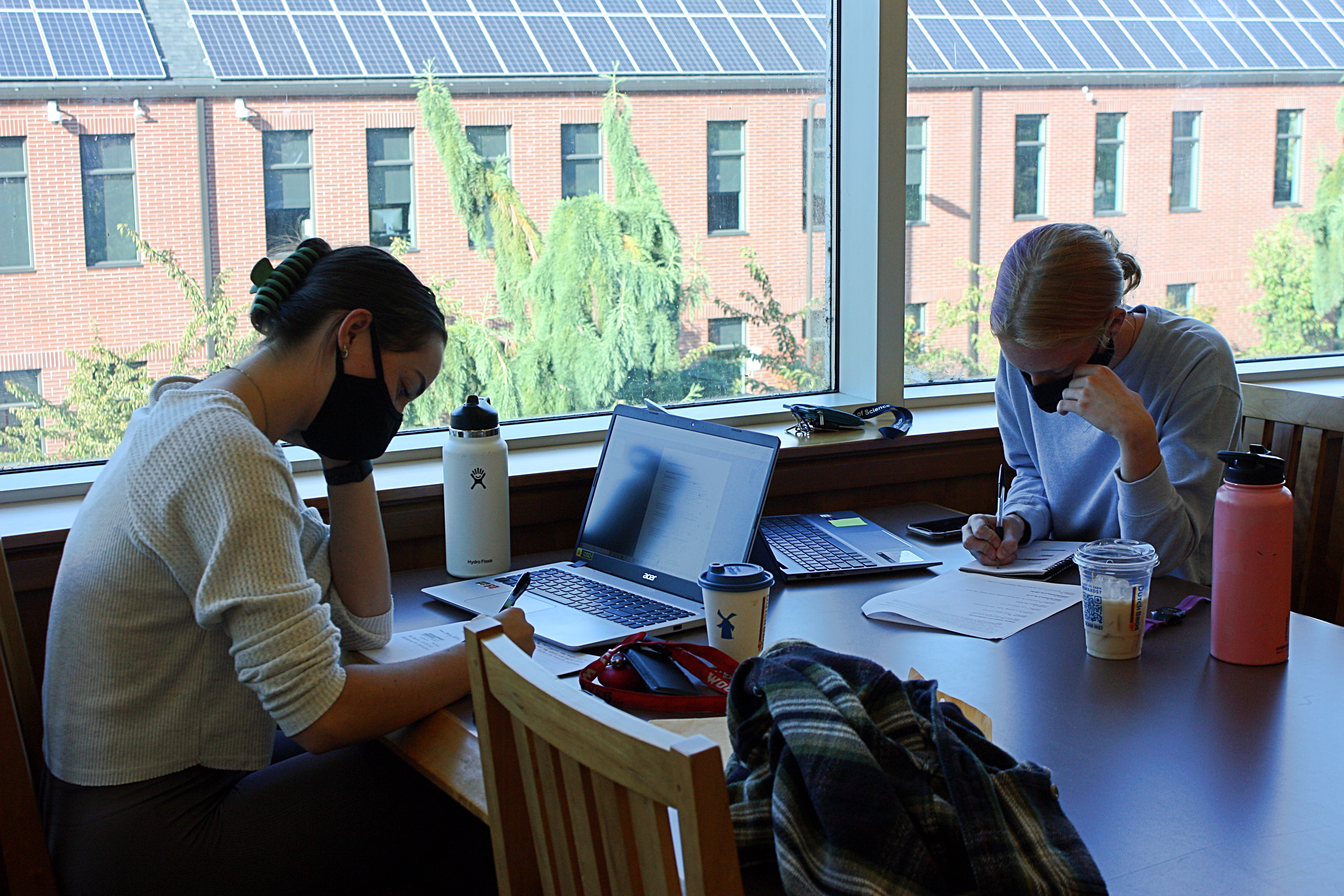
Sophomore social science major Lindie Larson and sophomore forensic chemistry major Amity Deters follow mask mandates while studying at Hamersly Library.

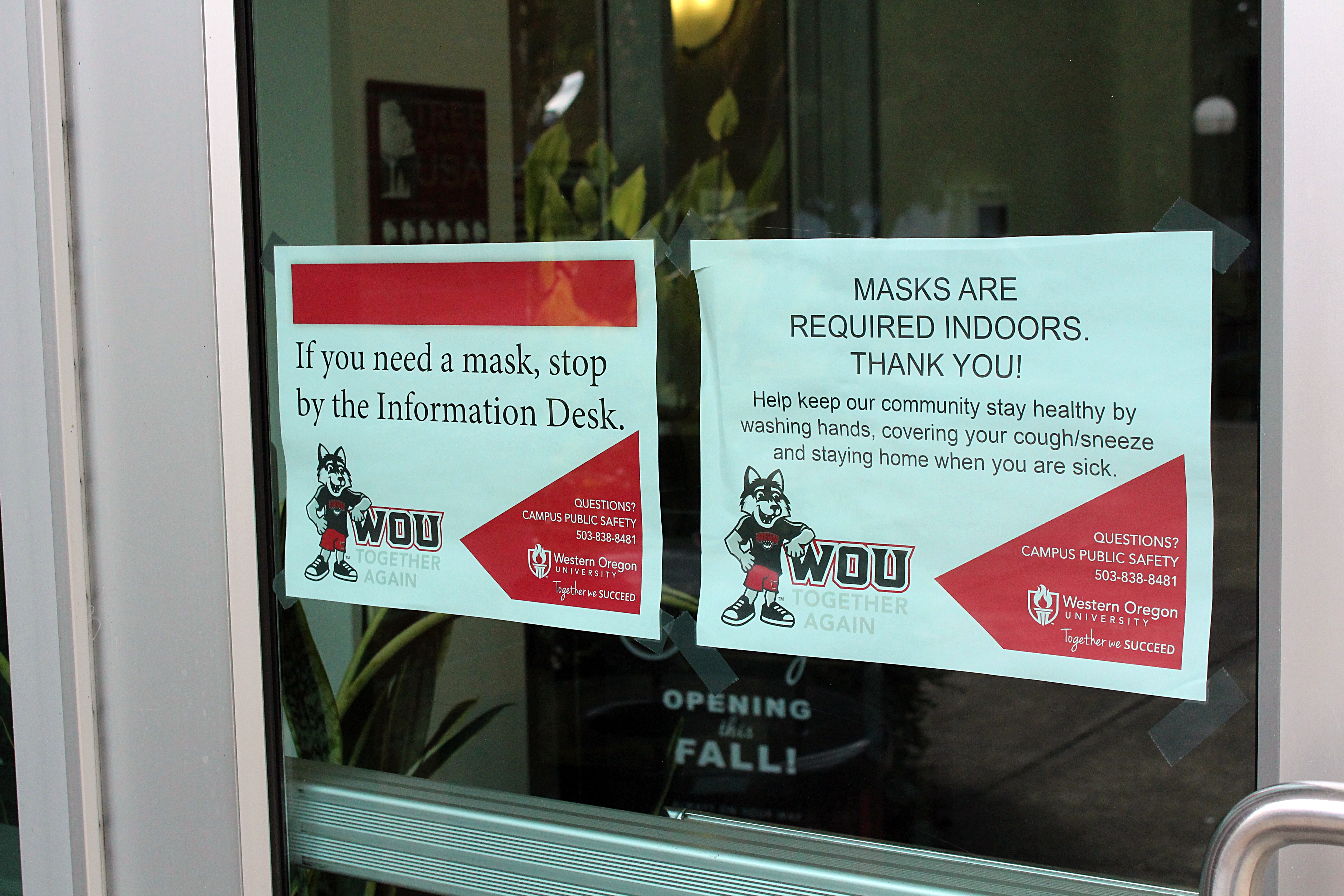
Where are masks required? Briefly over the 2021 summer break, fully vaccinated students were able to enjoy Western facilities maskless. However, since the development of the delta variant took the world by storm in July, masks have made a valiant return for the safety of everyone on campus. 

All vaccinated and unvaccinated employees, guests, vendors and students must wear a mask on campus when indoors. Masks are required outside when social distance cannot be maintained. 

If students have a disability that prevents them from wearing a face covering, reach out to the Office of Disability Services. 

Something new from the 2020-21 school year is that the campus is open to visitors. Said visitors must adhere to the same rules as students and staff members by wearing a mask when inside and outside. In person tours for prospective students are available by appointment only. 

Are vaccines required? Proof of COVID vaccination is required for all students and employees on campus unless they are able to receive an exemption through the university. The exemption is not limited to just medical reasons — religious or philosophical reasons for being unvaccinated are also being taken into consideration. 

Social distancing guidelines are posted outside the Werner University Center.

What do living situations look like? Living on campus and using high contact shared spaces have caused concern among students. Isolation that has been so heavily recommended throughout the pandemic is nearly impossible to achieve in a dormitory setting. Despite this, first-year students are still required to live on campus as they have been in past years. 

Working through the challenges that come with it, Western has put its best foot forward while preparing for students’ return. Student housing has made an effort to create more single dorm options. Students in residence halls are required to wear masks when not directly inside their assigned room. The university will also provide separate housing for COVID quarantine as needed. 

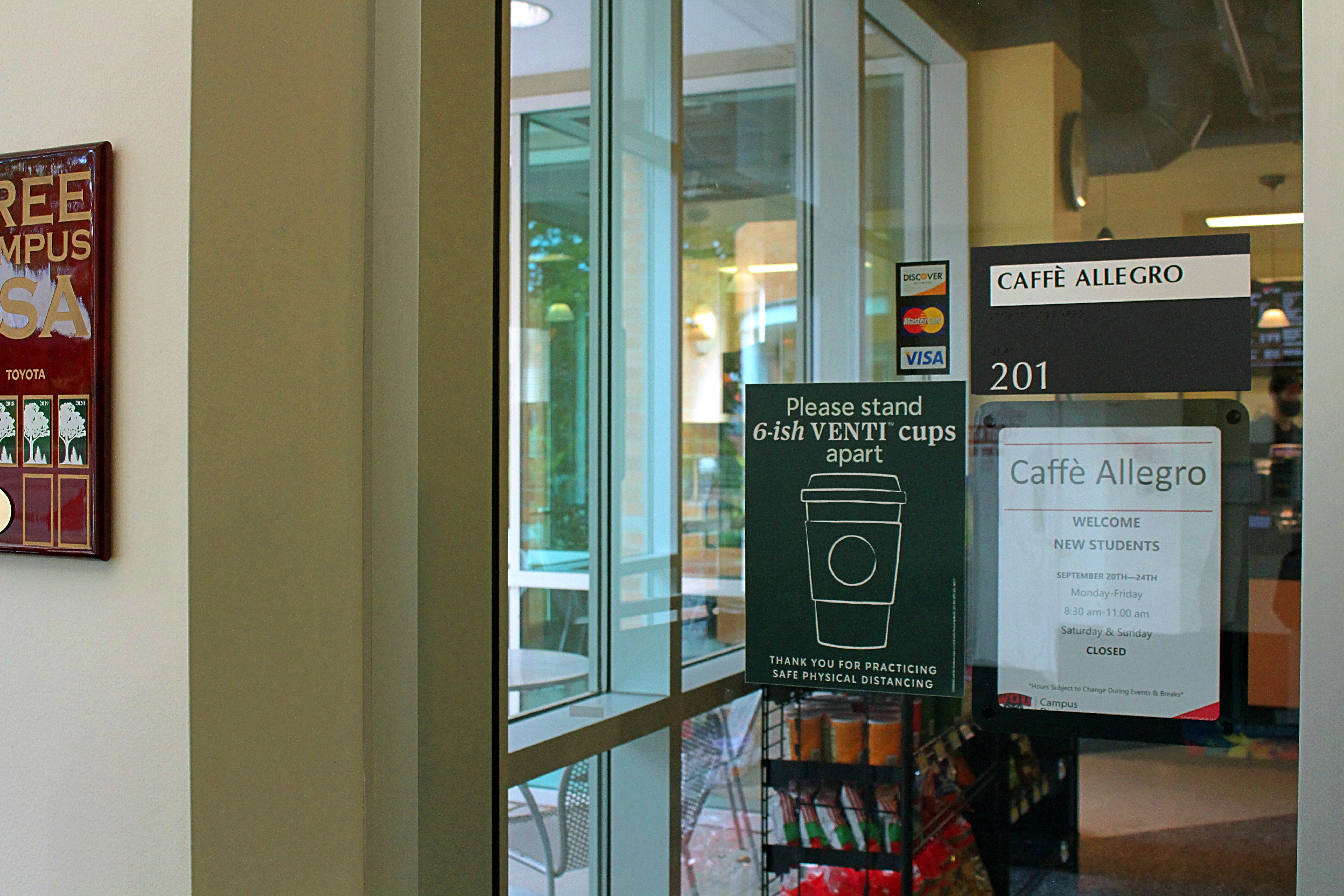
For students that have a meal plan, the Valsetz Dining Hall will be open with seating arranged for social distancing. Other retail dining options, such as Caffè Allegro, will be open with regular business hours. 

Caffé Allegro encourages social distancing protocols via venti cups.

What do the classroom situations look like? Western offers a wide range of flexible classroom environments to fit different students’ needs including in person, hybrid, online synchronous and online asynchronous courses. 

Western will be implementing contact tracing protocols for those that choose to attend in person classes. If a student participating in an in person class tests positive, all students also taking that course will be notified. 

What do extracurricular activities look like? In person activities such as sports events will be offered in order to provide the Western experience as long as it is deemed safe to do so. 

Creative arts programs expect to be back with concerts, plays, dance productions and art exhibits. Student Engagement plans to have a variety of in person activities to participate in, including clubs, activities and organizations. 

Contact the author at newseditor@thewesternhowl.com