


Mount Hood

Underrated books

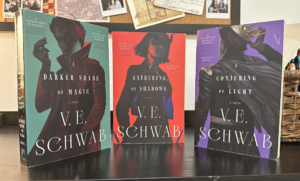
Photos of V.E. Schwab’s “Shades of
Magic” trilogy. | Photos courtesy of Hannah Field

Feb. 11, 2026 |  Hannah Field | Editor-in-Chief

Social media does a lot of bad things, and a lot of good things — but has done both to the rise of reading again. Suddenly, books I finished and despised are top-sellers, everyone’s reading the same thing and I can’t stop getting recommended books I’m not interested in by people I don’t know on TikTok.

The other day, I was just thinking to myself: I wish someone with a little bit more proximity to me, a knack for writing and reading and who shares some similarities with me would just give me a list of books I could check out. Now, I can’t do that for myself — but I can do it for the next person to read this article. Below are a variety of books that I’ve read that I enjoyed that I think are worth picking up if not yet already finished — all without spoilers.

“Before I Fall” by Lauren Oliver — This book was one that I read early on in my young adult book escapades that I haven’t forgotten about. It was catty, hard-hitting and turbulent. Having a 3.88/5 on Goodreads, and being Lauren Oliver’s debut novel in 2010, I consider it still rather impressive. “Before I Fall” follows a mean girl in high school, Sam, who goes through a kind of “Groundhog Day” effect and is forced to relive the day she dies over and over again. It’s not a spoiler if it’s the premise of the book, right?

Anyway, “Before I Fall” has all the criteria for an emotional ride, capitalizing on the importance of kindness and how short life can be. There’s love, there’s drama and, most fun, a selfish, kind-of-evil protagonist, a slight risk for author Lauren Oliver, considering this was in the age of “Twilight” — Mary Sues were everywhere. The book also has a movie adaptation, which I remember liking, except it only got a 64% on Rotten Tomatoes. I’ve been waiting to pick this one back up and give it a reread.

“Shades of Magic” trilogy by V.E. Schwab — Most know V.E. Schwab for her novels “The Invisible Life of Addie LaRue” and “Bury Our Bones in the Midnight Soil,” the former of which is my favorite book, but the three books in her “Shades of Magic” series are perfect for romantasy lovers. In this series, Kell is a magician who can travel between worlds, one of only a handful of people who can. After meeting a runaway sailor, Lila, the two must band together to save all of the Londons — Red, White, Gray and Black, as a dark magic takes hold in the rifts between worlds. The series explores queer romance, magical warfare, usurping expectations and stereotypes and complex family dynamics, and was one of the most interesting concepts I’ve read about in a long time.

“The Women” by Kristin Hannah  — So, no, Kristin Hannah isn’t underrated right now at all, but all I can find online is recommendations for “The Nightingale,” which I, actually, did not want to die for, unlike “The Women.” This book captivated me. It had a slow start, with a bit of simplistic writing, but I was simply taken on this ride with the main character, Frankie, once it picked up.

In “The Women,” which is historical fiction about women’s roles in the Vietnam War, Frankie signs up to become an army nurse. She’s taken out of her cushioned, well-fed life and taken to Vietnam, where she learns the truth of what the war looked like and how women were being treated, despite being incredibly pivotal and crucial to the war efforts.

I breezed through this book in two days, and I’ve been thinking about it since. I don’t want to give too much away, although I have much to say. If this book is on any reading list out there — this is a sign. Get through the first couple of chapters and report back.

Fair warning: this book does get a little graphic, considering the Vietnam War army nurse thing.

“To Sleep in a Sea of Stars” by Christopher Paolini — Christopher Paolini released “To Sleep in a Sea of Stars” in 2020, a standalone story told in Paolini’s new universe: “The Fractalverse.” The novel takes place in the future when humans have accomplished interstellar travel, met aliens and can modify their bodies. Xenobiologist Kira Navárez is our speaker, and we follow her as she encounters an unidentifiable alien lifeform that she accidentally — well, absorbs is the best word for it. From there, Kira finds out that if humanity is going to be saved, she has to be the one to do it.

Tied in with a love story, lovable and flawed characters and some really complex scientific writing that I’m unqualified to decode, “To Sleep in a Sea of Stars” is thrilling, intoxicating and long.

Paolini is most known for the series “The Inheritance Cycle,” a quadrilogy starting with “Eragon” and focusing on a farm boy who discovers a dragon egg in a fantasy realm that is ruled over by a tyrant. Paolini worked throughout his teens and early twenties on “The Inheritance Cycle,” boasting complex storylines, intense worldbuilding and great ratings online — a commendable consideration for a reader’s book list.

“The Fractalverse” also includes “Fractal Noise,” a 2023 prequel centered on a different protagonist, featuring no familiar faces from the sequel. While I liked the concept of “Fractal Noise,” it intrigued me much less, kept me less captivated and was slower than “To Sleep in a Sea of Stars.” It was an easier read and a smaller novel, and shouldn’t be discounted, as Paolini is still an accomplished author with a powerful, intelligent voice.

“The Wrong Side of Goodbye” by Michael Connelly — To be honest, my dad, who I very rarely take seriously, handed me this book, and it sat on my shelf for more than six months before I finally picked it up and found myself amazed. “The Wrong Side of Goodbye” is a crime-mystery thriller following recluse detective Harry Bosch. A billionaire enlists Bosch’s help to find his heir, which proves to be quite difficult, all while Bosch is trying to find a serial rapist who terrorizes Los Angeles.

I am not usually one to fall for an older white man’s recommended reads. However, I am very glad that I did. I could not stop turning the pages of “The Wrong Side of Goodbye,” and sequentially went to my local secondhand bookstore to buy as many Harry Bosch books as I could find. I read the first in the Harry Bosch series, “The Black Echo,” and read about his comeback from the Vietnam War (there it is again), another good Connelly novel. I’m taking a break from the murder — it was a lot — but hope to return soon, as Connelly has gained an unexpected fan for life.


Contact the author at howleditorinchief@wou.edu


Nintendo’s star princess

A photo of Rosalina’s original design from Super Mario Galaxy. | Photo from @nintenbingo on Instagram

Nov. 12 2025 | Belen Ponce Leal | Lifestyle Editor

Content warning: this article contains spoilers for “Super Mario Galaxy”

“Super Mario Galaxy” was a game that came out in 2007 on the Nintendo Wii. It introduced several new mechanics that were different from previous Mario games, such as the ability to stun enemies with the spin move and the introduction of 3D graphic manipulation as the game is set in various worlds with different physics. However, the biggest addition that this game brought to the forefront was the introduction of a new character, one who comes from the stars.
Introduction — Known as the “mother of the Lumas,” Rosalina debuted as a woman who possesses great cosmic power. She travels throughout space in her observatory, keeping an eye out for any threats. She has been called “an interstellar protector” by Nintendo. She is known as the adoptive mother of the Lumas, star-shaped creatures that are baby stars. They have the capability to transform into stars, comets, planets and even “Power Stars,” which are the main source of power in the world of the Mushroom Kingdom.
The plot — The game opens up with a few pages of a storybook, explaining that once every hundred years a comet passes by the Mushroom Kingdom. On this occasion, the people host an event called the “Star Festival,” meant to celebrate the comet’s return. Then, the game becomes similar to most Mario games where Bowser attacks the Mushroom Kingdom to kidnap Princess Peach. While Mario is attempting to save her, he gets knocked into space.
When he wakes up, it’s in the company of the Lumas. After a brief chase with them, they explain that their “Mama” needs his help. It is then that Rosalina makes her first appearance. She tells Mario that she is the guardian of the cosmos. She then entrusts Mario to take care of a Luma that will give him the power to travel through space to save Peach. This is what gives Mario his shake ability, which allows him to not only stun enemies, but to use “Launch Stars,” which help him travel through the cosmos throughout the game.
Mario is then taken to the Comet Observatory. Rosalina explains that they travel through the area once every hundred years, but were stopped by Bowser this time. He had attacked their home, taking the Power Stars, which give the observatory the power it needs to travel through space. Rosalina asks Mario if he would continue to collect the Power Stars from other galaxies around them. Once enough are collected and power is restored to the ship entirely, Rosalina agrees to help Mario save Princess Peach and defeat Bowser.
The ending —Another reason that Super Mario Galaxy is different from other Mario games is the ending. Most of the games end with Peach being saved, Bowser falling into lava and everyone going back home. However, when Mario manages to defeat Bowser, the universe that he was trying to create collapses on itself and creates a black hole. The Luma that was with Mario the entire game, along with all the others in the Observatory, sacrificed themselves by jumping into the black hole. An animation appears showing what’s implied to be a cyclone mixing up stardust. Mario then appears in some sort of limbo with Rosalina, where she explains how the cycle of life works for stars: “When stars die, they turn to stardust and scatter across the cosmos.” She explains that after a time, the stardust turns into a star and the cycle of life continues. Rosalina does say, though, that the cycle of life is never the same. When Mario awakens, everyone he encountered in the game who lived on different galaxies now share one planet. Rosalina’s voice is heard to say that all life carries the essence of stars, including all of them. Mario welcomes the new galaxy and a new cycle of life begins.
Origins — Rosalina’s backstory is told to the player throughout the game through a storybook. As Mario collects Power Stars, parts of the observatory unlock. One of the areas is a library, and when walking inside, Rosalina is sitting in a chair holding a storybook. She reads to a group of Lumas, and the story told is implied to be her own.
The story is about a young girl who encounters a lost Luma that crashed his spaceship near her home. The Luma says he’s waiting for his mama to come back for him on a comet, so the girl agrees to wait with him. A lot of time passes and they decide to go into space to try to find her. They eventually encounter a comet that they decide to stay on while the girl chooses to adopt the Luma as her child. They construct the Comet Observatory and have a large group of Luma children who live with them. The girl decides to check on her home planet and reminisce about her family. When the thought of her own mother comes to mind, she bursts out in tears as she tells her children that she can’t see her anymore, as she is “sleeping under the tree in the hill,” implying that she has passed away. Luma, the original star child that Rosalina encountered, tries to comfort her and, in the process, turns into a comet. The girl is shocked and the other Lumas explain to her that they all will grow up to become either stars, planets, comets and much more. They all surround the girl, hugging her and asking her not to cry anymore and from that day forward, “star bits no longer fell from the girl’s eyes.”
Utilization — Unfortunately, Rosalina hasn’t had a major role in a Mario game since her debut, with most of her appearances coming from spin-off games like “Super Smash Bros,” “Mario Kart” and “Super Mario 3D World.” However, fans still hold her dear in their hearts for several reasons. Unlike most of the Mario characters, who are tailored in a way that kids will enjoy them, Rosalina has a mature personality that is very much motherlike. Unlike Peach, who depends on Mario a lot in the games, Rosalina is an independent woman who not only takes care of herself, but takes care of all the Lumas under her care. Her backstory is compelling, even tragic, which is unique for a Nintendo character, as we don’t know a whole lot about the backstories of the characters in these games.
While Nintendo hasn’t taken advantage of how much love the fans have for this character in a while, there is good news for those who have been waiting. Not only are “Super Mario Galaxy” and its sequel available for the Nintendo Switch, but Nov. 25, her storybook will be available for physical release. It has also been announced that the next Mario movie will be based on Super Mario Galaxy. Considering how big a role she plays in the games, there is no doubt that Rosalina will make an appearance in this upcoming film. As a huge fan of Rosalina, I am definitely looking forward to seeing her in the next movie.

Contact the author at howllifestyle@wou.edu

Life-Changing Lessons from the World of Harry Potter

Written by: Liberty Miller | Lifestyle Editor

I, alongside many others, spent my childhood looking through the lenses of the main characters in the novels I read. Having pored over the “Harry Potter” series since third grade, I got to experience a large portion of my developmental years from the perspective of the Chosen One, Harry Potter. 

“Harry Potter” is a distinct pop culture personality, who openly defies the government, fights prejudice and is fiercely loyal to his friends. J.K. Rowling also creates a wonderfully dimensional character profile for everyone in the book — rather than making the characters one-dimensionally morally sound or evil, she creates multifaceted characters that make mistakes, have moral gray areas, apologize and evolve as people. 

“Harry Potter” makes a relatable variety of mistakes throughout the series, and while being an astute and stubborn personality, also admits when he’s wrong and works to make things right. 

Coming from an unsavory background as the humble punching bag of the Dursley family, Harry Potter had the beginnings befitting of a supervillain. Facing daily roadblocks and abuse with no connections or friends, Harry became self-reliant and resentful of his life. 

He eventually gained status as a wizard and escaped his life with the Dursleys to attend Hogwarts, a similar path to Voldemort’s. However, Harry chose to defend those less fortunate and befriend characters like Ron Weasley and Hermione Granger, who were not the most popular or influential characters but were genuine friends. 

He rejected the Sorting Hat’s offer to place him in Slytherin despite being offered power and influence. Throughout the series, he makes conscious decisions to defend and protect people against prejudice and hatred and recognizes his faults concerning his impulsiveness and how his actions affect others. 

Harry is a prime example of having a choice to be a good person or to pursue power and influence without regarding others, and he is a great role model for young readers in terms of being authentic to oneself and fighting for what one believes in. 

J.K. Rowling also tackles some tough subjects for young readers such as bullying, grief, unfair circumstances, jealousy between friends, family dynamics and the uncomfortable feeling of growing up. While most readers cannot relate to having to face a faceless, bald and red-eyed supervillain with murderous tendencies, there are many other subjects that coming-of-age readers can relate to or struggle with. What “Harry Potter” teaches readers is, in essence, to create strong dependable friendships, use power and influence to do good things and reject social prejudice and administrative or governmental systems that work against the people. Most importantly, the series reminds readers to stay true to themselves and what they believe in. 

Contact the author at howllifestyle@wou.edu

Witches through the years

Written by: Taylor Duff | Lifestyle Editor

The spooky season brings many frights, imagination and of course, costumes. Girls around the world might be dressing as witches this Halloween season, or they have done so in the past, or they just know that witches are generally associated with Halloween. When people think of a witch, they most likely appoint an old decrepit woman who rides a magic broom, casts spells and has a diet that consists of children. This depiction is far from what witches are, so where did the term “witch” come from? Where did they come from? 

It is believed that the term “witch” was a moniker given to women who practiced witchcraft and satanic rituals and ate children — but that is just what the fairy tales say. One early concept of what a witch is says that in mythology, witches were healers, shamans and spiritual workers who could affect the physical and the spiritual world. They used what is called “herbal medicine,” which is healing people with hand-crafted herbs. Not so different from what everyone in ancient times would do, however, witches were believed to have a special talent for healing. Some of the negative connotations come from Greek and Roman mythology: Deities like Hecate and Circe were goddesses that possessed magic and posed potential threats because of their power. 

Whether or not mythology is accurate, the witch hunts during the 15th-18th centuries caused significant harm. These included the Salem Witch Trials of 1692, precipitated by a real-life hysteria that affected many women during the time. A group of teenage girls from Salem, Massachusetts, claimed to be possessed by the devil and accused multiple local women of witchcraft. The trials resulted in the deaths of 25 innocent women, men and children. The purported witches were hung or crushed, not burned, which is a common misconception, as that was done in Europe during the Middle Ages. There is a museum in Salem, Massachusetts, where visitors can see just how the trials began and ended. 

Folklore and stories like “The Crucible,” a play by Arthur Miller, started to paint women as villains and self-absorbed, claiming they were witches. Fairy tales did the same, such as “Hansel and Gretel,” where two siblings travel in the woods and stumble across a witch’s house; she ends up eating them. Witches during this time were generally portrayed as old, bumpy and green; they were meant to look like they arrived out of the devil’s chambers and needed to take sources of life. Green witches appear often in fiction, most famously in “The Wizard of Oz” and its prequel “Wicked,” where the Wicked Witch of the West became the bad guy, and everyone was petrified because she was robbed. In Gothic literature, things looked a little different —  witches were usually painted as seductive and beautiful. But even then, they would use their beauty and seductive nature to lure men and hurt them. 

Women’s International Terrorist Conspiracy from Hell — WITCH — was a 1960s feminist group that used guerrilla theater and public rallies to criticize patriarchy and capitalism. Feminist witchcraft movements in the 1970s reclaimed the image that represents the witch as a powerful monarch. Wicca is the largest modern Pagan or Neo-Pagan religion. Its adherents, known as Wiccans, commonly identify as witches and derive inspiration mostly from pre-Christian customs in Europe. Dianic Wicca, which concentrates upon the worship of a goddess figure, or female deity, and publicly supported feminist values, frequently gained influence from the emerging women’s rights movement of the time. Because of this movement, witches are now more popular in pop culture. Movies such as “The Craft” and “The Love Witch” show women usually painted as outcasts or weird embrace their individuality and sex appeal to contradict the patriarchy. Shows like “Buffy the Vampire Slayer” and “American Horror Story, Coven” showed witches as everyday people who were just trying to navigate the world, and because pop culture sparks, the public made witches more approachable. This also opened up self-expression for LGBTQ+ characters, such as Willow Rosenberg from “Buffy,” emphasizing the connection between magic and gay identity. As environmental problems, feminism and LGBTQ+ rights continue to dominate public discourse, the witch remains a symbol of resistance and self-empowerment. 

TikTok, which has #WitchTok; Pinterest; Instagram and more platforms show modern-day people participating in witchcraft. Many creators provide spells, rituals, tarot readings and astrological insights. They show their lifestyles with aspects such as decor, clothing — witch-inspired Gothic apparel with Bohemian and crystal-laden looks, — black hats, pentagrams, jewelry, tattoos, books and much more. Halloween, in particular, has converted the witch into a fun, approachable figure for people of all ages. The internet enables individuals to combine cultural traditions, such as Wicca, Hoodoo and New Age practices, and participate in virtual covens or communal rituals. 

Overall, the witch isn’t one type of person. A witch can be multiple types of people, they can be friends, family, teachers, parents and your next-door neighbor. They are someone who embraces their faith and individuality and wears it proudly. Witches just want to be accepted and painted in a light that isn’t demeaning or harmful. The witch is a symbol of feminism and strength and has spent too many years not being understood. 

Contact the author at howllifestyle@mail.wou.edu