


March 11, 2026 | Abbi Duhart | News Editor
In 2025, Western became the first four-year public Hispanic-Serving Institution in Oregon, meaning more than 25% of the student population self-reports during enrollment identifying as Hispanic or Latino.
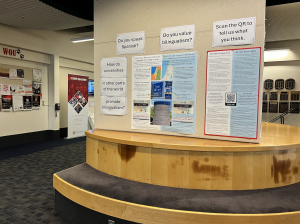
On display on the second floor of the Werner University Center, posters are put up with information regarding HSI institutions, as well as how bilingualism and multilingualism are displayed in universities. The posters include two case studies of universities around the world and how they utilize multilingual signs around campus, and a QR code is included for students to scan and take a survey about bilingual signs around campus, and if students would like to see more of this.
The first case study is about a college in Israel where local Jewish and Arab populations coexist multilingually on campus. The majority of students are Jewish at 72%, followed by Arab students at 28%. Both student populations are valued in their diversity through the posting of multilingual signs all around campus with both languages.
The second case study is about a university in Finland in which the majority of students speak Finnish and 7% speak Swedish in addition to Finnish. Despite this, all of the signs around campus include both Finnish and Swedish, even though all of the students speak Finnish. To explain their reasoning, the university said that they want to promote bilingualism and normalize utilizing two languages because it reflects the diversity of the student population.
The intention of bilingual signs in these two places, and many colleges around the world, often isn’t to assist the minority language speakers in understanding the signs because the majority know both languages, but is instead to honor their heritage. They are used as a symbol to convey that bilingualism is a valued skill, that all languages are important and to help the majority language speakers in learning a second language.
Many students at Western speak Spanish, grew up speaking Spanish and come from Spanish-speaking families, yet almost all of the signs around campus are only displayed in English. In response, the survey displayed in the WUC is recognizing this and seeking an answer on whether students would like to see more Spanish around campus.
The number of Arab speaking students in the first case study is very similar to the number of Spanish-speaking students at Western, yet their university, like others around the world, displays their language, while Western often doesn’t display Spanish.
Many people in the United States are so used to seeing English and only speaking English that it’s common to find resistance to displaying signs with another language. Many believe these signs look cluttered, are a waste of money and that everyone knows English, so there’s no purpose. In other countries around the world, though, these types of signs are extremely common, sometimes with even more than two languages on each sign.
According to a 2016 Academy of Arts and Sciences report, more than 65 million United States residents speak a language other than English, yet this only represents 20.7% of the population and the majority remains monolingual. Further, “the study of a second language has been linked to improved learning outcomes in other subjects, enhanced cognitive ability, and the development of empathy and effective interpretive skills.” Despite the vast benefits of learning a second language, the United States lags behind most other countries in the world in the number of citizens who know a second language. Many other countries start teaching a second language in grade school, so by the time students graduate, they are bilingual. It is continually proven that, in the United States, the two years of a second language requirement in high school is not enough.
For these reasons, promoting bilingualism and multilingualism is very important, especially at the educational level. Western has both a Spanish major and minor offered to students, and is also very well-known for its American Sign Language program, offering both studies and interpreting majors and a language minor. Not only do these programs promote bilingualism and allow students to learn not just languages but cultures, but they also create career opportunities post-grad. Adding bilingual signs to Western would continue to expand the promotion of multiple languages that other programs have started. For example, this year, The Western Howl hired Spanish translators for the first time and now offers articles in Spanish.
For more information surrounding these topics, students can go see the posters about bilingualism and multilingualism displayed in the WUC and can scan the QR code there to fill out the survey.
Contact the author at howlnews@wou.edu