

Mount Hood

A march for fundamental rights

Written by: Mirella Barrera-Betancourt

On the afternoon of March 16, Western students from an immigration and politics course gathered in union to support and advocate for immigrant rights, as well as a number of interrelated and prevalent issues across the United States, including human rights, gun violence, the war on Ukraine and climate justice. As a result, these students marched for various causes, not primarily limited to immigrant rights. 

The event was arranged by Professor of Political Science, Eliot Dickinson.

According to Dickinson, the idea of the peace march came to light in two political science courses: “Causes of Peace” and “Immigration Politics and Policy.” The former course, “Cause of Peace,” centers around the study of nonviolent protests, while the latter focuses on discussion of the Deferred Action for Childhood Arrivals and the illegal exploitation of immigrant child labor.

Dickinson said, “The two topics kind of went together, and I asked the students if they wanted to end the term with some kind of an immigrant peace march.”

Although the march was designated for the enrolled students of the course, all students — including students outside of the political science community — were encouraged to attend. 

With handmade signs in hand, the participants of the march welcomed the sunny weather — void of the chilliness of previous days. 

The group met at the Werner University Center, where they continued their march through Monmouth Avenue and up towards Main Street. 

While most advocated for immigrant rights, a few participants advocated for climate change. One sign read, “Immigrants Make America Great,” while another read, “Climate Justice Now.”

“The purpose was to get out of the classroom and express ourselves,” said Dickinson. “We wanted to say that it’s time for a green revolution, time to stop burning fossil fuels, and time to stand up for human rights.”

According to the National Centers for Environmental Information, 2022 ranked as the sixth warmest year on record. Likewise, statistical analyses warn of the potential likelihood that 2023 will rank among the top tenth warmest years.

In response to why it’s important to advocate for these issues, Dickinson said, “There’s so much gun violence in our society, so much economic anxiety, so much bad news about global heating, and so much war and so many refugees that at some point you just feel like expressing yourself.” 

Ultimately, the march turned out to be a progressive end to the semester for the two political science courses, as well as a positive step in the right direction concerning fighting for policies on immigration.

Dickinson added, “We realized it wasn’t going to solve all the world’s problems or bring peace overnight, but it sure does feel good to get out and demonstrate.”

Contact the author at howlnews@wou.edu

President Peters perceives

Written by: Dakota Gange

President Jesse Peters confidently and humbly displays what one may assume are aspects to his true self; a cozy sweater, jeans and brown leather shoes with stitching resembling that of a Moccasin. A small silver hoop earring hangs on his left ear. 

Though his sweater and shoes are soft, one does not need to ask if he rides a Harley, or a bike alike, to guess that he does.   

Peters began his undergraduate studies in business but switched to English after being heavily drawn to literature. His minor is in sociology. 

During his graduate school studies, Peters said he “…specifically became interested in Native American literature. So I went to the University of New Mexico and did my Ph.D. there in Native American Literature.” 

Dr. Peters has seemingly dedicated his youth to education. 

His resume is impressive — spending 18 years at the University of North Carolina at Pembroke, where he worked up the ranks, beginning as an assistant professor and progressing through to a full-tenured professor. Peters was also Dean of the Honors College and Director of Undergraduate Research. 

And there’s more — during his tenure at Fort Lewis College, Peters served as the Dean of Arts and Sciences. He also was the Interim Provost for one year, overseeing the college’s development of new programs in Environmental Science, Health Science, Nutrition, Borders and Languages, Computer Engineering and Musical Theatre.

After receiving a $500,000 Mellon Foundation Grant — a Foundation which supports a wide range of initiatives to strengthen the arts and humanities — Peters used his grant to promote inclusive pedagogy — the ways that courses, curricula, assessments and classrooms weigh issues of diversity with a goal to engage all students in meaningful, relevant and accessible learning. 

In addition to his already busy schedule, he currently serves on the “National Collegiate Honors Council, Honors Semesters Committee as well as the Diversity Committee, and he frequently co-facilitates national faculty institutes on experiential learning,” he said in an interview with Western.  

Peters likes “…the smallness of regional universities (like Western) and the personalized nature of the education and how we can really get to know students and serve them the best way that we can in a community-based holistic system.” 

Influenced by the literature and art of Scott Momaday, Lesley Silko, Louise Erdrich and James Welch, the “…large figures of the Native American renaissance literary movement that came out of the 60s and 70s. Since then I have been fortunate enough to know many artists and authors of the Native American communities.” 

Peter’s passion and affinity for Native American culture echoes throughout his office, in bright and neutral colors.  

He feels a connection to these artists and writers, drawing him to Native American culture. 

“The art of those writers, any good novelist or poet, appeals to me. I think I probably had some connection to notions of land relationships, like growing up in swamps, fishing and hunting, and being in the woods a lot myself — I think there’s something about that that comes through a lot of that art. I was also sort of drawn to notions of relationships of intersectionalities of human beings and communities and living things that you often see in ways of thinking about existence and creations that are probably more holistic than in western traditions,” he expressed. 

“I think notions of balance and reciprocity and lots of things that I believe those cultures have to teach and have taught the world, and I was just drawn to engaging with those ideas, as I am an outsider to those experiences, which fosters good exploration of those ideas.” 

Growing up on a farm in Southern Georgia, Peters enjoys camping, being outdoors around water, and farming with his family. He likes to go fly fishing and wishes he had more time to ride his motorcycles.

Western feels very homelike to Dr. Peters, and he plans to “tell Western’s story better and to more people,” hopefully growing awareness of Western and enrollment. He feels that “it’s important that the student body and faculty are proud of how well Western serves students and the student body that we do serve — how diverse it is, how innovative it can be — how many strong alumni we have in the state and around the region. We need to talk about that and make sure we are a part of conversations about higher education.”  

Through his more profound understanding and openness of one’s cultural lens, perhaps President Peters will launch us into a future centered around Western’s growth, diversity and inclusion. 

Contact the author at howlmanagingeditor@wou.edu

Compassionate CPP

Written by: Jude Bokovoy

Finding one’s way in the corporate world can be hard. No matter where one is at — searching for a job related to their career, a job to gain experience or an internship — Western’s Center for Professional Pathways — CPP — is here to help. Staff members are equipped with the knowledge, experience and connections to guide students through their next steps. Think about where one is at in the process, then pick from the list of appointments below to continue one’s journey.

Career counseling — For those who are uncertain of what career path they should take or are overwhelmed with all of their options, this is a great place to start. In this style of appointment, one will meet with a career counselor to explore career options as well as major options if needed. Students will also learn strategies on how to move forward in their exploration.

Career assessments — If one still isn’t quite sure about their career path, this is a way to narrow the options down and find out about how one’s interests and abilities can be a part of one’s career. CPP also offers Strong Interest Inventory, StrenthsQuest and MBTI. An MBTI personality assessment highlights strengths and how you make decisions. On the other hand, Strong Interest Inventory helps people identify what their interests are and career paths depending on the score. 

Job search advising — This is when one starts to take action. Once settled on a career, the advisor can assist in applying for specific jobs in the field. This includes identifying and strategizing to get a job related to one’s interests and major.

Advanced resume and cover letter review — After having one’s resume looked over by a Student Career Advisor by drop in or appointment, the final step before applying is to make this appointment. During this time, the advisor will give assistance with editing, organizing and making educated suggestions. 

Mock interviews — Got a call back for an interview? Get some practice and feedback before the big day. 

Internship advising — Not looking for a job? An internship may just be the perfect opportunity to get experience without the pressure of a position. This appointment will secure one’s goals and strategize. If desired, the advisor will go over one’s resume and give a mock interview.                                                                                         Graduate school counseling — Brainstorm about one’s interests and gain insight to start looking into graduate schools with confidence. 

Graduate school search and application materials — Students will receive assistance in writing personal statements and other application materials, as well as in searching for graduate schools in one’s chosen field of interest. 


Volunteer advising — Search for volunteer opportunities on and off campus to assist in one’s education, community and career development.

Alternative Break advising — Interested in participating in an Alternative Break? This opportunity gives students the chance to volunteer in various ways over school breaks. Set up an appointment to find out all about it and what one will need to do. 

Contact the author at howllifestyle@mail.wou.edu
Western’s Model United Nations Trip

Written by: Gretchen Sims

Recently, from Feb. 23 — Feb. 25, members of Western’s Model United Nations club took part in a well-established academic tradition — the London International Model United Nations. 

Model UN is a popular activity for students interested in political science and allows participants to simulate the proceedings of an actual United Nations conference. 

Each participant is assigned a committee that replicates an actual committee in the UN. In that committee, the student represents a randomly assigned country — sometimes this can be a specific person, but this is quite rare.

Once these committees are assigned, students are given a real-world topic and are tasked with accurately representing and bolstering their country’s interests.  

Two Western MUN members were assigned to the United States on the Security Council. This was an interesting predicament for these students, as being assigned to the state from which you originate is rare and did not sit well with other participating schools. 

While Western delegates did not win an award, members did exceptionally well. The delegates were working on energy security and the energy crisis, and went against the grain. While most focused on the energy pipelines and creating a singular energy grid, the U.S. Security Council felt ignored and decided to take action. mozambique, an elected member of the Security Council, was trying to start a resolution paper — one of three circulating the General Assembly — however, it kept getting looked over and shut down. 

It was then that Russia decided to back mozambique’s paper — a big deal due to the P5, one of the five permanent members on the security council, state’s veto power.  Sharon Mann and Max Laine decided to beat Russia at their own game and back mozambique’s paper as well. This left the rest of the states in deep trouble because, with the backing of two P5 states, the previously overlooked resolution was protected by two veto powers.

Immediately, the U.S. Security Council delegates were the center of attention — with everyone suddenly begging the U.S. to work with them. However, the U.S. used its veto power to its full capacity and shut everyone down in true American style. 

However, at the end of the day, this was a huge accomplishment for Western. 

Mann, one of the two students on the Security Council, said that “All the schools that went to this conference were big-name schools internationally. Universities from France, Spain, lots from London — I think there was a delegation from Oxford there… It was big! We were one of the only American schools — I think there was one other one from New Jersey — but we were Western Oregon. At this huge conference that thousands of people went to, and it wasn’t like U of O going, or even Stanford.”

Contact the author at howlentertainment@wou.edu

Western makes major department deductions

Written by: Mirella Barrera-Betancourt

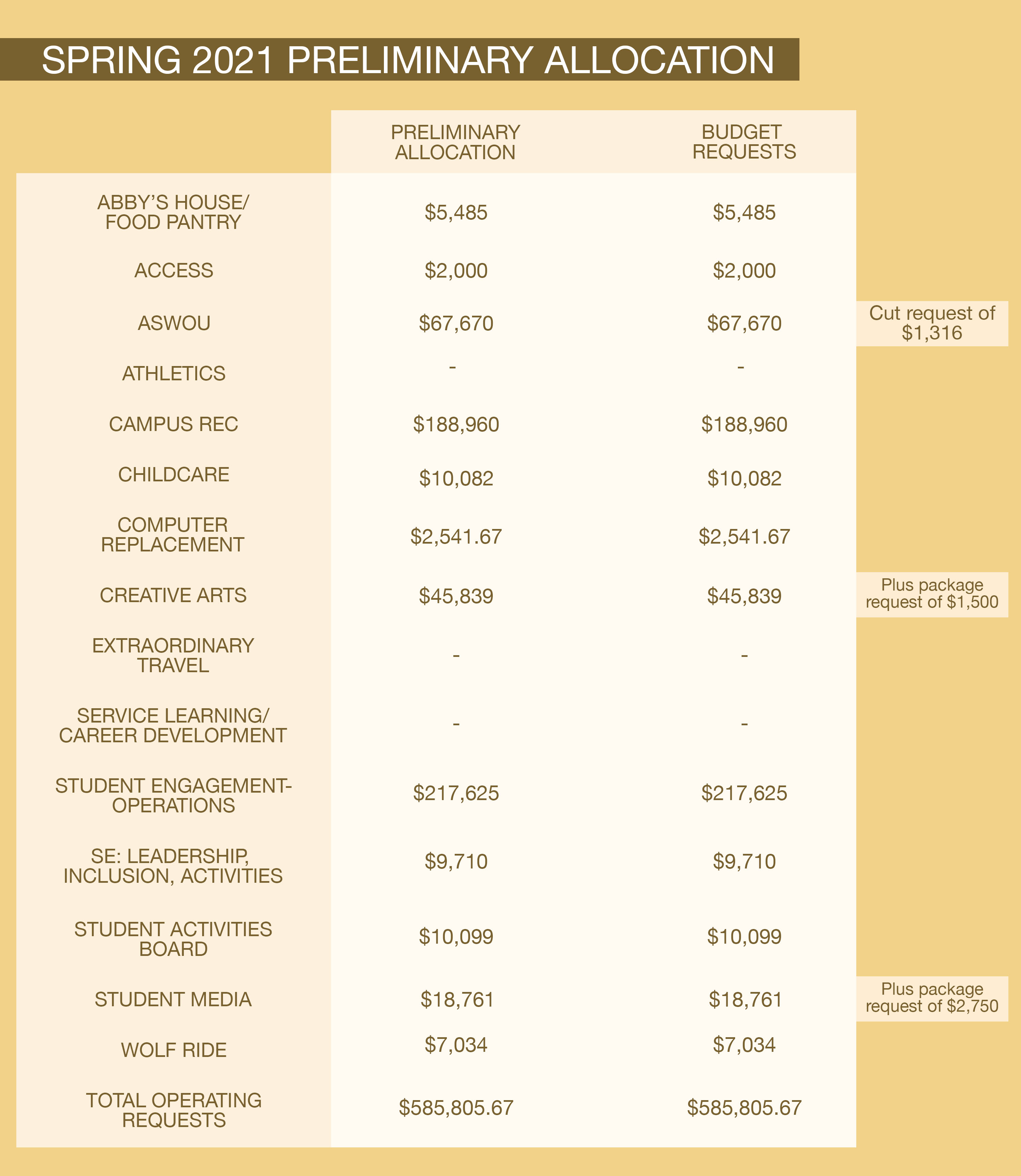
The Incidental Fee Committee has concluded open hearings and discussions regarding the incidental budget allocations for the 2023-24 academic year. 

On Mar. 10, the IFC released the finalized budgetary allocations for Western’s departments, as well as the student incidental fee application.

For the 2023-24 academic year, students can anticipate a flat fee of $415 per term for on-campus courses, and $210 for courses fully online/off campus — including the Salem campus — on their student bill. Students taking courses in the summer of 2024 will be charged a fee of $150, regardless of course modality. The final incidental fee decision for 2024 reflects an increase of $43 from the previous academic year.

All departments are to face a reduction in funding, with the largest of the budget reductions targeting Athletics and Student Media. 

The final budgetary reductions are: 17% to Abby’s House, 0% to Access, 17% to the Associated Students of Western Oregon University, 19% to Campus Recreation, 21% to Student Activities Board, 26% to Student Media, 18% to Creative Arts, 19% to WOLF Ride, 26% to Athletics, and 23% to Student Engagement: Leadership, Inclusion, Activities. 

The preliminary decisions for the IFC budgetary plans were released in early February, with the incidental fee charge positioned at $390 for on-campus courses, $210 for online courses, and $150 for courses taken in the summer. The majority of departments — such as Student Media, Campus Recreation, Student Engagement — saw a preliminary budget cut of 25%, and many other areas saw an increase by a range of up to 28%.

Budget requests for the fiscal year’s incidental allocations totaled at $4,367,953, while the preliminary decisions estimated a total of $3,229,883. However, available allocations totaled at $3,500,454, which guaranteed lower allocations in the final decisions.

In the finalization meeting on Friday, Mar. 10, the committee discussed student comments collected from the open forum and three open hearings. The committee observed student concern primarily in the Campus Recreation Department.

In their preliminary decision, the committee proposed a major budget cut of 26% to the Campus Recreation Department, a decision which would result in the removal of the swimming pool as an element included in the budgetary cut. However, the student body strongly opposed this preliminary decision. The committee and ASWOU have rejected the proposition.

The funds from IFC provide an avenue of opportunity for student employment. Additional student concerns stemmed regarding the impact of preliminary funding on on-campus organizations and job employment, with a large majority of the open hearings consisting of student athletes and student swimmers. 

Unfortunately, with student enrollment continuously decreasing, Western is expected to continue facing challenges regarding incidental budget cuts. This year, this challenge was illustrated in the decrease in available budget allocations.

Contact the author at howlnews@wou.edu

Western’s accounting major pairs well with UO program

Written by: Dakota Gange

New to the liberal arts university is Western’s business and economics accounting major. 

As of 2023, students can now obtain their Bachelor’s of Science in Accounting. Students completing this degree track take a plethora of business, marketing, management, financial, accounting and taxation classes. 

However, in order to even sit for the Certified Public Accountant – CPA – exam, an exam one must pass in order to be a licensed accountant, one must have more credits than what is required for a Bachelor’s in Accounting. 

Representing the University of Oregon, Jessie Johnnes was tabling in the Werner University Center, talking to interested students about their Lundquist College of Business degrees. Those with their Bachelor’s of Science in Accounting can continue on to get their Master of Science in Accounting or Finance, all while satisfying the credit and knowledge requirements needed to sit for the CPA exam, through UO’s programs.  

Western does not offer any master’s degrees in accounting or finance, only a baccalaureate degree. Students who seek to further their education and get a masters in accounting or finance, can find a great program through UO.  

“Graduates from these programs (at University of Oregon) have a high first try pass rate of the CPA exam,” said Johnnes. 

UO’s Master of Accounting — MAcc — program placed in the top 10% worldwide in accounting research, according to Brigham Young University rankings in 2021. 

The master’s accounting program at UO allows one to accelerate their professional development through curriculum and culture, supporting a holistic understanding of accounting and business. 

Candidates can expect to gain skills in financial accounting and auditing, managerial accounting, tax planning and business analytics. 

MAcc candidate Meredith Thomas told UO’s Lundquist College of Business, “I chose the MAcc because it was the next best step to help me achieve my goal of passing the CPA exam as quickly as I can. Hearing that graduates from this program have a higher first try pass rate and classes directly tailored to the CPA exam materials made the decision easy. Working with a small cohort of students builds community and creates friendships that will last throughout my professional career.” 

97% of graduates of the MAcc secured a career within six months of graduation. The accelerated program takes 12 months to complete, or 45 credit hours.   

The Master of Science in Finance program — MSF— focuses on valuation and asset management, ideal for those who wish to have a coveted career as a financial analyst. 

The MSF program curriculum is CFA Institute-recognized, preparing students for the Chartered Financial Analyst exam. It is one of fewer than 150 participating universities worldwide and is designed to only take 12 months to complete, or 45 credit hours.  

85% of MSF graduates secured a career related position within six months of graduation.

MSF candidate Alejandro Hernandez Bustamante said, “I chose the MSF program at the University of Oregon, not only because of the university’s worldwide recognition, but also because it allows me to choose the courses I need to take my desired career path. Oregon is a powerhouse when it comes to innovation, resources for students are nearly endless, and support is always available. Class sizes are small and that allows for more personalized attention and learning. I like how accelerated and effective the learning process has been and all the networking opportunities that I’ve had.” 

Even at this top-tier university, the class sizes within the MAcc and MSF programs are small, allowing for more personalized and tailored learning. 

If either of the programs spark interest, more information can be found at business.uoregon.edu.

Contact the author at howlmanagingeditor@wou.edu

Judy Shepard speaks to Western on Mathew Shepard

Written by: Mirella Barrera-Betancourt

Nearing the 25th anniversary of the murder of Matthew Shepard, Western is honoring Shepard’s memory with the “Legacy of Matthew Shepard Project.” This project was brought to Western and sponsored by the Oregon Cultural Trust.

On Oct. 7, 1998, Matthew Shepard, a 21 year old, gay college student, was deceptively lured from a bar in Laramie, Wyoming by two men, who subsequently robbed and brutally beat Shepard. Shepard would die five days later at the hospital as a result of his injuries.

Shepard’s unjust murder drew national attention to the prevalence of anti-gay hate crimes, eventually leading to the passing of the Matthew Shepard and James Byrd Jr. Hate Crimes Prevention Act in 2009 and the establishment of the Matthew Shepard Foundation.

The “Legacy of Matthew Shepard Project” is a collaborative, campus-wide effort with Western’s Creative Arts — Western Oregon University’s Music, Theatre, Dance and Visual Arts  Departments. 

The project transpires over two consecutive weeks, beginning Feb. 27 with the opening of “Catalyst: An Exhibit Honoring the Legacy of Matthew Shepard” — an exhibition featuring visual artwork centered around LGBTQ+ themes. The exhibit consists of a diverse selection of art forms from artists Pablo Cazares, Chelsea Couch and Andrew Campbell, including artwork from “The t4t Art Collective,” a collective by trans artists from Portland, Oregon. Located in the Cannon Gallery of Art, the exhibit will remain open to the public through March 24.

For a number of days, Western’s theatre department will present the performance of “The Laramie Project,” originally written by Moisés Kaufman in 2000. “The Laramie Project” is based on the true story of Matthew Shepard, detailing the aftermath of his murder in the town of Laramie.

Western’s theatre department offers seven performances of “The Laramie Project” for public viewing. The next performances take place on March 8, 9, 10 and 11. 

Additionally, the series includes the Oregon premiere of Grammy-nominated Fusion oratorio, “Considering Matthew Shepard,” featuring the combined voices of Western and Chemeketa Community College choirs. The oratorio was originally composed by Craig Hella Johnson — American choral conductor and composer, and Grammy award winner for Best Choral performance. Western’s choral director and chair of the music department, Dr. James Reddan, will be conducting the next concert on March 11, which is presented by the Smith Fine Arts Series.

On the special night of Monday, March 6, Judy Shepard — the mother of Matthew Shepard — spoke to the community about the death of her son and the prevalence of hate crimes, including the tear jerking recitation of the victim impact statement she gave in a trial hearing nearly twenty-five years ago in 1999.

Judy Shepard is the author of the best-selling book, “The Meaning of Matthew,” and played a critical role in the founding of the Matthew Shepard Foundation, alongside her husband, in 1998. Today, Shepard continues to advocate for basic rights for the LGBTQ+ community. 

“We’ve become a sickness; society — sick, silent, indifferent and complacent,” Shepard said, in a portion of her victim impact statement. “… my answer is this: educate, educate, educate. Bring understanding where you see hate and ignorance. Bring light when you see darkness, (and) bring freedom when there’s fear and begin to heal.”

Furthermore, during her original speech, Shepard encouraged the audience to rally for change.

She states, “We have to start being louder. We need to be the loudest. We need to vote. We need to run for office. We need to support people running for office. We need to partake in the system. Yes, it takes time. But it’s the only way things change. This is a marathon, not a sprint.”

Additional performances took place on Tuesday, March 7 as part of the “Legacy of Matthew Shepard Project.” Western’s dance department premiered two original dance pieces, choreographed by Samuel Hobbs and Keith Johnson.

As a reminder for future events, Western students receive free admission to all Rice Auditorium performances provided they show their student ID. However, students will still need to purchase tickets to reserve seating. For more information on the “Legacy of Matthew Shepard Project” and/or to purchase tickets, visit the Creative Art’s official page at http://wou.edu/creativearts/.

Contact the author at howlnews@wou.edu

Western’s track teams take home double win

Written by: Nicholas Sarysz

Western’s Women’s track team closed out the 2022 spring track season with a conference championship in outdoor track. However, the team has  never won an indoor conference meet in the program’s history.

This changed when both the men’s and women’s track teams took home the trophy at the Greater Northwest Athletic Conference Championship meet on Feb. 21. It was also the men’s first meet victory since 2012.

The women beat the second place Western Washington University Vikings by a narrow margin of just five points. They were led by numerous strong first place performances coming from Jenelle Hurley, who scored a Western school record of 3,585 in the pentathlon, Ujunwa Nwokoma, who jumped a Western  school record 19-0 in the Long Jump and Ana Popchock, who won the triple jump with a distance of 38-2 3/4.

The men also narrowly beat Western Washington University for the top spot, winning by six points. They were led by Dominique Loggins, who took first with a time of 6.87 seconds in the 60m dash, Justin Conklin, who took first with a time of 0:8.33 in the 60m hurdles and Dayne Gordien who took first in the shot-put with a throw of 53-2 3/4.

“GNAC Indoor was a moment where we were all truly a team and not just competing in individual events,” stated Wyatt Smith, a sophomore who competed in the men’s second place Distance Medley Relay team. “There was not one WOU event where we were silent, and that electric energy carried into our performances. Everyone stepped up when they needed to and it all paid off with two team titles. Spokane is a great place to spend time in and it’s great that we will get to have our indoor champs there (in the newly constructed Spokane Podium) for the foreseeable future.”

Despite their historical efforts, competition in the GNAC this year was far weaker than many other NCAA Division II conferences and only Hunter Hutton was able to secure a bid to the NCAA national meet. Hutton currently ranks 13th in D-II in the mile with a time of 4:03.6 and will be competing for the top spot in Virginia Beach, Virginia on March 10.

Contact the author at howlsaffwriter@wou.edu

Interamural Tournaments

Written by: Gretchen Sims

Interested in participating in competitive sports, but don’t want the commitment or stress of a school or club team? Campus Recreation is hosting several intramural tournaments for students 

and is hoping to drum up participation for their events in the spring. Associate Director of Campus Recreation, Andy Main, noted that they currently have had quite the turnout for winter term and hope to cater to just as many or even more students in the spring — as many as 40 students attend the nights for basketball, futsal, volleyball and table tennis, and the typical  turnout for the pickleball and badminton night can be upwards of 20 students. 

Although most intramural sports for winter term have already come to a close, here are a few that are still open and some different options to consider for the spring. 

Winter Term 2023

Drop-In IMs — Drop-in leagues are a good way to participate in sports commitment free. Sign up at imleagues.com

Basketball and Futsal — Wednesday from 7 p.m. – 9 p.m., Basketball in the Peter Courtney Health and Wellness Center, Futsal in the Old PE Gym

Pickleball and Badminton — Tuesdays from 7 p.m. – 9 p.m. in the Peter Courtney Health and Wellness Center 

Volleyball and Table Tennis — Thursdays from 7 p.m. to 9 p.m. in the Peter Courtney Health and Wellness Center 

Spring Term 2023

Drop-In Volleyball, Futsal, Pickleball, Badminton, Table Tennis and Basketball — same times as winter term

Rec in the Grove  — lawn games will be held in the grove, time and date TBD

Futsal League — Old PE Gym, time and date TBD, keep updated by checking out the listing on imleague.com

Bowling Tournament — Starlite Lanes in Dallas, OR, time and date TBD, keep updated by checking out the listing on imleague.com

Volleyball League — Peter Courtney Health & Wellness Center, time and date TBD, keep updated by checking out the listing on imleague.com

Golf Tournament — Cross Creek Golf Course in Dallas, OR, time and date TBD, keep updated by checking out the listing on imleague.com

These activities are subject to change. Stay up to date by signing up for imleagues.com

Contact the author at howlentertainment@wou.edu

Western now has its own student-run Filipino American Club

Written by: Mirella Barrera-Betancourt

Western is home to over 70 clubs and organizations. One of the newest clubs on campus is the Filipino American Association at Western Oregon University. Established in Nov. 2022, FAAWOU is Western’s first and only student-run Filipino American organization.

The first meeting of the club was originally scheduled for Feb. 23. However, due to adverse weather conditions, the meeting was postponed to Feb. 28.

The agenda of the first meeting was to provide students the opportunity to meet the executive committee and learn more about the future and aspirations of the association. 

According to Presence, FAAWOU’s purpose is to encourage the learning of the customs and culture of the Philippines among Filipinos and advocates, as well as promote friendship and coalition amongst Filipinos and Filipino Americans.

Carl Joseph Garon, senior interdisciplinary studies major, is president of FAAWOU. When asked why the establishment of the club was important, Garon said, “I think we, Western, have a diverse community and we often don’t see that enough … Oregon (specifically), is not known to have a lot of Filipino Americans, and not a lot of the Filipino Americans get to see themselves out there, so having this association makes them feel like they’re welcome.”

FAAWOU provides Filipinos and Filipino Americans with a “shoulder to lean on.” The club’s contact information can be readily accessed via Presence or Instagram, which is a great service for students to utilize in the situation where they could use support.

According to Garon, FAAWOU’s “Konseho” — executive committee — largely consists of upperclassmen. The executive members are willing to help fellow Filipino Americans — who may not have the support to find nor access certain services at Western — by pointing them in the right direction. 

The biggest month for FAAWOU is Asian American and Pacific Islander Heritage Month, to which they are currently in discussion with the Residential Housing Association regarding future events. 

FAAWOU has made it clear that everyone is welcome to join their meetings, regardless of race or ethnicity.

Junior criminal justice major and Vice President of FAAWOU, Marione Corpus said,

“It’s not limited to Filipino Americans, not limited to minority groups, not limited to anyone at all. I really want anyone who is interested in learning about our culture or heritage to join us.”

Garon added, “Filipinos are welcoming people. We’re known to welcome everyone. We’re known to, like, be able to make friendships with everyone. So anyone who’s wanting to join … they’re welcome to join our small little family here (at) Western.”

Because the association is still in its development stage, the organization’s recurring meeting dates and location are yet to be announced. However, according to Garon, Tuesdays operate as the agreed and available arrangement for committee members involved. 

For more information, and to stay updated on future developments regarding FAAWOU, follow their Instagram at @faa.wou or check out their organization on Presence.

Contact the author at howlnews@wou.edu