


Feb. 18, 2026 | Hannah Field | Editor-in-Chief
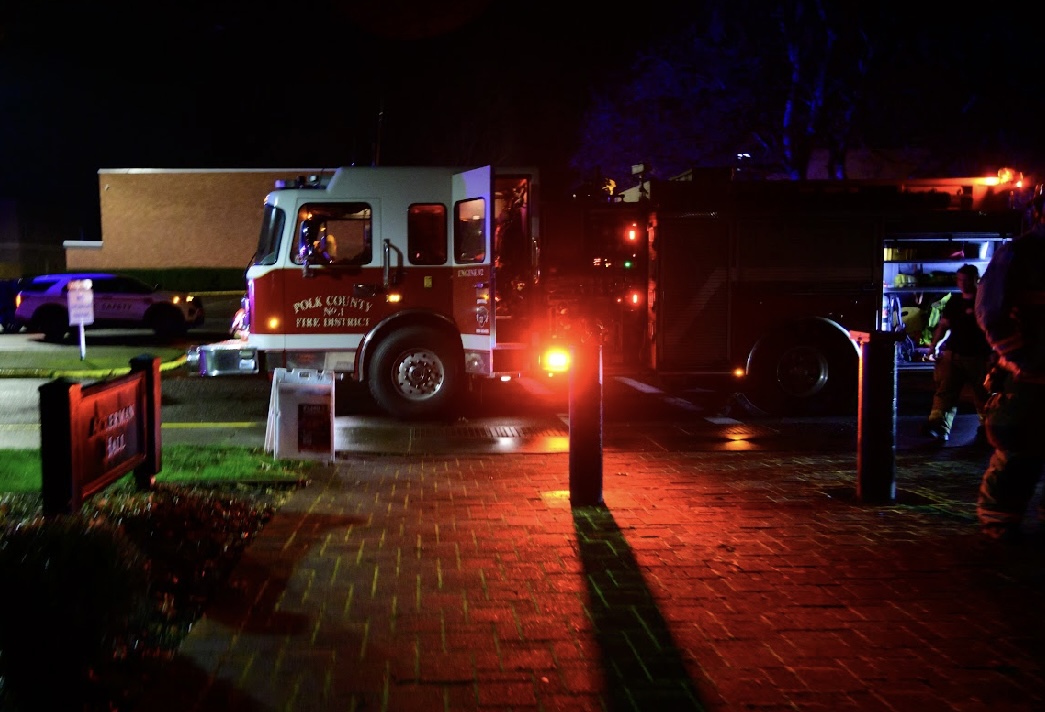
Late Saturday night, Feb. 7, at approximately 10:15 p.m., anyone inside Ackerman Hall was evacuated following a call to Campus Public Safety that led to the arrival of multiple firetrucks and police presence. A small fire was confirmed in a bathroom in the Gilmore wing on the fourth floor that caused no damage, but no details have been released. The incident is reportedly under investigation by Monmouth authorities.
“It was a pretty small incident, we followed protocol, and our public safety and campus partners and community partners responded quickly,” said Lindsey Gibson, director of housing for the last four years, whose office also resides within Ackerman Hall.
Campus Public Safety responded to the call quickly, confirmed the fire, triggered the alarm, oversaw evacuation efforts, contacted the fire department and worked to extinguish the fire, which was successful. Custodian assistance was needed to invoke a clean-up of the fire extinguisher.
After smelling strong smoke in certain parts of the building during evacuation, students were made to stay outside in the cold for upward of an hour until reentry to the building was granted. Inside, the fire alarm triggered again but was dismissed as a false alarm, and students were allowed to continue with their night routines. Ackerman Hall has 240 student residents.
“It was really frustrating to get called out and we saw firetrucks pull up, and we didn’t know how serious anything was. Nobody came to talk to us except to tell us to stay away from the building,” said one anonymous resident. “We were out there for an hour and a half, and that was longer than any other fire drill or fire incident since I’ve been here. The lack of communication was irritating at the time and it didn’t get cleared up later either. All I know about what actually happened is hearsay.”
“We got no updates, and fire and rescue didn’t even check in with the students that may have been affected. All we were told to do was wait in the outdoor basketball court,” said another anonymous student. “We didn’t get back in until around 11:30 p.m.”
“I was here that night, I responded to campus,” said Gibson. “I think the hard part is that when something like this happens, for example, the fire department was here, they’re the ones who take the lead on a fire. Rightly so. That’s their job. That’s not our job. And, so, we don’t know how long something’s going to take. We don’t know what their protocol is exactly — and maybe they don’t know how long it’s going to take … We don’t know, because it’s not in our hands. So some of it, I think, is that in the moment, those things can be challenging because there was a lot of people here and a lot of things going on. So I get that frustration. And, also, we didn’t have information to share.”
Additionally, students were unsure of the conditions of the fire and reportedly were met with minimal contact from paramedics and firefighters while waiting. After reentry, information was kept under wraps, and all that remained were rumors regarding the incident’s origin, which were swiftly dismissed and discouraged by Resident Assistants and other Western staff and faculty.
“Most of the time, if we see any kind of fire, most of the time it’s food related,” said Director Mike Hanson from Campus Public Safety, recalling a kitchen incident from the fall. “True fires where we’re deploying extinguishers, that kind of stuff are very far and few between. But we do see, you know, burnt food in our park apartments, that kind of stuff.”
In the 2025 Clery Report — the annual security and fire safety report — only one fire was reported in 2024, occurring in Heritage Hall because of an intentional burning. In 2022, Western residential halls reported three fires due to intentional arson, metal in a microwave and an air fryer cooking fire, with the most damage — an estimated $50,000 to $100,000 worth — done at an Alder View Townhouse following the air fryer fire. In 2021, charcoal debris in a trash can ignited a flame. A small cooking fire happened in 2018, with one electrical fire reported in 2015, resulting in an estimated $500 in property damage.
Western, as well as Campus Public Safety, is unlikely to release any report due to no report of physical damage to property or student health concerns. Students should remain alert, brush up on safety protocol in case of a fire and stay conscious of any potential actions that could spark a flame, including cooking. If a student encounters anything concerning, they shouldn’t hesitate to reach out to Campus Public Safety, or, if more emergent, 911.
Contact the author at howleditorinchief@wou.edu