


Feb. 4, 2026 | Jaylin Emond-Hardin | Entertainment Editor
One of the best-known facts about Western is that the university has educated future teachers for generations.
Western was founded in 1856 as Monmouth University, just three years after Monmouth was settled, by members of the Church of Christ, who wished to create a “college under the auspices of the Christian Church.” In 1865, Monmouth University partnered with Bethel College, a private college in the now unincorporated Bethel, Oregon, and became Christian College. During the 17 years under this name, the university focused on training religious leaders in theology and teaching the inner workings of the classroom.
Oregon state legislators approved a bid to become a state-supported teacher training school in 1882, and the school was renamed “Oregon State Normal School.” A ballot initiative was passed in 1910 to establish a normal school in Monmouth, and the name changed for a fourth time to “Oregon Normal School.” 1939 saw another name change, and, when enrollment dropped due to World War II, liberal arts and science programs were added to the university. It wasn’t until 1997 that the school became Western Oregon University, reflecting a broader academic mission.
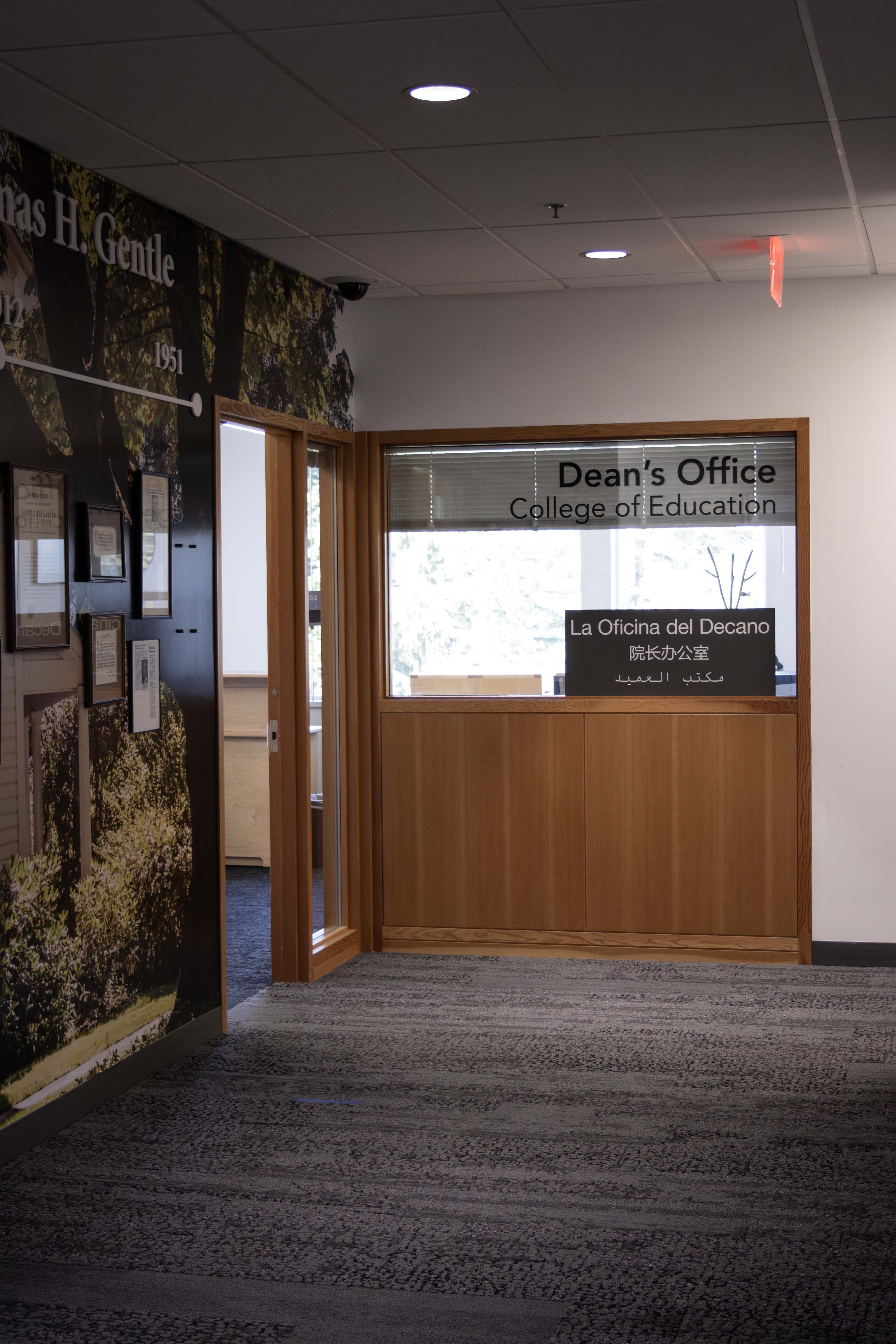
Today, the College of Education retains the highest enrollment in the university, housing not only the Division of Education and Leadership — with teacher licensure programs, specializations and endorsements available — but also the Division of Deaf Studies and Professional Studies and the Division of Health and Exercise Science. All three divisions focus on community or school partnerships, as well as providing leadership opportunities to students within the College of Education.
Perhaps the most popular pathway in the Division of Education and Leadership is the Bachelor of Science in education with the option of teacher licensure. Students enter Western as a pre-education major and must eventually apply to enter the licensure program, which is a culmination of their previous three years of work and means the start of student teaching.
During their time in the licensure program, teacher candidates will complete Western’s Teacher Performance Assessment, which tests their knowledge and classroom readiness.
Students applying to the undergraduate licensure program can apply for a fall or winter cohort, depending on how many credits they have completed, as well as the additional requirements of observing two different classroom types and having some experience with the age group they wish to teach. Each cohort then has a faculty member who oversees them through their year-long program journey. This year, the fall cohort is led by Mandy Olsen and Micah Walker, while Rachel Frazier leads the winter cohort.
“We have the best job! We get to spend our days supporting teacher candidates who care about students and families,” Walker said. “Each cohort has its own personality, and it is so fun getting to know them throughout the year. As cohort leaders, we have an open-door policy. Even if it is outside of our office hours, we encourage students to stop by, check-in or just stop for a chat.”
Walker also spoke of the joy that this year’s cohort has brought to the program and how important connection and community is.
“Success looks different for each person and even each cohort. We have had cohorts who have navigated a variety of factors… and those ‘out of school’ factors can really impact the experiences of our students,” she said. “Therefore, being able to individually and as a group define or model success is part of the fun of each new group of students.”
Rylie Cader is an elementary and special education-focused candidate in the fall cohort. Placed in a fourth and fifth-grade blended classroom, Cader spoke of her own experiences and those of her friends in school that drew her into being a teacher in the first place.
“I gravitated towards being a Special Education teacher because I was a Special Education student myself. I had many learning disabilities and received specialized instruction for years,” Cader said. “Because I was so behind when I was younger, and my brain works differently since I am neurodivergent, I often had a negative academic view of myself and thought at times that I wasn’t smart enough. I decided that I wanted to help students never to feel this way, and that was the final nail in wanting to be a Special Education teacher.”
Justin Parnell, a secondary single-subject candidate placed in a middle school English Language Arts class, also said his experiences were what solidified his decision to become a teacher: “I felt like my childhood dream job of being a teacher became more like a reality and the right path for me as I continued to grow and spend time tutoring and coaching. The experiences I’ve gained through my life, coaching, tutoring and now candidate teaching have solidified for me that I am on the right path, and this is what I want to do.”
Both Cader and Parnell have stated that their students’ energy in the classroom surprised them when they first started student teaching, and expressed that they want to change their students’ lives through love, skill-building and providing a safe place.
“I hope to make a difference in my future students’ lives through unconditional love, lifelong skill learning and as much laughing as humanly possible within an English classroom,” Parnell said.
“We never know what a kid is going through in their personal lives,” Cader agreed. “If I can make my students feel seen, safe and there for them, that’s all I care about at the end of the day.”
They both agreed that the program often pulls candidates in many different directions, and that the weekly schedule — between a full class load, student teaching and all the extras that come with both — can be chaotic. Parnell recommends that candidates find a strong support system — be it classmates, family members or even a significant other — to help sustain them throughout the program, or, as he humorously puts it, to help with “carrying my worn-out husk of a body through the program.”
“The program is crazy, the classroom is chaotic and it can be a lot sometimes. But I promise it is all worth it, the kids are worth it. They made me happy to be there every day,” Cader said, sharing the consensus of all candidates in the licensure program.
Contact the author at howlentertainment@wou.edu