


Linguistic Landscape Bibliography
About the LL Bibliography
A resource for Linguistic Landscape scholars and students
The LL Bibliography is the most comprehensive collection of LL publications that exists, and it is freely available at https://www.zotero.org/groups/216092/linguistic_landscape_bibliography.
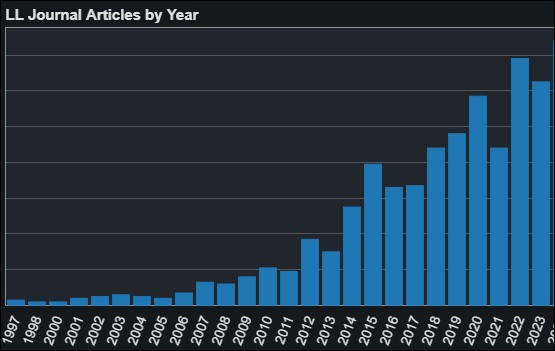
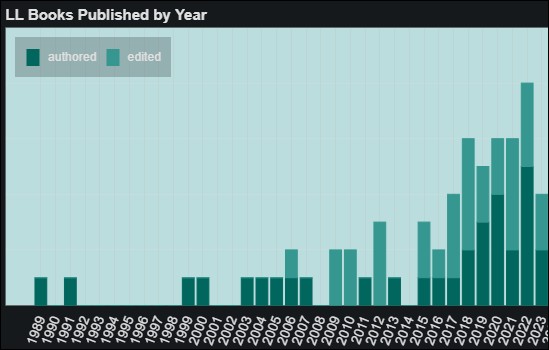
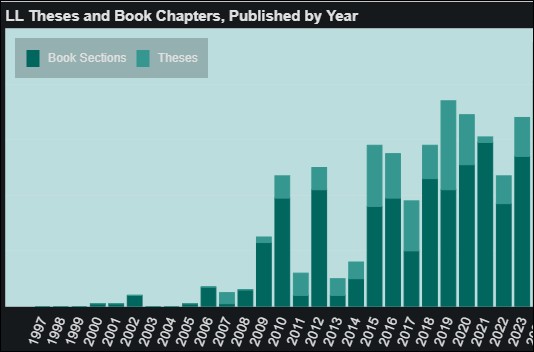
New! Charts showing the growth of Linguistic Landscape Publications
The thumbnails shown below link to a webpage containing charts that list the numbers and types of LL publications over the years and number of studies per country drawn from the most recent LL Biblography updates.
Why do we need a Linguistic Landscape Bibliography?
For better or worse, the term “linguistic landscape” is used by both scholars and the general public to refer to not only studies of the visible language of public places but also to the collection of languages and varieties that are used in a geographical region and even sometimes to the discourses that are circulating among a language community. Thus, searches for the term ‘linguistic landscape’ among scholarly work and the internet in general will retrieve many irrelevant results. My goals for the LL Bibliography are:
- to separate the wheat from the chaff and provide LL scholars and students with sources that are relevant to them and easy to access
- to level the playing field in terms of representation of voices in LL studies–a keyword search in the Zotero LL Bib will find lesser known scholars and publications alongside those who are more frequently referenced
- to hasten scholarship in the field by creating a tool that makes researcher’s work faster and easier, both in terms of finding relevant resources and citing them quickly
- to document the exponential growth of this interdisciplinary endeavor to study the linguistic and semiotic practices that manifest in public places
- to make easily available to scholars the range of recent publications in LL studies–we tend to live in our bubble of topics and known scholarship with little time to see larger trends; scanning the list of titles and abstracts from the recent years, one quickly recognizes these.
As of this update, April 15, 2026, the LL Bib contains 2,270 entries. But… I have around 30 additions for 2023 and more than that for 2024 and 2025 to be added in the coming weeks.