|
Past
and Present(ing) |
|
|
|
|
Born:
Education: Work (partial list): |
|
|
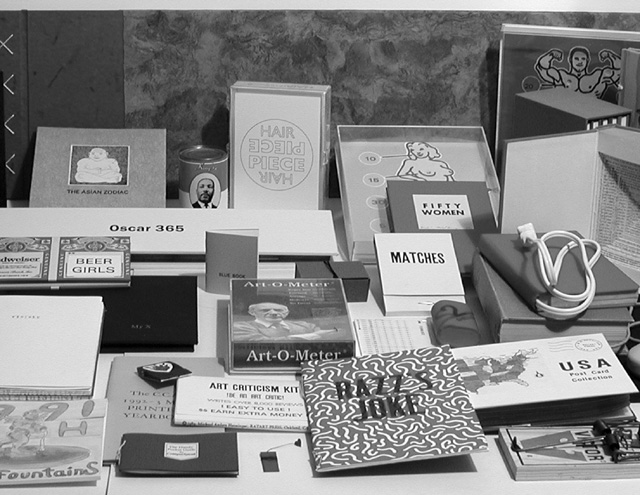
In keeping with the general theme of history that guided the selection of exhibits for the Hamersly Library this year, it is my intention to provide not only a history of my own work through this retrospective exhibit, but also a general introduction to the field of artist’s books. |
| Where to Begin |
What have we lost? |
Where to begin, indeed, for we are all too familiar with books. After all we have had books for thousands of years. The average person has books at home or knows they can find them at the local library or Barnes & Noble. They know that there are textbooks, literary books, encyclopedias, dictionaries, reference books, how-to books, and so on. We’ve all had these books since our first days at school if not earlier. The average person will tell you there are books about almost any subject; they will tell you these books contain text and perhaps a few images, and they will probably tell you that books come in two forms: paperback and hardback. And the average person would be correct
in describing 99.9% of the books. |
What we have lost is the craftsmanship and range of materials often present in earlier, handmade books. We have also largely lost the ability to imagine books that could be different from that vast majority, that 99.9%. Fortunately there are a few people imagining and making books not constrained by the common conception. These artists are considering much more than economics when making their books, and they are thinking of the book form as more than a mere container for words and a few pictures. They consider what they are making to be a piece of art just as Picasso would one of his paintings. These art works are called Artist’s Books. This exhibit endeavors to give an overview of contemporary Artist’s Books. As with any time and space constrained endeavor and any single artist show, this exhibit has many types of Artist’s Books that are not represented, but I feel the spirit of the Artist’s Book has been captured by the work that is shown. My main goal in curating this exhibit is to broaden the conception of what a book can be and hopefully inspire you to seek out more Artist’s Books or perhaps even to make your own. |
The Secrets Men Keep |
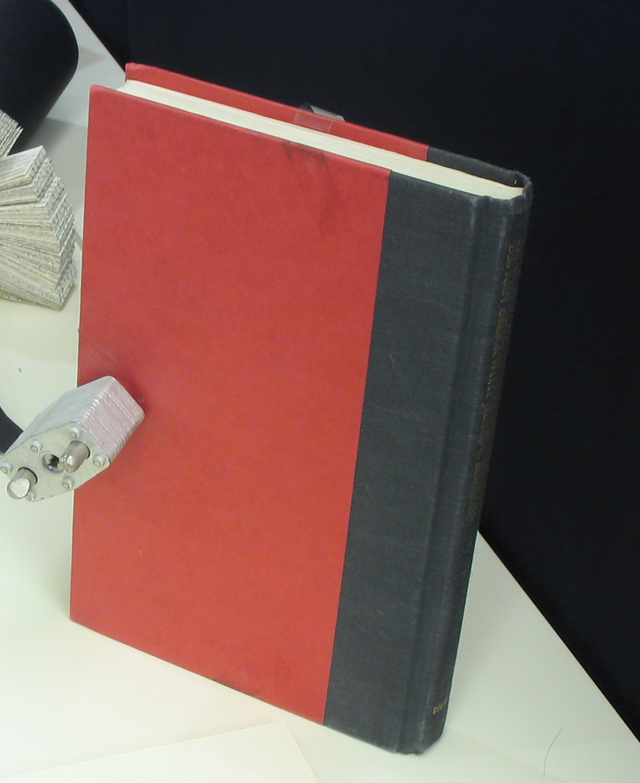
Tell me a secret Case bound book with a rubber ear on the cover. Readers become participants by writing their secret on the blank pages. Unique. |

|
Making books |
|||
A wide range of tools can be employed in the construction of Artists’ Books: printing presses, binding presses, clamps, hammers, drills, awls, needles, knives, saws, computers, metal type, wood type, rubber stamps, linoleum blocks, inks, paints, stencils, glue, thread, paper, leather, plastic, metal, brushes, pencils just to name a few! However, the more remarkable thing is that many excellent books can be made with just one mark-making tool and one material to hold the marks. In addition to any text and images a book might have, the Book Artist will also give consideration to the materials, structure, typography, sequencing, and their relation to and effects upon the reader. When you go through this exhibit I encourage you to consider all these things. Let me give some book history and some concrete examples of things to look for in this exhibit. |
|||
|
Rat Trap Mystery Small letterpress accordion with folio covers is the bait on a large rat trap. Unique. |
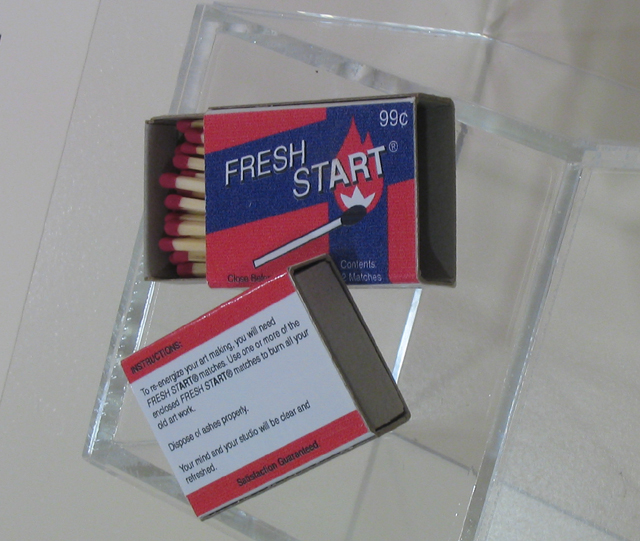
Fresh Start Stick matches and box. This piece, which advises one to burn all their old art works, was made in 1999 in response to study of the Fluxus artists. This work was exhibited at the Rosalyn Keep Salon, Mills College, and received a Juror's Award. |
||
|
A Brief History of Books |
Contemporary Artist’s
Books & Artists
|
||
The
history of books is certainly very long (but I must be brief). One
can stretch the concept of book back to pre-historic cave painting.
Perhaps the caves at Lascaux can be considered one of the oldest
and largest Artist’s Books because it has a sequence of images
that are read by the viewer. If that is too much of a stretch for
you, let us jump ahead to early writings on stone or clay tablets.
Next we see some new materials like papyrus in Egypt, and later
in 105 A.D. paper is made in China. The earliest known text printing
is the dharani, a prayer scroll from 8th century Japan. In the Americas,
books made from bark papers are common. Perhaps the most famous
example is the Mayan Dresden Codex circa 950 AD. Before 1500 in
Europe, books are handwritten and hand-painted on parchment and
vellum. In the 1450’s, Gutenberg makes a Bible using a hand
printing press and movable type for the text.
The printing press and movable type prove suitable for the next few hundred years of book making. Sometime during this period the range of what books could be is severely narrowed. The average person forgets that books could be art. Then we get lithography in 1800’s and then photographic-based printing methods which supplant movable type in commercial printing. During the late 19th and early 20th centuries some of the Modern artists embrace the book as art. These Livres d’ Artistes are the predecessors of the contemporary Artist’s Books. |
In recent years there has been
a resurgence in interest in artist’s books and book making
that has resulted in more numerous and frequent exhibitions. A
good place to look for artist’s books is at the Special
Collections department of the public library or university library.
There are also numerous organizations like Pacific Center for
the Book Arts, San Francisco Center for the Book, and Center for
the Book in New York that hold exhibitions and have classes about
book arts. And, of course, one can find quite of bit of information
on the web about book arts and book making.
There are so many artists making books and so many fine examples of artist’s books that it can be hard to know what to look at. There are many artists and artist’s books that had a profound influence on my development and they are all worth looking for: Julie Chen, Ulises Carrion, Betsy Davids, Alisa Golden, Lisa Kokin, Edward Ruscha, Keith Smith, David Stairs, and Philip Zimmerman are some of the names that come to mind immediately.
USA Postcard Collection Side-bound with pages that hold postcards that depict the states and were sent to the artist. One page for each of the 50 states. Unique, in progress. |
||
| Overview of the Books in the Exhibition | |||
|
The books on display span my
bookmaking career with selections ranging from my earliest book,
Art Criticism Kit (1989), to fairly recent examples like Collage
Cards: View from the steps of El Castillo (2004). The books tend
to be grouped in the cases either by type or because they have a
similar subject matter.
One case contains examples of a category of Artist’s Books known as altered books. An altered book often begins as a commercially printed and published book and is transformed by the artist’s alterations. These alterations might consist of drawing, cutting, collage, etc. One example is Book-let in which a book was deconstructed, cut down, and sewn onto a strap that can be worn around the wrist like a bracelet. Another example is The Secrets Men Keep, a found trade book, which the artist permanently closed to the reader by means of a lock thus insuring the text remain secret. Beyond altered books, only a small number of Artist’s Books employ current commercial binding or printing methods. There are a number of reasons for this. One is that commercial printing and binding tends to be economical only when large quantities are involved. Another important reason is that these methods have a limited range of expressive qualities. Beyond the cheap and sterile Perfect Binding (aka paperback), there are three basic types of bindings: pamphlet, side-sewn, and accordion. By elaborating on these three basic types one can create a wide array of complex book structures. The pamphlet structure is fairly simple and one I have used frequently. A pamphlet is a gathering of folded pages fastened through the fold with thread, staples, or some other fastening method. Examples of Artist’s Books using the pamphlet structure are Razz’s Joke and The Handy Pocket Guide to CritiqueSpeak. Side-sewn book structures are very common in Asia and are in some sense simpler than even pamphlets. A side-sewn book consists of pages stacked on top of one another then fastened at the side. A multipage memo stapled in the top corner is technically a side-sewn structure. Fortunately, most side-sewn artist’s books are more interesting than that. USA Post Card Collection is an example of a side-sewn book. The last basic structure, the accordion, is very simple but is the least well known to the average person. The accordion book requires no fasteners whatsoever because it is just a single piece folded multiple times in a zig-zag fashion. The accordion structure allows at least two ways of viewing the book, either one page at a time, or all at once when the accordion is stretched out. Accordion structure books to look for are Oscar 365 and 50 Men, a volume of 5 books. Of course these three structures (accordion, pamphlet, and side-sewn) are not the only ones seen in artist’s books, however understanding these basic book structures is a good place to begin one’s journey into the realm of artist’s books. Some other book structures to look for are folios/cases with loose pages as seen in A Dark Corner, or a sewn on cords binding used for Smokey the Bear Sutra, or a plastic comb binding in Matches. For many people, subject matter is also a good way to approach artist’s books. In this exhibit 2 of the display cases emphasize a particular subject. One case contains books that focus on the “Art World” and its idiosyncracies. In this case you will see the Art-O-Meter, the Art Criticism Kit, The Handy Pocket Guide to CritiqueSpeak, and Fresh Start. In the second case you will notice products that address our consumer culture and our misconceptions and foibles relating to human sexuality. The books seen in this case are The Rack (small version), True/False Test, and the Claytonizer. Finally, I would like to state that in the process (which began some 6 or 7 months ago) of putting this exhibit together I realized that words beginning with the letter P perfectly describe my predilections and artworks’ points. Words like perception, process, personal stories, pyramids, portals, puzzles, packaging, play, and the past to pick a few. You will hopefully find these aspects, and more, evident in the books on display here at WOU. |
Book-let Part of a series of wearable book art produced in 2000. Worn on the wrist. This book utilizes cut-down signatures from a commercially made book. This one-of-a-kind book
was exhibited at the R. A. Keep Book Arts Salon at Mills College
in 2000. |
||
|
Razz’s Joke Pamphlet with letter press and linocuts and pop-up. Assumes the guise of a children’s book to tell puerile dirty joke. Edition of 30 |
|||
|
Oscar 365 A collection of pictures, one from each day, of Oscar’s life from birth to one year old. Accordion structure with digitally printed images and text. Unnumbered edition. |
|||
|
Smokey the Bear Sutra
The text is the poem by
Gary Snyder. Signatures sown on cords attached to wooden covers.
Letterpress text and screen-printed images. Edition 25. This copy
signed by Gary Snyder. |
|||
|
Animal Matches Matchbook-like structure with 10 split pages. Each half page contains half of an animal’s face which can be matched to another half. Letterpress and Xerox. Unnumbered edition. |
|||
|
Acknowledgements |
|||
I would like to acknowledge and thank Betsy Davids (my first book arts teacher), the always helpful and gracious Jerrie Lee Parpart and Ashley Zentz for their support and assistance, as well as Dr. Gary Jensen and the rest of the Hamersly Library staff, Charles and Maren Anderson, and finally, my wife and son for all their love, past & present. ~ Michael Henninger |
|||



LOCATION:
2nd floor gallery
Curator: Michael Henninger
Return to Main Exhibitions Return to Library Home