| The
RED Scare |


"Communism in reality is not a political party. It is a way of life, an evil and malignant way of life. It reveals a condition akin to a disease, that spreads like an epidemic, and like an epidemic, a quarantine is necessary to keep it from infecting this nation."
J. Edgar Hoover, former FBI director
Why
red?
Red is the color most associated with the communist
party. There are several explanations for why this is, with the correct
interpretation probably being some combination of them.
• The fist theory is that the Bolsheviks may have selected red as their color because red has always been the color of revolution. Probably dating back as far back as the 6th century, groups rising in revolution have carried a red flag or otherwise dubbed their movement with the color red (particularly when the group they are rising against uses the color white, as was the case in both the French and Russian Revolutions).
• The second theory as to why the color red was selected is that the Russian word for red is very similar to, and can have the same meaning as, the Russian word for beautiful. This is why Red Square, the famous Moscow landmark, is named as it is.
• The final theory on the selection of the color red for the Communist party is the symbolism of the red blood that was shed by workers in their struggles against the capitalist system.
Gus Hall Affair
 On
February 12, 1962, the General Secretary of the Communist party USA,
Gus Hall, spoke to an overflow crowd of nearly 2,000 people at the
Oregon College of Education Stadium. Hall spoke about thirty minutes
and then fielded a few questions from the audience. After about six
questions he left, escorted by two bodyguards and the crowd quietly
dispersed in the drizzling rain. Although this scene does not lend
itself to excitement, it is the tumultuous uproar that preceded that
is the heart of the story.
On
February 12, 1962, the General Secretary of the Communist party USA,
Gus Hall, spoke to an overflow crowd of nearly 2,000 people at the
Oregon College of Education Stadium. Hall spoke about thirty minutes
and then fielded a few questions from the audience. After about six
questions he left, escorted by two bodyguards and the crowd quietly
dispersed in the drizzling rain. Although this scene does not lend
itself to excitement, it is the tumultuous uproar that preceded that
is the heart of the story.
Fallout Shelters
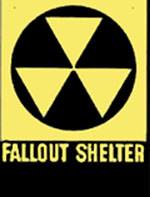 Fallout
shelters became a
media and cultural craze
with magazines like Time,
Bulletin of the
Atomic Scientist, and even Sunset featuring articles on them. A new
industry devoted to fallout shelter construction and supplies sprang
up almost overnight. Plans for fallout shelters ranging in design
from a basement snack bar that converted into shelter space to trenches
underneath parked cars were made available to the public.
Fallout
shelters became a
media and cultural craze
with magazines like Time,
Bulletin of the
Atomic Scientist, and even Sunset featuring articles on them. A new
industry devoted to fallout shelter construction and supplies sprang
up almost overnight. Plans for fallout shelters ranging in design
from a basement snack bar that converted into shelter space to trenches
underneath parked cars were made available to the public.
Despite the publicity and fear generated by nuclear war, few Americans
actually invested in a home fallout shelter. Public fallout shelters,
however, were created and retrofitted into existing buildings, caves,
and tunnels. Federal spending for civil defense and fallout shelters
peaked in 1962 with a budget of $294 million.
Oregon and OCE
Oregon, although located far from high value targets, was not immune
to the fallout shelter hysteria. Approximately 1,000 fallout shelters
had been built or designated in the state by early 1963. These shelters
had enough space and supplies for a two-week stay for half of the state’s
population at that time. Alternative seats of government were established
and evacuation routes created for the major population centers. Oregon
College of Education in Monmouth (now Western Oregon University) was
designated as an emergency headquarters for some state and federal agencies,
as well as a refuge for residents from Portland and Polk County. OCE
selected twelve areas as fallout shelters, and stockpiled two-week’s
worth of rations for up to 1,774 people. Courses in shelter management
were offered and plans for education in the advent of nuclear war were
formed.

o Humanities
o Social Sciences
o Administration
o The University Center
o The Library (now the Academic Programs and Support Building)
• Windowless areas of New PE
o Food Service Building (now Valsetz Dining Hall)
o Education
o Landers
o Gentle
o Barnum
o Arbuthnot
|
|
This fiber storage drum is designed to meet the sanitation needs of fallout shelter occupants. The sanitation kit inside each drum, stocked by the Federal Civil Defense Administration with a two week supply for 50 people, contains required items for basic human sanitation, including a toilet. |
 |
 |
Food supplies in the shelters consisted of crackers or biscuits and a candy carbohydrate supplement. Carbohydrate supplement pieces were made about the size of a piece of bubble gum and came in cherry and pineapple flavors. Due to the presence of possible carcinogens, the red dye in the carbohydrate supplements, Red No. 2, was banned by the Food & Drug Administration (FDA) in 1976. |
 |
|
|
Each shelter was equipped with enough water for each person to consume one quart per day over a two week period. Water was stored in 17.5 gallon metal containers lined with two polyethylene bags to prevent contamination from fallout and leakage. A siphon and plastic drinking cups were also provided. |
|


LOCATION: 1st floor
main lobby
Curator: Camila Gabaldon Winningham, Jackson Stalley, & Rebecca
Mayer
Return to Main Exhibitions Return to Library Home
This page was modified April 16, 2008 . rmw