| Punchcards
to Laser Discs
A history of the computer
January
21 - March 18, 2004
|
|

The inspiration for this exhibit
was a suggestion by Professor John Leadley that we collect the old
computer parts from around campus and present a short history of
computer use at the Western campus. During the curatorial process
for this exhibit, I discovered several computer enthusiasts on this
campus who saved numerous parts from their old computers for just
such an occasion.
The purpose of this exhibit is to give a brief overview of what
has happened in the computer industry over the last three decades
and the evolution of computer use on this campus.
The timeline reflects only a few highlights of the computer industry
and is not intended to be comprehensive. Numerous websites have
compiled comprehensive computer history timelines that cover the
abacus through nanobots. I have gathered some of these websites
in the web documentation for this exhibit. I invite you to view
them.
Most of the artifacts displayed were in use on this campus at one
time. However to fill in the blanks where artifacts from this institution
were not available, some of the artifacts come from faculty or staff
who used them at other institutions.
~ Jerrie Lee Parpart, Exhibit
Curator
LASER DISC circa
late 1970s
Courtesy of Kathy Alderson,
Hamersly Library
LD or LaserDisc is the industry-wide
term for consumer laser video, also known as LV (LaserVision) and
CDV (Compact Disc Video). LD
was first demonstrated by Philips and MCA in 1972, and has been
on the market since 1978, or about as long as the VCR and six years
longer than CD. The LD has a bright and detailed picture, sound
that sounds like a CD and is clearer than VHS formats.
PUNCH
CARDS circa early 1980s
Courtesy of Dr. John Leadley, Business & Economics Division
and Bud Smith, Retired WOU Educational
Media Director
Each line of a computer
program had to be entered on a separate card. The cards had to be
stacked in the correct order and given to the computer operator.
After the pro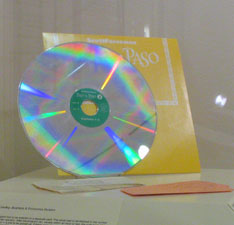 gram
ran, usually within an hour or two, the output would be printed
on large sheets and put in a pile to be picked up. If there were
any mistakes, including a typo or getting the cards in the wrong
order, you would have to correct the error and resubmit the stack
of cards. gram
ran, usually within an hour or two, the output would be printed
on large sheets and put in a pile to be picked up. If there were
any mistakes, including a typo or getting the cards in the wrong
order, you would have to correct the error and resubmit the stack
of cards.
These cards were created
to run TSP, a statistical program. Today, the same operation could
be done in Excel by entering a formula into a spreadsheet cell,
and the result would appear instantly!
The orange colored punch cards were
used for ‘arena style’ registration for classes. Faculty
members would sit around the gymnasium and students would pick up
a punch card for each class they wanted to attend. The cards were
then fed through a computer that would detect time conflicts and
verify them as enrolled.
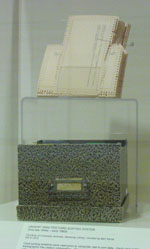 UNISORT
ANALYSIS CARD-SORTING SYSTEM circa late 1950s – early
1960s UNISORT
ANALYSIS CARD-SORTING SYSTEM circa late 1950s – early
1960s
Courtesy of University Archives, Hamersly Library, donated by Bert
Kersh
Card-sorting systems were used prior
to computer use to sort data. Each card in this bibliography has
citation information. The numbers correspond with the holes around
the edge of the card. Specific holes assigned a subject are notched
on the card corresponding with the citation information. To pull
all cards that pertain to a subject, a rod inserts into the assigned
hole on the block of cards. The ones that fall through are the ‘hits’
for that subject.
|
|
|
|
In January 1975 Popular Electronics magazine introduced the first
kit microcomputer. Although not the first available microcomputer,
it was the start of the industry. Popular Electronics offered readers
a complete Altair 8800 kit for only $397
(a factory-assembled Altair was $498).
|
| |
Altair kit $397 ($498 assembled)
• a box of parts,
• circuit boards,
• some poorly written instructions,
• 256 bytes memory (no, not "K-bytes")
• no memory board or input/output board
additional parts:
• 1K memory board in kit form $97 ($135 assembled)
• 2K memory board $145 ($197 assembled)
• giant 4K memory board $264 ($338 assembled)
• a serial interface board $119 ($138 assembled)
• a parallel interface board $92 ($114 assembled)
|
|
|
Initial cost: $586 - $772 ($747 - $1088 assembled)
In 2003 dollars: $2,005 - $2,640 ($2,555 - 3,720 assembled)
~PC – History, http://www.pc-history.org/index.html
|
| |
In 1975, an IBM mainframe computer that could perform 10,000,000
instructions per second cost around $10,000,000. In 1995 (only twenty
years later), a computer video game capable of performing 500,000,000
million instructions per second was available for approximately
$500!
~A history of Computers, http://www.maxmon.com/history.htm
|
|
|
Current computer prices change rapidly. In January 2004 the following
could be purchased for approximately $400 available from various
stores and online sources.
Intel® Celeron® Processor 2.4GHz with 128K Cache
Microsoft® Windows® XP Home Edition
128MB DDR SDRAM
40GB Ultra ATA100 5400rpm hard drive³
20x min./48x max. CD-ROM drive
~ Gateway Computer
– Promotions, http://gateway.com/work/promotions/
|
Before
computers were a part of standard office supplies, other tools assisted
with calculations.
ABACUS circa early
1970s
Courtesy of Jim Birken, University Advancement
The world's first computing system,
the abacus was an ingenious invention designed to perform speedy
calculations through the movement of beads on a series of rods.
The modern Chinese abacus is still widely used in China and other
countries, dates from about 1200 A.D. It is possible that it derives
from the earlier counting boards used around the Mediterranean
as early as 300 B. C. An Aztec version of an abacus, circa 900-1000
A.D., is made from maize (corn) threaded through strings mounted
in a wooden frame.
LONG LOG DUPLEX DECITRIG
SLIDE RULE by K&G circa early 1970s
Courtesy of Jim Birken, University
Advancement
A slide rule contain scales for
multiplying, dividing, and extracting square roots, and some contain
scales for calculating trigonometric functions and logarithms.
The slide rule remained an essential tool in science and engineering;
widely used in business and industry until the portable electronic
calculator superseded it late in the 20th century.
MAGIC BRAIN CALCULATOR
circa 1950
Courtesy of Jim Birken, University
Advancement
”Your Magic Brain Calculator
is a technical instrument that solves you math problems with ease.
It requires practice to achieve perfection. Practice Makes Perfect.
In a few weeks you will be doing you mathematical calculation
as fast as adding machines many times the cost of this instrument.”
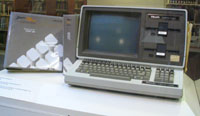 HEATH
COMPUTER and MANUALS circa mid 1980s HEATH
COMPUTER and MANUALS circa mid 1980s
Courtesy of Bud Smith, Retired WOU Educational Media Director
This computer, built from a kit,
is still functioning. It is similar to the Apple IIc and
Apple IIe computers used in the computer lab.
DEC RAINBOW MANUAL
c. 1982
Courtesy of Jim Birken, University
Advancement
Western purchased a number of these
microcomputers with funds from a Department of Education grant.
At the time, Digital Equipment Corporation was the second largest
computer company in the world, dominating the market for minicomputers
(more powerful than a microcomputer but smaller than a mainframe).
Their microcomputers, the DEC Rainbow and the DEC One, were not
commercially successful.
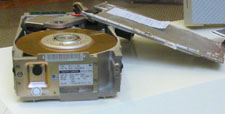 HARD
DRIVE from ‘UHRO’ circa 1989 – 1994 HARD
DRIVE from ‘UHRO’ circa 1989 – 1994
Courtesy of Dr. Bob Broeg,
Computer Science Division
Each Sequent Balance had twenty-four
264MB hard drives, weighing about 50 lbs. each. The drives were
unstable and often failed. Modern hard drives are more than 100
times larger in capacity and weigh about one pound.
WANG TERMINAL circa
1990
Courtesy of Jim Birken, University
Advancement
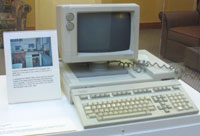 In
the early 1990s University Advancement purchased a used Wang system
from the State Fire Marshall’s Office for about $7,000 to
store donation records. This was a substantial saving as a new
system cost nearly $15,000. In
the early 1990s University Advancement purchased a used Wang system
from the State Fire Marshall’s Office for about $7,000 to
store donation records. This was a substantial saving as a new
system cost nearly $15,000.
|

|
| Computers
have taken a high profile role in streamlining processes in higher
education. During his twenty plus year tenure in the Oregon Higher
Education System, Jim Birken has used over 10 different types of
computer systems. Here are a few of the systems he has used and
the approximate dates used. |
| 1980
1981
1983 (1986)
1984
1985
1988
1988
1989 |
|
HoneyWell mainframe
1981 Apple II PC
IBM XT PC 8088
1984 IBM AT PC 80286
1985 Bull Mainframe
HoneyWell Bull 386
DEC Rainbow PC
1989 NorthStar Dimension 80383 internal network system
(Beta test version of Abacus)
|
| 1990
1991
1991
1992
1990 to date |
|
Zenith 80386
Wang minicomputer
Wang PC (not compatible with other PC)
1992 Sequent System (Odin and Uhro)
Various 386, 486 and Pentium based PCs |
|
MOTHER
BOARD, early IBM XT circa 1982 – 1983
Courtesy of Dr. Bob Broeg, Computer
Science Division
XT compared to current
computers:
Processor speed: 4.77 megahertz (compare to 2+ gigahertz)
Memory: 512 kilobytes (compared to 512+ megabytes)
Storage: 10 megabytes (compared to 100+ gigabytes) [giga
= 1,000 mega]
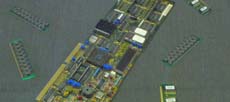
MOTHERBOARD from
‘ODIN’ circa 1989 – 1994
Courtesy of Dr. Bob Broeg, Computer
Science Division
In the early 1990’s,
the Sequent Corporation, located in Beaverton, Oregon, donated computers
to all of the OUS schools. Western received two Sequent Balances,
which were named Uhro and Odin. Each machine used 20 microprocessors
and had twenty four 264 MB hard drives, weighing about 50 pounds
each.
NETWORK CARD
– early IBM XT circa 1982 – 1983
Courtesy of Dr. Bob Broeg, Computer
Science Division
MEMORY MODULES,
early IBM XT circa mid to late 1980s
Courtesy of Dr. Bob Broeg, Computer
Science Division
Each memory stick hold
1 kilobyte of data.

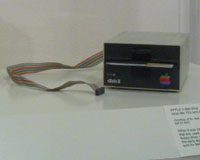 APPLE
II disk drive circa late 70’s and early 80’s APPLE
II disk drive circa late 70’s and early 80’s
Courtesy of Dr. Bob Broeg, Computer
Science Division
When it was introduced
in 1977, the Apple II computer, like other personal computers of
that era, used an ordinary cassette tape player to store programs
and data. The Disk II floppy drive, developed in 1978 by Apple cofounder
Steve Wozniak, was a major factor in the early dominance of the
personal computer market by Apple Computer. It originally sold for
$495 (with inflation, this is the equivalent of $1,400 in 2003).
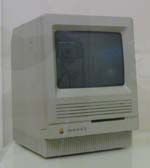 MACINTOSH
COMPUTER circa mid 1984 MACINTOSH
COMPUTER circa mid 1984
Courtesy of Dr. Hilda Roselli,
College of Education Dean
The Macintosh was the
successor to the popular Apple II. It was the first successful personal
computer to use a graphical user interface (GUI) with a mouse, windows
and drop down menus. (The Apple Lisa was the first to use GUI, but
was not successful.) The first Mac had 128 kilobytes of memory (1/8
of a megabyte) and one floppy drive. It was the first personal computer
to use the 3.5 inch floppy disks, which are still in use today.
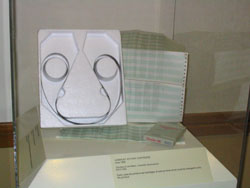 WANG PRINTER FONT BANDS circa 1990Courtesy
of Jim Birken, University Advancement
WANG PRINTER FONT BANDS circa 1990Courtesy
of Jim Birken, University Advancement
The font type on a printout
from the Wang printer was altered by changing the band of type in
the printer.
LASERJET IID FONT CARTRIDGE circa 1990
Courtesy of Jim Birken, University
Advancement
Early LaserJet printers
had cartridges of various fonts which could be changed to vary the
printout.
|

|
| There are numerous
timelines available on the Internet which are more comprehensive
than the one below. This timeline highlights events which apply
to the items in this exhibit.
1975
-
Popular Electronics publishes an article in its January 1975 issue
by MITS announcing the Altair 8800 computer for US$397 in kit
form, or US$439 assembled. It features a 2-MHz Intel 8080 processor,
and 256 bytes of RAM.
- IBM's Entry Level Systems unit unveils the
IBM 5100 Portable Computer. It is a briefcase-size minicomputer
with BASIC, 16 KB RAM expandable to 64 KB, tape storage drive
holding 204 KB per tape, keyboard, and built-in 5-inch screen.
The code name during development was Project Mercury. It weighed
55 pounds and the price is over US$10,000.
- The October issue of MITS' Computer Notes
newsletter announces the availability of BASIC 2.0 from Micro
Soft for the Altair 8800, in 4K and 8K editions. (This is the
earliest known reference to "Micro Soft".) Also announced
was a new Altair 680 based on the Motorola 6800 processor. The
price is US$293 as an unassembled kit.
- By December MITS has sold 2,000 Altair 8800
systems
1976
- Steve Jobs and Steve Wozniak incorporate
the Apple
Computer Company, on April Fool's Day. By July the Apple I computer
board is sold in kit form, and delivered to stores.
The price is US$666.66. In December the first prototype for the
Apple II was demonstrated at a Homebrew Computer Club meeting.
- Texas Instruments introduces the TMS9900,
the first 16-bit microprocessor. The microprocessor implements
the same 16-bit architecture used on the TI 990 minicomputer.
- Shugart Associates announces its Model SA400
5.25-inch "minifloppy" disk drive for US$390. Disk capacity
is 110 KB. The disk size is based on that of a cocktail napkin,
which a customer requested, rather than the usual eight-inch format.
- By December 31, MITS has shipped over 10,000
Altair 8800 kits.
1977
- Apple is selling its Apple II for $1,195,
including 16K of RAM, but no monitor. Most customers use their
television as an inexpensive color monitor.
- PCs from Tandy and Commodore come with build-in
monitors and thus require no television hookup.
1978
- DEC introduces the VAX 11/780, a 32-bit
minicomputer that becomes popular for technical and scientific
applications
1979
- The first electronic spreadsheet program,
Don Bricklin and Bob Franston’s VisiCalc, is unveiled on
May 11 and contributes to the success of the Apple II computer.
1980
- The Osborne 1 ‘portable’ computer
is introduced, weighing 24 pounds and the size of a small suitcase.
1981
- The open-architecture IBM launched in August,
signaling to corporate America that desktop computing is going
mainstream.
1982
- Autodesk is founded and ships the first
version of AutoCAD.
- Time magazine names the computer as its ‘Man
of the Year.’
- In November, Compaq unveils an IBM-compatible
portable PC.
1983
- By including graphics such as pie charts
and bar graphs, Lotus 1-2-3 does for the IBM PC what VisiCalc
did for the Apple II.
- Completion of the TCP/IP switchover marks
the creation of the global Internet.
- Though not destined for commercial success,
Apple’s Lisa, launched in May, demonstrates what could be
done with a mouse, icons, and pull down menus.
1984
- In January, the Macintosh is unveiled with
a publicity campaign that includes an Orwellian-themed ad during
the Super Bowl.
- MIDI (Musical Instrumental Digital Interface)
standards developed for interfacing computers and digital music
synthesizers.
- The CD-ROM, introduced by Sony & Philips,
provides significantly greater storage capacity for digital data.
- Beginning in August, Intel’s 16-bit
80286 chip, installed in IBM’s new PCAT, expands desktop
computer capabilities.
1985
- Supercomputer speeds teach 1 billion operations
per second with the release of the Cray 2 and Thinking Machines’
parallel-processor Connection Machine.
- With the development of Windows 1.0, Microsoft
brings Macintosh-like features to DOS-compatible computers.
- In October, Intel introduces
the 80386 chip with 32-bit processing and on-chip memory management.
- Paul Brainard’s PageMaker is the first
desktop publishing program for PCs and is widely used, first on
the Macintosh then later on IBM compatibles.
1986
- The four-processor Cray XP performs 713
milling floating-point operations per second.
 1987 1987
- Experimental
4- and 16 Mbit memory chips are introduced.
1988
- Motorola’s 32-bit 88000 series of
RISC microprocessors offer processing speeds of up to 17 million
instructions per second.
1989
- Intel’s 80486 chip with 1.2 million
transistors is introduced in April.
1990
- Microsoft introduces Windows 3.0 in May,
intensifying its legal dispute with Apple over the software’s
‘look and feel’ resemblance to the Macintosh operating
system.
- Hewlet-Packard and IBM both announce RISC-based
computers.
- Intel’s i486 and iPSC/860, and Morotola’s
68040 become available.
- Berners-Lee writes the initial prototype
for the World Wide Wed, which uses his other creations; URLs,
HTML, and HTTP.
- Arpanet, the progenitor to the Internet,
is officially decommissioned.
1991
- In March, the first M-bone audio multicast,
is transmitted on the Net.
1992
- DEC introduces its 64-bit RISC (reduced
instruction set computer,) Alpha architecture, a kind of computer
architecture that has a relatively small set of computer instructions
that it can perform.
1993
- Apple releases the Newton, the first popular
personal digital assistant. It uses a stylus pen, but the first
generation suffers from poor handwriting recognition.
- Intel introduces the Pentium processor in
March.
- Students and staff at the University of
Illinois’ National Center of Supercomputing Applications
create a graphical user interface for Internet navigation called
NCSA Mosaic.
1994
- In April, Jim Clark and Marc Andreesen found
Netscape Communications (originally Mosaic Communications).
- Netscape’s first browser becomes available
in September and creates a rapidly growing body of Web surfers.
1995
- Toy Story is the first full-length feature
movie completely computer generated.
- JAVA programming language, unveiled in May,
enables platform independent application development. “Duke”
is the first applet.
- Windows 95 is launched on August 24 with
great fanfare.
 1996 1996
- The Intel Pentium Pro is announced.
- Netscape Navigator 2.0 is released and is
the first browser to support JavaScript.
- Windows '95 OSR2 (OEM System Release 2)
is released - partly to fix bugs found in release 1 - but only
to computer retailers for sale with new systems.
There are actually two separate releases of Windows 95 OSR2 before
the introduction of Windows '98, the second of which contains
both USB and FAT32 support - the main selling points of Windows
'98. FAT32 is a new filing system that provides support for disk
partitions bigger than 2.1GB and is better at coping with large
disks (especially in terms of wasted space).
- Intel releases the 200 Mhz version of the
Pentium Processor.
1997
- Intel Release their Pentium II processor
(233, 266 and 300 Mhz versions) featuring an increased instruction
set and a much larger on-chip cache.
1998
- Intel releases of 333 MHz Pentium II processor.
Code-named Deschutes, these processors use the new 0.25 micron
manufacturing process to run faster and generate less heat than
before.
- Microsoft releases Windows '98. Some U.S.
attorneys try to block its release since the new O/S interfaces
closely with other programs such as Microsoft Internet Explorer
and so effectively closes the market of such software to other
companies. Microsoft fighs back with a letter to the White House
suggesting that 26 of its industry allies said that a delay in
the release of the new O/S could damage the U.S. economy. The
main selling point of Windows ‘98 was its support for USB
and its support for disk partitions greater than 2.1GB.
1999
- Apple releases the PowerMac G4. Using PowerPC
G4 chips from Motorola, it is claimed to be the first personal
computer to be capable of over one billion floating-point operations
per second.
2000
- Intel releases very limited supplies of
the 1GHz Pentium III chip.
2001
- Apple releases MacOS X. At its heart is
`Darwin', an Open Source operating system on the FreeBSD version
of UNIX. MacOS X gives Mac users the stability benefits of protected
memory architecture along with many other enhancements, such as
preemptive multitasking. The BSD base also makes porting UNIX
applications to MacOS easier and gives Mac users a fully featured
command line interface alongside their GUI.
2003
- MacOS 10.3 continues to improve MacOS X,
with major updates to 'Aqua' (the user interface) as well as performance
improvements and new features.
- Sir Tim Berners-Lee is knighted in recognition
of his creation of the 'World Wide Web'.
~Chronology of Personal Computers http://www.islandnet.com/~kpolsson/comphist/
~A Brief History of Computing - Complete Timeline;http://www.ox.compsoc.net/~swhite/history/timeline.html
~Institute of Electrical and Electronics Engineers,
Inc. http://www.computer.org/computer/timeline/timeline.pdf
|

This exhibit would not be possible without the
generosity of those who were willing to dig into their closets and
storage basements to loan us their old working computers and various
computer parts they saved through the years.
Kathy Alderson,
Hamersly Library ~ for loan of artifacts
Jim Birken,
University Advancement ~ for loan of artifacts, his infectious enthusiasm
for computers, and for sharing his extensive oral history of computer
use at OUS and WOU
Dr. Bob
Broeg, Computer Science Division ~ for
loan of artifacts and sharing his oral history of the computers
on this campus
Dale Goodell,
Hamersly Library ~ for loan of artifacts
Jonah Hanson,
WOU student ~ for exhibit installation and documentation assistance
Dr. John
Leadley, Division of Business and Economics
~ for originating the concept of this exhibit, loan of artifacts,
and for participating as exhibit editor
Dr. Hilda
Roselli, College of Education Dean ~ for
loan of artifacts
Bud Smith,
Retired WOU Educational Media Director ~ for loan of artifacts and
sharing his oral history of the computers on this campus |
LOCATION:
3rd floor galleries
Curators: Jerrie Lee Parpart and Jonah Hanson, WOU Student curator
Return
to Main Exhibitions
Return to Library Home
This page was modified
November 25, 2008
. jlp & jh |
