| A Quick Sketch of Campus Buildings |
These sketches of building on the Western Oregon State University campus were created for the College Center around the time of the 1986 renovation by the then director Neil Werner. We refer to these as sketches rather than drawings because of the unusual medium. Created with a Sharpie Marker on masonite, they retain a temporary feel. The sketches hung in the Pacific room until the building’s most recent renovation in 2000.
Neil Werner, a musician, artist and active student advocate, came to the Monmouth campus 1980 and was eventually promoted to director of the College Center. After his untimely death in 1988 building was renamed Werner College Center in his honor.
For more information on the buildings see the archive webpage
 |
|
|
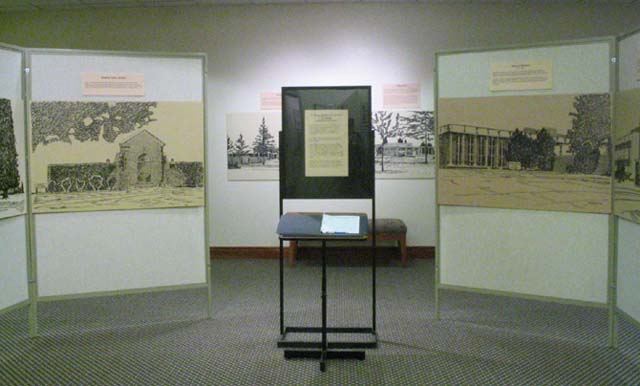
New
Physical Education - Built: 1971
New PE was built to augment the space and amenities of Old PE built in 1935. CURRENT USES: New PE offers a gym, gymnastic facilities, indoor tennis courts, and a multi-purpose surface that accommodates baseball and softball practices as well as basketball, volleyball, floor hockey, tennis, and soccer. Additionally, New PE contains the education and health classrooms and athletic offices. The building can seat over 3,000 spectators.
|

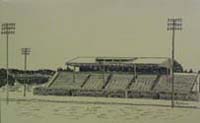 |
Stadium
- Built: 1980 Renovated: 2000 Playing surface replaced:
1987
McArthur Field was built to replace Memorial Stadium which burned to the ground in spectacular fashion in 1979. McArthur Field underwent modernization in by Rekortan Sports Corp. of Seattle, who also built the track for the Los Angeles Olympic Games. The football field, built by volunteers from the football team and the Oregon National Guard, was one of the first of its kind. The field is flat surface rather than a crowned one and is able to drain nine inches of rain an hour. The track features a world-class surface such as those used during the Seoul Olympic Games. The facility is named after Coach William McArthur, multi-sport coach and football head coach from 1947-1982. CURRENT USES: McArthur Field is home to the athletic field and track. In addition, McArthur Field features a fully-equipped weight room.
|
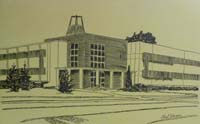 |
Humanities
and Social Science - Built: 1964-65
The Humanities and Social Sciences building was built to replace the south wing of Campbell Hall destroyed in the Columbus Day Storm of 1962. The Carillon, an Alumni Association gift, was added on May 2, 1965 to commemorate the Bell Tower of Campbell Hall that stood in approximately the same location prior to its destruction. CURRENT USES: HSS houses the classrooms and the offices of the Humanities and Social Sciences Departments. The building contains 34,948 square feet of floor space.
|
 |
Natural
Science - Built:1969
Natural Science was built as a classroom and laboratory building for the science department. Until completion of the Natural Sciences Building, science classes were taught on the third floor of the Administration Building, and prior to that in Campbell Hall. CURRENT USES: The Natural Sciences building houses the chemistry, biology, and geology departments. Offices, classrooms, and state-of-the-art labs are all in the Natural Sciences. The Natural Sciences building has a rooftop greenhouse and a basement cadaver lab.
|
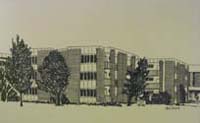 |
Butler Hall
- Built: 1964-1965
Constructed as dormitory, Butler Hall was opened for students in September, 1965. The building dedication was performed on May 6, 1966 during Alumni Day. During the ceremony, a framed picture of J.B.V. Butler was hung in the dormitory. CURRENT USES: Butler Hall is one of the University’s coeducational dormitory buildings. Butler and Gentle Hall house approximately 75 junior and senior students in 24,641 square feet. Butler Hall is named in honor of J.B.V. Butler. Butler, born in Monmouth in 1862, was a graduate of Oregon Normal (class of 1884), teacher, Dean of Men at OCE, Secretary of the Board of Regent of Normal Schools, librarian, registrar, and an acting president of OCE during his educational career.
|
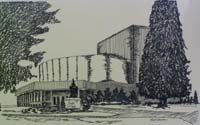 |
Rice
Auditorium - Built: 1976
Rice was built as a cultural entertainment center for Western Oregon University and the towns of Monmouth and Independence. Scarce funds in 1971 delayed the building project, and due to budget constraints the art wing, balcony, and classrooms were never built. The Little Theatre had been condemned as a fire hazard, so a new building was required. Prior to the Little Theater, productions were held in Campbell Hall but the Columbus Day Storm of 1962 destroyed the South Wing which contained the stage facilities. CURRENT USES: Seating 619 people, Rice is one of the state’s finest mid-sized performance facilities. Major theater, dance, public speaking, and musical productions at the university are held in Rice Auditorium's 26,000 square feet. Rice Auditorium is home to the Smith Fine Arts Series, bringing talented performers and audiences to the area each year. The theater is said to be the home of the ghost of George Harding, a former Western theater professor. Harding's ghost is friendly but loves to play with the lighting in the theater. Rice Auditorium is named after the former university president Leonard Rice who was instrumental in the building project.
|
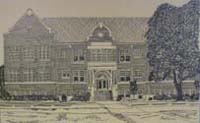 |
Campus
Elementary - Built: 1915 Renovations and Additions: 1949,
1959, 1962, 1986
In the late 1880s a wooden structure was built to house the College’s model school and provide training for future teachers. The model school facility was Monmouth’s only school until completion of Monmouth High School in 1911. After the high school was built, the model school housed only the elementary students (K-8). In 1915, ONS constructed a new building for the Training School which later became the ITC building. Two annexes were added to the building in 1949 and the name changed to Monmouth Training School. After the completion on the Monmouth Elementary School in 1964, the name was changed to College Elementary School (CES) to avoid confusion. In 1986, CES vacate the building to make way for the building rededication as the university’s Instructional Technology Center (ITC). CURRENT USES: The building now houses the university’s computer and audio/visual centers in addition to office space and classrooms. Over the front doors is the quote “He who dares to teach must never cease to learn.” The subject of some controversy, the quotation has been attributed to librarian John Cotton Dana who initially suggested it for a New Jersey teachers training college in 1912.
|
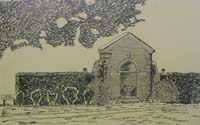 |
Queens Rose Garden Since 1968, the Homecoming Queen has planted a rose bush in the Queen’s Rose Garden. Until 1980, the roses were planted near the pergola and decorative wall behind Todd Hall that once hid the physical plant and root cellar from view. Current Homecoming Queens now plant their roses by the west entrance to the Werner University center.
|
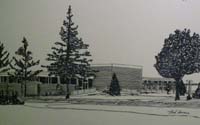 |
Education
- Built: 1966
The Education Department was housed in Swindel Hall prior to the completion of the new General Laboratory and Office Building or GLOB, the name initially given to the Education Building. CURRENT USES: The Education Building houses the College of Education and the regional Resource Center on Deafness. Most education and sign language classes are held in Education. The Center on Deafness and the College of Education are nationally recognized and has been awarded numerous honors and grants.
|
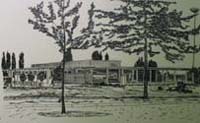 |
College
Center - Built: 1960 Renovated: 1972, 1986, 1996-2000
The Student Center was built to replace Maple Hall. Built in 1914, Maple Hall was simply too small and poorly designed for a student center. Initially, the building was called the Student Center-Commons. By the 1970s, the name had changed to the College Center. Werner University Center was built as a student activities center. Until the completion of Valsetz Dining Hall in 1971, this building housed the university's food service. CURRENT USES: The Werner University Center is the hub of student activities on campus. Werner University Center features a game room, computer lab, coffee shop, bookstore, snack bar, food court, and rooms for movie screenings and meetings. Student Leadership and Activities, Student Government, Student Media, Career Services, Disability Services, and Non-Traditional Student Services are all located in the University Center. The name was changed to Werner College Center in 1989 to honor Neal Werner. Werner was the College Center director and key advocate for an expanded and remodeled student center. The convict-made bricks in the sidewalk on the south side of the Werner building were salvaged from the demolished smokestack of the old physical plant which once stood behind Todd Hall.
|
| The Warner Sketches normally reside in the University Archives and can be viewed by appointment. Contact Camila Gabaldon | |
LOCATION: 2rd floor
gallery
Curators: Jerrie Lee Parpart and Ruth Weston
Return to Main Exhibitions page. Return to Library Home page.